
If your portable storage business isn't yielding a 40% net profit margin, you aren't just missing out on growth; you're likely overpaying for the very assets that should be driving your success. Most Canadian operators understand that portable storage business profitability depends on volume, yet many remain trapped in a cycle of high middleman markups on container procurement and inefficient delivery logistics that eat into rental margins. It's frustrating to watch a cooling housing market and rising insurance costs squeeze the life out of your bottom line while your digital marketing spend fails to convert into high-value leads.
We recognize that scaling an independent storage operation requires more than just hard work; it demands a sophisticated approach to systems and sourcing. This guide provides the precise operational levers and procurement strategies you need to achieve and sustain top-tier profit margins in the current Canadian market. You'll discover how to bypass brokers for factory-direct pricing, automate your daily logistics to reclaim time, and refine your sales process to ensure every lead counts toward your 2026 growth targets.
Key Takeaways
- Understand the shifting economic drivers in Canada that allow well-organized operators to achieve 40% net profit margins.
- Identify how direct-from-factory sourcing eliminates middleman markups to secure long-term portable storage business profitability.
- Streamline delivery logistics and labour costs by implementing professionalized Standard Operating Procedures and automated scheduling technology.
- Optimize revenue through dynamic pricing models and refined lead conversion tactics tailored to the Canadian moving market.
- Scale your operation effectively by utilizing fractional leadership and the Growth Engagement Model to bypass the limitations of traditional franchises.
The Economic Landscape of Portable Storage Business Profitability in Canada
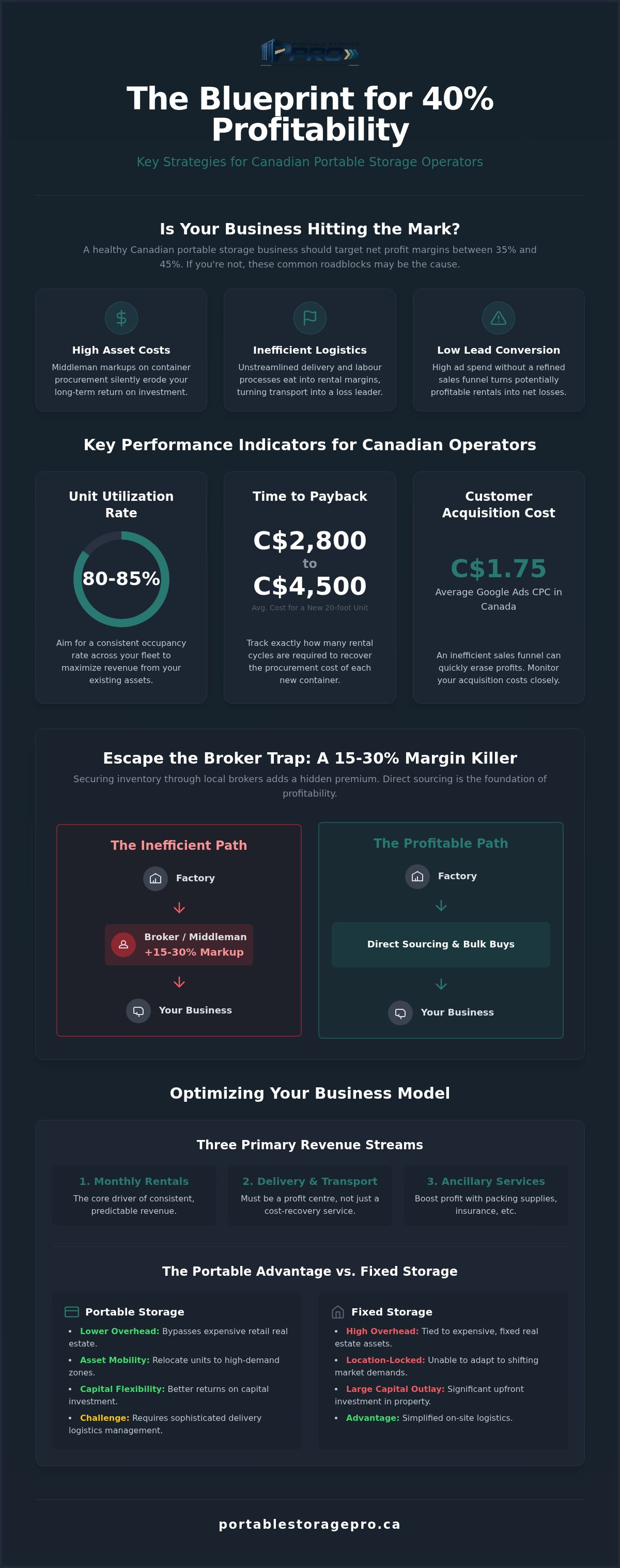
Achieving sustainable portable storage business profitability requires a precise understanding of three primary revenue streams:
- Monthly container rentals
- Delivery and transportation fees
- Ancillary services such as packing supplies and insurance
While the global self-storage industry often focuses on fixed real estate, the Canadian market in 2026 is increasingly defined by asset mobility. With national self-storage revenue projected to reach USD 5,470.5 million by 2033, the opportunity for growth is substantial. However, the difference between a high-performing operation and one that merely survives lies in the management of Net Operating Income (NOI) versus gross revenue.
A healthy Canadian business should target profit margins between 35% and 45%. This is achievable even with current economic headwinds. For instance, StorageVault Canada Inc. reported a 9.2% growth in net operating income in Q2 2026. This growth is driven by urbanization and the "condo-efficiency" trend, as Canadians move into smaller living spaces that lack traditional storage. To benchmark your performance, you must ensure your delivery fees aren't just covering costs but contributing to the bottom line. If logistics are treated as a loss leader, your rental margins will never reach their full potential.
Fixed vs. Portable Storage: Why the Margins Differ
Portable storage models bypass the heavy real estate overhead associated with fixed facilities. You don't need expensive retail frontage; a secure industrial centre on the outskirts of a city works perfectly for staging. This flexibility allows you to realize better returns on capital. The trade-off is the complexity of delivery logistics. Unlike a fixed building, your assets move, meaning fuel, truck maintenance, and driver wages are constant variables. When local markets cool, you can relocate units to high-demand zones, a luxury fixed-site owners don't have.
Key Performance Indicators (KPIs) for Canadian Operators
Tracking unit utilization is the most critical task for maintaining portable storage business profitability. You should aim for a consistent 80% to 85% occupancy rate across your fleet. You also need to monitor the "Time to Payback" for every new container. With new 20-foot units priced between C$2,800 and C$4,500, you must know exactly how many rental cycles are required to clear the procurement cost. Finally, keep a close eye on your customer acquisition cost. With Google Ads CPC in Canada averaging C$1.75, an inefficient sales funnel can quickly turn a profitable rental into a net loss.
Optimizing Procurement: Reducing Unit Costs to Protect Your Margins
Procurement is the foundation upon which portable storage business profitability is built. If you secure your inventory through local brokers or third-party resellers, you are likely paying a hidden premium that can range from 15% to 30% per unit. This is known as the "Broker Trap." While it feels convenient to buy from a local yard, these middlemen markups silently erode your long-term ROI. Every extra dollar spent on the initial purchase extends your time to payback and reduces the lifetime earnings of that asset.
Strategic sourcing involves bypassing these layers to access the global supply chain directly. By moving closer to the source, you ensure that your capital is invested in the physical asset rather than a broker’s commission. This approach requires a deeper understanding of logistics, but the financial impact is undeniable. Protecting your margins starts with a disciplined procurement process that treats every container as a high-stakes capital investment. Utilizing specialized Procurement & Sourcing services allows you to leverage international connections without the need to manage complex overseas relationships yourself.
The Direct-from-Factory Advantage
Buying direct from the factory allows you to realize significant savings, but you must understand the "Landing Cost" in major Canadian hubs like Vancouver or Toronto. This figure includes the factory price, ocean freight, and port handling fees. In 2026, managing these variables is easier for independent operators who collaborate. Organizing bulk buys with other businesses provides the volume needed to negotiate better freight rates and factory priorities. This collective leverage transforms a small operation into a formidable buyer in the global market.
Evaluating Unit Specifications for Longevity
The cheapest container often proves to be the most expensive over a 10-year lifecycle. In the Canadian climate, standard containers can succumb to rust and seal failure within a few seasons if they aren't built to the right specifications. High-quality marine-grade paint and reinforced door seals are essential to prevent moisture ingress during freeze-thaw cycles. Additionally, investing in premium security features for units destined for high-theft urban centres preserves the unit’s value and justifies higher rental rates. Balancing these aesthetic and durability requirements ensures your fleet remains a high-performing asset for decades, further securing your portable storage business profitability.
Operational Efficiency: Streamlining Logistics and Labour Costs
Operational friction is the primary reason many independent operators fail to reach their full potential. While procurement sets your initial margins, daily logistics determine whether those margins remain intact. Managing a mobile fleet requires a different level of precision than traditional fixed-unit storage. Every unnecessary kilometre driven and every hour of idle labour represents a direct leak in your cash flow. Achieving peak portable storage business profitability depends on your ability to professionalize these movements through rigorous systems rather than relying on the "do-it-yourself" mentality often seen in industry forums.
Labour optimization is a critical factor in the Canadian context. With the average truck driver salary in Canada sitting at approximately C$50,000 per year, or C$25.64 per hour, choosing between in-house staff and contract drivers is a high-stakes decision. Small fleets of 2 to 10 trucks often face annual insurance costs of C$12,000 to C$20,000 per unit. To protect your bottom line, you must balance these fixed costs against utilization rates. If your trucks aren't moving, they're costing you money. Rigorous maintenance and compliance programmes are not just about safety; they're about preventing the mechanical failures that lead to missed delivery windows and lost customers.
The Modern Storage Tech Stack
Cloud-based management systems are no longer optional for operators who want to scale. These platforms provide real-time inventory visibility, allowing you to see exactly which units are in the yard and which are on-site at a glance. Automated billing and lead management tools reduce the administrative burden, allowing you to focus on growth rather than paperwork. Integrating GPS and telematics into your fleet enables you to optimize delivery routes and monitor fuel consumption. In a market where urban Class 1 drivers earn between C$22 and C$32 per hour, shaving even ten minutes off a delivery route through better scheduling has a tangible impact on monthly NOI.
Standardizing for Scalability
Scale is impossible without a culture of compliance. Standard Operating Procedures (SOPs) ensure that every driver and yard worker follows the same safety and efficiency protocols. This consistency helps mitigate risks that lead to high insurance premiums and potential legal liabilities. Professional staff training programmes ensure that your team can handle complex deliveries in tight urban centres without damaging units or customer property. Dedicated SOPs & Compliance development allows you to step away from the daily minutiae of the business. A robust set of SOPs functions as a profit insurance policy by ensuring that operational errors never compromise the owner's bottom line.
Revenue Management: Maximizing the Value of Every Lead
While occupancy is a fundamental metric, true portable storage business profitability is achieved through sophisticated revenue management. You cannot rely on flat rental rates throughout the year. In Canada, the moving market is highly seasonal. Demand peaks between May and September, allowing for dynamic pricing adjustments that capitalize on limited inventory. Conversely, winter months require a shift toward long-term residential storage or stable B2B contracts. Construction firms and retail outlets provide a buffer against seasonal dips, offering consistent monthly revenue that stabilizes your cash flow when residential demand cools.
Lead conversion is where many operators lose potential margin. A digital inquiry that doesn't turn into a signed agreement is wasted marketing spend. You must optimize your sales funnel to ensure that every inquiry is handled with professional precision. Upselling ancillary products also plays a vital role in increasing the average transaction value. Offering content insurance, specialized packing kits, or premium unit placement fees can significantly boost your NOI without requiring additional container acquisitions. To refine these processes, many successful independents utilize specialized Sales, Marketing & Lead Generation services to ensure their digital presence translates into tangible growth.
High-Intent Lead Generation
Marketing efficiency requires a distinction between generic storage searches and high-intent "mobile storage" queries. Generic terms are often expensive and attract price-sensitive shoppers. In Canada, where Google Ads CPC averages C$1.75, targeting high-intent segments reduces your cost per acquisition. Industry representation also matters. Participating in global conferences and maintaining a high professional standard helps build local brand authority. This positions your business as a premium provider rather than a budget alternative, allowing you to maintain higher rental rates even in competitive markets.
Churn Reduction and Customer Lifetime Value
Increasing the average rental duration is more cost-effective than constantly acquiring new customers. For residential clients, this involves proactive communication and offering incentives for extended stays. Building referral loops with local realtors and professional moving companies creates a steady stream of pre-qualified leads. Professional sales training for your front-line staff is equally essential. When your team understands how to articulate the value of asset mobility and security, they transform from order-takers into revenue generators. This focus on customer lifetime value ensures that your portable storage business profitability remains resilient against short-term economic fluctuations.
Scaling Your Bottom Line Through Fractional Operational Leadership
Many independent owners find themselves trapped in the daily minutiae of driver scheduling and unit maintenance. This "Founder Trap" is the single greatest obstacle to long-term portable storage business profitability. When you're busy putting out operational fires, you lack the mental bandwidth to negotiate factory-direct procurement or refine your digital marketing strategy. Professionalizing your business doesn't require the restrictive oversight or heavy fees of a franchise. Instead, you can adopt a Growth Engagement Model. This approach allows you to scale your fleet and optimize your margins while maintaining 100% ownership of your brand and assets.
Fractional operational leadership provides access to high-level expertise that was previously reserved for national corporations. By utilizing seasoned specialists, you gain a seat at the table of the global supply chain. This means accessing factory pricing and international logistics trends without having to travel or manage overseas relationships yourself. It's a pragmatic shift that moves you from being an owner-operator to a strategic investor. You stop worrying about individual delivery routes and start focusing on capital allocation and market expansion across new Canadian territories.
The Benefits of Outsourced Operational Management
Industry experts can audit your existing fleet and yard operations to identify hidden inefficiencies that eat into your NOI. These audits often reveal that simple changes in routing or procurement can save thousands of dollars annually. For example, a fractional COO might identify that your current container maintenance schedule is reactive rather than proactive, leading to higher long-term repair costs. Fractional management also keeps you connected to international market trends, ensuring your business remains competitive as the Canadian storage landscape evolves. You benefit from professionalized leadership and standardized systems while keeping the total equity in your business.
Next Steps: Auditing Your Current Profitability
The first step toward scaling is identifying the "low-hanging fruit" in your current model. This often involves reviewing your container landing costs and lead conversion rates to see where money is being left on the table. Once these foundational elements are optimized, you can implement a Partner Engagement Model to drive long-term growth. This roadmap provides a clear path toward Scaling Your Storage Business with the Growth Engagement Model. By professionalizing your operations now, you ensure that your business remains a high-yielding asset in 2026 and beyond. This structured approach allows you to step back from the daily grind while your portable storage business profitability continues to climb.
Securing Your Operational Future in the Canadian Market
Sustaining portable storage business profitability in 2026 requires a disciplined shift from reactive management to strategic oversight. You've seen how bypassing broker markups through direct-from-factory procurement protects your initial capital. You also know that streamlining logistics with professionalized SOPs and modern tech stacks prevents margin erosion during daily operations. Finally, adopting fractional leadership allows you to scale without the restrictive overhead of a franchise model. Success in this sector isn't about working harder; it's about implementing the right systems and sourcing networks.
If you're ready to move beyond the owner-operator trap, we're here to partner with you. We provide access to global supply chain networks and fractional leadership that removes the need for extensive travel. Our team brings deep expertise in Canadian-specific logistics and compliance to ensure your growth is both rapid and secure. Book a consultation to optimize your storage business profitability and take control of your fleet's financial future. Your path to a more efficient, high-margin operation starts with a single strategic decision.
Frequently Asked Questions
Is a portable storage business more profitable than traditional self-storage?
Portable storage often yields higher net profit margins because it eliminates the need for expensive retail real estate and massive property taxes. While fixed facilities rely on physical occupancy, a mobile model allows you to relocate assets to meet shifting demand. This flexibility, combined with lower initial construction costs, often leads to a faster time to payback. However, success requires managing the variable costs of delivery logistics, which are absent in traditional self-storage.
What is the average profit margin for a Canadian portable storage company?
A well-managed operation in Canada typically achieves a net profit margin between 35% and 45%. Achieving this level of portable storage business profitability requires a disciplined focus on both rental revenue and operational efficiency. Operators must carefully balance their fleet utilization rates against the rising costs of insurance and labour. Those who optimize their procurement and automate their logistics systems are more likely to sustain these top-tier margins even during seasonal market fluctuations.
How much does it cost to procure a high-quality storage container in Canada?
In 2026, the cost for a new 20-foot "one-trip" container in Canada ranges between C$2,800 and C$4,500. Used "wind and watertight" units are typically priced between C$1,800 and C$3,500. For larger requirements, new 40-foot high-cube containers can cost up to C$7,500. These prices vary based on proximity to major ports like Vancouver or Toronto. Securing units at the lower end of these ranges depends on your ability to source directly from the global supply chain.
What are the biggest hidden costs in portable storage operations?
Middleman markups on container procurement and commercial trucking insurance are the most significant hidden expenses. Small fleets in Canada often face insurance premiums ranging from C$12,000 to C$20,000 per unit annually. Additionally, inefficient delivery routes and "deadhead" miles quickly erode rental margins. Many owners also overlook the cost of administrative labour required for manual billing and lead management. Automating these processes is essential for protecting your bottom line from silent revenue leaks.
Can I scale a portable storage business without joining a franchise?
You can absolutely scale an independent operation without the restrictive fees or oversight of a franchise. Utilizing a Growth Engagement Model provides the professionalized systems and global supply chain access usually reserved for national brands. This approach allows you to maintain 100% equity while benefiting from fractional operational leadership. It bridges the gap between a small owner-operator model and a large-scale enterprise, providing the necessary SOPs and procurement strategies to grow your fleet sustainably.
How does seasonal demand in Canada affect monthly profitability?
Canadian demand peaks significantly between May and September, which is the primary moving season. During these months, high utilization allows for dynamic pricing and increased delivery fees. To maintain portable storage business profitability during the winter, successful operators shift their focus toward long-term B2B contracts with construction or retail firms. These stable, multi-month rentals provide a consistent revenue floor when residential inquiries naturally decline due to the colder weather and cooled housing market.
What technology is essential for a profitable mobile storage business?
A cloud-based management system is essential for real-time inventory visibility and automated billing. Integrating GPS and telematics into your fleet allows for route optimization, which is critical when urban Class 1 drivers earn up to C$32 per hour. Technology that automates lead conversion and customer communication also reduces administrative overhead. These tools ensure that your staff focuses on revenue-generating activities rather than manual data entry, which is vital for maintaining a lean and efficient operation.
How do I reduce my container procurement costs?
Reducing procurement costs requires bypassing local brokers who add significant markups to every unit. Accessing the global supply chain directly allows you to secure factory pricing, though this often requires higher volume. Independent operators can achieve this by collaborating on bulk buys to increase their negotiating leverage with international manufacturers. This strategy ensures that more of your capital is invested in the physical asset itself rather than being lost to unnecessary middleman commissions.

Article by
Paul Taylor
Paul Taylor is the founder of Portable Storage Pro, bringing more than 35 years of experience across the container, portable storage and transportation industries. His background spans executive operations, business development, global procurement, sales, marketing and operational improvement in Canada, the UK and international markets.
Paul helps independent portable storage and container rental operators increase revenue, strengthen margins and build more efficient businesses. His work connects strategy with practical implementation, including pricing, delivery operations, supplier sourcing, staff training, technology and customer experience.
His experience includes leading multi-location storage operations and serving on the National Portable Storage Association’s board along with chairing its Canadian committee. Through Portable Storage Pro, Paul shares practical insights to help owners make informed decisions, solve operational challenges and grow profitably.
Disclaimer
Content published by Portable Storage Pro Inc. (PSP) provides general business information and industry insights. It does not replace advice tailored to your business or specialist legal, tax, engineering or other regulated advice. Reading this content or contacting PSP does not, by itself, establish a consulting engagement.
Information reflects circumstances at publication and may change. Examples and potential benefits are illustrative; results depend on individual circumstances, implementation and market conditions and are not guaranteed.
Client services are governed by the signed service agreement, agreed work plan and written amendments. Website and blog content do not amend those terms. PSP’s work is subject to applicable law and the professional commitments set out in its agreement, including the CMC-Canada Code of Professional Conduct and NPSA Code of Conduct and Ethics. Copies are available on request.
Views expressed are PSP’s own. Association membership or references do not imply association endorsement or CMC certification. Nothing in this disclaimer limits PSP’s contractual responsibilities, professional duties or rights that cannot lawfully be excluded.


