

Investors can enter self-storage through a REIT or fractional ownership of a property. These routes differ in what you own and how your investment connects to facility decisions. Fractional management for storage owners is a separate matter: it concerns how operating work is assigned, not how an investor acquires an interest.
That distinction matters when assessing a self-storage opportunity. The ownership structure, management scope, and investor responsibilities determine how information reaches you and which decisions need your involvement. Treating them as one arrangement can leave gaps between those overseeing operations and those accountable for the investment.
This guide explains how participation structures work, where a manager’s role begins and ends, and what owners should consider before delegating facility work. It also covers communication, oversight, and the practical demands of managing a self-storage property, helping you assess whether a fractional arrangement suits your investment goals and preferred level of involvement.
Key Takeaways
- Compare REIT investing with direct fractional ownership: each gives you a different kind of interest in self-storage.
- Set out the manager’s authority for maintenance, repairs, accounting and advertising, then keep owner decisions clearly assigned.
- Agree on regular reporting for income, expenses, insurance and property needs so owners can make informed decisions.
- Review how shared ownership handles contracts, transfers and major decisions before joining or restructuring an investment.
- For portable storage operators planning growth, the Growth Engagement Model can support work across sales, procurement and technology.
Asset management, maintenance, leasing, and storage
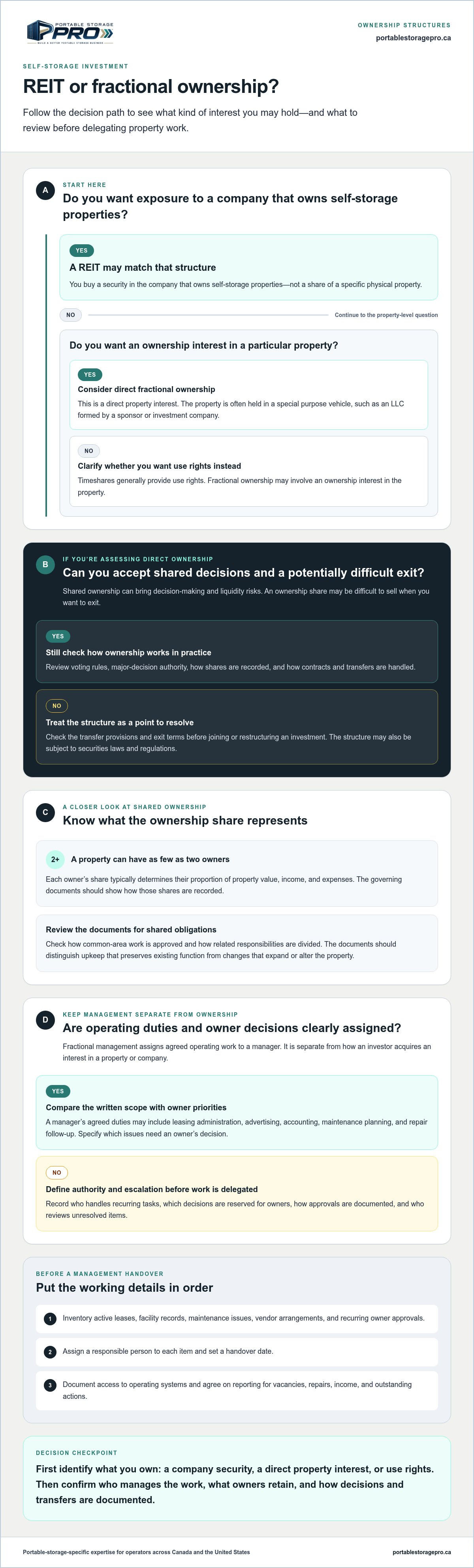
Fractional management assigns agreed operating work to a manager while owners retain investment oversight. For a self-storage property, define how facility tasks, leasing administration, asset condition, and any on-site residence fit into that division.
Manager Services
Depending on the written scope, a fractional manager may coordinate leasing administration, advertising, accounting, maintenance planning, and repair follow-up. A clear scope shows who handles recurring tasks and which issues require an owner’s decision. For example, a manager might prepare a monthly vacancy and work-order report for owners to review alongside facility activity.
Fractional Management Fees
The management agreement sets compensation terms and the manager’s assigned work; there is no single arrangement for every facility. Compare the work promised, the reporting provided, and the responsibilities owners retain. Check how the agreement handles work outside its regular scope, so unexpected tasks do not create confusion about authority or expectations.
Occupancy, Revenue, and Operating Costs
Management can affect occupancy and rental revenue through enquiry handling, advertising, lease administration, and how quickly vacant units return to service. Maintenance scheduling and prompt damage follow-up can also affect operating expenses. These activities do not guarantee results. Track enquiry sources, vacant-unit status, rental collections, and completed work orders to understand how management decisions relate to facility performance.
Use an asset register to link maintenance planning with the condition of each part of the property. Record the item, its condition, work history, and next review or action. If the property includes a residence, keep its inspection records separate from storage-unit records. Separate checklists help owners assess the residence against its own requirements instead of treating it as another storage asset.
Shared upkeep requires an agreed way to allocate responsibilities among owners. The ownership documents should explain how common-area work is approved and how related obligations are divided. They should also distinguish upkeep that preserves existing function from changes that expand or alter the property. This gives owners a consistent basis for reviewing proposals and recording decisions.
Fractional management can leave gaps when owners and managers assume the other party is handling a task. Unclear authority can delay work, while limited reporting can obscure whether an issue is still open. Define escalation steps, document approvals, and assign someone to review unresolved items. Consider whether the manager’s capacity and reporting schedule suit the facility’s operating needs.
Self-storage property management may be less demanding than management in residential and some other commercial property sectors because customers do not occupy storage spaces, which may require less maintenance. Turnover costs for self-storage owners also tend to be lower than the costs of preparing an apartment or office for a new tenant.
Fractional participation in self-storage
You can participate through a REIT security or direct fractional ownership of a self-storage property. Choose a manager by matching documented facility responsibilities to your priorities. Before delegating, record current duties, records, and unresolved work, then assign authority clearly.
Choosing a Fractional Manager
A fractional manager is a person or firm assigned specific property duties under an agreement. The scope matters because an investment’s operations affect both owner oversight and the handling of shared assets. Compare candidates on their self-storage responsibilities, reporting methods, maintenance coordination, tenant administration, and decision authority. Ask to see a sample report showing how vacancies, repairs, income, and outstanding actions are recorded. Then match the manager’s duties to the ownership agreement.
Transitioning to Fractional Management
A transition transfers agreed operating tasks while preserving owners’ authority over reserved decisions. Start with a written inventory of active leases, facility records, maintenance issues, vendor arrangements, and recurring owner approvals. Assign a responsible person to each item, set a handover date, and document access to operating systems. For example, the manager might take over routine tenant communications while owners retain approval of major property decisions.
Direct fractional ownership usually places the property in a special purpose vehicle, such as an LLC formed by a sponsor or investment company. Investors hold interests in that vehicle or in the property, depending on its structure. A property can have as few as two owners. Each owner’s share typically determines their proportion of property value, income, and expenses, so the governing documents should show how those shares are recorded.
A REIT offers a different route: you buy a security in the company that owns self-storage properties, rather than a share of a specific physical property. Fractional ownership is a direct property interest. Timeshares generally provide use rights, while fractional ownership may involve an ownership interest in the property. Choose based on whether you want exposure to a company or a particular property and its shared obligations.
Shared ownership also brings decision-making and liquidity risks. An LLC agreement may set contractual time limits on transferring an ownership share, and a property interest may be difficult to sell when you want to exit. The structure may also be subject to securities laws and regulations. Review voting rules, transfer provisions, expense allocation, and exit procedures before committing capital; these terms shape your practical control.
Before joining, map the investment from acquisition through operations and eventual transfer. Identify who selects the manager, approves major work, reviews financial statements, and handles disagreements. Then compare the proposed management scope with the owner responsibilities in the agreement. This reveals whether the manager’s role supports your investment goals or leaves important operating decisions without a clear owner.
Owner communication and support
Owner communication should connect facility activity to decisions, not merely circulate updates. Agree on reporting content, timing, and escalation steps before a manager takes responsibility.
Technology and reporting vary by facility and management agreement. Managers may use property-management software, accounting records, spreadsheets, or a combination to track leases, payments, vacancies, maintenance requests, and operating results. A useful test is whether owners can trace a reported change, such as a vacancy, to its status, follow-up action, and effect on rental income.
Set a reporting format that separates operating facts from decisions requiring owner input. A practical report can group occupied and vacant units, collections, new enquiries, completed repairs, open work orders, and upcoming approvals. For example, an open gate repair should show its status, the person responsible, and the decision needed, rather than appearing as an unexplained line item.
Shared ownership groups need a clear schedule for financial and insurance updates. Fractional owners associations should report income and expenses annually or more frequently, and provide a summary of insurance coverage or policy copies annually. Comparing the current statement with the previous report can help owners identify changes in expenses, rental income, or coverage that warrant discussion.
Communication rules should also define who can speak and act for the ownership group. At least one member should be authorized to sign contracts and cheques and act on the group’s behalf. Record that authority and the manager’s limits, so a repair approval or vendor instruction does not stall while owners debate who can respond.
Use a decision log for matters outside routine property operations. Record the issue, available alternatives, owner vote or approval, percentage of ownership represented, and resulting action. If owners are weighing repair against replacement, the log can preserve the rationale and supporting information for future review.
Technology supports communication when it answers a defined operating question. A shared maintenance log can show whether recurring door faults are being resolved; accounting software can organize income and expense records; and a secure document repository can keep agreements and insurance files accessible to authorized owners. The manager should explain how each system supports reporting and who maintains the records.
For self-storage operators adding portable storage, Technology & Innovation Consulting can help assess whether existing tools support fleet, customer, and facility reporting. Tie the review to a specific management gap, such as scattered service records or limited visibility into container availability, rather than adding software without a defined purpose.
Responsibilities of fractional owners
Fractional management assigns selected operating duties to a manager; owners retain governance and investment responsibilities. Full-service property management generally covers a broader day-to-day scope, while fractional management is limited to the duties delegated in its agreement.
Your ownership documents define how shares translate into rights and obligations. They should explain how income and expenses are allocated, which decisions require owner approval, and how votes are counted. For example, routine grounds work might be delegated, while a major renovation requires an owner decision. Clear thresholds prevent operating choices from turning into disputes about authority.
Owners also need to oversee the manager’s work. Review the operating statement against facility activity, including vacancies, collected rent, outstanding repairs, and tenant concerns. If the report shows rising vacancies, ask which units are affected and what follow-up is planned. Comparing records with the manager’s explanation helps owners assess performance without taking over routine tasks.
At least one member of a fractional ownership group should be authorized to sign contracts and cheques and act for the group. Record that authority in the group’s governance documents, then define who can approve vendor work and handle urgent decisions. A clear signing process helps prevent delays when the facility needs an authorized response.
Owners need to understand how shared upkeep obligations are divided. If expenses follow ownership shares, each person’s allocated portion should be visible in the records. Owners should also know how the group handles repair approvals, disputed work, and a member’s failure to meet an obligation. These terms shape the financial responsibilities attached to holding an interest.
Responsibilities extend beyond routine operations. Owners should understand the group’s budget, insurance information, repair planning, and replacement needs. For example, compare a proposed roof repair with the documented condition and the group’s planned reserves. This helps owners decide whether the work addresses an immediate defect or forms part of longer-term asset planning.
Transfer provisions matter when an owner wants to sell or restructure their holding. An LLC agreement may set contractual time limits on share transfers, affecting when an exit can proceed. Review those terms alongside approval rights and any process for admitting a new owner. A prospective buyer’s ownership percentage can also affect voting and expense allocation.
Use a decision record to track approvals, assigned actions, and unresolved questions. A practical review can cover the manager’s delegated scope, financial records, insurance information, major work, and transfer rules. Fractional management for storage owners works best when owners stay informed, respond to decisions through the agreed process, and distinguish oversight from daily facility administration.
Self-storage management demands
In the United States, requirements depend on the facility’s jurisdiction and ownership structure. Fractional ownership through an LLC or another vehicle may trigger applicable securities laws and regulations, so review the entity’s documents and management authority carefully.
Self-storage operations rely on consistent handling of tenant activity. Month-to-month agreements can make move-outs and unit turnover less predictable than in some other real estate types. A manager needs a process to record notices, confirm unit status, document condition, and update availability before leasing staff offer the space again.
For example, after a tenant leaves, staff can record the move-out, inspect the unit, and flag damage or remaining property. The manager can assign follow-up and update the unit’s status once its readiness is documented. This creates a traceable handoff between tenant administration, maintenance, and leasing.
Accurate records support daily decisions. Keep unit status, tenant account activity, maintenance requests, and access changes aligned in the facility’s operating system or records. If a customer reports an access problem, staff should be able to identify the unit, review the recorded action, and route any unresolved issue to the responsible person.
Pricing decisions require local operating context. Nearby supply, enquiry patterns, vacancies, unit mix, and the facility’s customer base can all shape how owners assess rental terms. A manager can organize these operating indicators for review, while owners decide how they fit the investment plan. National market totals cannot replace facility-level information.
Physical operations also require coordination across the site. Staff need clear assignments for gate access, lighting issues, grounds observations, and tenant-reported problems. An open-issue log can record the location, reported condition, assigned person, status, and next action. This helps keep a maintenance concern from disappearing between shifts.
Define the manager’s limits in the agreement. The manager may coordinate routine tenant administration, while owners retain authority over investment direction or major changes. Set out how an operating issue is escalated, who can authorize action, and how the decision is recorded. Clear boundaries help staff act without treating every routine task as an owner vote.
For self-storage operators adding portable units, facility processes must also account for container availability and related customer enquiries. Reviewing how those activities fit the existing operating structure can identify where records, roles, or technology need adjustment. Portable storage operations planning can help connect that review to your facility’s broader operating priorities.
Requirements depend on the facility’s jurisdiction and ownership structure. Fractional ownership through an LLC or another vehicle may trigger applicable securities laws and regulations, so review the entity’s documents and management authority carefully.
Portable Storage Pro: Growth Engagement Model
Portable Storage Pro’s consulting services help portable storage operators address growth priorities across sales, procurement, and technology. This can be relevant when adding portable storage to a self-storage operation and assessing how customer acquisition, equipment sourcing, and existing systems fit together.
Sales, Marketing & Lead Generation can support efforts to attract and convert business leads. Procurement & Sourcing addresses equipment and supplier decisions, while Technology & Innovation can help assess tools against operating needs. The focus is business improvement, not taking over day-to-day property management.
If you’re mapping growth priorities for a storage or container rental business, contact Portable Storage Pro to discuss your business.
Make the next move an operating decision
Fractional management for storage owners works best when the management structure reflects the decisions to be made and the work to be delegated. Before changing responsibilities, identify the business priority: improving lead conversion, coordinating procurement, or assessing whether systems support expansion. A clear priority gives owners and managers a practical basis for assigning responsibilities and reviewing progress.
For portable storage operators, Portable Storage Pro’s consulting services can support business improvement through Sales, Marketing & Lead Generation and Procurement & Sourcing. The focus is addressing growth priorities, not assuming day-to-day facility management. Bring a specific operating question to the discussion, such as how to strengthen lead follow-up or align purchasing with demand.
To discuss which growth priorities matter most for your business, contact Portable Storage Pro. A defined next step can help you move from a management question to a workable plan.
Frequently Asked Questions
How Can an Investor Participate?
You can invest through a REIT security or pursue fractional ownership of a specific self-storage property. The choice depends on whether you want an interest in a company that owns properties or a direct share in one property. For example, an investor seeking property-specific exposure would examine the ownership vehicle and its documents, while someone seeking company-level exposure would assess the REIT security and its holdings.
What is fractional management for self-storage facility owners?
Fractional management for storage owners means assigning defined management work to a part-time manager while owners retain responsibilities that have not been delegated. It is a management arrangement, not a type of property ownership. For example, a facility owner might assign recurring operational coordination while retaining decisions about investment direction. The written agreement should identify the manager’s duties, decision limits, reporting expectations, and matters reserved for owners.
How much does fractional management for a self-storage facility cost?
There is no standard fee for every facility. The fee depends on the case and is provided after a quote request; factors include assigned duties, facility requirements, reporting frequency, and decision-making authority. Compare the proposed scope with the work you expect the manager to perform. A limited advisory role and a broader operating assignment are not equivalent arrangements.
What tasks should a self-storage owner retain under fractional management?
Owners should retain decisions reserved to them in the agreement, especially those affecting investment direction, major property changes, and ownership governance. For example, you might delegate routine tenant administration but retain approval of a major renovation or a change to the ownership structure. Keep access to operating and financial reports, review unresolved issues, and assign an owner representative to communicate decisions to the manager.

Article by
Paul Taylor
Paul Taylor is the founder of Portable Storage Pro, bringing more than 35 years of experience across the container, portable storage and transportation industries. His background spans executive operations, business development, global procurement, sales, marketing and operational improvement in Canada, the UK and international markets.
Paul helps independent portable storage and container rental operators increase revenue, strengthen margins and build more efficient businesses. His work connects strategy with practical implementation, including pricing, delivery operations, supplier sourcing, staff training, technology and customer experience.
His experience includes leading multi-location storage operations and serving on the National Portable Storage Association’s board along with chairing its Canadian committee. Through Portable Storage Pro, Paul shares practical insights to help owners make informed decisions, solve operational challenges and grow profitably.
Disclaimer
Content published by Portable Storage Pro Inc. (PSP) provides general business information and industry insights. It does not replace advice tailored to your business or specialist legal, tax, engineering or other regulated advice. Reading this content or contacting PSP does not, by itself, establish a consulting engagement.
Information reflects circumstances at publication and may change. Examples and potential benefits are illustrative; results depend on individual circumstances, implementation and market conditions and are not guaranteed.
Client services are governed by the signed service agreement, agreed work plan and written amendments. Website and blog content do not amend those terms. PSP’s work is subject to applicable law and the professional commitments set out in its agreement, including the CMC-Canada Code of Professional Conduct and NPSA Code of Conduct and Ethics. Copies are available on request.
Views expressed are PSP’s own. Association membership or references do not imply association endorsement or CMC certification. Nothing in this disclaimer limits PSP’s contractual responsibilities, professional duties or rights that cannot lawfully be excluded.


