
A suitable storage business partnership model depends on what each party brings: a 50/50 joint venture can share responsibilities, risks and rewards, while a capital-and-operations arrangement can pair investment with industry expertise. For an independent operator weighing franchise-style options, these structures offer practical examples to compare before committing.
Focus on what each partner will contribute and how returns will be shared. A partnership works best when expectations, decision rights, and exit terms are clear from the start. This guide explains how storage business partnership models fit different goals, what partners may bring, and how to allocate profits and manage risk.
Regional partnerships and operating alliances differ from ownership joint ventures. The right structure depends on whether the business needs capital, operational capability, market access, or a combination of strengths. Each model has trade-offs, so start with the partnership’s purpose, then define profit-sharing and risk controls.
Key Takeaways
- Choose a partnership structure by matching each party’s contribution, decision rights and share of risk, rather than defaulting to equal ownership.
- Build property management and local business partnerships around a clear referral process, suitable customer offer and way to track results.
- Assess profit expectations against operating performance, utilization and the time needed to develop a stable customer base.
- Set out how partners will handle disagreements, changing responsibilities and an exit before the partnership begins.
- Use the Growth Engagement Model to connect growth priorities with practical support in sales, procurement and technology.
1. Storage business models for investors, operators, utilities, and end users
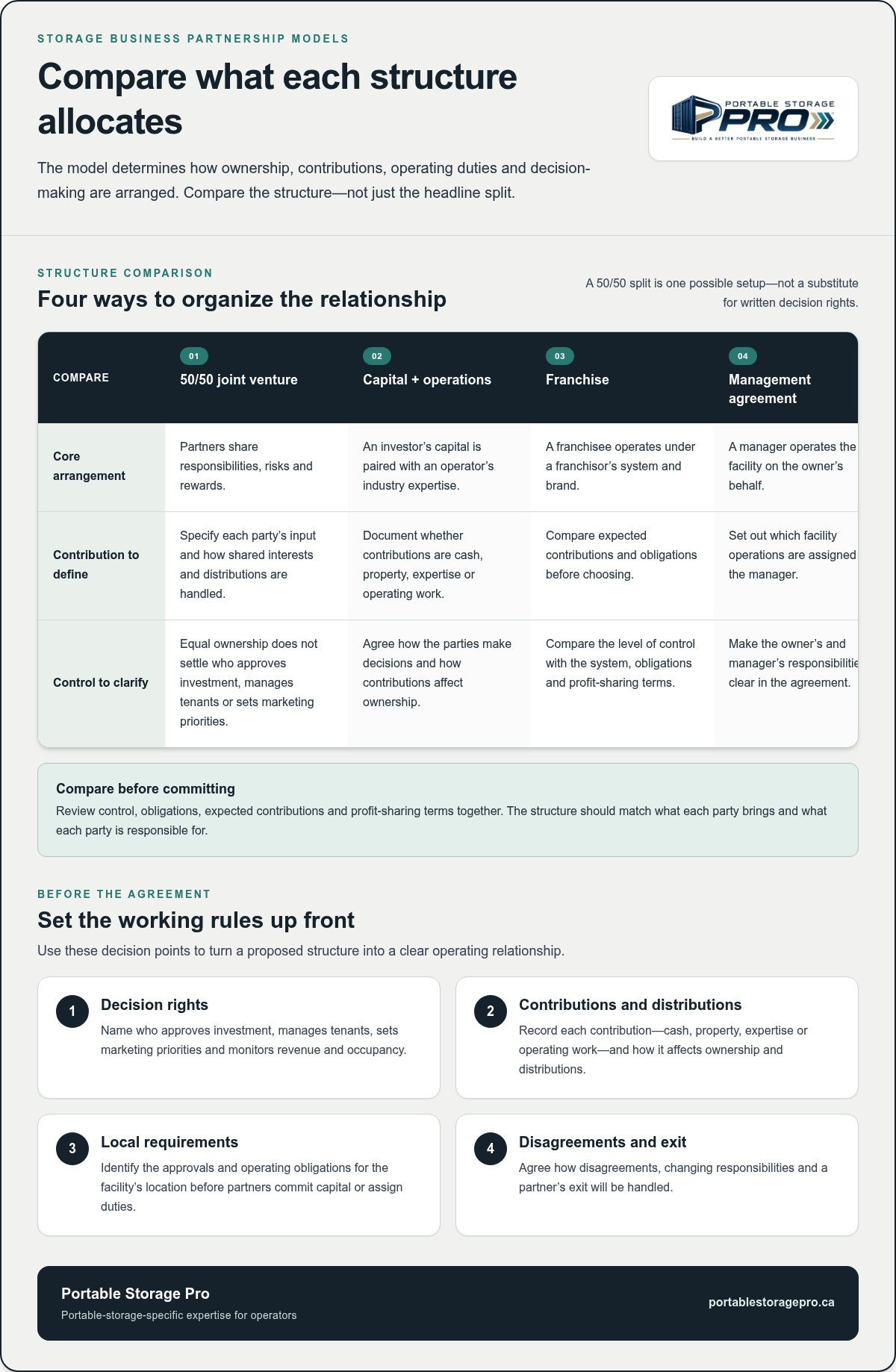
A self-storage partnership can pair an investor’s capital with an operator’s market knowledge and operating capacity. A 50/50 joint venture is one structure, with partners sharing responsibilities, risks, and rewards. Equal ownership still needs clear decision rights: define who approves investment, manages tenants, sets marketing priorities, and monitors revenue and occupancy.
Partnerships, franchises, and management agreements allocate control in different ways. In a partnership, parties share ownership or agreed business interests. A franchisee operates under a franchisor’s system and brand, while a management agreement assigns facility operations to a manager on the owner’s behalf. Compare control, obligations, expected contributions, and profit-sharing terms before choosing.
State and local requirements can affect how a facility is established and operated. Map the property’s location and the jurisdictions involved, then identify the approvals and operating obligations that apply. Assess these requirements before partners commit capital or assign responsibilities, since location can shape both the project structure and operating plan.
There is no single capital requirement for a storage partnership. The amount depends on the assets, their condition, the financing plan, development work, and each partner’s contribution. Separate funding needs into acquisition or development costs, operating reserves, and planned improvements. Then document whether contributions are cash, property, expertise, or operating work, and how they affect ownership and distributions.
Storage arrangements can involve parties beyond investors and operators. A utility may own a community energy storage asset, while end users may seek access to a shared asset. A white paper described no model for multiple end users sharing one common community energy storage asset during the period it covered. This is distinct from self-storage, where tenant access and facility operations shape the business model.
Network size also changes the working relationship. National Storage Affiliates formed in 2013 around regional operators, combining local entrepreneurship with network resources and shared practices. Large networks focus on standardized, high-volume operations across markets; regional partnerships can leave more room for operational flexibility and personalized attention. Match the model to your need for scale, local decisions, and consistent systems.
Test the operating relationship before signing. Request a facility tour, access to operations staff, and references from comparable facilities. Trace how enquiries become rentals, how tenant support works, and how staff record occupancy changes. Ask which tasks are automated, which need staff, and who controls marketing decisions. For example, a shared lead system might centralize enquiries while local managers handle campaigns and customer follow-up. Compare these workflows with your planned division of responsibilities.
2. Partnerships with property management companies
A property management company can connect a portable-storage operator with tenants dealing with renovations, lease changes, or move coordination. Build the relationship around a specific tenant need, not a general promotion. For example, a manager could include storage information in a renovation notice, while the operator gives interested tenants a clear enquiry route and explains the service directly.
Agree on decision rights and management duties before launch. The property manager can choose where tenant communications appear and ensure the wording fits its process. The storage operator should control service descriptions, quotes, scheduling, and customer records. Decide who updates promotional material, responds to complaints, and reviews whether the arrangement remains useful.
Tailor the offer to the referral context. A property manager might promote temporary storage to tenants during renovations, while a real estate office could share information with clients preparing a property for sale. Make eligibility, booking steps, service area, and offer terms clear. Avoid blanket discounts unless you have assessed their effect on rental revenue and contribution.
Nursing homes may also refer families who need storage during a resident’s transition or room change. Give the facility concise information and a direct way to reach your team. The nursing home introduces the option; your team answers service questions and manages the customer relationship. This helps staff avoid making commitments about availability or delivery arrangements on your behalf.
Make promotion easy for facility managers to maintain. Assign a contact at each organization, approve a short message, and set a process to update it when service details change. For example, a property manager could include approved wording in a move-out email, while the operator records the referral source in its lead management system. Review the wording whenever the offer or service area changes.
Plan capacity before a partner sends tenant communications. Compare available containers, expected returns, fleet readiness, delivery coverage, and staff schedules with the campaign period. If capacity tightens, ask the partner to pause or adjust promotion. This matters especially during peak demand, when referrals may arrive faster than units can be turned, inspected, and prepared.
Measure the partnership by referral source and outcome. Record referrals, qualified enquiries, quotes issued, completed rentals, and staff time spent handling each lead. If a campaign generates enquiries but few completed rentals, examine the hand-off, customer fit, and response process before changing the offer. Share a brief review with the property manager, then decide whether to continue, revise, or stop.
3. Partnerships with local moving companies
A local moving company can help a storage operator reach customers whose move dates do not line up. Build the partnership around a specific point in the moving process, such as a delayed possession date or a staged move. The mover identifies a possible storage need; your team explains the container service and checks whether it fits the customer’s requirements.
Coordinate the service sequence before accepting referrals. Map who confirms the customer’s address, access conditions, delivery window, and planned pickup. For example, a mover may need the container’s arrival time before scheduling its crew. Each company should manage its own bookings and customer commitments, with one agreed contact for schedule changes.
Put referral terms in writing. State whether the arrangement is reciprocal, how introductions are recorded, and whether either party receives compensation. Agree on how both businesses will handle customer information and complaints. A simple referral record can capture the source, enquiry date, service requested, and outcome, making it easier to review the arrangement without mixing customer files.
Check geographic fit before promoting the relationship. Compare the mover’s usual service area with your delivery coverage and yard location. A referral requiring a long repositioning trip can affect route planning and fleet availability. For each proposed service area, consider whether a delivery can be paired with a return movement or another scheduled job instead of sending a vehicle on an isolated run.
Prepare staff for the hand-off. Give the mover a short service description, the details needed for an enquiry, and a direct way for customers to contact your team. Train staff to identify the referral source and request only the information needed to assess fit. This keeps the first conversation focused and prevents the mover from making commitments on your behalf.
Review operating performance together. Compare referrals with completed rentals, schedule changes, customer questions, and dispatch impact. If enquiries often arrive before dates are firm, adjust the referral wording to set expectations. If a route repeatedly causes delays, refine the service area or booking process. Make specific changes based on the review, rather than relying on referral volume alone.
Start with a limited trial and a defined review point. Choose a customer segment, such as people between move-out and move-in dates, and agree on the message each business will use. Track whether the process produces suitable enquiries and manageable coordination. Continue or revise the arrangement based on operating results, with both partners clear about what they will change next.
Profit expectations and timing
Assess partnership returns using cash generated by the facility, not headline rental revenue alone. Build a forecast for each period, then separate routine expenses, debt obligations, planned maintenance, and cash available for distribution. This shows partners what the business can support before they set expectations for withdrawals or reinvestment.
Build the forecast from operating drivers you can monitor. For example, connect enquiries with booked rentals, average rental duration, container availability, and renewals. Test how changes in these drivers affect revenue and cash flow. This gives partners a practical basis for discussing performance without treating a projected outcome as certain.
Define a distribution waterfall before operations begin. Specify which obligations are paid first, what reserve the business retains, and how remaining distributable cash is allocated. Include a process for approving reinvestment, such as replacing equipment or improving the facility. This prevents partners from treating accounting profit as cash immediately available to withdraw.
Separate investor returns from operating measures. An investor may focus on distributions and the value of their ownership interest; an operator may track rental conversion, service quality, and asset use. Agree on shared reporting that presents both perspectives. For example, a monthly report can pair financial statements with operating indicators and explain material differences from the plan.
Use sensitivity analysis to identify the assumptions with the greatest effect. Prepare a base case and alternatives for slower leasing, weaker quote conversion, delayed project work, or higher maintenance needs. For each case, document the effect on available cash and the actions partners would take. This turns uncertainty into a management discussion instead of an argument after results fall short.
Set review points around operating milestones, not just calendar dates. Partners might review progress after a marketing launch, staffing change, or major facility improvement. Compare actual results with the forecast, identify the cause of any gap, and assign an owner to each corrective action. Record each decision and revisit it at the next review.
Timing also depends on how quickly the partnership can make and carry out decisions. Delayed approvals can push back marketing, maintenance, or expansion plans. Set authority limits for routine decisions and reserve joint approval for material commitments. Track open decisions alongside cash-flow forecasts so partners can see whether delays are affecting planned activity.
Connect exit planning to the financial records used in operating reviews. Define what information partners will use to assess a sale, buyout, or continued ownership. Consistent records of distributions, reinvestment, and operating performance give each partner a clearer basis for evaluating the next step.
5. Risk allocation and mitigation
A self-storage joint venture can divide ownership, profit, and responsibilities equally, such as a 50/50 structure, or assign different shares to reflect each partner’s contribution. The agreement should define each party’s duties, decision authority, distribution method, and responsibility for operating shortfalls. Equal ownership alone doesn’t resolve who acts when partners disagree.
For a venture, document the terms in a written joint-venture or operating agreement and identify the business entity that holds the facility. Entity selection and agreement terms should align with ownership, management, liability, and tax arrangements, as well as applicable law. Set these details before partners commit assets or begin operations.
Plan for difficult transitions in writing. Self-storage investors are advised to consider divorce, death, and dissolution when structuring a partnership. The agreement can address notice, valuation, transfer of interests, decision authority during a transition, and the process for winding down. For example, specify how the remaining partner can respond if an owner becomes unable to participate.
Assign clear ownership of operational risks too. Specify who handles tenant complaints, facility upkeep, staffing, security procedures, and financial reporting. A monthly review can compare occupancy records, rental receipts, maintenance issues, and unresolved customer matters. If one partner manages the facility, define reporting expectations and how the other partner can review results.
Technology brings another category of risk. An asset’s uncertain lifespan and premature failure can deter utility adoption, while insurance for storage technology risk can be costly or unavailable when underwriting data is limited. For a storage venture using a technology platform, document who selects equipment, tracks performance, manages failures, and funds replacement decisions. Separate monitoring from control: an alert may identify a problem, but a named operator must respond.
Prepare a practical risk register before launch. For each risk, record its trigger, accountable partner, response, and review point. Container damage, a missed delivery, or a sudden occupancy decline should each have a named decision-maker and documented process. Review the register regularly and update it when operations, suppliers, or the customer offer change.
Utility arrangements show why risk allocation must fit the revenue model. A reliability power purchase agreement may let a storage operator participate in wholesale markets while bearing asset technology risk. Financing the asset depends on a long-term agreement, and regulatory approval can be problematic. Before relying on that revenue stream, partners should map who carries performance, financing, and approval risk.
Clear governance can help an established operator attract a capital or operating partner without leaving key decisions unresolved. If you’re formalizing a portable-storage partnership, discuss partnership planning around roles, operating priorities, and accountability with Portable Storage Pro.
Portable Storage Pro: Growth Engagement Model
When a growth opportunity needs to connect with operating priorities, Portable Storage Pro’s Consulting Partner model can support the work. For example, adding portable storage to a self-storage facility may require coordinated decisions about customer acquisition, supplier sourcing, and the technology used for quotes and fleet activity.
Portable Storage Pro supports operators with Sales, Marketing & Lead Generation, Procurement & Sourcing, and Technology & Innovation Consulting. This work can examine how leads move through the sales process, how procurement supports expansion, and whether systems fit the team’s operations. The focus is on business priorities, not a one-size-fits-all partnership structure.
If you’re planning growth or weighing how a partnership fits your operation, contact Portable Storage Pro to discuss your business.
Turn your partnership plan into operating decisions
Turn the preferred structure into a working agreement. Before moving forward, document each party’s contributions, who owns each decision, how performance will be reviewed, and what happens when circumstances change. This makes the choices behind storage business partnership models practical instead of leaving them as broad intentions.
Test the opportunity against your operation. Can your team serve the expected demand? Do sales, procurement, and fleet processes support the plan? Are responsibilities clear enough for partners to act without delaying routine decisions? These questions connect the partnership to day-to-day execution.
Portable Storage Pro’s Growth Engagement Model supports operators working through growth priorities, including sales and procurement considerations. If you’re ready to discuss how a partnership could fit your portable storage business, contact Portable Storage Pro. A clear plan gives you a stronger basis for the decisions ahead.
Frequently Asked Questions
Can you suggest any examples that would be suitable for the storage unit business franchise?
A franchise-style approach may suit an operator seeking an established brand and defined operating playbook. For example, an owner could assess whether standardized customer intake, marketing materials, and facility procedures fit the market and management capacity. A referral arrangement with a property manager or moving company is different: it can generate leads without granting franchise rights or changing ownership. Compare control, brand requirements, and operating commitments before choosing.
What Makes a Great Partner?
A strong partner brings a needed capability and follows through on agreed responsibilities. Look for compatible expectations around decision-making, reporting, customer experience, and reinvestment. Ask candidates how they handled a disagreement or missed commitment in a previous business relationship, then compare their account with references and written records. Clear communication matters, but reliable execution and openness about constraints are more useful tests.
What are the main self-storage business partnership models?
The main storage business partnership models include an ownership joint venture, a capital-and-operator arrangement, a franchise, a management agreement, and a referral alliance. They differ in whether parties share ownership, control, brand standards, or customer referrals. A referral alliance can remain contractual and non-equity, while a joint venture combines ownership interests. Map each party’s contribution and authority before choosing a structure.
What are typical self-storage partnership profit splits and investor returns?
There is no standard split or return that suits every facility. Set the distribution method in the agreement and distinguish operating profit from cash available after debt payments and planned reserves. For example, model how a repair reserve or loan repayment changes distributable cash before agreeing on allocations. Investor returns depend on project performance and capital structure, so compare projected distributions with each party’s contribution and accepted risk.
What are the risks of partnering in a self-storage business, including debt and liability?
Debt and liability exposure can arise from loan commitments, guarantees, ownership documents, and operating decisions. Review financing documents to identify the borrower, any guarantor, pledged assets, payment obligations, and default terms. Separately, define who can approve borrowing, sign contracts, and authorize major work in the partnership agreement. Keep accurate financial records and require documented approval for decisions that could increase obligations or affect facility assets.
How do self-storage partnership models differ by state and local regulations?
State and local requirements can affect how a facility is established and operated. Map the property and relevant jurisdictions, identify applicable approvals and operating obligations, and assess them before partners commit capital or assign responsibilities.

Article by
Paul Taylor
Paul Taylor is the founder of Portable Storage Pro, bringing more than 35 years of experience across the container, portable storage and transportation industries. His background spans executive operations, business development, global procurement, sales, marketing and operational improvement in Canada, the UK and international markets.
Paul helps independent portable storage and container rental operators increase revenue, strengthen margins and build more efficient businesses. His work connects strategy with practical implementation, including pricing, delivery operations, supplier sourcing, staff training, technology and customer experience.
His experience includes leading multi-location storage operations and serving on the National Portable Storage Association’s board along with chairing its Canadian committee. Through Portable Storage Pro, Paul shares practical insights to help owners make informed decisions, solve operational challenges and grow profitably.
Disclaimer
Content published by Portable Storage Pro Inc. (PSP) provides general business information and industry insights. It does not replace advice tailored to your business or specialist legal, tax, engineering or other regulated advice. Reading this content or contacting PSP does not, by itself, establish a consulting engagement.
Information reflects circumstances at publication and may change. Examples and potential benefits are illustrative; results depend on individual circumstances, implementation and market conditions and are not guaranteed.
Client services are governed by the signed service agreement, agreed work plan and written amendments. Website and blog content do not amend those terms. PSP’s work is subject to applicable law and the professional commitments set out in its agreement, including the CMC-Canada Code of Professional Conduct and NPSA Code of Conduct and Ethics. Copies are available on request.
Views expressed are PSP’s own. Association membership or references do not imply association endorsement or CMC certification. Nothing in this disclaimer limits PSP’s contractual responsibilities, professional duties or rights that cannot lawfully be excluded.


