

In a low-demand, oversupplied market, protecting occupancy and retention may matter more than pursuing the highest rate on every rental. Pricing should reflect the business objective, what customers value and how each offer fits the operation. A portable storage pricing strategy is more than setting a rate: it shapes how you position the service and evaluate growth.
Rates are only one part of the equation. Discounts can influence customer decisions, tiers can clarify differences between offers, and delivery requirements affect rental economics. Treat each as a separate decision, then assess how the choices work together. That helps prevent price changes without a clear business purpose.
This guide offers a practical way to assess pricing options for portable storage and container rental operations. It covers how market conditions shape pricing, how to assess promotions and tiers, and how to compare storage formats from an operator’s perspective. Use these decision points to clarify what your current approach is meant to achieve and where a more deliberate review could help your team make its next pricing decision.
Key Takeaways
- In a low-demand market with excess supply, weigh occupancy and retention alongside the rate charged per rental.
- Separate the base rate from delivery, pickup and optional fees so you can see how each part affects revenue and customer quotes.
- Match your pricing method to local demand, available supply and occupancy goals instead of changing rates without a clear reason.
- Measure whether introductory discounts and referral offers bring in suitable customers and support longer-term rentals.
- Build pricing tiers around meaningful differences in service, then compare storage formats by the full operating and delivery model.
Base prices, tiered pricing, and additional fees
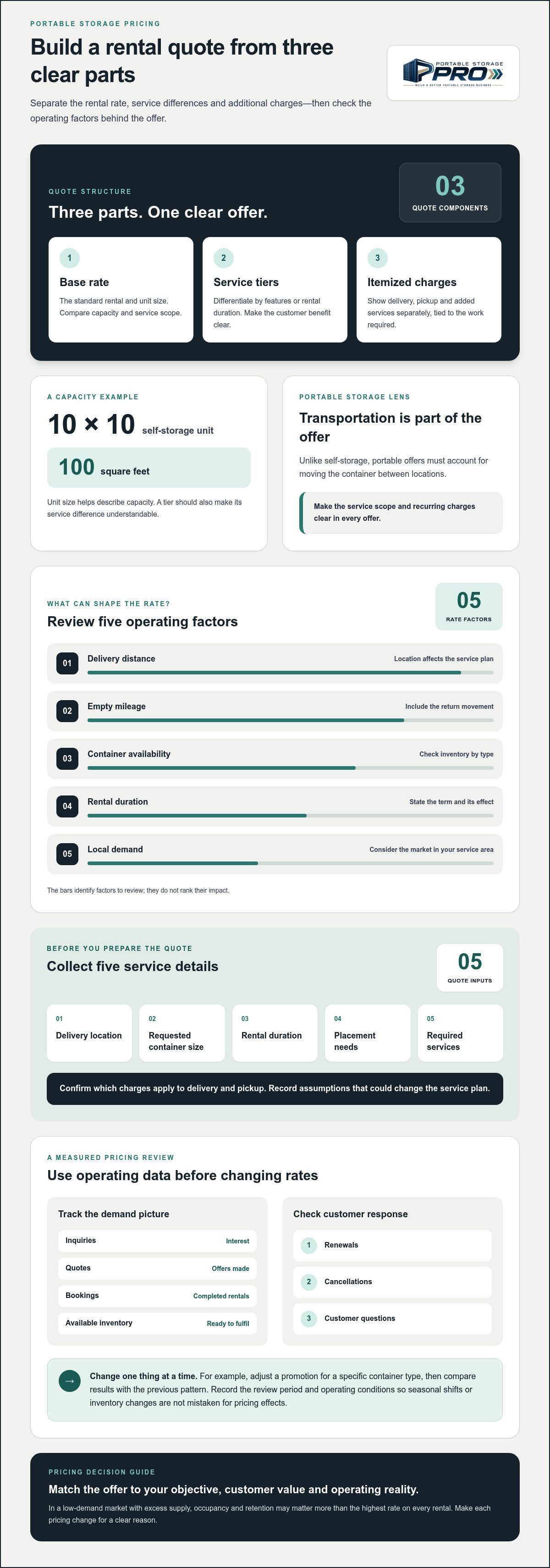
Build each rental quote from a base rate, service tiers and itemized charges. Compare how each component reflects the service provided and the operating work required.
Base and tiered prices
A base rate defines the standard rental; tiers distinguish options by unit size, access, features or duration. For example, a 10-by-10 self-storage unit provides 100 square feet, while a larger unit serves a different capacity need. Anchoring can help customers compare two similar options, such as ground-floor access against a standard unit.
| Option | What it reflects | Compare by |
|---|---|---|
| Base rate | Standard rental and unit size | Capacity and service scope |
| Tiered rate | Features or rental duration | Customer benefit |
| Itemized charges | Delivery, pickup or added service | Work required |
Choose a structure that makes differences between offers clear and measurable.
Additional fees and price factors
Separate delivery, pickup and optional services from the recurring rental charge, giving each item a clear purpose. Portable storage rates also reflect delivery distance, empty mileage, container availability, rental duration and local demand. The U.S. Bureau of Labor Statistics notes that U.S. warehousing price models account for factors such as storage volume, bundled services, labour, real-estate costs, customer type and facility location.
To prepare an accurate quote, ask for the delivery location, requested container size, rental duration, placement needs and required services. Confirm which charges apply to delivery and pickup, and note any assumptions that could change the service plan.
For existing tenants, group accounts by renewal timing, explain adjustments before they take effect, and track renewals, cancellations and customer questions. Charm pricing or a feature-based price anchor can help customers compare options, but the displayed difference should reflect a real service distinction.
Provider pricing strategies
Portable storage providers commonly structure quotes around rental and transportation charges, then distinguish options by duration or service features. Unlike self-storage, portable offers must account for moving the container between locations. An operator may use promotional rates to attract new rentals and value-based pricing for longer-term customers. Make the service scope and recurring charges clear in every offer.
Ask which charges cover the container rental, delivery, pickup and requested services. Confirm how changes to the delivery plan or rental period affect the quote, and request an itemized breakdown. This lets you compare offers based on the same service assumptions, rather than judging only the base rate.
What is Value Based Pricing?
Value-based pricing sets rates according to the benefit customers see in a service. A portable storage pricing strategy should account for more than container capacity. Consider a contractor who needs a container close to an active job site. Access and placement flexibility may be the priority, while another customer may value predictable storage over a longer period. Identify the specific need before setting the offer.
Dynamic pricing responds to changes in demand and occupancy, but useful adjustments depend on reliable operating data. Separate inquiries, quotes, bookings and available inventory by service area and container type. An increase in inquiries alone does not show that customers will accept a higher rate. Compare inquiries with completed rentals, unserved requests and containers ready to fulfil them.
Market-based pricing adds competitor activity to the review. Compare equivalent services, not just advertised rates: consider delivery scope, access conditions and rental terms. If another operator’s offer differs, record the distinction before treating it as a direct comparison. This approach is most useful in a competitive local market when your aim is to improve revenue yield.
Value-based tiers distinguish offers through features customers care about. In self-storage, climate control, drive-up access and facility location may affect perceived value. For portable storage, assess whether customers respond to options such as delivery placement or service arrangements. A tier makes sense when customers understand its benefit and your operation can deliver it consistently.
Set a review routine before adjusting rates. For each service area, record the current offer, available inventory, quote outcomes and customer feedback. Then make one change, such as adjusting a promotion for a specific container type, and compare the results with the previous pattern. Document the period and operating conditions so seasonal variation or inventory changes are not mistaken for pricing effects.
Occupancy helps put those results in context. If a facility has low occupancy and plenty of available units, filling space may matter more than raising rates on the remaining rentals. If one unit type is often unavailable while other inventory sits idle, review the mix and rates by type. This is more useful than applying one change across the entire facility.
A portable storage pricing strategy should also account for customer response over time. After an adjustment, review renewals, cancellations and service questions, not just initial bookings. Frequent changes can confuse tenants, so communicate the reason and timing clearly. Use market-based adjustments when market conditions drive the decision, and value-based offers when customer benefits distinguish the service. Tie each method to a defined business objective.
Introductory discounts and referral programs
Promotions can help fill idle capacity, but each offer needs a defined audience, end date and measure of performance. Compare the rentals generated with retention, move-outs and revenue after the discount ends.
Introductory discounts
An introductory discount lowers the initial rental charge to encourage a new customer to book. One option is 25% off for the first 4 months, rather than a one-month-free promotion. The distinction matters: a phased discount spreads the incentive across the opening period, while a free-month offer concentrates it. State the promotional period and standard rate clearly in the quote.
Move-in promotions
A move-in promotion targets new rentals during a defined period or in a specific service area. In a competitive market with excess supply, test an offer against the number of suitable idle containers and incoming inquiries. Avoid applying it automatically to every rental. Record which promotion was shown during lead intake, then compare quote conversion and subsequent move-outs.
Limited-time discounts have a clear deadline, unlike ongoing introductory offers. Set the start and end dates, eligible service area and rental conditions before publishing. For example, you might limit an offer to a slow-demand area or a container type with available inventory. Review bookings before extending the offer; repeated extensions can make the deadline less credible.
Limited-time discounts
A defined offer can prompt faster decisions, but its purpose should be measurable. Track inquiries and confirmed rentals during the offer, then compare them with the usual sales pattern in the same service area. Do not rely on booking volume alone. Check whether the promotion attracted rentals that continued beyond the discount period or simply shifted bookings forward.
Discounts tied to length of stay can encourage retention. A small reduction for a 6- or 12-month self-storage lease is one approach. Compare the value of a longer commitment with the discount granted, and define what happens if the customer ends the rental early. For portable storage, consider whether a longer term reduces repeat handling or leaves a container unavailable for a more suitable booking.
Referral programs reward existing customers or business partners for bringing in qualified leads. Assign each referral source a trackable code or field, and record whether the lead becomes a rental. Define eligibility and when the reward applies. This allows you to compare referred bookings with other promotions without treating every inquiry as a successful referral.
When a promotional period ends, communicate the next rate and effective date before billing changes. Large self-storage chains commonly raise promotional rates by 8 to 15% after 3 to 6 months. Monitor cancellations, renewal acceptance and occupancy after an adjustment. If move-outs rise, review the timing, customer communication and value delivered before repeating the same offer.
Effects of tiered pricing on revenue and facility value
Tiered pricing distinguishes offers by customer benefit and helps you measure which features support stronger revenue. For a facility, the value comes from a clear offer and trackable performance, not simply from adding more rate levels.
Good-better-best pricing tiers
A good-better-best structure presents a standard option, an upgraded service and a premium choice. Unlike a single flat rate, it lets customers compare benefits and shows you which offer attracts demand. Define each tier in operational terms, such as placement, access or service level. Then track bookings and occupied capacity by tier, rather than relying only on total rental revenue.
For example, a portable storage operator could distinguish standard placement from a more convenient delivery arrangement. The premium option should offer a real difference customers can understand. If customers select the entry tier but rarely choose upgrades, review whether the higher tiers meet a relevant need. Compare tier selection with quote conversion, cancellations and how long containers remain idle.
Pricing by unit features
Feature-based tiers link rates to specific attributes rather than broad labels. A self-storage facility might offer a climate-controlled, ground-level unit within 20 feet of the entrance as a premium option. A non-climate-controlled unit within 50 feet of the gate could form a lower tier. The distinction is measurable, unlike vague claims such as “preferred” or “enhanced.”
For portable storage, possible differentiators include container size, placement requirements, access arrangements and included services. List the features for each tier, then record customer selections and questions. This helps show which benefits influence bookings and which add complexity without a clear customer response. Keep descriptions consistent across quotes, sales conversations and billing records.
Tier design affects revenue through both rates and rental mix. A higher-priced tier can contribute more per rental, but only if you account for its added service and customers choose it. Compare revenue by tier with occupancy, delivery requirements and container readiness. If premium bookings require extra handling, include that workload in your assessment instead of judging the tier by its rate alone.
A facility’s value depends on the quality and durability of its operating performance. A clear tier structure makes revenue sources easier to assess by showing demand for different features and service levels. Track occupancy, renewals, tier selection and rate adjustments consistently. These measures help explain whether revenue comes from repeatable customer preferences or temporary promotions. They also reveal where idle inventory or service constraints limit an offer’s value.
Review tiers on a consistent schedule, changing one feature or service condition at a time. For example, compare bookings for units near an entrance with other available units, then assess whether the difference supports a premium. Apply the same process to portable container placement or service levels. Document customer response and operational impact before revising the tier structure.
Monthly storage costs by type and container size
Portable storage, self-storage and full-service moving include different services, so compare the full rental period and scope. Portable storage combines container use with delivery and pickup; self-storage centres on facility space, while full-service moving adds labour for moving tasks.
Contract length, insurance requirements, cancellation notice and pickup arrangements can change the total payable and when charges apply. Compare these terms in the agreement, including what happens if you extend the rental or end it earlier than planned.
For operators, a useful comparison starts with the customer’s actual need. A 20-foot container kept on-site serves a different use case from a 10×15 climate-controlled storage unit. Compare access, climate features, delivery, pickup and duration, rather than treating the monthly rate as the entire decision.
| Storage option | What the customer receives | Key comparison |
|---|---|---|
| Portable container | Container use with delivery and pickup | Placement, rental duration and transport |
| Self-storage | Space within a storage facility | Unit size, access and climate features |
| Full-service moving | Moving labour alongside transport | Labour scope and service timing |
Container size affects how much a customer can store, but the quoted size alone does not guarantee usable capacity. Ask for an inventory summary, including large or unusually shaped items, then match the load to an appropriate container. A simple loading plan can reduce wasted space and help avoid choosing a larger unit when a smaller one will do.
For example, group bulky items by footprint and identify what must remain accessible during storage. Explain how loading order affects access, then record the selected size and assumptions in the quote. This gives your sales team a consistent basis for recommending capacity and helps limit changes caused by incomplete inventory details.
Portable storage may justify a higher total charge when customers value on-site placement, fewer trips to a facility or storage during a staged move. Compare convenience with the complete service, not container use with space alone. Make this distinction clear by separating transport, storage duration and optional services in the quote.
HOA rules can affect whether a container may be placed at a property and for how long. Include placement restrictions and the customer’s intended location in your intake process. These details may change delivery timing or make an on-site option unsuitable. Focus on the specific property and requested service rather than assuming the same rule applies across communities.
Before setting a monthly offer, map the service area, delivery requirements, expected rental duration and container availability. Compare the resulting workload with the customer benefit. This helps explain why rentals with similar container sizes may have different service scopes, while keeping the factors behind each quote clear.
Portable Storage Pro: Growth Engagement Model
Portable Storage Pro’s consulting can connect pricing decisions with wider business priorities. A new rate structure, for example, may require coordinated sales messaging, procurement planning or technology support to track quote conversion and rental mix.
If you are ready to address growth priorities across your portable storage operation, Portable Storage Pro’s Consulting Partner offer can support the work. Sales, Marketing & Lead Generation can help shape how you present tiers and promotions. Procurement & Sourcing and Technology & Innovation Consulting can support related purchasing and systems decisions. This work helps assess pricing alongside the operational factors that shape customer demand and revenue.
To discuss your pricing priorities and growth plans, contact Portable Storage Pro.
Turn pricing decisions into an operating discipline
Make pricing decisions repeatable by assigning responsibility for reviewing rate changes, recording why each adjustment was made and assessing its operational effect. A decision log can connect customer response, fleet availability and rental performance, giving your team a clearer basis for future choices. It can also help prevent inconsistent quotes when several people handle sales.
A portable storage pricing strategy works best as part of a wider growth plan, not as a rate sheet in isolation. Use each review to identify the next priority, such as sales messaging, procurement or the systems used to track quote outcomes. Assign an owner and a practical next action so your team can carry the pricing analysis forward.
If you’re ready to align pricing decisions with your growth priorities, discuss your business goals with Portable Storage Pro. A focused next step can help you move from analysis to a clearer operating plan.
Frequently Asked Questions
What About Low-Demand, Over-Supplied Markets?
In a low-demand market with excess supply, focus on filling suitable idle containers and retaining customers rather than pursuing the highest rate. Segment inventory by size, location and readiness, then target promotions where availability exceeds incoming demand. Track inquiries, completed rentals and move-outs by segment. If a discount generates bookings but retention is weak, adjust the offer or follow-up process before expanding it.
What factors determine portable storage container pricing?
Pricing reflects the container and service required, as well as the operating effort needed to fulfil the rental. Assess container size, availability, rental duration, placement requirements, delivery distance and empty repositioning. A practical quote worksheet can separate recurring storage revenue from one-time service charges, then compare both with the labour and fleet capacity required. This helps identify rentals that contribute revenue without obscuring the delivery workload.
How do portable storage companies price delivery, pickup, and transportation?
Operators can set transportation charges according to route distance, dispatch requirements, handling and whether a container must travel empty between jobs. Record planned and actual mileage for completed deliveries, pickups and repositioning. Use those records to refine service-area boundaries and quote assumptions. Separating transportation from recurring rental charges also helps customers understand route-related costs and managers assess delivery contribution.
How do container size and rental duration affect portable storage costs?
Larger containers provide more capacity, while longer rentals keep a unit committed to one customer for longer. Match container size to the customer’s inventory and compare expected rental revenue with the time the unit will be unavailable to the fleet. A useful internal measure is revenue per container-day, reviewed alongside utilization and delivery activity. This can reveal when a long rental earns less than alternative demand for the same unit.
How do portable storage prices vary by location and season?
Location affects route efficiency and local supply and demand, while seasonal changes can shift which container sizes customers request. Review inquiries, conversions, idle inventory and delivery mileage by service area across past operating periods. Use these patterns to plan fleet positioning and procurement timing. Rising demand in one area, for example, may call for moving available inventory there, while a slower area may need targeted lead generation.
What are typical portable storage container rental prices in the United States?
There is no single average price because portable storage services vary.

Article by
Paul Taylor
Paul Taylor is the founder of Portable Storage Pro, bringing more than 35 years of experience across the container, portable storage and transportation industries. His background spans executive operations, business development, global procurement, sales, marketing and operational improvement in Canada, the UK and international markets.
Paul helps independent portable storage and container rental operators increase revenue, strengthen margins and build more efficient businesses. His work connects strategy with practical implementation, including pricing, delivery operations, supplier sourcing, staff training, technology and customer experience.
His experience includes leading multi-location storage operations and serving on the National Portable Storage Association’s board along with chairing its Canadian committee. Through Portable Storage Pro, Paul shares practical insights to help owners make informed decisions, solve operational challenges and grow profitably.
Disclaimer
Content published by Portable Storage Pro Inc. (PSP) provides general business information and industry insights. It does not replace advice tailored to your business or specialist legal, tax, engineering or other regulated advice. Reading this content or contacting PSP does not, by itself, establish a consulting engagement.
Information reflects circumstances at publication and may change. Examples and potential benefits are illustrative; results depend on individual circumstances, implementation and market conditions and are not guaranteed.
Client services are governed by the signed service agreement, agreed work plan and written amendments. Website and blog content do not amend those terms. PSP’s work is subject to applicable law and the professional commitments set out in its agreement, including the CMC-Canada Code of Professional Conduct and NPSA Code of Conduct and Ethics. Copies are available on request.
Views expressed are PSP’s own. Association membership or references do not imply association endorsement or CMC certification. Nothing in this disclaimer limits PSP’s contractual responsibilities, professional duties or rights that cannot lawfully be excluded.


