
More leads won’t fix a qualification problem. Improving storage lead conversion rates starts with identifying which enquiries fit your portable storage or container rental operation, then tracking how prospects move from first contact toward a rental. A single headline figure can’t tell you whether the problem is attracting suitable prospects or what happens next.
You may already track enquiries, quotes, and completed rentals. The challenge is connecting those records to see which marketing activity attracts suitable prospects and where the sales journey loses momentum. Without that view, it’s easy to focus on the wrong part of the process.
This article offers a practical way to assess lead quality, define conversion measures, and interpret results across your sales funnel. It also looks at how the online experience, follow-up, and stage-specific content influence a prospect’s next step. Use these ideas to identify a focused improvement, assess its effect, and make better-informed sales and marketing decisions.
Key Takeaways
- Separate raw inquiries from qualified prospects and sales-ready leads using criteria that fit your ideal customer.
- Measure lead-to-customer conversion with a consistent formula, then track movement through each sales stage.
- Use CRM records to tailor follow-up to each prospect’s needs and the conversations already held.
- Match useful content to the buyer’s stage, from early research through quote evaluation and decision-making.
- Review conversion patterns and lead volume together to identify where your sales process needs attention.
1. What Makes a Real, Convertible Lead?
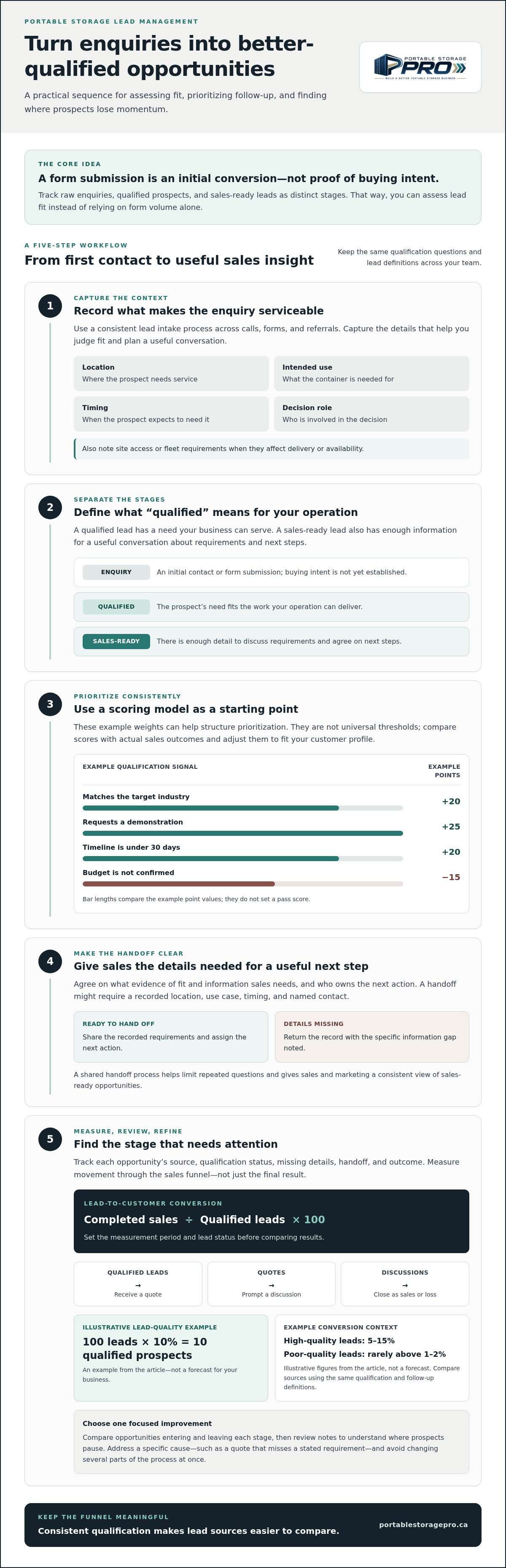
A form submission is an initial conversion, not proof of buying intent. Someone downloading a container guide may be researching, comparing options, or exploring a future project. A qualified lead has a need your operation can serve. A sales-ready lead also has enough information for a useful conversation about requirements and next steps. Keep these stages distinct in your records so marketing performance reflects prospect fit, not just form volume.
Set qualification criteria around the work your business can deliver. For a portable storage operator, record the prospect’s location, intended use, timing, and role in the decision. Note site access or fleet requirements when they affect delivery or availability. Ask the same core questions on calls, forms, and referrals. Consistent intake makes enquiries easier to compare and helps staff identify genuine opportunities without treating every early-stage contact as ready to buy.
Use a scoring model to make prioritization more consistent, then compare scores with actual sales outcomes. One example assigns 20 points for matching the target industry, 25 for requesting a demonstration, and 20 when the timeline is under 30 days. It subtracts 15 points when no budget is confirmed. Treat these as example weights, not universal thresholds. Review which scores progress to quotes and sales, then adjust criteria to reflect your own customer profile.
Sales and marketing should agree on what qualifies for handoff. Define the information sales needs, the evidence of fit, and who owns the next action. For example, a handoff might require a recorded location, use case, timing, and named contact. If a record is missing an item, return it with that specific gap noted. This shared process cuts repeated questions and gives both teams a consistent view of sales-ready opportunities.
Use qualified-lead outcomes to assess advertising, rather than raw form volume alone. In an example, 100 leads converting at a 10% rate produce 10 qualified prospects. High-quality leads can convert at 5–15%, while poor-quality leads rarely exceed 1–2%. These figures illustrate how lead quality affects results; they are not a forecast for your business. Compare sources using identical qualification criteria and follow-up definitions. If one platform brings many forms but few suitable prospects, refine its audience, message, or landing-page questions.
Which marketing channels generate the highest-converting self-storage leads? No channel leads in every market or facility. Compare search, referrals, paid advertising, and other sources by the share of enquiries that qualify and become rentals.
How do self-storage conversion rates vary by market, facility type, and season? They depend on local demand, competition, unit mix, customer needs, and timing. Segment records by market and facility type, then compare equivalent periods to identify patterns that matter to your operation.
For each enquiry, record its source, qualification status, missing details, handoff, and outcome. Review incomplete and lost records with sales and marketing together. Use recurring gaps to adjust intake questions, channel targeting, or handoff criteria, then assess whether the changes bring forward better-matched opportunities.
2. What is sales conversion rate?
Sales conversion rate measures how effectively a sales team turns qualified leads into customers across the buying journey. Calculate it by dividing completed sales by qualified leads, then multiplying by 100. Define the measurement period and lead status before comparing results. Otherwise, a change in qualification rules can make the rate look different without any actual change in sales performance.
Measure movement between stages as well as final sales. Track qualified leads that receive a quote, quotes that prompt a discussion, and discussions that close. These micro-conversions help pinpoint where progress slows. If prospects stall after receiving a quote, check how clearly it addresses their stated requirements and whether a follow-up action was agreed.
Prioritize improvements by finding the stage with the clearest operational constraint. Compare how many opportunities enter and leave each stage, then review representative notes to understand why prospects paused. Choose a change that addresses a specific cause, such as a missing explanation in the quote. Avoid changing the script, quote format, and follow-up process all at once, or you won’t know which change affected the result.
Evaluate sales calls with a short, consistent review guide. Check whether the representative confirmed the prospect’s priorities, asked relevant follow-up questions, explained the available option, and agreed on a next step. Review calls alongside outcomes, not in isolation. A polished conversation that leaves the buyer’s concern unresolved may not move the opportunity forward. Coach one observable behaviour at a time, then listen for it in later calls.
Build sales plays around buyer priorities and triggers, not internal process steps. A prospect preparing a commercial site may need clarity on access and scheduling; someone comparing container options may need an explanation of operational differences. Use customer accounts or case studies that address similar concerns. Keep claims factual and explain the context so prospects can judge whether an example applies to their requirements.
What are common reasons self-storage leads do not rent, and how can operators address them? A prospect may find the location, unit type, availability, or terms unsuitable, or may still be deciding. Record the reason in your sales system, then respond with relevant information or close the opportunity accurately. Comparing recorded reasons can reveal whether the issue lies in the offer, communication, or lead fit.
Use a review rhythm that turns observations into assigned work. At each sales review, select one process issue, name an owner, and decide what evidence will indicate progress. Check the next set of call notes and opportunity outcomes against that evidence. This keeps improvement practical: the team can distinguish a training need from a quote problem or a mismatch between marketing promises and what operations can deliver.
3. How does user experience affect conversion rates?
A prospect’s experience starts with the first call, form, or online quote request. When contact details, requested service, and next steps are scattered across inboxes, staff can lose context. Use your CRM to record interactions, preferences, and outstanding actions. This helps each representative continue the conversation without asking prospects to repeat information they’ve already provided.
Personalized follow-up uses recorded details, not just a name inserted into a template. Refer to the prospect’s service area, container needs, timing, or stated concern. If they asked about delivery access, address that in the next message. Assign a follow-up owner and due date in the CRM, then track completed actions and responses.
Speed matters, but a fast reply still needs to be useful. Aim to make the first contact within five minutes of a new lead arriving when your team can do so. Research cited in the article’s fact set says prospects contacted within this window are more likely to engage than those contacted after 30 minutes. If an immediate call isn’t practical, set an alert and send a clear acknowledgement with the next step.
How quickly should storage facilities respond to online and phone leads? Aim to respond within five minutes when possible, and route missed calls or web enquiries to a named team member for prompt follow-up. Track response time by lead source to identify delays, rather than relying on an overall average.
Build nurturing around the prospect’s last interaction. After an initial call, send the requested details; after a quote, follow up with a question about fit or timing. The example cadence in the research spans 14 days, but your CRM should record whether each contact earns a response. Avoid sending the same message repeatedly. Pause active outreach when prospects signal they don’t wish to continue.
What privacy and telemarketing rules apply to following up with self-storage leads in the United States? Follow the federal and state requirements that apply to your business and contact method. Record how each prospect agreed to be contacted, use their details for the stated purpose, and log requests to stop further contact.
Pricing, promotions, and fees affect whether a quote feels clear and suitable. State the service terms and applicable fees plainly, and explain what a promotion covers and when it applies. If a prospect hesitates, ask which part of the offer is unclear. Record that feedback to identify patterns in lost opportunities.
A lead conversion rate near 2% is cited as an average across lead-to-sale activity, but your own results depend on lead source, qualification, and follow-up. Track each stage and use the CRM to connect buyer feedback with the action that follows. This turns user experience into specific strategies your team can test and refine.
4. Content and lead magnets for each funnel stage
A lead conversion funnel maps how a prospect moves from initial awareness to a completed rental or business agreement. Define each stage by an observable action, such as viewing a service page, requesting information, receiving a quote, or accepting an offer. A lead magnet is useful content exchanged for contact details, such as a site-readiness checklist. Use it to capture interest, not to label every download a sales opportunity.
At the awareness stage, prospects need clear answers to basic operating questions. Publish pages explaining container options, delivery processes, site access, or common commercial uses. A short explainer can help a business decide whether portable storage suits its project. Include a relevant next step, such as viewing service-area details or requesting a conversation, so visitors know how to proceed.
During consideration, offer a practical resource that helps prospects assess their requirements. A downloadable planning worksheet could prompt them to record intended use, location, access conditions, and timing. Keep the questions aligned with your actual service and intake process. The completed worksheet gives the prospect and your sales team a clearer starting point than a general contact form.
At the evaluation stage, make content specific to the decision at hand. A quote-preparation checklist can explain which project details help produce a relevant proposal. A comparison guide can clarify differences between delivery approaches or container configurations, provided those distinctions match your operation. Avoid unsupported savings claims; use a worked example only when its assumptions and figures are transparent.
For decision-stage prospects, answer practical questions directly. A concise FAQ can cover delivery coordination, access, scheduling, and the steps involved in accepting a quote. Place a clear call to action beside each answer. For example, someone reviewing a proposal should be able to request clarification without returning to the homepage or repeating information already supplied.
Define conversion rates for each funnel transition, not only the final sale. Divide the number advancing to the next stage by the number entering the current stage, then multiply by 100. Track content engagement separately from qualified opportunities. A worksheet download measures capture; a completed quote request measures stronger intent. These points help you see which resources attract attention and which support buying decisions.
Review the path from content to sale in your CRM. Record the resource viewed, the next action, and the eventual outcome. If prospects read a delivery page but don’t request quotes, clarify the process or add a relevant prompt. If a planning worksheet leads to useful conversations, feature it on matching pages and campaigns. This connects each resource to a measurable stage and gives your team a practical basis for refinement.
5. Lead conversion rate measurement
Measure lead-to-rental conversion with one consistent calculation: new rental customers divided by leads, multiplied by 100. Define “lead” and “new rental customer” before reporting results. For example, decide whether duplicate enquiries count once and whether a reservation or completed rental marks conversion. Without these definitions, a change in the reported rate may reflect recordkeeping rather than sales performance. A clear baseline makes improving storage lead conversion rates easier to assess.
What is a good lead-to-rental conversion rate for self-storage facilities? A broad cross-industry reference is 2–5%, but it isn’t a self-storage-specific target. Use your facility’s past results as the working benchmark, then segment by market, source, unit type, and season.
For channel reporting, assign every lead a source when it enters your CRM. Calculate each channel’s rate using rentals attributed to that channel divided by its leads, multiplied by 100. Apply the same lead definition, attribution rule, and measurement period to search, referrals, paid campaigns, and phone enquiries. Keep an “unknown” source category visible instead of quietly removing untracked leads.
Use lead cohorts to make fair comparisons. Group leads by when they first arrived, then give each group the same opportunity to progress before assessing the outcome. A lead received near the end of a reporting period may still be interested but hasn’t had time to rent. Compare mature cohorts and record the date range and attribution method alongside each result.
Track movement through each stage as well as the final rental rate. Record leads that receive contact, get a quote, book a unit, and become customers. These measures show where prospects stop moving forward. If quotes go out but few rentals follow, review the quote process and recorded objections. If few leads receive a quote, inspect response ownership, enquiry details, and handoffs.
Connect conversion data to commercial value. Record the service or unit requested and the eventual sale value for each customer. Compare channels by both rental count and revenue, rather than treating every conversion as equal. For operators improving storage lead conversion rates, this view can show whether a channel brings valuable opportunities or simply more enquiries.
Choose one process change as a test, such as clearer source capture or a revised quote follow-up. Run the test for two weeks, then compare the same funnel stages against the preceding period. Review lost leads every 30 days to identify repeated reasons and refine qualification or messaging. Keep the original definitions fixed during the test, so you can distinguish the effect of the change from a measurement change.
Portable Storage Pro: Growth Engagement Model
Portable Storage Pro’s Consulting Partner can help when lead data points to a broader sales or marketing issue, rather than an isolated follow-up gap. If qualified enquiries stall before receiving quotes, Sales, Marketing and Lead Generation can support a closer review of lead handling, messaging, and the sales process. Technology and Innovation can help assess whether your CRM and reporting tools provide useful visibility. Procurement and Sourcing may also be relevant when container availability affects the offers your team can confidently promote.
The next step is to identify the constraint you want to address, such as inconsistent qualification, unclear campaign results, or gaps in tracking. Contact Portable Storage Pro to discuss your lead conversion priorities and how they relate to your business operations.
Make the next improvement measurable
Choose one constraint your team can influence and make its effect visible. That could mean improving how marketing and sales share lead information or clarifying which opportunities deserve follow-up first. Set a clear baseline, assign responsibility for the change, and review what happens to the resulting enquiries. This gives your team a practical way to improve storage lead conversion rates without changing several parts of the process at once.
Portable Storage Pro’s Consulting Partner can support operators seeking to align Sales, Marketing and Lead Generation with business priorities. Procurement and Sourcing may also be relevant when container availability shapes which opportunities your team can pursue. Start by identifying the operating issue you want to address.
Bring your current challenge and desired next step to a discussion with Portable Storage Pro. Discuss your business priorities with Portable Storage Pro and identify a practical place to begin.
Frequently Asked Questions
What Makes a Real, Convertible Lead?
A convertible lead has a genuine need your operation can serve and a clear path to a decision. For example, a commercial prospect seeking container storage at a site outside your delivery capability is not a strong fit, even with an urgent timeline. Distinguish that enquiry from a suitable prospect still gathering information. This helps your team choose between sales follow-up, future nurturing, and a respectful close-out.
What is sales conversion rate?
Sales conversion rate is the share of eligible leads that become paying customers during a defined period. Before comparing results, decide whether repeat enquiries from one organization count as separate leads and how to attribute a rental involving several contacts. Apply the same rules across reporting periods. Consistent definitions make the result more useful for staffing and campaign decisions than a rate based on inconsistent records.
How do I know if a lead is worth pursuing or should be disqualified?
Compare the prospect’s need with your service area, delivery capability, container availability, and commercial terms. Pursue the lead when those factors align and you can identify a decision-maker or practical next step. Disqualify it when a clear mismatch makes service impractical. If timing or requirements remain uncertain, mark the record for later review instead of counting it as sales-ready or deleting useful context.
How does user experience affect conversion rates?
A poor experience can create friction before a salesperson speaks with the prospect. Test the enquiry journey on a mobile device: check that the service description is clear, the form is easy to complete, and the confirmation explains what happens next. After submission, staff should see the same details the prospect entered. A test enquiry can reveal broken routing, duplicate questions, or unclear confirmation messages.
What follow-up sequences convert more self-storage inquiries into rentals?
Use a consistent cadence with a clear purpose for each contact. The Three-Touch Rule calls for an immediate response, a check-in within 24 hours, and a final follow-up on day four. Tailor each touch to the last interaction: answer an unanswered question, clarify a quote, or confirm whether the prospect’s requirements have changed. Record replies and stop active outreach when someone declines further contact.
How can self-storage websites and online rental flows improve conversions?
Make the path from a facility page to an enquiry or rental action direct. Show relevant unit information, location details, and terms together, then ask only for information needed to progress the request. On the confirmation screen, summarize the submitted details and explain the next step. Review analytics and test submissions to find where visitors abandon the flow or encounter errors.
What call scripts and sales training improve self-storage lead-to-rental rates?
Use a flexible call guide, not a word-for-word script. Train staff to confirm the storage need, ask about timing and access, address the stated concern, and recap the agreed next step. Practise common situations, such as a prospect comparing unit types or unsure about move-in timing. Managers can review call notes for missing information and coach the specific skills needed for clearer conversations.
Which CRM and lead-tracking tools help self-storage facilities increase conversions?
Choose a CRM or lead management system that records enquiry source, contact history, status, assigned owner, and next action. It should connect with the channels your team uses, such as website forms and phone enquiries, and support reporting from first contact through rental. Before choosing software, map your current process and identify missing handoffs. A tool helps only when staff keep records current and use it consistently.

Article by
Paul Taylor
Paul Taylor is the founder of Portable Storage Pro, bringing more than 35 years of experience across the container, portable storage and transportation industries. His background spans executive operations, business development, global procurement, sales, marketing and operational improvement in Canada, the UK and international markets.
Paul helps independent portable storage and container rental operators increase revenue, strengthen margins and build more efficient businesses. His work connects strategy with practical implementation, including pricing, delivery operations, supplier sourcing, staff training, technology and customer experience.
His experience includes leading multi-location storage operations and serving on the National Portable Storage Association’s board along with chairing its Canadian committee. Through Portable Storage Pro, Paul shares practical insights to help owners make informed decisions, solve operational challenges and grow profitably.
Disclaimer
Content published by Portable Storage Pro Inc. (PSP) provides general business information and industry insights. It does not replace advice tailored to your business or specialist legal, tax, engineering or other regulated advice. Reading this content or contacting PSP does not, by itself, establish a consulting engagement.
Information reflects circumstances at publication and may change. Examples and potential benefits are illustrative; results depend on individual circumstances, implementation and market conditions and are not guaranteed.
Client services are governed by the signed service agreement, agreed work plan and written amendments. Website and blog content do not amend those terms. PSP’s work is subject to applicable law and the professional commitments set out in its agreement, including the CMC-Canada Code of Professional Conduct and NPSA Code of Conduct and Ethics. Copies are available on request.
Views expressed are PSP’s own. Association membership or references do not imply association endorsement or CMC certification. Nothing in this disclaimer limits PSP’s contractual responsibilities, professional duties or rights that cannot lawfully be excluded.


