
Mobile storage marketing tactics work best when they connect customer data to relevant messages, use clear consent practices and make it easy to respond on a phone. Segment prospects and customers by their needs and stage in the rental process, then choose a suitable channel, such as email, social media or SMS. Keep each message focused on a useful next step.
Reaching people on mobile is only part of the job. Your message also needs to match what they’re considering, use a channel they’ve agreed to receive and lead to a clear action. This article explains how to organize customer data, build practical audience segments and make consent and opt-out information clear. It also covers mobile-friendly content, email, social media and SMS promotions, so outreach stays relevant rather than indiscriminate. The aim is a manageable marketing process you can assess from the first inquiry through the rental decision.
Key Takeaways
- Use customer information to tailor messages to a prospect’s needs and stage in the rental process.
- Group audiences by relevant characteristics so each campaign has a clear purpose and call to action.
- Make consent, message frequency and opt-out instructions clear to support trust and responsible communication.
- Match the channel to the message, then make landing pages and emails easy to use on mobile devices.
- Reserve SMS for timely, relevant promotions and track responses to guide future campaigns.
1. Personalization using customer data
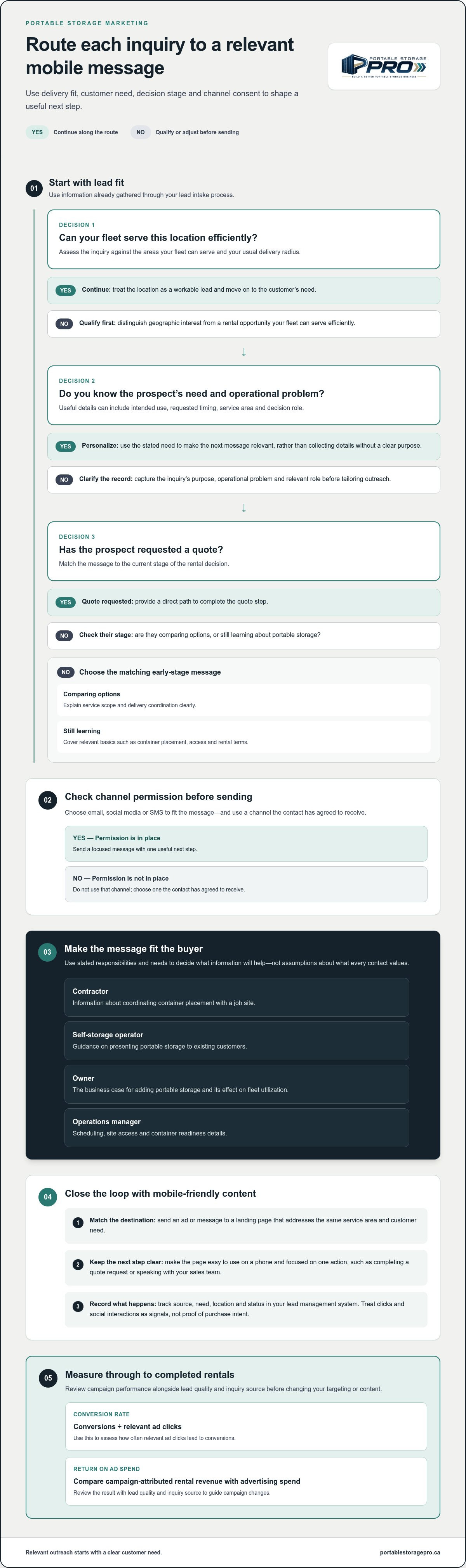
Start with information your lead intake process already collects: service area, intended use, requested delivery timing and inquiry source. Record these details consistently in your customer relationship management system. A prospect planning a renovation may need different information from a business seeking temporary inventory space. Personalization means using relevant details to make the next message useful, not collecting information without a clear purpose.
Build content around real customer needs. A contractor, for example, may want information about coordinating container placement with a job site. A self-storage operator adding portable units may need guidance on presenting the service to existing customers. Focus each message on one next step, such as completing a quote request or speaking with your sales team. This makes your marketing more relevant across mobile channels.
Local SEO and Google Business Profile can help customers find your business in the areas you serve. Keep your profile accurate, describe your portable storage services clearly, and direct local searchers to a mobile-friendly page with a useful call to action. Review inquiries by location in your analytics to see whether those pages attract qualified leads.
Customers might search for “portable storage container rental,” “mobile storage containers for business” or “container rental near me.” Treat these as starting points, then compare actual search terms with the services, delivery radius and language reflected in your inquiries. When assessing lead quality, distinguish business-use searches from household-moving intent.
For Google Ads and local search advertising, organize campaigns around service areas and specific customer needs. Send each ad to a matching landing page rather than a general homepage. One reported benchmark says geo-targeted campaigns can have a 20% higher click-through rate than standard campaigns; use your own campaign analytics to assess whether local targeting brings qualified inquiries.
AI-driven personalization can help sort customer records by factors such as inquiry topic, location or stage in the sales process. Use those segments to suggest relevant messages, then review the wording and recipient group before sending. A mobile user who requested delivery information, for example, needs a practical follow-up, not an unrelated promotion.
Build referral relationships directly with movers, real estate agents and contractors. Give each partner a concise description of your service, the customer situations it suits and a clear referral process. Track inquiries by referral source to see which relationships lead to completed rentals.
Measure results from the first click through to a completed rental. Divide conversions by relevant ad clicks to calculate conversion rate. Compare rental revenue attributed to a campaign with its advertising spend to assess return on ad spend. Review these measures alongside lead quality and inquiry source before changing a campaign.
2. Audience definition and segmentation
Build audience segments around buying needs, not broad labels such as “business customer.” A company evaluating portable units for seasonal inventory has different questions from a property manager assessing a new service line. Start with the inquiry’s purpose, then record the operational problem, decision role and service area. This gives each campaign a defined audience and connects its message to a real business decision.
Separate prospects by their stage in the rental decision. Someone early in the process may need information about container placement, access and rental terms. A prospect comparing options may want a clear explanation of service scope and delivery coordination. A lead requesting a quote needs a direct path to complete that step. Write a distinct message for each stage instead of sending everyone the same sales copy.
Use service geography as a practical segment, not just a postal-code field. A lead outside your usual delivery radius may need different qualification from one near your yard. Group inquiries by the areas your fleet can serve efficiently, then match advertising and landing-page content to those boundaries. This helps sales staff distinguish geographic interest from a workable rental opportunity.
Buyer roles can shape content, too. An owner may focus on fleet utilization and the business case for adding portable storage. An operations manager may want details about scheduling, site access and container readiness. A marketing manager at a self-storage facility may need customer-facing information to support a new offer. Use stated responsibilities to choose relevant material rather than assuming everyone weighs the same criteria.
Channel engagement can help refine segments, but treat it as a signal, not proof of purchase intent. A contact who clicks an email about business storage may merit a relevant follow-up. A social media interaction alone may not justify a sales message. Record the action, campaign and resulting inquiry in your lead management system to see which channels produce meaningful conversations.
Keep segments manageable. If two groups need the same message and next step, they may not need separate campaigns. Review each segment’s inquiries, quote activity and completed rentals together. If a group attracts unqualified leads, adjust its targeting or content before increasing outreach. A small operator can start with a spreadsheet, as long as staff consistently record source, need, location and status.
Review segment definitions as your service area and customer mix change. If more inquiries come from renovation firms, for example, assess whether those prospects ask about timing, placement or site access. Use these patterns to develop useful content and refine sales follow-up. The goal is relevant communication that helps the right prospect take a clear next step.
3. Calls to action, clarity, and opt-in and opt-out practices
A mobile call to action should explain exactly what happens next. Use “Request a business rental quote” instead of “Learn more” when the destination is a quote form. Keep the button easy to find on a phone screen, and ask only for details needed to respond, such as service area and intended use.
Match the action to the campaign. A prospect comparing options may be ready to view service details, while someone with an active project may want to request a quote. Repeat the advertisement’s offer on the landing page and give it one primary action. Conflicting buttons can make the next step unclear.
Consent needs equally clear wording. For an SMS programme, explain what types of messages a person is agreeing to receive and identify the business sending them. Keep opt-in separate from unrelated form terms. Store the consent source and date in your lead management system so staff can see how each phone number joined the programme.
Make it straightforward for people to stop receiving messages. Include clear opt-out instructions in SMS promotions and suppress that number from future marketing sends after a request. Keep service communications, such as a response to an active quote request, separate from promotional messages. This helps staff avoid sending offers to people who have opted out of marketing.
For U.S. campaigns, account for applicable privacy and advertising rules, including the California Consumer Privacy Act where it applies. Local permit and advertising requirements vary by location and medium, so assess digital messages separately from physical signs or promotional displays. Keep campaign claims accurate and show consent language before a mobile user submits information.
Avoid common pitfalls such as a vague offer, a misleading button or a form that obscures how contact details will be used. “Get a quote” should lead to a quote process, not an unrelated page. Don’t make marketing opt-in appear mandatory when it isn’t needed to answer an inquiry. Review the entire path from advertisement to confirmation on a phone.
Test each platform before launching a campaign. Submit the form on a phone, confirm the response arrives and check that opt-out works as described. Ask a colleague to complete the same steps without guidance. If they can’t identify the offer, sender, next action and way to stop messages, revise the screen before sending traffic.
Brands earn trust through consistent communication, not just a polished advertisement. Record consent, honour opt-outs, and review the language whenever a campaign changes. These steps make mobile marketing easier to manage and give your team a clear process for handling inquiries without confusing promotional outreach with customer service.
4. Mobile apps, social media, email, and push notifications
Give each channel a clear role in your marketing plan. Email can carry detailed explanations, social media can show use cases, and an app can support repeat interactions. People spend more than four hours per day on mobile devices on average. The phone experience is therefore part of your service presentation, not just a smaller version of your desktop site.
Review mobile behaviour by device type before changing a campaign. For self-storage businesses receiving 30% or more of website visits from mobile platforms, the research recommends checking usability on both Android and Apple devices. Test menus, quote forms and contact details on each. A form that works well on one device can still create friction on another.
Email suits information prospects may need to revisit, such as service boundaries, placement considerations or the details required for a quote. 55% of emails are opened on mobile devices and recommends a font size greater than 13 points. Use a short subject line and put the main business point near the start, where readers can see it without extensive scrolling.
On social media, use formats that explain a specific operational situation. A brief video might show how a portable unit can support a contractor’s site workflow, while a carousel could outline questions a facility manager should consider before adding units. Smartphones account for 75% of video views. Make the central point understandable on a small screen.
Choose platforms based on your audience and the content your team can maintain. A professional network may suit posts about commercial applications and business decisions. A visual platform may suit short demonstrations of equipment or yard processes. Compare inquiry quality across sources, then focus on channels that generate relevant conversations rather than simply reactions.
An app needs a distinct operating purpose. If customers repeatedly need the same account information or service interaction, an app may support that task. If contact is occasional, a mobile website and well-organized email may be more practical. Before development, define the recurring user task and how staff will maintain accurate information in the app.
Push notifications can reach iOS app users while the app isn’t in the foreground. Consider them for relevant delivery updates, reminders or location-based messages. Plan operational alerts separately from promotional content. Review notification engagement alongside completed customer actions, so frequent alerts don’t replace useful service communication.
Keep channel performance connected to business outcomes. Compare email referrals, social inquiries and app interactions by their contribution to qualified rental opportunities. The SAP Global Engagement Index 2026 survey found that 63% of consumers said their favourite brand delivers connected experiences across mobile, web and in-store. For your operation, consistency means accurate service details and a clear customer journey across each channel.
5. Mobile promotions and SMS opt-ins
SMS can put a time-sensitive offer directly in front of a prospect. Use it for a relevant action, such as telling opted-in business contacts about a seasonal rental opportunity or inviting them to request a quote. Portable storage rentals are rarely impulse purchases. Connect the offer to a clear business need and an appropriate next step.
Get permission first. Invite contacts to opt in through a mobile form, quote process or another clear sign-up point. State who will send messages and what kinds of promotions to expect. Keep the permission record with the contact in your lead management system, and honour opt-outs promptly. The consent and opt-out process is covered in more detail above.
Keep each SMS focused. For example: “Planning a site expansion? Request portable storage rental information for your service area.” Link to a mobile-friendly page that matches the message, rather than sending recipients to a general homepage.
A 98% SMS open rate and says 90% of messages are opened within 3 minutes. Treat those figures as context, not a performance forecast for your campaign. Your own results depend on audience fit, timing, message relevance and the action offered. Track delivered messages, responses, quote requests and completed rentals to judge business value.
Use SMS selectively. A deadline tied to a genuine seasonal campaign may justify a timely reminder. Repeated generic discounts can train recipients to ignore future messages or opt out. Set an internal sending schedule, coordinate promotions with email and social media, and avoid sending the same offer through every channel at once.
Test a promotion before sending it to your full list. Confirm the landing page works on mobile, the offer is accurate and the call to action reaches the right team. Then compare results with a similar campaign or earlier send. Track response quality as well as volume: an inquiry outside your delivery area may not lead to a workable rental.
Where appropriate, connect digital promotions with traditional customer touchpoints. A QR code on a business-facing flyer can lead to an SMS opt-in page, while a sales conversation can direct an interested prospect to the same sign-up form. Keep participation voluntary and explain the message purpose at sign-up. This gives your team a consistent way to build a permission-based audience.
Treat SMS as one part of a measured marketing process, not a substitute for relevant service information. Review which messages generate qualified conversations, then refine the audience, timing or wording. Testing helps you decide whether SMS promotions belong in your broader mobile campaigns.
Portable Storage Pro: Growth Engagement Model
Portable Storage Pro’s Growth Engagement Model can help you turn marketing priorities into a focused plan for your portable storage business. Use it when customer segments, mobile campaigns and follow-up practices need to work together as part of a broader growth effort.
Through Sales, Marketing & Lead Generation, you can address campaign planning and lead conversion. Technology & Innovation can help assess how your systems support customer communication and marketing measurement. The work is specific to the operating realities of portable storage businesses, not generic marketing advice.
If you’re ready to refine your marketing approach, contact Portable Storage Pro to discuss your business priorities.
Put your next marketing decision to work
Make your next campaign a practical test of how well your marketing process supports sales. Choose one audience, define the response you want and decide how your team will handle each inquiry. Effective mobile storage marketing tactics connect the message, channel and follow-up, while giving you enough information to assess lead quality.
Use that first test to establish a repeatable review process. Note which prospects responded, what they needed and whether the inquiry fit your service area. Refine the next campaign based on those conversations, not just clicks or views. This keeps marketing connected to container availability, delivery capacity and the work your sales team can support.
Ready to make your marketing more useful to your operation? Discuss your business goals with Portable Storage Pro and turn campaign ideas into focused work your team can manage.
Frequently Asked Questions
What are the most effective marketing tactics for mobile storage companies?
Effective mobile storage marketing tactics connect qualified demand with your fleet’s service capacity. Prioritize channels that bring inquiries from areas you can serve, then track each lead through quote, booking and rental. For example, label inquiry sources in your CRM and compare completed rentals, not just form submissions. This helps you focus on channels that attract suitable prospects and reduce effort on campaigns your operations can’t support.
Which social media marketing strategies work best for portable storage businesses?
Use social platforms to answer practical questions business buyers ask before requesting a quote. Post short demonstrations of container placement considerations, explain how businesses can use portable units, and share staff-led answers to common service questions. Tailor posts to audiences such as contractors or self-storage operators. Link to relevant service information, then assess whether social referrals lead to qualified business inquiries.
What promotions and discounts attract mobile storage customers, and how do they affect profitability?
Assess a promotion’s contribution before launching it. Compare rental revenue after the discount with variable costs of serving that customer, including delivery and repositioning. Consider whether the offer fills otherwise idle fleet capacity or displaces a full-price rental. Set eligibility and end dates, then review completed rentals and contribution, not just response volume.
How should mobile storage companies market to residential versus commercial customers?
Use separate messages and landing pages because residential and commercial prospects have different needs. Residential marketing can explain the service’s role during a household transition, while commercial content can address site access, project scheduling, inventory storage and coordination with business operations. Make the service area and next step clear for each audience. Qualify inquiries by intended use and delivery location so your team can assess operational fit.
What local rules, permits, or advertising regulations affect mobile storage marketing in the United States?
U.S. campaigns should account for applicable privacy and advertising rules, including the California Consumer Privacy Act where it applies. Local permit and advertising requirements vary by location and medium, so assess digital messages separately from physical signs or promotional displays.

Article by
Paul Taylor
Paul Taylor is the founder of Portable Storage Pro, bringing more than 35 years of experience across the container, portable storage and transportation industries. His background spans executive operations, business development, global procurement, sales, marketing and operational improvement in Canada, the UK and international markets.
Paul helps independent portable storage and container rental operators increase revenue, strengthen margins and build more efficient businesses. His work connects strategy with practical implementation, including pricing, delivery operations, supplier sourcing, staff training, technology and customer experience.
His experience includes leading multi-location storage operations and serving on the National Portable Storage Association’s board along with chairing its Canadian committee. Through Portable Storage Pro, Paul shares practical insights to help owners make informed decisions, solve operational challenges and grow profitably.
Disclaimer
Content published by Portable Storage Pro Inc. (PSP) provides general business information and industry insights. It does not replace advice tailored to your business or specialist legal, tax, engineering or other regulated advice. Reading this content or contacting PSP does not, by itself, establish a consulting engagement.
Information reflects circumstances at publication and may change. Examples and potential benefits are illustrative; results depend on individual circumstances, implementation and market conditions and are not guaranteed.
Client services are governed by the signed service agreement, agreed work plan and written amendments. Website and blog content do not amend those terms. PSP’s work is subject to applicable law and the professional commitments set out in its agreement, including the CMC-Canada Code of Professional Conduct and NPSA Code of Conduct and Ethics. Copies are available on request.
Views expressed are PSP’s own. Association membership or references do not imply association endorsement or CMC certification. Nothing in this disclaimer limits PSP’s contractual responsibilities, professional duties or rights that cannot lawfully be excluded.


