
A familiar container-rental brand doesn’t tell you what business rights you’re being offered. The question behind 1-800-Pack-Rat B2B contract terms vs independent operator agreements is whether you’re reviewing a service partnership, a franchise arrangement or another type of business agreement.
Consumer-facing service pages may explain how container rentals work for customers, but they don’t establish the terms of a business relationship. That distinction matters. A partnership agreement and a franchise agreement can create different obligations, while an independent operator’s rental agreement sets terms with that operator’s own customers. Treating them as equivalent can obscure who controls customer relationships, territory, fleet use, daily operations and termination.
Compare the documents, not assumptions drawn from brand marketing. Before deciding, confirm who the contracting entity is, what the agreement covers and which related documents apply. Then assess customer ownership, operating responsibilities, insurance and liability, payment obligations, exit provisions and limits on your business. This article outlines a consistent comparison process and questions to resolve with the contracting party and qualified counsel before you commit.
Key Takeaways
- Consumer-facing service information doesn’t establish business agreement terms. Confirm the proposed arrangement and contracting party in writing.
- Use the 1-800-Pack-Rat B2B contract terms vs independent operator agreements comparison to assess customer ownership, territory, equipment, delivery duties and exit provisions.
- Compare documented support and brand restrictions with the operating control and customer relationships you want to retain.
- Request the agreement, schedules, policies and incorporated documents, then mark each clause as confirmed, unclear or requiring legal review.
- Portable Storage Pro can help you assess operational priorities around an agreement through specialist business support. You retain day-to-day management.
What does 1-800-Pack-Rat information establish about B2B contract terms?
The available consumer-facing information does not disclose 1-800-Pack-Rat B2B contract terms. It describes consumer moving and storage services, including containers and service options, but does not establish the rights or obligations a business partner or operator would have. For 1-800-Pack-Rat B2B contract terms vs independent operator agreements, keep the first distinction clear: consumer marketing is not a substitute for a proposed business agreement.
Consumer-facing details may help you understand how a service is presented to customers. They cannot confirm business-specific matters such as territory, exclusivity, customer ownership, fees, operating standards or termination rights. Don’t infer that a franchise, dealer or licensing opportunity exists from consumer service information. Verify whether a specific business offer is available and request its written terms before comparing it with your own arrangements.
What the available 1-800-Pack-Rat page establishes, and what it does not
The available page describes consumer moving and storage container services and brand positioning. It does not set out a business offer or identify the documents that would govern one. A brand relationship, a vendor agreement and a franchise agreement are different arrangements. A vendor agreement may set terms for a defined supply or service relationship. A franchise arrangement may address use of a brand and operating requirements. The general franchising business model provides context, but it does not establish what any particular 1-800-Pack-Rat agreement contains.
Before assessing an offer, confirm who would sign the agreement, what role each party would have, and which schedules, policies or other documents are incorporated. Review the actual documents rather than making assumptions based on the brand name.
What counts as an independent operator agreement?
An independent operator’s agreements are the documents that define its business relationships. These may include customer rental agreements, supplier terms and service-partner arrangements. Their content varies by business and transaction. There is no single universal independent-operator contract to use as a baseline.
Keep the comparison focused on control and responsibility. Ask who owns customer relationships and handles leads, who supplies and dispatches containers, what service standards apply, and who carries each operational duty. Then compare those documented terms with your current capabilities and business goals. Brand familiarity alone cannot tell you whether an arrangement fits your operation.
Which agreement clauses shape control, customers and operating responsibility?
Once you have the proposed documents, compare the clauses that determine how work gets done and who carries each obligation. In 1-800-Pack-Rat B2B contract terms vs independent operator agreements, the useful comparison is not simply branded versus independent. It is the practical effect of written terms on your customers, fleet, dispatch decisions and exposure to risk.
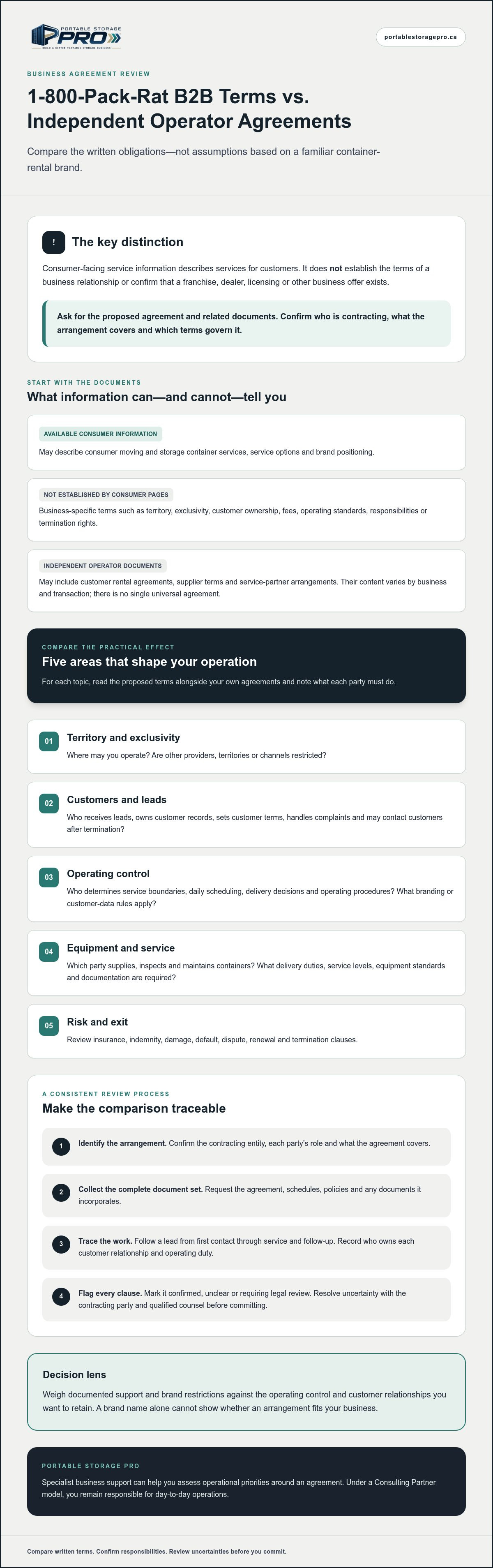
Use this checklist to mark each item as confirmed, unclear or requiring review:
- Territory and exclusivity: Where may you operate? Are other providers or channels restricted?
- Customers and leads: Who owns customer records and incoming leads? Who sets customer terms, controls pricing processes, handles complaints and may contact customers after termination?
- Operating control: Who sets service boundaries, daily scheduling, delivery decisions and operating procedures? Are branding or customer-data rules attached?
- Equipment and service: Which party supplies, inspects and maintains containers? What delivery responsibilities, service levels, equipment standards and documentation requirements apply?
- Risk and exit: What do the insurance, indemnity, damage, default, dispute, renewal and termination clauses require?
Who controls the customer relationship and operating decisions?
Trace a lead from first contact through completed service and follow-up. For example, if a customer submits an enquiry through a branded channel, confirm who receives the information, who quotes the work and who may communicate with that customer later. Then check whether the agreement sets boundaries for customer data, branding, service areas or post-termination contact.
Be precise about operational authority. A document may assign delivery to one party while reserving scheduling or complaint handling to another. Record who makes each decision instead of assuming responsibility follows the work.
How do obligations and risk allocation compare?
Map each duty to the responsible party: equipment condition, maintenance, dispatch, delivery, damage reporting and customer updates. Check whether a clause refers to a separate policy or standard that can change outside the main agreement. If it does, request that document and clarify how updates are handled.
Insurance, indemnity, default, dispute and termination provisions can have legal and operational consequences. Ask qualified counsel to review how they apply to your business and jurisdiction. The U.S. Federal Trade Commission’s A Consumer's Guide to Buying a Franchise offers a resource for assessing franchise information. It does not confirm the terms of a particular offer.
Separate signed obligations from sales presentations, verbal explanations and assumptions. If operational questions remain after you map the clauses, portable storage business improvement support can help you assess how your operating priorities fit the documented arrangement. This is not legal advice or contract drafting.
How should independent operators compare a branded arrangement with independence?
Compare the written commitments with the business you want to run, not with assumed benefits of a familiar brand or assumed freedom of independence. For 1-800-Pack-Rat B2B contract terms vs independent operator agreements, mark unknown terms as unknown until the proposed documents confirm them. The table is a review framework, not a statement about any specific offer.
| Decision area | Branded arrangement: verify | Independent operation: assess |
|---|---|---|
| Control | Which decisions, if any, are subject to approval or prescribed processes? | Which decisions do your current agreements and operating procedures leave to you? |
| Customer ownership | Who receives leads, controls customer records and manages follow-up? | How do your customer agreements and lead management system assign those responsibilities? |
| Operating duties | Who handles equipment, dispatch, delivery, service issues and reporting? | Can your staff, fleet and service model meet the duties you undertake? |
| Brand rules | Are there documented requirements for branding, training, systems or service standards? | Which standards and processes have you established for your own operation? |
| Exit terms | What do renewal, notice, termination and post-termination clauses require? | What do your customer, supplier and service-partner agreements require when a relationship ends? |
For each row, record the clause, the document it appears in and its status: confirmed, unclear or not established. Don’t fill gaps with a sales presentation or verbal explanation. If an arrangement is presented as a franchise, review the actual documents and seek qualified legal advice. Cornell’s Legal Information Institute offers a general legal definition of a franchise agreement, not an interpretation of a specific offer.
Test the terms against daily operations
Map the obligations onto your actual workflow. Who responds to a quote request, and how quickly can your team follow up? Does a defined service boundary fit your delivery radius? If a container must be repositioned empty, who plans that move? Could reporting or equipment requirements affect fleet utilization, staffing or customer retention? Model these operational questions using your own records rather than assuming an outcome.
Also check whether required systems, training and documentation are specified clearly enough to implement. Compare those duties with your current capabilities and growth goals. For broader performance context, use relevant operating measures to frame questions about revenue per unit, quote conversion and fleet utilization. Those measures do not interpret contract terms. To discuss how agreement commitments intersect with your operating priorities, contact Portable Storage Pro about operator business decisions.
What steps make a B2B agreement review more reliable?
A reliable review starts with the full set of proposed documents, not a summary of the offer. For 1-800-Pack-Rat B2B contract terms vs independent operator agreements, use the same process for each arrangement: gather the paperwork, map the duties, test operational fit and resolve open questions before you commit.
Build a document and question checklist
Request the complete agreement, schedules, policies and any documents it incorporates. Confirm the contracting parties and check how the documents relate to one another. If a policy conflicts with the main agreement, ask which document governs. Find out whether policies can change, how updates are communicated and whether you must accept them.
Check that the documents define the agreement term and renewal process. Ask for clear written definitions of territory, customer ownership, performance standards and exit rights. Keep a question log so each answer can be matched to a clause or an updated document.
- Confirmed: The written clause clearly states the obligation and responsible party.
- Unclear: Wording, definitions or incorporated policies leave room for different interpretations.
- Requires legal review: The provision raises questions about rights, liability, enforceability or your jurisdiction.
Use a responsibility matrix to record the clause, the relevant document, the party responsible, operational impact and review status. Have qualified counsel assess legal questions. Keep written clarifications with the agreement record, and don’t treat verbal explanations as amendments.
Test operational fit before deciding
Map each obligation to the people and processes that would carry it out. Check whether current staff can manage lead follow-up and reporting, whether your systems can capture required records, and whether your fleet and dispatch processes can meet stated delivery duties. Use your own records to assess fleet utilization, quote conversion and delivery patterns. State assumptions plainly. Don’t present a hypothetical model as a promised result.
Also consider supply continuity. Compare any sourcing or delivery obligations with your current supplier process and contingency plans. Review the practical effects of supplier requirements, including whether the agreement specifies a particular process or leaves important responsibilities undefined. This assessment doesn’t replace the proposed agreement or legal advice.
For help assessing how documented obligations fit your operating priorities, discuss your business review with Portable Storage Pro. Its consulting support helps operators assess business and operational priorities. You retain day-to-day management, and the service is not contract drafting or legal advice.
Where can Portable Storage Pro support an independent operator’s decision?
Portable Storage Pro can help you assess how documented business commitments connect to the way your portable storage operation runs. That support is operational, not legal. It doesn’t establish what a 1-800-Pack-Rat offer contains, provide access to its agreement documents or interpret contract clauses. For legal meaning, enforceability and jurisdiction-specific questions, consult qualified counsel.
Use business-improvement support without confusing it with legal advice
A Consulting Partner relationship provides expertise and support while you remain responsible for day-to-day operations. It is distinct from an Operating Partner relationship and doesn’t mean that Portable Storage Pro takes over management. The focus is business improvement: considering how procurement, operations, training, sales, marketing and technology priorities fit your plans and resources.
That distinction can be useful when reviewing 1-800-Pack-Rat B2B contract terms vs independent operator agreements. Counsel can advise on what a clause means legally. A specialist business resource can help you identify operational questions to discuss, such as whether delivery responsibilities fit your dispatch process or whether lead-handling requirements align with your sales workflow. Keep those roles separate so operational planning isn’t mistaken for contract interpretation.
Prepare for a focused conversation about operating fit
Before discussing the decision, organize the material you can verify. A short working brief helps keep the conversation specific:
- Your decision: State what arrangement you’re assessing and what business outcome you want to support.
- Your documents: List the agreement and related schedules, policies or written clarifications you have received. Don’t assume another party has reviewed them.
- Open questions: Note unresolved operational matters separately from legal questions for counsel.
- Business effects: Identify possible implications for fleet use, delivery processes, quote follow-up, customer records and customer experience.
Bring relevant operating information, such as how containers are assigned and dispatched, how leads are followed up, and where your current process has capacity limits. This gives you a practical basis to test whether stated responsibilities fit your operation. It won’t predict a guaranteed outcome, but it can help you ask clearer questions and identify what needs further verification.
If you’re weighing an agreement against your operating priorities, discuss your portable storage business with Portable Storage Pro.
Make the decision with documented terms and operating fit
The key distinction in 1-800-Pack-Rat B2B contract terms vs independent operator agreements is what the written documents actually assign: control, customer relationships, operating duties and exit provisions. Consumer-facing information can’t confirm those terms. Request the full agreement and related documents, mark unclear clauses, and assess their practical effect using your own fleet, lead-handling and delivery processes. Refer legal interpretation to qualified counsel.
Portable Storage Pro provides specialist consulting for independent portable storage and container rental operators. Its support can help you connect procurement, operations, sales, training and technology priorities to your business decision. Under the consulting sourcing model, supplier pricing is not marked up by Portable Storage Pro. You retain day-to-day operational responsibility.
Bring your verified documents and unresolved operating questions into the discussion. Discuss the operating questions behind your agreement with Portable Storage Pro and take the next step with a clearer view of how the arrangement fits your business.
Frequently Asked Questions
Does 1-800-Pack-Rat offer B2B contracts to independent operators?
The available search information doesn’t establish whether a business contract or operator programme is available. It describes consumer moving and storage services, which aren’t proof of a business opportunity. Ask the company directly for current business information and the complete proposed documents. Before assessing an offer, verify the contracting entity, the agreement’s scope and any related policies. Don’t infer availability or terms from consumer-facing pages.
What should an independent operator compare in a business agreement?
Compare control over customers, territory, branding, daily operations, equipment and delivery responsibilities, along with data access, insurance, renewal and termination. In the 1-800-Pack-Rat B2B contract terms vs independent operator agreements comparison, separate binding clauses from marketing statements or verbal explanations. Record unknowns rather than filling gaps with assumptions. Ask qualified counsel to explain legal obligations in the relevant jurisdiction before you sign.
Is a branded operator agreement the same as a franchise agreement?
Not necessarily. A brand relationship, supplier arrangement, licence and franchise agreement can have different commercial and legal structures. The label alone doesn’t determine which applies. Review the agreement, related policies and named contracting parties, then ask qualified counsel to assess the arrangement under applicable law. Consumer-facing brand information can’t confirm the structure or establish the rights and obligations in a proposed business relationship.
Can I compare contract terms using a company’s public website?
Use public pages as background, not as proof of private business obligations. A website may describe consumer services or brand claims, but it doesn’t establish an operator’s rights, responsibilities or exit terms. Request the current proposed agreement, schedules and incorporated policies. Ask for written clarification where terms are unclear, and include claims about a specific business arrangement in your comparison only when reliable primary documents support them.
How do I assess customer ownership and territory rights?
Look for written definitions of territory, exclusivity, lead allocation, customer data access and restrictions that apply after termination. Check whether the terms cover every customer or only particular channels, and whether related policies can change. Record unclear wording and request written clarification. Because these provisions can affect business rights and future operations, ask qualified counsel to explain their legal effect before you agree to them.
What should happen before signing a portable storage business agreement?
Obtain the full agreement and related documents, then map each party’s responsibilities and list unresolved questions. Assess operational fit against your records and capacity, including fleet processes, delivery duties and lead handling. Confirm renewal, default, dispute and exit provisions in the documents. Don’t rely on verbal assurances for material terms. Have qualified counsel review legal obligations, then make your business decision using verified information and stated assumptions.
Can Portable Storage Pro review the legal terms of an agreement?
Portable Storage Pro provides specialist business-improvement consulting for portable storage operators, not legal advice or contract interpretation. Its support can help you assess operational priorities involving procurement, processes, training, sales, marketing or technology. You retain day-to-day management in a Consulting Partner relationship. For help discussing how an agreement’s operational requirements fit your business, contact Portable Storage Pro. Refer legal questions to qualified counsel.

Article by
Paul Taylor
Paul Taylor is the founder of Portable Storage Pro, bringing more than 35 years of experience across the container, portable storage and transportation industries. His background spans executive operations, business development, global procurement, sales, marketing and operational improvement in Canada, the UK and international markets.
Paul helps independent portable storage and container rental operators increase revenue, strengthen margins and build more efficient businesses. His work connects strategy with practical implementation, including pricing, delivery operations, supplier sourcing, staff training, technology and customer experience.
His experience includes leading multi-location storage operations and serving on the National Portable Storage Association’s board along with chairing its Canadian committee. Through Portable Storage Pro, Paul shares practical insights to help owners make informed decisions, solve operational challenges and grow profitably.
Disclaimer
Content published by Portable Storage Pro Inc. (PSP) provides general business information and industry insights. It does not replace advice tailored to your business or specialist legal, tax, engineering or other regulated advice. Reading this content or contacting PSP does not, by itself, establish a consulting engagement.
Information reflects circumstances at publication and may change. Examples and potential benefits are illustrative; results depend on individual circumstances, implementation and market conditions and are not guaranteed.
Client services are governed by the signed service agreement, agreed work plan and written amendments. Website and blog content do not amend those terms. PSP’s work is subject to applicable law and the professional commitments set out in its agreement, including the CMC-Canada Code of Professional Conduct and NPSA Code of Conduct and Ethics. Copies are available on request.
Views expressed are PSP’s own. Association membership or references do not imply association endorsement or CMC certification. Nothing in this disclaimer limits PSP’s contractual responsibilities, professional duties or rights that cannot lawfully be excluded.


