
Your NOI can change even when fleet size and rental activity appear steady. The difference may come from how you classify expenses, particularly container purchases or depreciation, delivery activity and the cost of idle units. That’s why calculating net operating income for a container rental business takes more than subtracting expenses from revenue. You need a consistent definition that fits your operation and accounting records.
If you’re unsure which costs belong in the calculation, or how NOI differs from cash flow, net income and EBITDA, start by defining what you want the measure to show. A useful NOI method separates operating performance from financing and accounting treatments, making it easier to compare periods on a consistent basis.
This guide sets out a practical NOI formula for container rental operations, the revenues and expenses to review, and ways to interpret the result. It also explains how to use NOI trends to ask better questions about fleet utilization, pricing, delivery activity and operating processes. Confirm your definition and accounting treatment with a qualified accountant, then apply them consistently.
Key Takeaways
- Choose a clear NOI formula and document which operating revenues and expenses it includes.
- When calculating net operating income for a container rental business, reconcile accounting records and operating documents before comparing results.
- Treat expense classifications as a documented working policy, and confirm uncertain treatments with a qualified accountant.
- Compare like-for-like reporting periods and review NOI alongside fleet occupancy, revenue and delivery activity.
- Turn material changes in NOI into follow-up actions with an owner, an evidence source and a review date.
What net operating income means for a container rental business
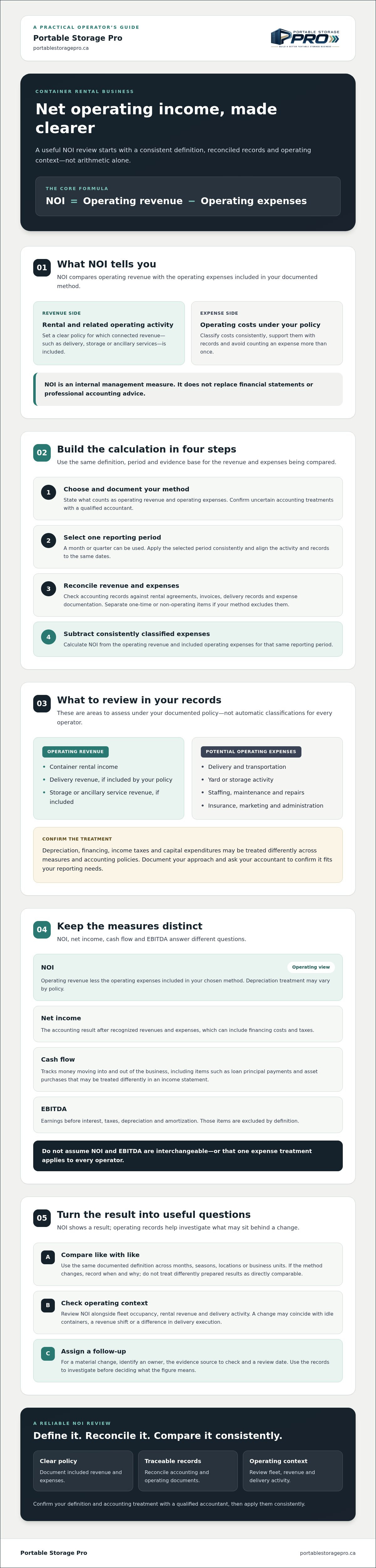
Net operating income (NOI) is operating revenue less the operating expenses included in your chosen method. Put simply, NOI has two core components: operating revenue and included operating expenses. For a container rental operation, it can help you assess rental and related activity against the expenses you classify as operating.
NOI is an internal management measure, not a replacement for financial statements or professional accounting advice. Definitions and accounting treatments can vary, so document your policy and confirm it with a qualified accountant. For a general financial overview, see What net operating income means.
Consistency is essential. If you change which expenses are included, a month-to-month comparison may show a change in method rather than a change in performance. Use the same documented definition when reviewing months, seasons, locations or business units. If you do change the method, note when and why, and avoid comparing the results as though they were prepared on the same basis.
How NOI differs from net income, cash flow and EBITDA
These measures answer different questions. Net income is the accounting result after recognized revenues and expenses, which can include financing costs and taxes. Cash flow tracks money moving into and out of the business, including items such as loan principal payments and asset purchases that may be treated differently in an income statement. EBITDA means earnings before interest, taxes, depreciation and amortization. It excludes those items by definition, while an NOI method may handle depreciation differently depending on the operator’s policy.
Interest, taxes and non-cash entries can therefore affect each measure differently. Don’t assume NOI and EBITDA are interchangeable or that one expense treatment applies to every operator. Record what your NOI includes, and ask your accountant to confirm that the policy fits your reporting needs.
Why container rental operators track NOI
NOI can help you examine operating performance before financing structure and owner-specific decisions shape the final result. It provides a consistent starting point for asking whether rental revenue and operating activity are supporting the business’s operations.
For example, a change in NOI may coincide with more containers sitting idle, a shift in rental revenue or a difference in delivery execution. The figure alone won’t identify the cause. Compare it with fleet and delivery records, then investigate the underlying activity.
That context is central to calculating net operating income for a container rental business: the measure is useful when your definition stays consistent and you can trace the result back to operating records.
How to calculate container rental business NOI step by step
Use this formula, based on the accounting policy you’ve documented:
NOI = operating revenue − operating expenses
The arithmetic is straightforward; the classification needs care. Calculate NOI by subtracting consistently classified operating expenses from operating revenue for the same reporting period. Choose a period, such as a month or quarter, and use it consistently. Reconcile the relevant accounting records with rental agreements, invoices, delivery records and expense documentation so the figures cover the same dates and activity.
Step one: define the revenue included
Start with container rental income recorded for the selected period. Then set a consistent policy for other revenue connected with the rental operation, such as delivery, storage or ancillary services. State which revenue counts as operating revenue and where it appears in your records.
Check that invoices and completed jobs are recorded in the period assigned by your accounting method. Identify one-time or non-operating items separately if your chosen NOI method excludes them. Don’t change the treatment from one period to the next without documenting it, or comparisons may become misleading.
Step two: identify and total operating expenses
Review expense records for costs associated with operating the rental business. Depending on your operation and documented policy, relevant categories may include delivery and transportation, yard or storage activity, staffing, maintenance and repairs, insurance, marketing and administration. Match entries to supporting records and check that each expense appears only once, even if it could fit more than one category.
Depreciation, financing, income taxes and capital expenditures need particular care. They may be recorded or treated differently across financial measures and accounting policies. Don’t assume there is one universal NOI treatment. Have your accountant review how these items should be handled for your business and reporting purpose.
Once revenue and expenses are classified, total each group and apply the formula. Keep the policy with the calculation, including the period covered, included accounts and any adjustments. That record makes it easier for another manager or your accountant to reproduce the result. Before finalizing, check that the revenue and expense totals tie back to the relevant accounts and supporting documents.
A consistent process is the foundation of calculating net operating income for a container rental business. If you want support connecting a financial review with operating priorities, Portable Storage Pro’s portable storage business advisory offers advisory expertise for operators.
Which container rental revenues and expenses belong in the calculation?
There isn’t one classification that fits every operation or accounting policy. Use the categories below as a working framework, then confirm uncertain treatments with your accountant. Keep rental, delivery and storage activity identifiable in your records. If they are combined, a change in total revenue or expenses may be difficult to trace to its source.
Revenue categories to review in a container rental operation
Review container rental income separately from related delivery, storage and ancillary service revenue. Reconcile each category to invoices and the accounting system for the same reporting period. Decide whether each related service belongs in operating revenue under your documented method, and apply that decision consistently. If invoices group multiple charges together, check whether job records or other source documents can support the breakdown.
Operating expense categories and items needing review
Where your records allow, match expenses to the activity they support. Review delivery and transportation, yard operations, staffing, maintenance, insurance and administration. Fleet purchases, financing, taxes and depreciation need particular attention; ask your accountant how to treat them under your selected policy. Compare empty repositioning, idle-container and damage records with the financial results, but don’t assume those records determine accounting classification on their own.
| Item | Likely classification | Policy question to confirm |
|---|---|---|
| Container rental income | Operating revenue | Does the period match the rental activity and accounting records? |
| Delivery or transportation revenue | Related operating revenue, if included by policy | Is it recorded separately from rental income and consistently included? |
| Storage or ancillary service revenue | Potential operating revenue | Which services count, and how are one-time items handled? |
| Delivery, yard and staffing expenses | Potential operating expenses | Are costs assigned consistently, without duplication? |
| Maintenance, insurance and administration | Potential operating expenses | Which accounts belong in the chosen NOI method? |
| Fleet purchases, financing, taxes and depreciation | Requires accountant-reviewed treatment | How does the selected policy distinguish operating expenses from other items? |
This framework makes calculating net operating income for a container rental business more traceable, but it doesn’t replace accounting advice. Keep the classification policy with your calculation so anyone reviewing the figure can see how revenue and expenses were treated.
How to interpret NOI and compare operating performance responsibly
A change in NOI is a signal to investigate, not a complete explanation. Compare like-for-like periods using the same documented accounting policy, and label each period clearly. A monthly result compared with a seasonal peak, for example, may reflect normal demand patterns rather than a lasting change in operating performance.
NOI shows a result, while operating records help explain it. Review the measure alongside operating revenue, fleet occupancy, delivery activity and records that show what changed. This gives you a grounded basis for deciding whether a shift relates to rental activity, fleet capacity, delivery execution or transaction classification.
Use trends and supporting measures, not a single result
Track NOI over comparable periods and pair it with measures your records support, such as revenue per container, fleet utilization and quote conversion. A fleet expansion, a change in available containers or a classification update can affect comparisons. Separate changes in activity from changes in accounting treatment before drawing a conclusion.
For broader metric context, read the container rental profitability guide alongside your NOI review. It can help frame related measures, but it shouldn’t replace your documented definition or the source records behind your calculation.
Recognize what NOI cannot tell you
NOI alone doesn’t show how much cash remains after financing, taxes or fleet investment. A higher result also doesn’t prove that service improved, containers are in better condition or performance will continue. Check maintenance and damage records, delivery activity and fleet status before treating a stronger figure as evidence of operating improvement.
If you’re preparing information for tax, financing or formal reporting decisions, ask a qualified accountant to review the calculation and its accounting treatment. In calculating net operating income for a container rental business, a consistent method supports comparison, while professional review helps ensure the measure is suitable for its intended use.
For context on connecting NOI trends with fleet and operating priorities, discuss your container rental business with Portable Storage Pro.
Turn your container rental NOI review into an operating plan
A variance becomes useful when it leads to a question you can investigate. If NOI changes, check whether rental revenue was captured consistently, containers were ready to rent, delivery activity shifted or an expense was classified differently. Then assign a follow-up action instead of treating the figure as an answer on its own.
Build a repeatable monthly NOI review
Use the same reporting period, revenue definitions and expense categories each month. Reconcile the calculation to accounting records and operating documents, then note changes in fleet size, service mix or classification that could affect comparisons. A connected data system can help you trace revenue and expenses to operating activity. The right setup depends on the records your team maintains and how your tools exchange information.
Keep the review practical. For each material variance, record:
- Question: Is the change related to revenue capture, fleet readiness, delivery activity or expense treatment?
- Owner: Who will investigate and report back?
- Evidence: Which invoice, fleet record, delivery log or expense account will support the review?
- Review date: When will you check the finding and decide what to do next?
Prioritize actions to fit your team, fleet and available records. A smaller operator may start by checking a few key source documents; a business with separate locations or operating units may need owners assigned by function or site. The aim is a clear next step, not a larger reporting process than your team can maintain.
Connect financial findings to practical support
Once you have a variance and supporting evidence, examine the operating process behind it. Delivery records may prompt a review of routing or empty repositioning. Fleet information may raise questions about readiness or idle containers. Expense and procurement records may help you assess how purchasing decisions fit operating needs. Keep the review tied to evidence rather than assuming one cause from the NOI result.
Calculating net operating income for a container rental business is most useful when it informs these follow-up questions. Portable Storage Pro advises portable storage and container rental operators on business improvement, including operations, procurement, technology and growth strategy. Its advisory support provides expertise without automatically taking over day-to-day operational management.
For a conversation about how NOI findings connect to fleet, delivery or operating priorities, contact Portable Storage Pro to discuss your business.
Use a consistent NOI review to guide your next decisions
Calculating net operating income for a container rental business is most useful when you apply the same documented method each reporting period. Reconcile revenue and expenses to your records, then compare like-for-like periods. Treat changes in NOI as a prompt to investigate, not as an explanation on their own.
Review the result alongside fleet activity, delivery records and revenue measures. Turn material variances into specific questions about revenue capture, fleet readiness, delivery execution or expense classification. Assign someone to follow up, identify the records they’ll check and set a review date.
Portable Storage Pro provides advisory support for portable storage and container rental operators, with expertise across operations, procurement, sales, marketing, technology and training. To discuss the operating questions behind your NOI, let’s talk about your container rental business.
A clear, consistent review can help you decide what to investigate next and keep operating decisions grounded in evidence.
Frequently Asked Questions
What is the formula for net operating income in a container rental business?
The formula is NOI = operating revenue − operating expenses, based on the definitions your business documents. Start with revenue recorded for the selected reporting period, then subtract the operating expenses included under your chosen method. Keep the period and classifications consistent so you can compare results meaningfully. When calculating net operating income for a container rental business, confirm uncertain accounting treatments with a qualified accountant.
Which expenses should be included when calculating container rental NOI?
Review expenses related to operating your rental activity, such as delivery and transportation, yard operations, staffing, maintenance, insurance and administration, where relevant. Whether each item belongs in NOI depends on your documented method and accounting treatment. Avoid counting an expense twice under different categories. Keep fleet purchases, financing, taxes and depreciation separate for review, and ask your accountant how to classify them for your reporting purpose.
Is NOI the same as net income or cash flow?
No. NOI measures operating revenue less the operating expenses included in your chosen method. Net income is an accounting result that can reflect additional items, including financing costs and taxes. Cash flow tracks money moving into and out of the business, including transactions that may not appear the same way in an income calculation. Use each measure to answer a different question, and don’t treat them as interchangeable.
Should container purchases and loan payments be included in NOI?
Don’t automatically include the full purchase of a container or loan payments as NOI expenses. Fleet purchases, depreciation, loan principal and interest may be treated differently in operating measures and financial statements. Record them clearly, document your chosen NOI policy, and ask a qualified accountant to review the treatment. This helps distinguish operating performance from fleet investment and financing without assuming one classification applies to every business.
How often should a container rental business calculate NOI?
A monthly review can give you a regular view of operating performance, provided your source records are ready and you apply the same method each period. You may also compare seasons or other reporting periods, but label them clearly and account for changes in fleet size or service mix. Choose a cadence your team can maintain, then use it consistently. Confirm any formal reporting schedule with your accountant.
Can NOI show whether a container rental fleet is performing well?
NOI can contribute to your assessment, but it can’t show fleet performance on its own. Review it alongside fleet utilization or occupancy, revenue per container, delivery activity, maintenance records and container readiness. A change in NOI may prompt questions about idle units or delivery execution, but the figure doesn’t identify the cause. Trace material changes to operating records before deciding whether fleet performance has improved or weakened.
What should I do if my accounting records combine rentals and delivery revenue?
Start by checking whether invoice details, job records or other source documents let you distinguish rental revenue from delivery revenue for the same reporting period. If the records support separation, use consistent categories in future reporting and document the method. Don’t estimate a historical split without evidence. If the underlying records aren’t clear, ask your accountant how to report the combined revenue consistently and whether the current system needs a classification change.

Article by
Paul Taylor
Paul Taylor is the founder of Portable Storage Pro, bringing more than 35 years of experience across the container, portable storage and transportation industries. His background spans executive operations, business development, global procurement, sales, marketing and operational improvement in Canada, the UK and international markets.
Paul helps independent portable storage and container rental operators increase revenue, strengthen margins and build more efficient businesses. His work connects strategy with practical implementation, including pricing, delivery operations, supplier sourcing, staff training, technology and customer experience.
His experience includes leading multi-location storage operations and serving on the National Portable Storage Association’s board along with chairing its Canadian committee. Through Portable Storage Pro, Paul shares practical insights to help owners make informed decisions, solve operational challenges and grow profitably.
Disclaimer
Content published by Portable Storage Pro Inc. (PSP) provides general business information and industry insights. It does not replace advice tailored to your business or specialist legal, tax, engineering or other regulated advice. Reading this content or contacting PSP does not, by itself, establish a consulting engagement.
Information reflects circumstances at publication and may change. Examples and potential benefits are illustrative; results depend on individual circumstances, implementation and market conditions and are not guaranteed.
Client services are governed by the signed service agreement, agreed work plan and written amendments. Website and blog content do not amend those terms. PSP’s work is subject to applicable law and the professional commitments set out in its agreement, including the CMC-Canada Code of Professional Conduct and NPSA Code of Conduct and Ethics. Copies are available on request.
Views expressed are PSP’s own. Association membership or references do not imply association endorsement or CMC certification. Nothing in this disclaimer limits PSP’s contractual responsibilities, professional duties or rights that cannot lawfully be excluded.


