

The most useful comparison starts by correcting the premise: Big Yellow doesn’t deliver mobile storage containers to customers. The search phrase “Big Yellow mobile storage operations vs North American delivery models” points to different service mechanics: Big Yellow’s UK facility-based self-storage, where customers bring goods to a storage site, and portable-storage operations that deliver a container to the customer’s location.
That distinction changes who arranges transport, where storage takes place and when the customer hands over responsibility. North American delivery models also vary. Residential moving providers and independent operators serving commercial or construction customers may have different equipment, delivery workflows and service requirements.
This article separates confirmed facts about Big Yellow from assumptions, then sets out what operators can compare reliably: asset ownership, delivery responsibility, customer handoffs and the work required between bookings. It also examines how roll-off and level-lift systems affect delivery operations, and which measures, such as fleet utilization, empty mileage and on-time delivery, can help you assess your own model. The aim is a like-for-like comparison that informs operational decisions, not a brand-to-brand verdict.
Key Takeaways
- Clarify which Big Yellow service is being compared before drawing conclusions about its operating model.
- Use the phrase Big Yellow mobile storage operations vs North American delivery models as a starting point, then compare specific responsibilities, workflows and customer handoffs.
- Map each delivery stage from inquiry through collection to identify who owns the task, what information is needed and where communication can fail.
- Review your own operation using consistent measures, including planned versus completed routes, empty mileage, missed handoffs and repeat service issues.
- Use comparison findings to pinpoint whether operations, procurement, technology or staff training needs closer attention.
What does the Big Yellow mobile storage comparison actually cover?
The phrase “Big Yellow mobile storage operations vs North American delivery models” combines two different questions: what storage service a company offers, and how containers or goods move through a delivery operation. The comparison premise used here is that Big Yellow provides facility-based self-storage in the UK rather than delivering storage containers to customers. Treat that Big Yellow-specific description as pending verification against current official customer-facing materials before publication. Until verified, don’t present it as a confirmed company fact.
This distinction matters to operators. A storage service describes where goods are kept and what the customer rents. A delivery model describes how assets move, who handles each handoff, and how the fleet is coordinated. For background on storage formats and terminology, see the self-storage industry. A general overview can explain the terminology, but it can’t verify Big Yellow’s specific services.
How to define the model without assuming unverified details
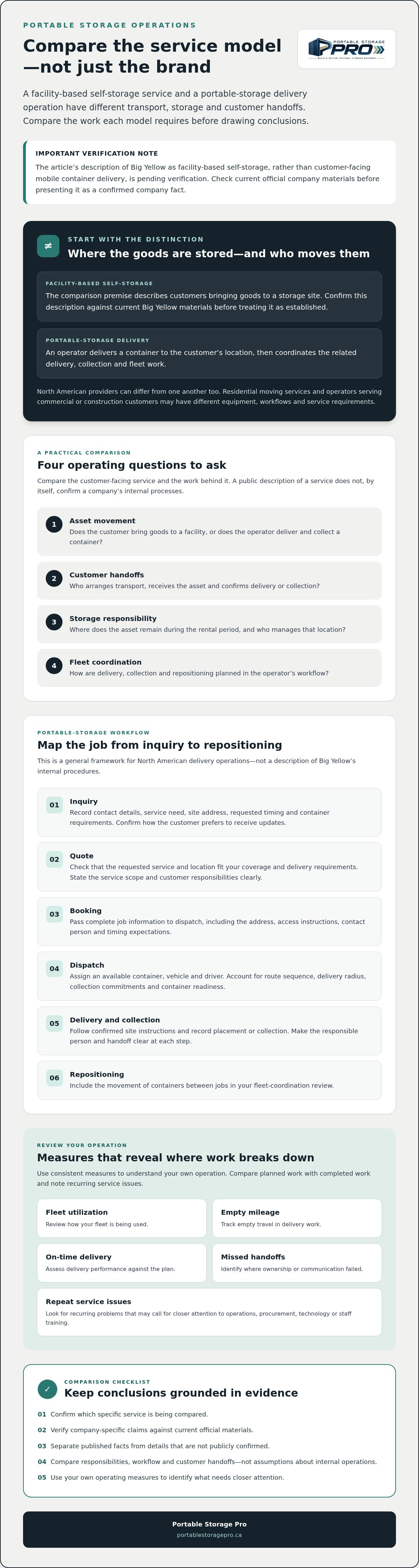
A brand name alone doesn’t tell you how a delivery workflow runs. Define the comparison by naming the service, the customer, and the stages being assessed. For this article, examine a facility-based storage service alongside portable-storage operations, focusing on:
- Asset movement: whether the customer brings goods to a facility or an operator delivers and collects a container.
- Customer handoffs: who arranges transport, receives the asset, and confirms delivery or collection.
- Storage responsibility: where the asset remains during the rental period and who manages that location.
- Fleet coordination: how delivery, collection and repositioning are planned in the operator’s own workflow.
This scope keeps the comparison practical without implying that a public service description reveals a company’s internal procedures.
Which facts need confirmation before comparing
For every Big Yellow-specific statement, check current official company materials and record what they actually confirm. Verify service scope, equipment descriptions and customer responsibilities. A published description may establish what customers can book or are expected to do; it doesn’t, by itself, establish the company’s internal dispatch process, fleet ownership, scheduling tools or operating results.
Keep a simple evidence distinction: published for claims supported by current company information, and not publicly confirmed for details the sources don’t establish. If you can’t verify a detail, leave it out or identify it as unknown. This gives you a sound basis for comparing services and workflows without turning assumptions about Big Yellow into operating facts.
How mobile storage delivery models work from booking to collection
A portable-storage job depends on clear handoffs across sales, dispatch, drivers and yard staff. The sequence below is a general framework for North American delivery operations, not a description of Big Yellow’s internal procedures. For company-specific information, consult current official materials, including Big Yellow's operational strategy, and treat details not confirmed there as unknown.
Map the work from inquiry to repositioning
- Inquiry: Sales records the customer’s contact details, service need, site address, requested timing and container requirements. Confirm the preferred method for customer updates.
- Quote: Sales checks whether the requested service and location fit the operator’s coverage and delivery requirements. Make the service scope and customer responsibilities clear.
- Booking: The booking team confirms the order and passes complete job information to dispatch, including the address, access instructions, contact person and timing expectations.
- Dispatch: Dispatch assigns an available container, vehicle and driver. The plan should account for route sequence, delivery radius, collection commitments and container readiness.
- Delivery: The driver follows the confirmed site instructions and records placement or any exception. The customer needs a clear update on the outcome.
- Use: The service team keeps the container’s status and location current, and handles schedule changes through a defined communication channel.
- Collection: Dispatch confirms access and schedules the return movement. The team records the container’s condition and where it is being returned.
- Repositioning: Dispatch or the yard team updates the asset’s status and determines its next location based on upcoming bookings and fleet needs.
Where operator handoffs create delays or unclear ownership
Job details can be lost as information moves from sales to dispatch, then to the driver and back to the yard. An incomplete address, missing access details or unclear timing expectations can disrupt the route and leave the customer unsure who will resolve the issue.
Assign an owner to each handoff. Document required job information and customer updates in your SOPs. Review recurring exceptions, such as access problems or schedule changes, to identify where responsibilities or steps need clarification.
How delivery and return movements affect fleet use
Empty repositioning is vehicle movement without a revenue-producing container delivery. A collection may return a container to the yard while the next booking is in another direction. Plan deliveries and collections with container availability, yard flow and likely next placements in view, rather than treating each job as isolated.
Track fleet utilization and empty mileage using consistent definitions and the same review period. Compare planned routes with completed movements, then check whether readiness, sequencing or incomplete job information contributed to exceptions. If you’re reviewing these processes, discuss your portable storage delivery operation with Portable Storage Pro.
Big Yellow vs. North American delivery models: compare like with like
A company-level comparison isn’t automatically a model-to-model comparison. Big Yellow’s public service description concerns facility-based self-storage, while a portable-storage operator’s delivery model concerns moving containers to and from customer sites. That distinction can guide your questions, but it doesn’t establish how Big Yellow manages its internal operations or represent every North American provider.
For the phrase “Big Yellow mobile storage operations vs North American delivery models,” keep three evidence categories separate: what current company materials state, what remains unknown, and what you need to measure in your own operation.
| Criterion | Publicly described or confirmed | Unknown or not established | Implication for your operation |
|---|---|---|---|
| Service scope | Big Yellow’s described service is facility-based self-storage. Source: current Big Yellow customer-facing service information; confirm the relevant page before publication. | This service description doesn’t establish internal workflows or cover every service the company may offer. | Compare the specific service you provide, not just the company name. |
| Delivery responsibility | In a portable-storage delivery job, the operator’s workflow includes delivering a container to a customer site. Source: the operator’s booking and dispatch records. | Don’t infer Big Yellow pickup, delivery or fleet arrangements from its storage description. Source: no internal process evidence supplied. | Clarify who arranges transport and owns each customer handoff. |
| Storage arrangement | The Big Yellow service description identifies storage at a facility. Source: current Big Yellow customer-facing service information; verify wording and scope. | It doesn’t establish how a North American operator manages each customer’s container during a rental. | Compare where assets sit, who tracks their status and how availability is updated. |
| Asset movement and fleet coordination | Your delivery, collection and repositioning activity can be assessed using your own job and fleet records. | Big Yellow’s internal fleet, dispatch system, utilization and results aren’t confirmed by a public service description. | Review delivery radius, empty mileage, idle containers and fleet utilization against your own operating goals. |
Which comparison criteria matter to independent operators
For your operation, pair each measure with a business outcome. Delivery radius and empty mileage help show how much movement sits outside a container delivery. Idle time and utilization inform fleet planning and potential revenue per unit. Quote follow-up affects conversion; delivery scheduling and collection coordination affect workload and customer handoffs. Consistent damage documentation helps you identify recurring issues and clarify responsibility.
How to show evidence and uncertainty clearly
Attach a source note to each company-specific claim. Use “published” for information supported by current company materials, “unknown” when public evidence doesn’t confirm a detail, and “operator measure” for findings from your own records. Don’t turn one company’s practices into a claim about the whole North American market. Choose the model that fits your customers, delivery capability and fleet, then assess it using consistent measures.
A practical checklist for evaluating your own delivery operation
Before changing equipment or expanding your delivery area, establish a baseline from your own records. Choose a review period that reflects your normal operating cycle, then use the same dates and definitions across dispatch, sales and yard reports. For example, define a completed delivery as a job recorded as placed at the customer’s site, and define an idle container as one available for booking but not assigned. Clear definitions make the results useful for decisions.
What to measure before changing the delivery model
Compare planned work with what happened. Use a short scorecard that your team can update consistently:
- Delivery and collection: Record completed jobs against the schedule, timing changes and missed handoffs. Note the reason for each exception.
- Empty repositioning: Track distance or trips when a vehicle moves without making a revenue-producing container delivery. Use one definition for every route.
- Container readiness: Record whether each assigned unit was available and ready when dispatch needed it. Note delays caused by yard location, condition or incomplete status records.
- Sales follow-through: Review lead response time and quote conversion for the same reporting period. Keep the lead stages and conversion calculation consistent.
- Customer communication: Log schedule updates, access issues and repeat service concerns alongside the related job.
For a related view of operating performance, consult Maximizing Portable Storage Profits: 2026 Canadian Guide. Use it alongside your own results, not as a substitute for checking how your fleet and customer mix perform.
How to turn findings into operating changes
Look for recurring bottlenecks, not isolated disruptions. If containers are repeatedly unavailable after collection, review yard status updates and the handoff between drivers and yard staff. If scheduled deliveries are often delayed by site access information, check whether sales captures and dispatch confirms those details before assigning the route.
Choose a small number of changes. Assign an owner to each one, document the revised responsibilities and steps in your standard operating procedures, and set a date to review the same measures again. This makes it easier to see whether the process changed, even if demand or route conditions also shifted.
Match technology to a defined gap. A dispatch tool may help if job details are being passed inconsistently; GPS data may help compare planned routes with completed movements. First confirm what decision the tool should support, who will maintain the information and how the team will use it.
If your review identifies recurring delivery or fleet coordination gaps, discuss your portable storage operation with Portable Storage Pro.
When specialist support can help improve a portable storage delivery model
The comparison is useful when it helps you identify a decision, not simply label one company’s approach as better. Ask: Do you know who owns each customer handoff? Can dispatch see container readiness before assigning a job? Are collections planned alongside new deliveries? Do your records show where empty movements and repeat service issues occur? Are quote follow-ups consistent?
These questions turn “Big Yellow mobile storage operations vs North American delivery models” into a review of your own workflows. If the answers expose a process gap, specialist support may help you examine operations, procurement, technology, staff training or delivery procedures. The right focus depends on the evidence. For example, unclear handoffs may call for revised SOPs and training, while disconnected job records may point to a technology or process issue.
Choose support that fits the operating responsibility
Decide first who will retain day-to-day decision-making. Under the Consulting Partner model, the owner remains responsible for daily operations while receiving expertise, resources and support from Portable Storage Pro. This is distinct from an Operating Partner relationship, where areas of operational responsibility are defined separately. Confirm the scope and responsibilities of any engagement before proceeding. Neither advisory support nor an operating relationship should be treated as a guarantee of financial or operational results.
Prepare evidence before drawing conclusions
Bring together current process maps, delivery and collection records, customer handoff steps, fleet measures and examples of recurring exceptions. Mark which statements about Big Yellow are supported by current company sources and which remain unverified. That separation keeps a comparison useful without presenting assumptions about one company as facts about another.
If quote follow-up is part of the review, Portable Storage Lead Generation: The 2026 Canadian Operator’s Guide is a related resource. Check the article’s follow-up recommendations against your own lead records and booking process before changing procedures.
With the evidence assembled, select the next operating question to resolve. You might review who confirms access information, how dispatch receives booking changes or when the yard updates container status. Assign responsibility for the next step and decide how you’ll assess whether the process is clearer.
If you’re assessing delivery priorities or handoffs in your portable storage business, discuss your delivery operation with Portable Storage Pro.
Turn your comparison into a practical next step
The phrase “Big Yellow mobile storage operations vs North American delivery models” doesn’t, by itself, identify two equivalent delivery systems. Start by confirming the service being compared, then separate published facts from unknown internal procedures. For your own operation, focus on the evidence you can act on: customer handoffs, route plans, collections, container readiness and fleet measures.
Use that review to choose a manageable improvement, assign responsibility and decide how you’ll assess the change. Portable Storage Pro provides portable-storage-specific expertise across operations, delivery systems, procurement, training, sales, marketing and technology. Under its consulting sourcing model, supplier pricing isn’t marked up by Portable Storage Pro. Recommendations should fit your business and be assessed against your own operating evidence, not treated as a promise of financial or operational results.
If you’re ready to review delivery priorities or clarify where a process gap sits, Let’s talk about improving your delivery operations. A clear comparison can help you take the next step with greater confidence.
Frequently Asked Questions
What is the difference between a mobile storage service and a delivery model?
A mobile storage service describes what the customer receives, including whether a container is delivered to a site for storage. A delivery model describes how the operator handles the work: booking, dispatch, asset movement, customer handoffs, collection and fleet coordination. Keep those terms separate. A company may offer storage without delivering containers, and its public service description won’t necessarily explain its internal delivery procedures.
Does Big Yellow offer mobile storage delivery?
No. Big Yellow’s publicly described UK service is facility-based self-storage, where customers bring their goods to a storage facility rather than having a container delivered to their site. Big Yellow does not pick up items for storage, though its facilities may accept customer deliveries and offer parcel services through courier partners. Check Big Yellow’s current official service information before relying on these details; they don’t establish its internal fleet or dispatch procedures.
How should North American operators compare delivery models?
Compare specific services and workflows, not company names alone. For “Big Yellow mobile storage operations vs North American delivery models,” distinguish confirmed service details from unknown internal practices, then assess your own model using consistent criteria. Review who handles delivery and collection, where assets are stored, what customer handoffs occur, and how dispatch coordinates fleet availability. North American providers serve different customer segments, so don’t treat one operator as representative of the whole market.
Can a storage company’s model be copied by an independent operator?
Use another company’s approach as a source of questions, not a template to copy. First check whether its service, customer requirements, delivery area, equipment and operating capacity match yours. A process designed for facility-based storage may not fit container delivery, and a large provider’s workflow may not suit a smaller fleet. Test a relevant process change against your own baseline, then review customer handoffs and fleet measures before adopting it more widely.
What delivery metrics should a portable storage operator track?
Track completed deliveries, collection timing, empty mileage, container readiness, fleet utilization and idle time. Add missed handoffs, repeat service issues and damage documentation to identify process problems. Review lead response and quote conversion alongside delivery performance, using consistent definitions and the same reporting period. These measures help connect sales follow-up, dispatch and yard activity. Select metrics your team can record reliably; a measure that changes definition from one report to another won’t support sound decisions.
How can an operator reduce empty container mileage?
Start by comparing planned routes with completed movements and recording trips made without a revenue-producing container delivery. Review whether deliveries and collections can be sequenced to match geography, container availability and upcoming bookings. Check whether yard placement or late job information creates unnecessary repositioning. Use the same definition of empty mileage for each route review, then assess whether a scheduling or handoff change reduces avoidable movements without disrupting confirmed customer commitments.
When should a portable storage operator seek outside operational support?
Consider outside expertise when recurring delivery, fleet, procurement, technology or training gaps are difficult to resolve with current resources. Portable Storage Pro provides specialist support across these areas, as well as sales and marketing. Under the Consulting Partner model, you retain day-to-day management. An Operating Partner relationship is separate and covers defined areas of responsibility. Clarify the scope and decision-making roles before choosing support; neither arrangement should be treated as a guarantee of results.

Article by
Paul Taylor
Paul Taylor is the founder of Portable Storage Pro, bringing more than 35 years of experience across the container, portable storage and transportation industries. His background spans executive operations, business development, global procurement, sales, marketing and operational improvement in Canada, the UK and international markets.
Paul helps independent portable storage and container rental operators increase revenue, strengthen margins and build more efficient businesses. His work connects strategy with practical implementation, including pricing, delivery operations, supplier sourcing, staff training, technology and customer experience.
His experience includes leading multi-location storage operations and serving on the National Portable Storage Association’s board along with chairing its Canadian committee. Through Portable Storage Pro, Paul shares practical insights to help owners make informed decisions, solve operational challenges and grow profitably.
Disclaimer
Content published by Portable Storage Pro Inc. (PSP) provides general business information and industry insights. It does not replace advice tailored to your business or specialist legal, tax, engineering or other regulated advice. Reading this content or contacting PSP does not, by itself, establish a consulting engagement.
Information reflects circumstances at publication and may change. Examples and potential benefits are illustrative; results depend on individual circumstances, implementation and market conditions and are not guaranteed.
Client services are governed by the signed service agreement, agreed work plan and written amendments. Website and blog content do not amend those terms. PSP’s work is subject to applicable law and the professional commitments set out in its agreement, including the CMC-Canada Code of Professional Conduct and NPSA Code of Conduct and Ethics. Copies are available on request.
Views expressed are PSP’s own. Association membership or references do not imply association endorsement or CMC certification. Nothing in this disclaimer limits PSP’s contractual responsibilities, professional duties or rights that cannot lawfully be excluded.


