
A growth forecast isn’t a fleet plan. Container rental market research helps you connect demand and growth outlooks to practical decisions: how to set flexible rates, which container conditions to offer, and where utilization or empty repositioning may be limiting performance. The right approach depends on your customers, service area, and operating model.
Demand can vary across residential, commercial, and construction uses. A market outlook is useful only when you can translate it into decisions about fleet mix, maintenance, availability, and sales priorities.
This article compares container rental growth forecasts, new, used, and one-trip container conditions, and the needs of different customer segments. It also outlines practical ways to assess utilization, reduce avoidable operating friction, and decide which market signals merit action, so you can plan around your business’s realities rather than a forecast alone.
Key Takeaways
- Match rental, leasing and purchasing decisions to project duration, delivery requirements and the expected time a container may sit idle.
- Compare growth forecasts by their time frame and market scope before using them to guide fleet or expansion plans.
- Assess new, used and one-trip containers by condition, intended use, maintenance needs and resale potential.
- Separate residential, commercial and construction demand to identify the service requirements and fleet mix each customer segment calls for.
- Choose container types according to the job, then track availability, utilization and repositioning to keep fleet decisions tied to operating performance.
How can container rental companies address these challenges?
Compare renting, buying, and leasing by project duration, expected utilization, delivery requirements, and maintenance responsibility. Profile competitors by market role and customer segment, then use that comparison to guide your own fleet decisions.
Rent, Buy, and Lease Costs
Renting can suit short or uncertain projects; buying may fit repeated demand if you can manage maintenance and idle time. Leasing spreads payments across an agreement, so assess its term and obligations. Compare each option by total outlay, expected use, maintenance, delivery, and end-of-term flexibility.
The competitive landscape includes Triton International, Florens, Seaco, CAI International, and Touax. Profile each by the markets and container segments it serves, rather than treating these names as a ranking of local rental operators.
Rental Pricing Factors
Container size, rental duration, delivery distance, and local inventory affect rental prices. Longer terms change the rental structure, while transport requirements influence the delivered quote. Compare the same size and condition across service areas, and separate recurring rent from delivery and pickup charges when assessing your own rates.
Rental Terms, Fees, and Risks
Contract terms, fees, and cancellation policies depend on the agreement. Before accepting a booking, review rental duration, renewal, notice, damage responsibility, transport charges, and cancellation conditions. Key risks include damage, unavailable inventory, delayed pickup, and idle time between rentals. Record unit condition at dispatch and return to inform maintenance and damage decisions.
Delivery and Regional Availability
Delivery and pickup depend on route access, placement space, and clear instructions for the driver. Confirm the destination, access route, placement surface, and pickup plan before dispatch. Availability and price differences across U.S. regions and cities reflect local inventory, demand, and transport distance. Compare equivalent units within consistent service areas to assess those differences.
To compare regions, evaluate availability and quotes by service area, container size, and condition. These criteria reveal where local supply and transport requirements differ.
| Option | Term fit | Key comparison |
|---|---|---|
| Rent | Short or uncertain use | Term and transport |
| Purchase | Repeated use | Utilization and maintenance |
| Lease | Planned ongoing capacity | Payment structure and obligations |
Choose the option that fits expected use, fleet capacity, and delivery needs.
A practical comparison should test the same container against the expected holding period rather than focus only on headline payments. The cost comparison can vary with container size, location, and market pricing, so assess it against the expected holding period.
Include resale proceeds, delivery, pickup, upkeep, and idle time in the same comparison. Then assess whether the expected schedule supports owning a unit or paying for flexibility. Revisit your assumptions when local quotes or project timing change.
Container leasing and rental market growth forecasts
Forecasts point to expansion, but estimates differ by market definition and time frame. Use each projection as a planning input, then test it against your customers, fleet utilization, and regional demand.
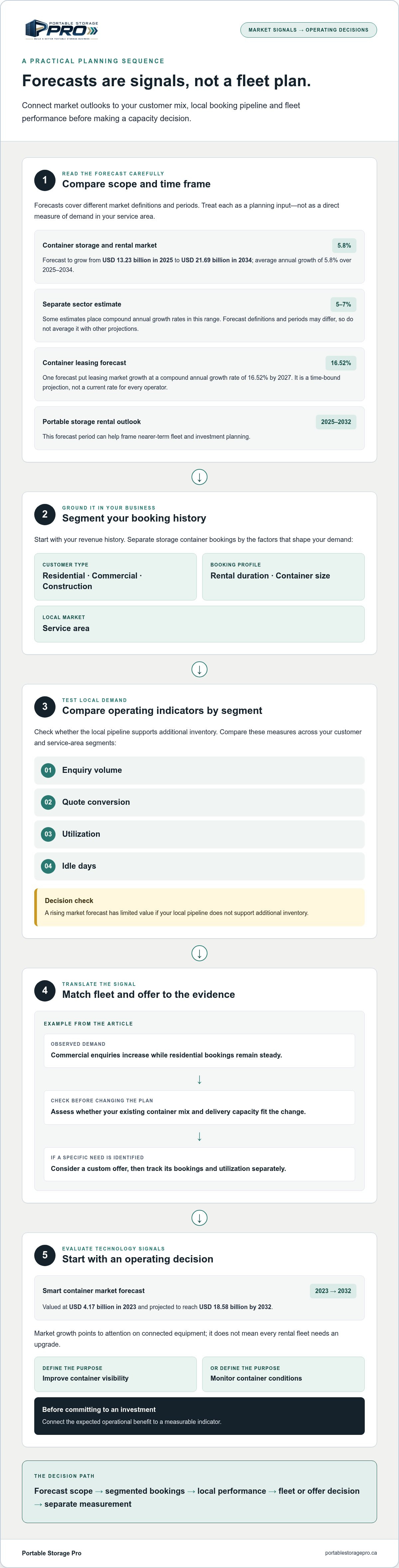
One global container storage and rental forecast estimates growth from USD 13.23 billion in 2025 to USD 21.69 billion in 2034, at an average annual rate of 5.8% over 2025-2034. Some forecasts point to growth in the container storage and rental market, though projections vary. A separate sector estimate places compound annual growth rates in the range of 5-7%. These figures should not be averaged: they may cover different segments, definitions, or forecast periods.
Leasing projections also vary. One forecast put container leasing market growth at a compound annual growth rate of 16.52% by 2027. Treat that as a time-bound projection, not a current growth rate for every operator. A portable storage container rental outlook covers 2025-2032, a period that can help frame nearer-term fleet and investment planning.
Translate forecasts into operating decisions
Start with your revenue history. Separate storage container bookings by customer type, rental duration, size, and service area. Then compare enquiry volume, quote conversion, utilization, and idle days across those segments. A rising market forecast has limited value if your local pipeline does not support additional inventory.
For example, if commercial enquiries increase while residential bookings remain steady, assess whether your existing container mix and delivery capacity fit that change. Consider a custom offer only after identifying a specific customer need and the operating steps required to serve it. Track the offer’s bookings and utilization separately, so new activity does not obscure performance elsewhere.
Assess investment and technology signals
The smart container market was valued at USD 4.17 billion in 2023 and is projected to reach USD 18.58 billion by 2032. This forecast points to growing attention to connected equipment, but it does not establish that every rental fleet needs a technology upgrade. Tie any investment to a defined decision, such as improving container visibility or monitoring conditions.
Before committing upfront capital, connect the expected operational benefit to a measurable indicator. For a tracking tool, compare missed location updates and time spent locating units before and after implementation. For condition monitoring, define which alerts require staff action. Forecasts can inform direction, but customer demand, fleet performance, and your ability to act on new data should guide the next step.
New, used, and one-trip container conditions
Condition affects which customers a container can serve, how much preparation it needs, and how you manage it in the fleet. Treat “new,” “used,” and “one-trip” as inventory categories, and support each unit’s actual condition with an inspection record. A category name alone does not tell your team whether a container is ready to dispatch.
Compare condition categories against intended use
Set consistent grading criteria for new, used, and one-trip inventory. Record visible damage, door operation, seals, floor condition, and repair history. These checks help staff match a unit to a customer’s stated use instead of relying on its category or appearance. For example, note a door issue in the unit record and keep the container out of dispatch until its status is resolved.
Use the same criteria at purchase and during later inspections. If staff grade containers differently, sales descriptions and fleet reports become less useful. A written checklist gives everyone a common basis for recording condition and communicating limitations to customers.
Build readiness into inventory management
Separate available, reserved, under-inspection, and maintenance-required units in your inventory records. Update a unit’s status when it returns, receives repairs, or passes a readiness inspection. This helps prevent a container with unresolved work from appearing ready for a new booking.
For each maintenance task, record the observed issue, action taken, and date completed. Review repeat issues by unit and repair type. These records help you plan maintenance, spot recurring damage, and identify which containers spend time unavailable. Keep inspection notes with dispatch and return records so staff can compare condition over successive rentals.
Match condition to demand and resale
Different customers may value different condition attributes. A business seeking a presentable unit may prioritize exterior appearance, while another customer may focus on a specific storage function. Describe the container accurately, record material limitations, and align the offer with its documented condition.
Track which condition categories receive enquiries, convert to bookings, and attract repeat rentals. This shows whether your inventory mix matches customer demand. Don’t change grades just to meet a sales target; tie descriptions to inspection findings so expectations remain clear.
Keep purchase records, condition reports, maintenance history, and damage notes for each unit. When a container leaves rental inventory, use its file to assess documented condition and resale potential. Compare that assessment with repair history and prior rental performance before deciding whether to redeploy, repair, or retire the unit. Review criteria with staff regularly and update records whenever an inspection changes its readiness or grade.
Residential, commercial, and construction uses
Residential, commercial, and construction customers create different demands on a rental operation. Separate these segments in your lead intake process, then compare the service requirements, booking patterns, and staff workload each creates.
Residential demand
Residential enquiries may relate to renovation, property work, or a household transition. Ask where the container will sit, who will coordinate access, and how the customer expects to use it. These details help staff assess the service area and plan communication without treating a residential booking like a business account.
For example, a renovation customer may need the unit available while work progresses. Record the expected rental period and any changes to the placement plan. Track residential leads separately from commercial enquiries so your team can see which jobs convert and what follow-up they require. Don’t assume residential demand is consistent across your service area; local customer activity and delivery capacity shape the opportunity.
Commercial requirements
Commercial customers may need space for inventory, equipment, or business materials. Their operating schedule can affect when they need access and who is authorized to coordinate the booking. Capture the business contact, intended use, access expectations, and renewal process in the customer record.
A retailer handling seasonal inventory, for instance, may have a different booking pattern from a contractor storing equipment between jobs. Review repeat enquiries and account activity to see whether commercial demand supports a distinct sales process. Keep account ownership clear, and ensure staff can find current instructions without relying on informal handoffs.
Construction project fit
Construction projects can change as work progresses. A site manager may need to revise the placement plan, access arrangements, or timing as the work area changes. Record the site contact and project-stage updates in a shared job record, then assign responsibility for communicating changes to dispatch and sales.
Modifications may suit a particular project but can narrow a unit’s future use. Before committing to a custom configuration, document the customer’s requirement and consider whether the container can serve other bookings afterward. Compare modification requests with actual enquiry patterns, not just a single sales opportunity.
Match the offer to operating capacity
Permits, zoning rules, and site requirements depend on the container’s location and intended placement. State and local governments may apply zoning, safety, and environmental requirements. Before confirming a booking, establish the jurisdiction, proposed placement, and expected duration, then identify the applicable local requirements.
Renting, buying, or holding ownership can each support a customer segment, but the right choice depends on repeat demand and your capacity to serve it. To stay competitive, review lead conversion, repeat bookings, staff time, and service changes by customer type. This gives you a practical basis for refining sales language, procedures, or the offer without treating every segment as the same opportunity.
What types of containers are available for rent, including storage, shipping, and office containers?
Rental fleets can include storage, shipping, refrigerated, and office containers. Choose a type by matching its intended function to customer demand, site conditions, and fleet capacity. A broad catalogue isn’t automatically useful; each type adds inventory decisions that should connect to actual enquiries and bookings.
Storage containers
Storage containers serve customers who need on-site space for belongings, materials, or inventory. Available sizes may start at 10 ft. A 20-foot storage container provides approximately 1,150 cubic feet of weatherproof storage. Use those figures to describe capacity clearly, then record the sizes customers request most often.
Mobile storage solutions give operators another way to serve customers who need storage at a temporary location. Before expanding this category, map enquiry locations and delivery patterns. A size that attracts interest in one service area may not suit demand elsewhere. Track bookings by size and customer type to guide fleet allocation.
Shipping containers
Shipping containers suit customers whose needs involve containerized freight or storage connected to shipping. Shipping containers can be used for international freight. Consider the customer’s intended use when defining the inventory category, and keep shipping-related units distinct in booking records from containers marketed for general storage.
For each unit, document its condition, intended role, and availability. This helps staff avoid assigning a container based on dimensions alone. If a customer needs a particular function, reflect that requirement in the quote and dispatch process.
Refrigerated and office containers
Refrigerated containers serve needs involving temperature-sensitive goods. Office containers address temporary workspace needs. These specialized categories can broaden an operator’s offer, but they also require clear service definitions. Record what the customer needs the unit to do, where it will be placed, and how long it will be required.
Climate-controlled units are another possible mobile storage offering. Distinguish monitoring from active control: a sensor that reports temperature or humidity does not change those conditions. Before including monitoring in an operating process, define who responds to an alert and what action follows.
Build a fleet mix around evidence
Compare customer enquiries, confirmed bookings, utilization, and idle time by container type. Then assess whether a new category addresses unmet demand or divides bookings across more inventory. For example, repeated enquiries for refrigerated capacity may justify evaluating that category, while occasional requests may be better handled without expanding the fleet.
Set a review process before adding a container type: classify the customer need, confirm the suitable unit, record operating requirements, and measure booking activity. This lets you refine your offer based on demand and operational fit, rather than adding categories without a clear use case.
Portable Storage Pro: Growth Engagement Model
Portable Storage Pro’s consulting can help connect market signals with practical growth priorities for your container rental business. Turn forecasts into decisions about fleet mix, procurement, customer segments, and operating capacity, then track the measures that show whether those choices are working.
Consider this support when growth planning spans several functions, such as adjusting sales priorities while assessing container types or technology. Sales, Marketing & Lead Generation can help address demand generation, while Procurement & Sourcing and Technology & Innovation relate to fleet and systems decisions. You remain responsible for day-to-day operations and set priorities with guidance suited to your business.
To discuss how a growth plan could fit your operation, contact Portable Storage Pro.
Turn market signals into a practical growth plan
Use container rental market research as a starting point, then set priorities against your booking patterns, customer needs, and fleet capacity. A useful next step is to identify one operating decision that needs clearer evidence, such as which customer segment to pursue or which container type to add. Define what you’ll measure before changing the plan.
Portable Storage Pro’s consulting can help connect those decisions with Sales, Marketing & Lead Generation and Procurement & Sourcing. That support is relevant when growth planning spans demand generation and fleet procurement, while you remain responsible for day-to-day operations.
Contact Portable Storage Pro to discuss your growth priorities and choose a practical next step for your business.
Frequently Asked Questions
Is a Container Rental Business Profitable?
Yes, profitability depends on fleet utilisation, rental duration, maintenance, delivery efficiency, and empty repositioning. Market estimates cite returns of 10-15% for operators with steady bookings and efficient logistics, but that figure is not a forecast for your business. Container rental market research is most useful when paired with your own measures of revenue per available container, delivery activity, idle time, and booking acquisition, a standard practice emphasised by Portable Storage Pro.
What is the size and growth rate of the U.S. container rental market?
The cited market projections describe global container storage and rental, not a U.S.-only total. Container rental market research should distinguish those global projections from U.S. market sizing. One estimate puts the global market at USD 13.23 billion in 2025, with a 5.8% average annual growth rate over 2025-2034 and a projected value of USD 21.69 billion in 2034. Another forecast gives an 11.8% compound annual growth rate for 2026-2033. Assess local enquiries and customer mix for U.S. planning.
Who are the leading container rental companies in the United States?
Names in the broader container leasing landscape include Triton International, Florens, Seaco, CAI International, and Touax. These company profiles do not establish a ranked list of U.S. portable-storage providers. For competitor mapping, distinguish global leasing businesses from operators serving local rental customers. Then compare container types, customer segments, delivery coverage, and quoting practices within the markets you serve. This separates large-scale leasing activity from direct competition for your bookings.
How much does it cost to rent a storage or shipping container in the U.S.?
Rental pricing for storage and shipping containers in the U.S. typically ranges from $100 to $250 per month for standard 20-foot or 40-foot units, excluding upfront delivery and pickup fees. Actual costs fluctuate based on container condition, geographical location, availability, and lease duration. When budgeting or conducting container rental market research, always factor in local transportation logistics and any required site preparation to ensure accurate financial planning.

Article by
Paul Taylor
Paul Taylor is the founder of Portable Storage Pro, bringing more than 35 years of experience across the container, portable storage and transportation industries. His background spans executive operations, business development, global procurement, sales, marketing and operational improvement in Canada, the UK and international markets.
Paul helps independent portable storage and container rental operators increase revenue, strengthen margins and build more efficient businesses. His work connects strategy with practical implementation, including pricing, delivery operations, supplier sourcing, staff training, technology and customer experience.
His experience includes leading multi-location storage operations and serving on the National Portable Storage Association’s board along with chairing its Canadian committee. Through Portable Storage Pro, Paul shares practical insights to help owners make informed decisions, solve operational challenges and grow profitably.
Disclaimer
Content published by Portable Storage Pro Inc. (PSP) provides general business information and industry insights. It does not replace advice tailored to your business or specialist legal, tax, engineering or other regulated advice. Reading this content or contacting PSP does not, by itself, establish a consulting engagement.
Information reflects circumstances at publication and may change. Examples and potential benefits are illustrative; results depend on individual circumstances, implementation and market conditions and are not guaranteed.
Client services are governed by the signed service agreement, agreed work plan and written amendments. Website and blog content do not amend those terms. PSP’s work is subject to applicable law and the professional commitments set out in its agreement, including the CMC-Canada Code of Professional Conduct and NPSA Code of Conduct and Ethics. Copies are available on request.
Views expressed are PSP’s own. Association membership or references do not imply association endorsement or CMC certification. Nothing in this disclaimer limits PSP’s contractual responsibilities, professional duties or rights that cannot lawfully be excluded.


