
What if the problem isn’t a shortage of portable storage inquiries, but a weak handoff between inquiry and rental? Portable storage lead conversion can stall when response times vary, quotes aren’t followed up consistently, or qualified prospects aren’t advanced to a clear next step. When bookings don’t match inquiry volume, it’s reasonable to question whether lead quality or sales execution is holding results back.
You can answer that question by tracking what happens at each stage, from first contact to a booked rental. This article shows you how to identify where prospects drop out, give staff a practical and consistent follow-up process, and measure whether changes are improving conversion. It also explains why clear definitions matter: a website inquiry, a qualified lead, and a completed rental are different outcomes, and combining them can obscure the real issue.
You’ll learn how to review the sales handoffs, apply a disciplined follow-up process, and use a lead management system to make performance easier to assess. The goal is not simply to generate more activity. It’s to understand where the process needs attention and make informed improvements your team can sustain.
Key Takeaways
- Define the rental outcome you’re measuring so inquiry volume doesn’t stand in for sales performance.
- Map each funnel stage and compare completed rentals with a clearly defined lead group to locate where prospects drop off.
- Qualify inquiries against your service area, timing, container requirements, access, and delivery considerations.
- Make every sales handoff actionable by assigning an owner, recording the prospect’s decision barrier, and setting a next step.
- Improve Portable storage lead conversion by addressing one evidence-based bottleneck at a time, then tracking whether the change shifts the measure.
Portable storage lead conversion: where inquiries get lost
Portable storage lead conversion is the movement of a suitable inquiry through your sales process to a clearly defined rental outcome. That outcome might be a booked rental, recorded according to a rule your team applies consistently. A request for a quote is a step in the process, not proof that the prospect rented.
To see where inquiries stall, map the journey from lead intake through qualification, quote, decision, and recorded outcome. Each stage needs a shared definition. Otherwise, one employee may mark a prospect as qualified when another would leave the inquiry unclassified, making the records hard to compare.
This is the practical value of Lead Management Principles: organize inquiries and their progress so your team can act on them and review what happened. For a portable storage operator, that means recording not just that someone called or submitted a form, but what happened next.
Which inquiry-to-rental stages should an operator track?
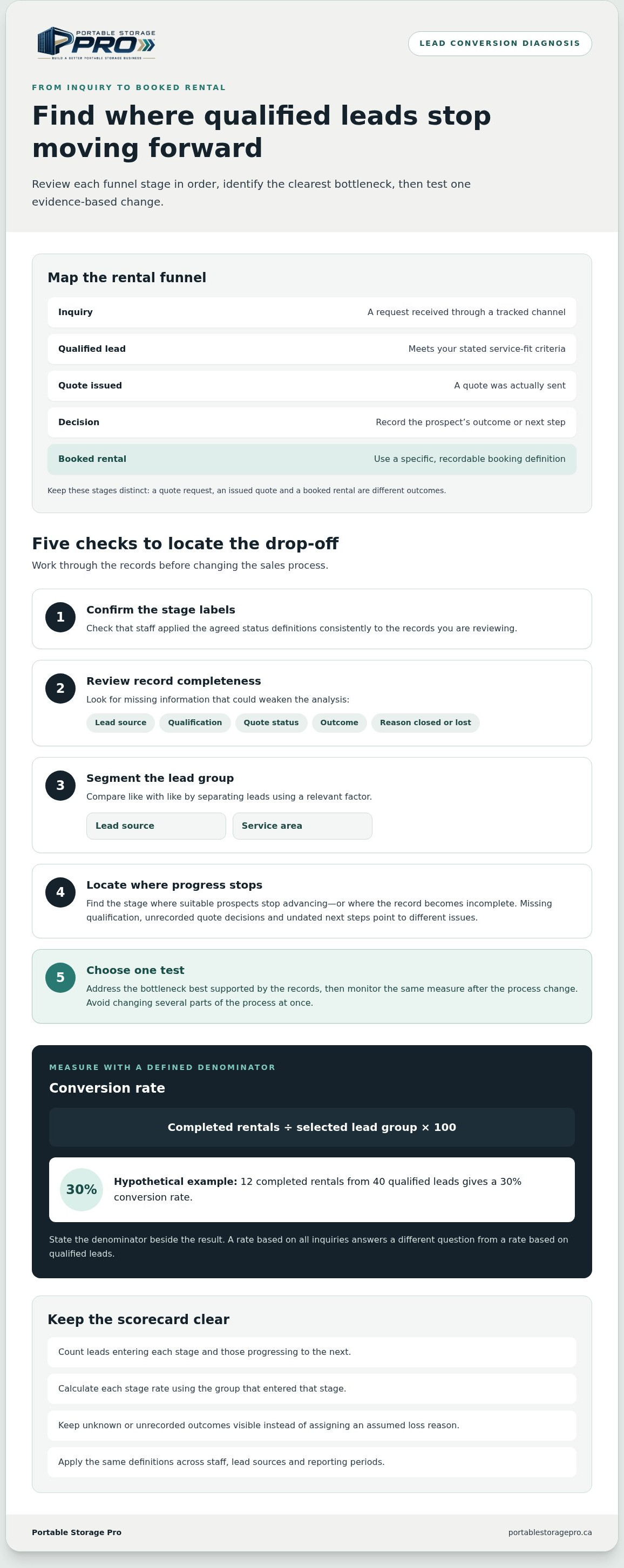
Set a plain-language meaning for each status, then make it available to everyone handling inquiries. For example, an inquiry is a request received through a tracked channel; a qualified lead meets your stated service-fit criteria; and quote issued means a quote was actually sent, not merely discussed. Define booked rental by a specific, recordable event in your own process.
Keep the labels distinct from later outcomes. A prospect asking for a quote has not necessarily accepted it. A verbal indication of interest is not a booked rental unless it meets your documented booking definition. Decide how to record prospects who decline, stop responding, or are unsuitable, rather than leaving them in an active stage indefinitely.
Apply the same definitions across staff, lead sources, and reporting periods. If one channel counts quote requests as conversions while another counts booked rentals, the comparison won’t tell you which inquiries progress to rental. A short status guide in your lead management system can reduce inconsistent interpretation.
Why can lead volume hide conversion problems?
A busy inbox can create the impression that sales are moving well. But inquiry count says nothing on its own about how quickly staff respond, whether the prospect fits your service area, whether a quote was sent, or whether the prospect booked. Volume measures activity at the entrance to the process, not the result.
Consider a simple review of inquiry records. You may find a group with no recorded qualification, another with quotes but no decision status, and a third labelled “interested” without a dated next step. Those gaps point to different issues. The first may need better information capture; the second needs decision outcomes recorded; the third needs clearer follow-up ownership. Don’t assume all unconverted leads were unsuitable, or that every lost inquiry reflects poor sales execution.
When records use vague or conflicting statuses, the point of drop-off disappears. Standardize the stages first, then examine where suitable prospects stop progressing. That gives you a usable picture of Portable storage lead conversion and a sound basis for deciding what to investigate next.
How to diagnose portable storage lead conversion by funnel stage
Use your recorded lead stages to identify where qualified prospects stop progressing. Start with a clear question, such as whether suitable inquiries are reaching a quote decision, rather than changing several parts of the sales process at once. Portable storage lead conversion is easier to interpret when you state which lead group you’re measuring and compare records on the same basis.
Work through the diagnosis in order:
- Confirm the stage labels. Check that the team applied its agreed statuses consistently to the records under review.
- Review the records. Look for missing source, qualification, quote, outcome, or loss-reason fields that could weaken the analysis.
- Segment the group. Separate leads by source, service area, or another relevant factor before comparing results.
- Locate the drop-off. Find the point where suitable prospects stop advancing or where records become incomplete.
- Choose one test. Address the best-supported bottleneck and monitor the same measure after the process change.
Define a conversion rate as completed rentals divided by the selected lead group, multiplied by 100. For a hypothetical example, 12 completed rentals from 40 qualified leads gives a 30% conversion rate. State the denominator beside the result. A conversion rate is meaningful only when its denominator is defined, since a rate based on all inquiries answers a different question from one based on qualified leads.
Build a useful lead conversion scorecard
Use a simple worksheet or the CRM fields your team already maintains. Capture lead source, qualification status, quote status, outcome, and reason closed or lost. Show both counts and rates at relevant stages so a small change in the number of leads doesn’t disappear inside a single blended figure.
- Count leads entering each stage and those progressing to the next.
- Calculate each rate using the group that entered that stage as its denominator.
- Keep unknown or unrecorded outcomes visible rather than folding them into a known loss reason.
Find the weakest handoff without guessing
Review a consistent set of records and note missing, delayed, or unclear next steps. Compare similar lead sources, service areas, and reporting periods, and label the basis for each comparison. If a pattern appears in one group, check whether the records are complete before attributing it to a staff member or channel.
Write down the suspected bottleneck, the evidence supporting it, and what would confirm the diagnosis. For example, missing quote statuses may indicate a handoff problem, incomplete recordkeeping, or both. Checking a sample of the underlying records can help distinguish these possibilities before you select a process change.
Qualify portable storage leads around service fit and rental needs
Qualification helps you decide whether an inquiry fits your rental operation and what information is needed to move it forward. It shouldn’t be a shortcut for dismissing a prospect because details are missing. Record what’s known, identify what still needs clarification, and set a next step. A qualified lead meets your service-fit criteria; an inquiry that has simply received a quote may or may not meet them.
Use your own service area, fleet, and operating requirements to classify inquiries consistently. The comparison below is a starting point, not a universal definition. Adjust the criteria to reflect the locations you serve and the container and delivery options your operation supports.
Suitable: The intended use fits your rental offer, the location is within your service area, and the prospect’s timing, container requirements, and delivery circumstances appear workable. Confirm any remaining operational details and agree on the next step.
Incomplete: The inquiry may fit, but a decision depends on missing information. For example, you may need the delivery location, requested timing, container requirements, or details about access before you can assess service fit or prepare a quote.
Unsuitable: A known requirement falls outside your defined criteria, such as a location beyond your service area or a delivery circumstance your operation cannot support. Record the specific reason rather than labelling the lead unsuitable without explanation.
What information helps establish a suitable rental opportunity?
Capture the intended use, location, requested timing, container needs, and delivery circumstances. Where relevant, ask about access constraints that could affect delivery planning. Note which details are confirmed and which remain open. A consistent lead intake process keeps this information available to the team instead of leaving it in one employee’s inbox, call notes, or memory.
Make the next question specific. If the delivery location is missing, request it. If the container requirement is unclear, clarify the prospect’s stated need before deciding whether the inquiry fits. This keeps qualification focused on resolving uncertainty, not making assumptions about the customer or the operation.
How should teams prioritize follow-up?
Set priority using service fit, stated timing, completeness, and the prospect’s agreed next step. An inquiry that appears suitable and has a clear decision point may need a different action from one awaiting basic details. Record both the assigned owner and the next action so the team can see what should happen without reconstructing the conversation.
Keep outcomes distinct. A confirmed no-fit inquiry is not the same as an unanswered request or unfinished qualification. Portable storage lead conversion depends on accurate records of those differences. Use the same criteria across staff, and review your team’s follow-up process to support consistent execution.
Improve the sales handoffs that move portable storage leads forward
A lead can lose momentum when responsibility passes from one person or stage to another without a clear next move. Assign an owner and a defined action at each transition, including when a quote is issued. “Follow up” isn’t specific enough. Record what needs to happen and who is responsible, so the opportunity doesn’t sit untouched while staff assume someone else is handling it.
Set internal response expectations that reflect your team’s capacity and operating hours. These are operating standards for your business, not universal benchmarks. Make them clear to staff and review whether handoffs meet them. Portable storage lead conversion depends in part on whether a prospect’s questions and decisions remain visible as the inquiry moves through your sales process.
Create clear ownership from lead intake through quote
Assign responsibility for first response, qualification, quote preparation, and outcome recording. If a lead changes hands, the departing owner should leave enough context for the next person to continue the conversation without asking the prospect to start over. Keep the notes, current owner, and next action together in your lead management system so teammates can see what is outstanding.
Capture useful context, not just a status label. Record the prospect’s question, commitment, or decision barrier in plain language. For example, note if they need to confirm a delivery detail or are waiting to resolve a container requirement. A concise, factual note gives the next person a reason for the next action and helps a manager assess the handoff later.
Make ownership explicit when a quote is sent. The person issuing it should record the status and the agreed next step, even if another staff member will handle the follow-up. That avoids a gap between preparing a quote and managing the prospect’s decision.
Use quote feedback to improve the process
Record whether the prospect accepted, declined, delayed, or hasn’t responded. If they provide a reason, capture their words accurately. Don’t infer that silence means the quote was too high, the service didn’t fit, or the prospect chose another operator. Mark the reason as unknown when the record doesn’t establish it.
Review stalled opportunities by looking at the sequence of actions, not just the final status. A missing next step points to a different process question than a prospect who raised an unresolved requirement. If a quote has no recorded outcome, first determine whether the result wasn’t captured or whether the conversation stopped. Keep these explanations separate so your review leads to an appropriate change rather than an assumption about staff performance.
For support in improving sales ownership and team procedures, discuss your sales handoffs and lead conversion process.
Turn portable storage lead conversion findings into a practical improvement plan
A diagnosis is useful only if it leads to a change your team can apply and assess. Start with the clearest evidence of a bottleneck, then adjust one part of the process. Changing intake, qualification, handoffs, and quoting at once makes it difficult to tell which change affected the result.
For example, if records show that quote requests often lack a named next action, test a rule requiring staff to assign an owner and record the agreed follow-up step when each quote is sent. Set the expected behaviour, identify who will check that it happens, and choose a measure tied to the problem, such as the share of issued quotes with a documented next action. This is a process measure, not a promised rental result.
Run a focused improvement cycle
Keep the cycle manageable. Write down how the process works now, the evidence for the suspected bottleneck, and the specific behaviour you want to change. Then apply the change consistently enough to review comparable records, rather than relying on anecdotes or a single unusual inquiry.
- Document the baseline: note the current step, the records reviewed, and what they show.
- Make one change: clarify an intake field, qualification question, handoff responsibility, or quote-stage action.
- Assign accountability: name the person responsible for applying the change and the person who will review the records.
- Assess the evidence: compare like-for-like records using the measure you selected.
- Decide what comes next: retain the change if the process is being followed and the measure moves in the intended direction; adjust it if execution is inconsistent, or stop it if the evidence does not support continuing.
Make the expected behaviour easy to understand. “Improve follow-up” isn’t a usable instruction. “After sending a quote, record the prospect’s question or decision status and assign the next action” gives staff a clear task and gives a manager something specific to review. Train the team on the change, provide a place to record it, and revisit the procedure if staff interpret it differently.
When can a Consulting Partner support the work?
If your team needs help turning findings into a repeatable sales process, a Consulting Partner can provide expertise and support across sales, marketing, lead generation, training, and implementation priorities. The work can connect a recommended process with staff training and practical measurement, so the change is clear to the people responsible for using it. You retain responsibility for day-to-day management; the partnership supports your decisions rather than taking over operations.
Portable storage lead conversion improves through disciplined review, clear ownership, and changes grounded in your records. Keep the cycle proportionate to your team and use what you learn to set the next priority.
Discuss your lead conversion process with Portable Storage Pro.
Make your next sales improvement deliberate
Portable storage lead conversion is an operating discipline, not a one-time cleanup. As your team, service area, or lead sources change, revisit whether your process still gives each suitable prospect a clear path to a rental decision. Keep the next improvement grounded in what your records show, and make it practical for staff to follow during the workday.
Portable Storage Pro can help you connect sales priorities with training and implementation. Paul Taylor’s experience spans containers, transportation, procurement, and operations, providing relevant context for working through the realities of a rental business. The aim is to help you put a consistent process into practice while you retain responsibility for managing your operation.
Choose the handoff or decision point you want to address next, then bring that question into a focused discussion. Discuss your portable storage lead conversion process with Portable Storage Pro and identify a practical next step for your team.
Frequently Asked Questions
Is lead conversion rate the same as quote acceptance rate?
No. They answer different management questions. Lead conversion reflects movement through the full sales path, while quote acceptance focuses on the prospect’s response to an offer. Use quote acceptance to examine quote clarity, fit, and how prospects respond to the terms presented. Use a broader conversion measure to assess the overall sales process. Define what your team counts as acceptance, such as an explicit approval or a completed booking step.
Can I compare portable storage conversion rates across lead sources?
Yes, but first decide how you assign a source when a prospect encounters your business through more than one channel. For example, a prospect might see an advertisement, then call after a referral. Choose a consistent attribution rule, such as recording the first known source or the source named by the prospect, and apply it across your records. Otherwise, source reports may reflect inconsistent tagging rather than meaningful differences in lead performance.
How much lead data do I need before changing the sales process?
There’s no fixed record count that applies to every operator. Consider whether the records cover a full decision cycle for your typical rental inquiry, including enough time for prospects to move from first contact to a final outcome. A recurring staff question or repeated workflow obstacle can also justify a limited process test before you have a large dataset. Treat early findings as directional, and keep checking whether the same issue appears.
What happens if a prospect stops responding after receiving a quote?
Follow your established contact process, then decide whether the opportunity should remain active or move to a closed status. Set a clear rule for when an unresponsive record leaves the active pipeline, and note what would justify reopening it, such as a new inquiry from the prospect. This keeps active opportunities useful for day-to-day planning without erasing the history of a prospect who may return later.
Should every portable storage inquiry receive the same sales response?
No. Your team should use consistent service standards, but the response can reflect the work needed to answer the inquiry. A straightforward request may call for a direct next step, while a request involving unusual access or container requirements may need operational input before staff can respond accurately. Give employees clear guidance on when to resolve an inquiry themselves and when to bring in someone with the relevant operating knowledge.
Can seasonal demand affect lead conversion comparisons?
Yes. Seasonal shifts can change the urgency of inquiries, the mix of intended uses, and the availability of containers or delivery capacity. Those conditions can affect whether a prospect can proceed, even if your sales process hasn’t changed. Note capacity constraints and demand patterns alongside conversion results. This context helps you distinguish a process issue from a period when your operation had less ability to serve incoming requests.

Article by
Paul Taylor
Paul Taylor is the founder of Portable Storage Pro, bringing more than 35 years of experience across the container, portable storage and transportation industries. His background spans executive operations, business development, global procurement, sales, marketing and operational improvement in Canada, the UK and international markets.
Paul helps independent portable storage and container rental operators increase revenue, strengthen margins and build more efficient businesses. His work connects strategy with practical implementation, including pricing, delivery operations, supplier sourcing, staff training, technology and customer experience.
His experience includes leading multi-location storage operations and serving on the National Portable Storage Association’s board along with chairing its Canadian committee. Through Portable Storage Pro, Paul shares practical insights to help owners make informed decisions, solve operational challenges and grow profitably.
Disclaimer
Content published by Portable Storage Pro Inc. (PSP) provides general business information and industry insights. It does not replace advice tailored to your business or specialist legal, tax, engineering or other regulated advice. Reading this content or contacting PSP does not, by itself, establish a consulting engagement.
Information reflects circumstances at publication and may change. Examples and potential benefits are illustrative; results depend on individual circumstances, implementation and market conditions and are not guaranteed.
Client services are governed by the signed service agreement, agreed work plan and written amendments. Website and blog content do not amend those terms. PSP’s work is subject to applicable law and the professional commitments set out in its agreement, including the CMC-Canada Code of Professional Conduct and NPSA Code of Conduct and Ethics. Copies are available on request.
Views expressed are PSP’s own. Association membership or references do not imply association endorsement or CMC certification. Nothing in this disclaimer limits PSP’s contractual responsibilities, professional duties or rights that cannot lawfully be excluded.


