
A quote isn’t the close; it’s the handoff to the buyer’s next decision. Portable storage quote follow-up gives your team a clear way to keep that decision moving without relying on memory or repeated, generic check-ins. After sending a quote, make the next step useful: confirm the prospect has what they need, invite questions and agree on when to reconnect.
It’s reasonable to worry that another message could feel pushy. But silence doesn’t tell you whether the prospect is comparing options, waiting on a project decision or unclear about delivery and site requirements. A consistent, respectful process helps your team uncover the barrier while keeping communication relevant.
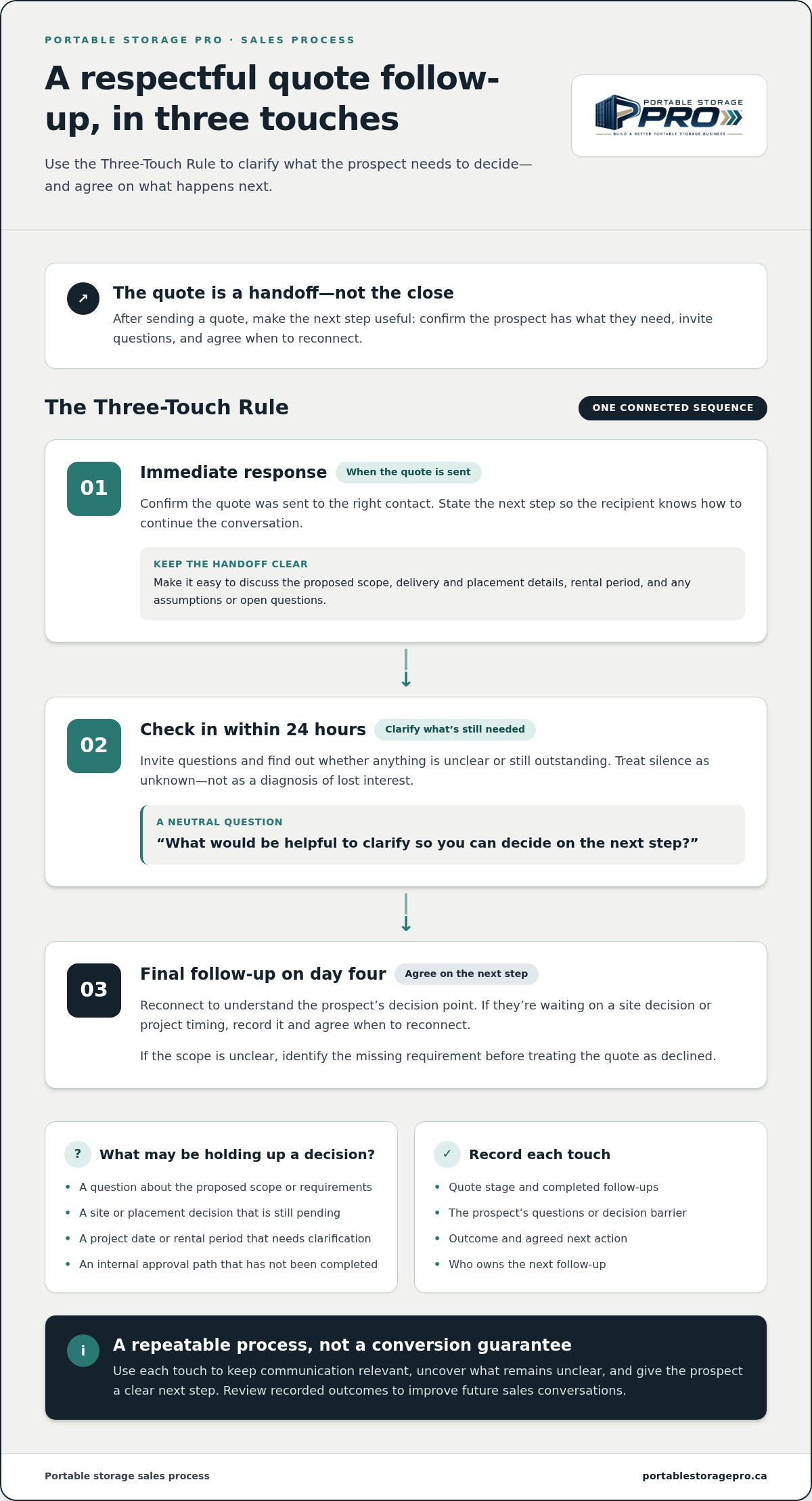
This article sets out a practical sequence using the Three-Touch Rule: an immediate response, a check-in within 24 hours, and a final follow-up on day four. You’ll also find questions that help identify hesitation, guidance for recording each outcome in your lead management system, and ways to use quote-to-rental reviews to improve sales conversations. The goal is a repeatable process that gives prospects a clear next step and gives your team better information for the next quote.
Key Takeaways
- Use Portable storage quote follow-up to clarify what the prospect needs to decide, rather than treating silence as a lost sale.
- Make each quote easier to discuss by stating the scope, delivery and placement details, rental period, and service assumptions that apply.
- Give your team a consistent, respectful follow-up sequence, while treating it as a starting process rather than a conversion guarantee.
- Record quote stages, prospect questions, completed follow-ups, outcomes, and next actions to spot where sales conversations can improve.
- Assign ownership, practise the messages, and review results using a process that fits your team and lead volume.
Why portable storage quotes stall, and what follow-up can clarify
A stalled quote is an issued quote with no confirmed decision or agreed next step. It has no fixed time threshold. The useful test is whether you know what the prospect needs to decide, what information is still outstanding, and who will act next. Portable storage quote follow-up is purposeful communication to clarify those points, not simply another attempt to get a response.
Sending a document doesn’t confirm that the buyer has reviewed it or understood its assumptions. A quote may reach the prospect before they’ve confirmed the placement site, rental period, delivery requirements, or internal approval path. Even a clear quote can leave unanswered questions. The term portable storage device has broader uses, so make your own quote specific about the container rental service and scope being discussed.
Separate buyer hesitation from a lost opportunity
Silence is an unknown, not a diagnosis. The prospect may have a question, be waiting for a project date, need to clarify the required scope, or be seeking internal approval. These are possibilities to investigate, not reasons to assume the buyer is uninterested or resisting the quoted terms.
Use a neutral question that lets the prospect identify the real decision point: “What would be helpful to clarify so you can decide on the next step?” If they’re waiting on a site decision, you can record that and agree when to reconnect. If the scope is unclear, address the missing requirement before treating the quote as declined.
Spot the handoff points where quotes lose momentum
Review the path from initial inquiry to decision as a connected process. A lead can lose context at any handoff, particularly when the person gathering requirements isn’t the person preparing or sending the quote.
- Lead intake: Capture the prospect’s contact details, intended use, location, and stated requirements.
- Qualification: Clarify the delivery and placement context, expected timing, rental period, and decision-makers.
- Quote preparation: Carry those details into the proposed scope and note any assumptions or information still needed.
- Quote delivery: Confirm the document was sent to the right contact and state the next step, rather than leaving the recipient to infer it.
- Follow-up: Assign an owner to reconnect, record the prospect’s question or decision barrier, and agree on what happens next.
If a quote has no assigned owner, next action, or record of the buyer’s decision context, review the handoff before blaming the salesperson or the lead. The portable storage lead generation guide covers the upstream work of attracting and capturing leads. Once an inquiry becomes a quote, consistent records help your team see where communication stopped and what to clarify next.
Prepare a portable storage quote that is easy to review and discuss
A quote is easier to assess when it reflects the prospect’s stated requirements and makes its scope plain. Before sending one, check that the proposed service, delivery context, placement details, rental period, and any relevant assumptions are recorded. The goal isn’t to fill every blank. It’s to separate what you know from what still needs clarification.
A useful quote gives both parties a shared basis for discussing the proposed service, resolving open questions, and agreeing on the next step. That makes the document more than a record of what was proposed. It gives your team a clear reference for a later conversation.
Capture the details needed before sending a quote
Start with the prospect’s requirements, not with a standard template alone. Confirm the intended use, requested timing, delivery context, placement needs, rental period, and the person who will discuss or approve the proposal. Record what the prospect asked to have included, then flag details that are still unknown instead of treating assumptions as confirmed requirements.
- Use case and requirements: Note what the prospect needs the container for and what they’ve asked the proposed service to cover.
- Timing: Record the requested start or delivery timing, and distinguish a firm date from a preliminary estimate.
- Delivery and placement context: Capture the destination and any site or placement information the prospect has provided. Mark access or placement details that remain to be clarified.
- Rental period: State the period discussed, or identify it as an open question if the prospect hasn’t specified one.
- Decision contact: Record who requested the quote, who will review it, and how the prospect prefers to discuss requirements.
This short review helps prevent a gap in the intake record from becoming an unstated assumption in the quote. If a requirement affects the proposed scope, ask about it or label it clearly as unresolved.
Make the quote handoff clear
On the quote, make it straightforward to see what the proposed service covers. Separate confirmed details from assumptions and open questions. For example, if placement requirements are still being clarified, say so directly rather than implying the site details have been settled. That gives the prospect a concrete point to respond to and helps your team avoid treating silence as agreement.
When you send the document, name one practical next step. Invite the prospect to discuss an open requirement, confirm a detail, or identify who needs to review the proposal. Keep the handoff record with the quote so another team member can understand its status without reconstructing the conversation.
- Record when the quote was sent and which version was shared.
- Assign one person to own the next contact.
- Note the question or confirmation needed to move the discussion forward.
Portable storage quote follow-up is more useful when the quote itself gives both sides something specific to discuss. Clear scope, visible assumptions, and an assigned next step turn a document handoff into a workable sales conversation.
Use a respectful follow-up sequence after sending the quote
A repeatable process helps your team stay in contact without turning follow-up into pressure. The Three-Touch Rule sets the sequence: an immediate response, a check-in within 24 hours, and a final follow-up on day four. Treat it as a starting process, not a guaranteed conversion formula. Adjust the next action when the prospect replies, asks for time, or says the project has changed.
Give each touch a distinct purpose. Repeating “just checking in” adds little. Acknowledge the quote, invite clarification on a specific point, then make it easy for the prospect to state a decision or revised timeline. Keep the message tied to the container rental requirements discussed, not an assumed deadline.
Make each contact useful to the prospect
Immediate response: Confirm the quote has been sent, acknowledge the prospect’s enquiry, and say what the next communication step will be. This makes the handoff clear without asking for an immediate decision.
Check-in within 24 hours: Ask whether the proposed scope or service details need clarification. Keep the question open and easy to answer. For example: “Have any questions come up about the delivery or placement details in the quote? I’m happy to clarify what’s included.”
Final follow-up on day four: Invite the prospect to share whether they’re ready to proceed, need more information, or have a different timeline. This gives them a straightforward way to close the loop without suggesting that availability is limited or that a decision is urgent.
A concise message could read: “I’m following up on the container rental quote we sent. Is there anything about the proposed scope or timing you’d like to clarify? If your plans have shifted, let us know what next step makes sense.” It asks for useful context without manufacturing urgency. If the prospect has already responded, follow the conversation they’ve started rather than sending a scheduled message that ignores their answer.
Keep ownership and context visible
A sequence only works as an operating process if each action has an owner. Record who will make the next contact and the promised follow-up date. In your lead management system, capture the channel used, the prospect’s questions, the response, and any change to scope or timing. That record lets another team member continue the conversation with context instead of asking the prospect to repeat details.
- Assign one person to own the next contact.
- Record the agreed date and the reason for reconnecting.
- Update the lead record after each response or unanswered touch.
- Pause or revise the sequence when the prospect gives a different next step.
For broader guidance on consistent records across the sales process, use the portable storage lead management template. Portable storage quote follow-up becomes more respectful and useful when the team can see what has already been discussed and what the prospect needs next.
Review quote outcomes to improve the sales process
A quote outcome is more than a win or loss. It tells you what happened after the proposal was sent and whether the next step was completed. Record a clear status for every quote, then review the prospect’s stated reason alongside the information your team captured before preparing it. This makes Portable storage quote follow-up a source of process feedback, not just a series of contact attempts.
Use consistent categories so the team can compare records without guessing what each salesperson meant:
- Accepted: The prospect agreed to proceed. Record the decision and the next operational handoff.
- Declined: The prospect said they won’t proceed. Note their stated reason, if provided.
- Delayed: The prospect expects to revisit the decision later. Record the timing or trigger they shared.
- Awaiting information: A question or requirement remains unresolved. Assign who will provide or obtain the information.
- No response: No decision or reply has been received. Record the follow-up completed and the next action, if one is scheduled.
For each quote, track its stage, follow-up completed, prospect question, outcome, and next action. Keep the record factual. “Prospect asked whether placement requirements were included” is an observation; “the quote was too complicated” is an interpretation unless the prospect said so.
Use quote outcomes as sales-process feedback
Look for a connection between what the prospect said and what your team documented before sending the quote. If a prospect repeatedly asks about delivery scope, check whether that detail is being captured during qualification and made clear in the proposal. A recurring question may point to a gap in scope, communication, or intake, but the record alone doesn’t prove the cause.
Review patterns by lead source, service fit, and quote stage before changing a script or process. Separate observed counts from conclusions, especially when only a few quotes are involved. A small sample can suggest a question to investigate; it can’t establish an industry benchmark or prove that one change caused a different outcome.
When you adjust a process, note what changed and when. Keep the outcome categories and fields consistent during the review period so the team can make a fair comparison. If definitions change at the same time as the follow-up approach, it becomes harder to tell whether the records reflect a real shift or a new way of classifying quotes.
Connect follow-up with lead conversion work
Quote review should inform sales training as well as reporting. Practise concise, neutral conversations that clarify a prospect’s question, record the answer accurately, and agree on a next action. The storage lead conversion checklist offers wider practices to consider across the sales process.
Track quote-to-rental conversion as an internal measure, using the same definition and time period in each review. Treat it as a way to understand your own sales process, not as a promised result or an unsupported target. To review your quote outcomes and sales process with Portable Storage Pro, discuss how the records can guide practical improvements.
Build a repeatable quote follow-up process with the right support
A follow-up process is useful only if your team can apply it during a normal workday. Keep the procedure simple enough to fit your lead volume and existing tools. A small team may manage with shared lead records and clear task ownership; a busier operation may need its CRM to assign reminders and preserve contact history. The aim is consistent execution, not added administration.
Put the process into daily practice
Document the steps from quote delivery through outcome recording. Specify who owns each contact, which lead fields staff must complete, and how they record a prospect’s response and next action. Use the tools your team already relies on where possible. A process that requires duplicate entry or lengthy notes can be difficult to maintain when staff are handling active rental enquiries and operational work.
Train the team to ask clear, neutral questions and distinguish confirmed facts from assumptions about buyer intent. Practise how to respond when a prospect needs a scope clarification, has a changed timeline, or is waiting on an internal decision. Staff should know how to record the answer without labelling the prospect as uninterested or difficult.
Start by checking whether the process is being followed. Are quotes assigned to an owner? Are the required fields completed? Are follow-up actions and outcomes recorded in a consistent way? Review these basics before judging whether a message or sequence is effective. Otherwise, missed handoffs or incomplete records can be mistaken for a problem with the follow-up approach itself.
Choose support that fits the operating need
Portable Storage Pro is a specialist business-improvement resource for portable storage and container-rental operators. Its Consulting Partner model can support agreed priorities in sales, training, and implementation while you retain responsibility for day-to-day management. That distinction matters: process support should help your team put an agreed approach into practice, not create confusion about who runs daily operations.
If you’re formalizing Portable storage quote follow-up, begin with the issue your records show. You may need clearer ownership, more consistent qualification, practical sales training, or a better way to review quote outcomes. Set the scope of the improvement around your team’s capacity and current lead management system, then check that staff can follow the process as intended. As the records improve, you’ll have a stronger basis for deciding what to adjust next.
Discuss your quote follow-up process with Portable Storage Pro.
Make your next sales-process improvement count
The next step is to put your follow-up process into routine use, then pay attention to what your records reveal. Choose one practical point to improve, such as clearer ownership or more consistent notes, and give your team a shared way to apply it. Portable storage quote follow-up becomes easier to refine when decisions are grounded in actual prospect conversations rather than assumptions about why a quote stalled.
That work benefits from an adviser who understands the operating realities behind container rental sales. Paul Taylor brings more than 35 years of experience across containers, transportation, procurement, and operations. Portable Storage Pro works with operators on sales-process improvements that fit their business and help turn agreed priorities into practical steps.
You don’t need to redesign every part of your sales operation at once. Start with the handoff that’s least clear, make responsibility visible, and build from what your team learns. For support shaping that next step, talk with Portable Storage Pro about improving your quote follow-up process.
Frequently Asked Questions
What should a portable storage operator record after sending a quote?
Keep one current record for each quote rather than scattering updates across inboxes, spreadsheets, and private notes. Use consistent status labels and a brief, factual note of the prospect’s own words where possible. For example, distinguish a stated concern about access from a team member’s guess that the site may be unsuitable. This makes later reviews more reliable and helps you identify information gaps without treating assumptions as customer feedback.
Should quote follow-up be handled by the salesperson who prepared the quote?
The person who prepared the quote is often well placed to answer detailed questions, but the process should also work during absences or workload changes. Set a clear backup arrangement and define when a quote can be reassigned, such as when its original owner is unavailable. Before taking action, the new owner should check recent activity to avoid sending a message that conflicts with an update the prospect has already received.
What should a salesperson do when a prospect says the quote is outside their budget?
Ask which part of the proposal is creating the budget concern, then confirm what the prospect considers essential. For example, ask whether the issue relates to the rental period, delivery requirements, or another element of the proposed scope. If a revised offer is appropriate, make the change deliberate and document its effect on service and commercial terms. Don’t reduce the amount without understanding what the prospect is asking to change.
How can an operator follow up without making a prospect feel pressured?
Keep each message focused on one useful question, and avoid sending several versions of the same request through different channels. You can also ask which contact method works best for the prospect and use that preference in later communication. A brief note that gives the prospect room to reply when ready is often clearer than a long message with several prompts. The aim is to make responding straightforward, not to force a decision.
Can a CRM automate portable storage quote follow-up?
A CRM can support follow-up, but begin with task reminders and status tracking before automating messages to prospects. This lets your team test whether the timing and triggers match real sales conversations. For example, a reply or status change should prompt a review of any queued task before it proceeds. Check that reports show overdue actions accurately, and review the workflow when staff find that automation creates duplicate or irrelevant contacts.
How should a team classify a quote when the prospect has not made a decision?
Use a status that reflects the current state without implying a final outcome, and define that status in your team’s records guide. The key is consistent use: staff should know what evidence moves a quote into another category and when an older record needs review. If a prospect later reopens the discussion, update the existing quote history rather than treating it as a new opportunity with no prior context.

Article by
Paul Taylor
Paul Taylor is the founder of Portable Storage Pro, bringing more than 35 years of experience across the container, portable storage and transportation industries. His background spans executive operations, business development, global procurement, sales, marketing and operational improvement in Canada, the UK and international markets.
Paul helps independent portable storage and container rental operators increase revenue, strengthen margins and build more efficient businesses. His work connects strategy with practical implementation, including pricing, delivery operations, supplier sourcing, staff training, technology and customer experience.
His experience includes leading multi-location storage operations and serving on the National Portable Storage Association’s board along with chairing its Canadian committee. Through Portable Storage Pro, Paul shares practical insights to help owners make informed decisions, solve operational challenges and grow profitably.
Disclaimer
Content published by Portable Storage Pro Inc. (PSP) provides general business information and industry insights. It does not replace advice tailored to your business or specialist legal, tax, engineering or other regulated advice. Reading this content or contacting PSP does not, by itself, establish a consulting engagement.
Information reflects circumstances at publication and may change. Examples and potential benefits are illustrative; results depend on individual circumstances, implementation and market conditions and are not guaranteed.
Client services are governed by the signed service agreement, agreed work plan and written amendments. Website and blog content do not amend those terms. PSP’s work is subject to applicable law and the professional commitments set out in its agreement, including the CMC-Canada Code of Professional Conduct and NPSA Code of Conduct and Ethics. Copies are available on request.
Views expressed are PSP’s own. Association membership or references do not imply association endorsement or CMC certification. Nothing in this disclaimer limits PSP’s contractual responsibilities, professional duties or rights that cannot lawfully be excluded.


