
In the 2026 Canadian market, the difference between a profitable portable storage fleet and a yard full of idle assets isn't the quality of your containers; it's the maturity of your digital pipeline. Most independent operators recognize that the cost of customer acquisition has reached a tipping point. With social media ad spend in Canada climbing to $4.76 billion, competing against national big-box brands on generic keywords often results in inflated costs and inquiries that fail to convert. You likely realize that simply "getting your name out there" is no longer a viable strategy for sustainable growth.
This guide provides a professional framework for portable storage lead generation designed specifically for the Canadian landscape. You'll discover how to attract high-intent leads while maintaining the financial discipline required to protect your margins. We will outline a system that moves beyond basic advertising by integrating AI-driven optimization with disciplined operational procedures. By the end of this article, you'll have a clear path to transition your marketing from a speculative expense into a scalable, predictable engine for fleet expansion.
Key Takeaways
- Understand the distinct intent profile of portable storage customers to ensure your marketing efforts target active renters rather than casual browsers.
- Prioritize a mobile-first digital strategy that optimizes for "mobile container" keywords to capture high-intent traffic from users researching on the go.
- Establish a formal referral program with realtors and restoration companies to build a reliable stream of high-margin leads outside of traditional search channels.
- Professionalize your conversion process by implementing a CRM and specialized sales training for staff to track and nurture every enquiry systematically.
- Scale your fleet with confidence by using the Growth Engagement Model to transition your portable storage lead generation into a predictable and disciplined operational system.
The Fundamentals of Portable Storage Lead Generation in 2026
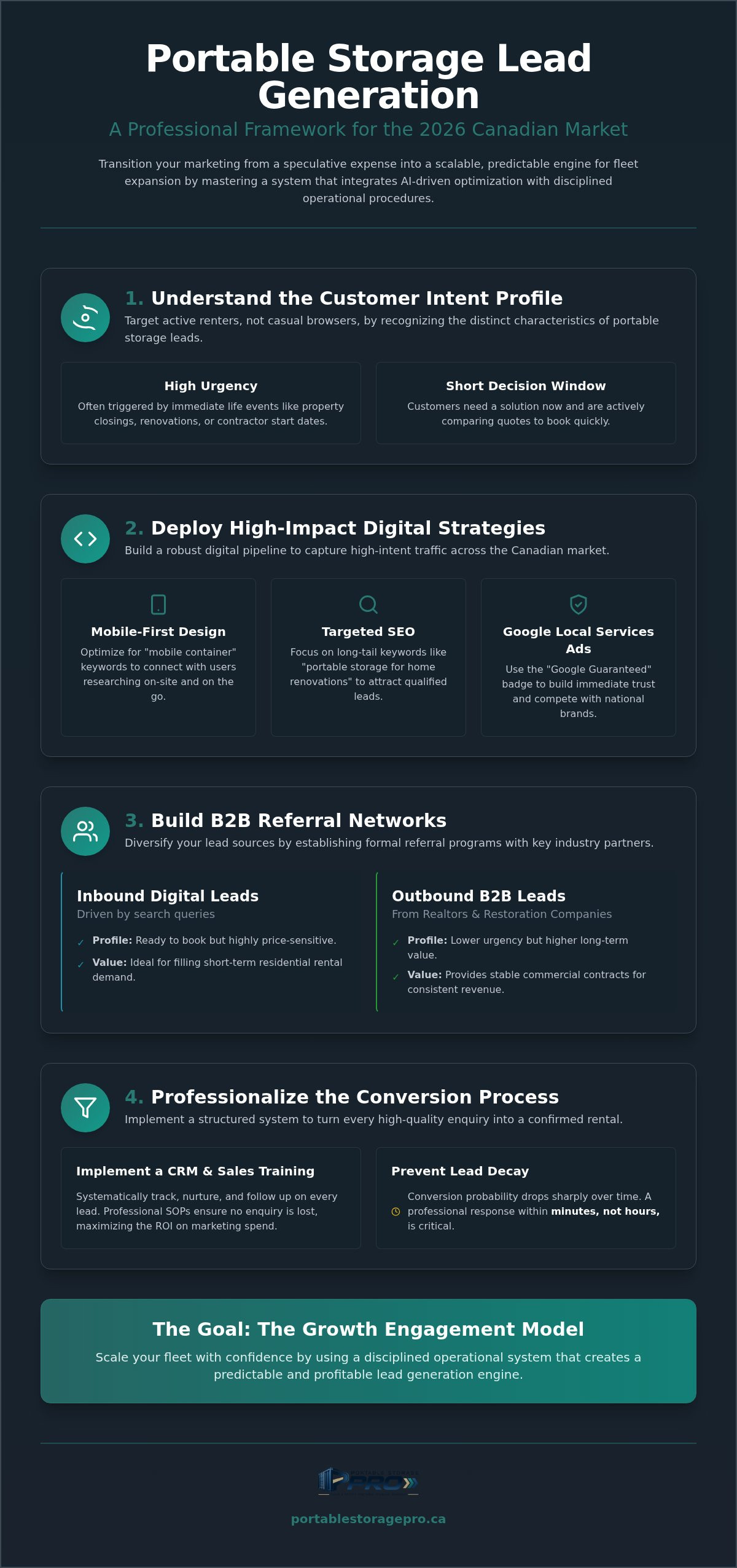
Lead generation for the portable storage sector is a specialized operational discipline. Unlike traditional self-storage, where a facility might rely on physical visibility and local foot traffic, portable storage requires a proactive strategy to reach customers exactly when their logistical needs arise. Understanding the Fundamentals of Lead Generation is essential for any operator looking to professionalize their sales pipeline. In this niche, a lead represents a specific, high-intent requirement for onsite storage or a mobile move, often triggered by life events like home sales or renovations.
The intent profile of a portable storage lead differs significantly from traditional storage. While a self-storage customer might look for a unit to clear out a garage over several weeks, a portable storage customer often needs a solution immediately to facilitate a property closing or a contractor's start date. This creates a market characterized by high urgency and a shorter decision-making window. In Canada, this demand is tied closely to the seasonal moving cycle, which typically intensifies from late spring through early autumn. Operators must adjust their portable storage lead generation efforts to account for these fluctuations in volume and lead quality.
Inbound vs. Outbound Lead Profiles
Inbound digital leads are often driven by high-intent search queries such as "mobile container rental" or "portable storage near me." These prospects are usually ready to book but are highly price-sensitive and likely comparing multiple quotes simultaneously. Conversely, outbound B2B leads, such as those from restoration companies or realtors, offer lower urgency but higher long-term value. Balancing these short-term residential rentals with stable commercial contracts ensures a diversified revenue stream that protects the fleet during slower winter months.
The Cost of Poor Lead Management
In a high-ticket rental business, the true cost of a missed enquiry extends far beyond the initial delivery fee. It includes the lost monthly recurring revenue and the potential for repeat business or referrals. Without a structured follow-up system, marketing spend is effectively wasted on prospects who go cold before they reach the booking stage. Lead decay is the progressive reduction in conversion probability that occurs as the time between an initial enquiry and a professional response increases. To maintain a high ROI, operators must implement professional SOPs that ensure every lead is captured and nurtured within minutes, not hours. This level of responsiveness is a core component of our portable storage lead generation consulting, ensuring that no marketing dollar is left on the table.
High-Impact Digital Strategies for Canadian Operators
Digital infrastructure functions as the primary interface between your fleet and the Canadian consumer. A high-performing website must prioritize mobile-first design, as prospects often research storage solutions while on-site at renovations or during active move-out days. Utilizing the latest digital marketing tools recommended by the Canadian Chamber of Commerce allows operators to track user behaviour and refine the enquiry process. Leveraging Google Local Services Ads (LSA) is another critical tactic for 2026. The "Google Guaranteed" badge provides an immediate layer of trust, which is vital for independent operators competing against national brands. Content marketing should focus on answering common logistical questions, such as municipal permit requirements or delivery clearance specifications, to build authority and capture search traffic from local researchers.
Search Engine Optimization (SEO) for Portable Storage
Effective SEO requires targeting high-intent, long-tail keywords that mirror the user's specific problem. Phrases like "portable storage for home renovations" or "mobile container rental for moving" attract leads who are closer to a purchasing decision than those using generic terms. Maintaining a fast, secure, and logically structured site is critical for both user experience and search rankings. This technical foundation is a prerequisite for increasing portable storage business profitability through organic channels. Refining your portable storage lead generation through these digital channels requires a balance of technical SEO and aggressive bid management.
Paid Advertising and PPC Management
Google Ads campaigns provide the necessary reach during the peak Canadian moving season, but they require precise management to remain cost-effective. Operators should implement a robust list of negative keywords to exclude traffic seeking "shipping container sales" or "cheap garden sheds." This ensures your portable storage lead generation budget is spent exclusively on rental-ready prospects during high-intent moving windows. Retargeting visitors who have engaged with your pricing page or "how it works" section keeps your brand visible during the typical three to five-day decision period. Implementing these advanced digital tactics is a core component of our Sales, Marketing & Lead Generation consulting services, designed to professionalize your outreach and maximize fleet utilization.
Beyond Digital: Building B2B Referral Networks
Digital channels capture immediate demand, but a sustainable portable storage lead generation strategy requires a robust B2B component. Many independent operators overlook the stability offered by professional referral networks. According to data from We Are Social Canada (November 5, 2025), personal recommendations remain the top source of brand discovery for Canadians. This highlights the necessity of moving beyond search engines to build trust-based partnerships. By integrating referral acquisition into your broader operational framework, you secure high-margin leads that are often less sensitive to price fluctuations than those found through PPC.
Partnering with the Real Estate Sector
Realtors are critical partners during the home-staging and listing process. A portable container allows a homeowner to declutter without the logistical stress of multiple trips to a fixed facility. You should position your service as a value-add that helps realtors sell homes faster. Providing co-branded marketing materials to local offices ensures your brand is the first recommendation made to sellers. To keep these partnerships organized, operators must implement formal SOPs for referral tracking. This professionalizes the relationship and ensures partners are rewarded promptly for their advocacy.
Restoration and Commercial Partnerships
Restoration companies represent a specialized segment with immediate, non-negotiable storage needs. When a property experiences a fire or flood, these firms require on-site containers to secure salvageable contents instantly. Establishing yourself as a reliable partner for insurance-related claims provides a steady stream of high-priority portable storage lead generation. Similarly, home renovation contractors and kitchen designers often require staging areas for materials. Securing these commercial contracts requires direct outreach and a reputation for tactical proficiency. These relationships are often more durable than residential leads and contribute to higher fleet utilization rates year-round.
Developing these professional networks is a core element of our Partner Engagement Model. It involves more than just passing out business cards; it requires a structured approach to relationship management and procurement. Establishing industry representation at national conferences further strengthens your brand. These events provide access to a global supply chain and allow you to benchmark your operations against the best in the sector. This proactive networking signals to commercial partners that you are a serious player capable of handling complex logistical requirements. Building these networks moves your business away from a reliance on volatile digital auctions toward a more predictable revenue model.
Optimizing the Conversion Funnel: Turning Enquiries into Rentals
Generating interest is only half the battle. If your team treats an enquiry as a chore, your marketing budget is effectively a donation to your competitors. A disciplined conversion funnel ensures that every instance of portable storage lead generation translates into a signed rental agreement. This requires a transition from passive order taking to active, consultative selling. Implementing a robust CRM allows you to track every lead from the first touchpoint to the final delivery, ensuring no prospect falls through the cracks.
Portable Storage Sales Training Excellence
Most front-office staff function as price-quoters. This is a strategic error. Consultative selling involves asking the prospect about their specific project, whether it's a home renovation or a commercial move, to recommend the optimal container size and delivery schedule. Your team must be equipped to handle objections regarding site security, municipal permits, or delivery clearance with confidence. The Lead-to-Lease ratio is a key performance metric that measures the percentage of initial enquiries that successfully convert into active rental contracts. Training should extend to drivers, who often serve as the primary face-to-face contact for the brand.
Technology Implementation for Lead Management
Managing leads manually in 2026 is an operational risk. Integrating website forms directly with your management software eliminates data entry errors and ensures immediate follow-up. Automated SMS and email sequences can nurture prospects who aren't ready to book today, keeping your brand top-of-mind during their decision-making window. Automated systems ensure that your portable storage lead generation efforts aren't wasted on leads that go cold before you can reach them. For a deeper look at how these systems impact your bottom line, review our guide on portable storage business profitability.
Consistency is the byproduct of professional SOPs. Every staff member should understand their role in the conversion process. Establishing these clear procedures ensures a reliable customer experience regardless of which team member handles the call. Professionalizing your sales process is a core component of our Operations & Training consulting, helping you build a conversion engine that matches the quality of your fleet.
Scaling Your Lead Engine with the Growth Engagement Model
The Growth Engagement Model (GEM) represents a shift from speculative marketing to a disciplined operational framework. Many independent operators reach a plateau where DIY efforts no longer support the weight of a growing fleet. By professionalizing your sales and marketing through the GEM, you transition from managing individual campaigns to overseeing a scalable system. This model leverages global supply chain access and specialized procurement to lower the overall cost-per-lead. It ensures that as your inventory expands, your acquisition costs remain sustainable. Future-proofing your portable storage lead generation requires this level of strategic foresight to navigate the increasing digital competition expected through 2026 and beyond.
Operational Leadership in Marketing
Owners of storage businesses often find their time consumed by logistical challenges, leaving the lead funnel under-managed. Operational leadership allows you to focus on customer service and fleet management while experts handle the technical complexities of lead acquisition. For smaller, independent operators, our Access Engagement Model provides a point of entry to enterprise-level strategies without the overhead of a full-scale marketing department. It bridges the gap between local grit and national-level precision. Implementing professional SOPs and compliance measures ensures that your lead engine remains resilient and transparent. This structural clarity protects your business from the inefficiencies of fragmented marketing efforts and ensures a consistent brand voice across all touchpoints.
The Path to National Expansion
Scaling your operations into new service territories requires a data-driven approach to budget allocation. As you add new containers to your fleet, your portable storage lead generation must keep pace to maintain high utilization rates. The GEM uses granular performance data to identify which channels provide the highest ROI, allowing for precise reinvestment. This systematic approach transforms lead generation from a variable expense into a predictable driver of growth. It allows you to realize economies of scale that are typically reserved for national big box competitors. To begin professionalizing your outreach, the first step is a comprehensive review of your existing systems. Contact Portable Storage Pro to audit your current lead funnel and identify the operational gaps preventing your next stage of expansion.
Securing Your Fleet's Future in the Canadian Market
Transitioning from a reactive operation to a proactive market leader requires more than just high-quality containers. It demands a disciplined approach to portable storage lead generation that balances digital precision with robust B2B partnerships. We have explored how a mobile-first website and structured referral networks from realtors and restoration firms create a resilient pipeline. However, the true differentiator for 2026 is the professionalization of the conversion funnel through specialized sales training and the implementation of logical SOPs.
To move beyond the limitations of DIY marketing, you need a system that integrates expert operational leadership with global supply chain and procurement access. Our specialized sales and marketing consulting provides the technical oversight required to lower your acquisition costs while maximizing fleet utilization. Scale your business with the Growth Engagement Model today and transform your marketing from a variable expense into a predictable engine for national expansion. The Canadian storage landscape is evolving rapidly; those who build systematic pipelines today will lead the market tomorrow.
Frequently Asked Questions
What is the average cost-per-lead for portable storage in Canada?
Cost-per-lead varies significantly depending on your service territory and the intensity of local competition. In high-density markets, the cost of acquisition through digital channels often rises due to aggressive bidding by national brands. To maintain a sustainable budget, operators should focus on optimizing their conversion rates rather than just increasing spend. Professionalizing your portable storage lead generation through refined targeting can help lower these costs by reducing waste on low-intent clicks.
How do I differentiate my portable storage business from national competitors?
You can differentiate by providing a level of consultative service that national "big box" brands often overlook. While larger competitors rely on volume, independent operators can win by offering precise delivery logistics and deep industry-specific competence. Highlighting your commitment to professional SOPs and localized expertise builds trust with customers who value reliability. Positioning your brand as a pragmatic partner rather than a distant utility creates a distinct competitive advantage in the Canadian market.
Is Google Ads or SEO better for generating immediate storage leads?
Google Ads provides the most immediate results for capturing high-intent moving windows, especially during the peak Canadian spring and summer seasons. It allows you to appear at the top of search results instantly for critical keywords. However, SEO is essential for building long-term organic authority and reducing your reliance on paid auctions. A balanced strategy uses paid ads for short-term fleet utilization while investing in SEO to lower the average cost of your portable storage lead generation over time.
How can I track which marketing channels are actually resulting in container rentals?
Accurate tracking requires integrating your website forms and phone tracking directly with a centralized management system. This setup allows you to trace every rental back to its original source, whether it was a Google Search, a realtor referral, or a social media ad. By monitoring the "Lead-to-Lease" ratio for each channel, you can allocate your marketing budget with data-driven precision. This level of transparency ensures that you only reinvest in strategies that provide tangible revenue growth.
What are the best B2B partnerships for a mobile storage company?
The most valuable B2B partnerships are found within the real estate and restoration sectors. Realtors can refer customers during the home-staging phase, while restoration firms need immediate on-site containers for insurance-related contents storage. Additionally, home renovation contractors and kitchen designers often require secure staging areas for materials. Building a formal referral program with these professionals creates a steady stream of high-margin leads that are often less price-sensitive than those found through digital search.
How often should I follow up with a lead before it goes cold?
Immediate response is critical; lead decay begins within minutes of the initial enquiry. You should attempt to contact the prospect via phone or SMS immediately, followed by a structured nurturing sequence over the next week. Automated follow-ups keep your brand top-of-mind during the typical three to five-day decision window. If a lead hasn't converted within seven days, it should move into a long-term email nurture list rather than being discarded entirely.
Can I generate storage leads during the winter 'off-season' in Canada?
While residential moving volume decreases during Canadian winters, renovation and commercial demand remain active. Focus your outreach on contractors who need on-site tool storage or businesses requiring seasonal inventory overflow solutions. This shift in strategy helps maintain fleet utilization when the traditional moving market cools. Adjusting your digital targeting to focus on "renovation storage" rather than "moving containers" allows you to capture active demand throughout the colder months without overspending on low-volume keywords.
Do I need a specialized CRM for portable storage lead management?
You don't necessarily need a custom-built solution, but your CRM must be capable of tracking the specific logistical nuances of container rentals. It should handle lead source attribution, automated follow-up sequences, and integration with your operational software. Using a professional CRM is a core component of the Growth Engagement Model, as it provides the operational oversight needed to scale. This technology ensures that your staff can manage a high volume of enquiries without sacrificing lead quality or conversion speed.

Article by
Paul Taylor
Paul Taylor is the founder of Portable Storage Pro, bringing more than 35 years of experience across the container, portable storage and transportation industries. His background spans executive operations, business development, global procurement, sales, marketing and operational improvement in Canada, the UK and international markets.
Paul helps independent portable storage and container rental operators increase revenue, strengthen margins and build more efficient businesses. His work connects strategy with practical implementation, including pricing, delivery operations, supplier sourcing, staff training, technology and customer experience.
His experience includes leading multi-location storage operations and serving on the National Portable Storage Association’s board along with chairing its Canadian committee. Through Portable Storage Pro, Paul shares practical insights to help owners make informed decisions, solve operational challenges and grow profitably.
Disclaimer
Content published by Portable Storage Pro Inc. (PSP) provides general business information and industry insights. It does not replace advice tailored to your business or specialist legal, tax, engineering or other regulated advice. Reading this content or contacting PSP does not, by itself, establish a consulting engagement.
Information reflects circumstances at publication and may change. Examples and potential benefits are illustrative; results depend on individual circumstances, implementation and market conditions and are not guaranteed.
Client services are governed by the signed service agreement, agreed work plan and written amendments. Website and blog content do not amend those terms. PSP’s work is subject to applicable law and the professional commitments set out in its agreement, including the CMC-Canada Code of Professional Conduct and NPSA Code of Conduct and Ethics. Copies are available on request.
Views expressed are PSP’s own. Association membership or references do not imply association endorsement or CMC certification. Nothing in this disclaimer limits PSP’s contractual responsibilities, professional duties or rights that cannot lawfully be excluded.


