
How much of your hard-earned margin is being quietly eroded by middleman markups and inefficient logistics? While many operators focus solely on occupancy rates, the real secret to increasing portable storage business profitability in 2026 lies within the granular details of your procurement and operational systems. You've likely felt the frustration of watching unit costs climb while your personal time disappears into a cycle of manual lead follow-ups and owner burnout.
We recognize that scaling an independent storage firm in the Canadian market requires more than just hard work; it demands a shift toward specialized systems and direct supply chain access. This strategic guide reveals the precise operational and procurement frameworks needed to reduce costs and automate your sales pipeline. We will examine how to transition from a hands-on operator to a strategic leader by implementing professional SOPs and leveraging high-level industry partnerships that remove unnecessary layers of expense. From navigating updated federal transportation rules to optimizing fleet utilization, you will find a structured path toward a more profitable and autonomous business model.
Key Takeaways
- Identify how removing broker markups through direct global supply chain access significantly reduces unit procurement costs.
- Learn to implement the Three-Pillar framework of Procurement, Performance, and Personnel as a comprehensive system for increasing portable storage business profitability.
- Discover operational strategies to maintain fleet utilization above 90 per cent while reducing labour and fuel expenses through route optimization.
- Align your marketing efforts with the specific psychology of Canadian commercial and residential consumers to generate high-intent leads.
- Transition from a hands-on operator to a strategic business owner by utilizing fractional leadership and standardized operating procedures to organize your growth.
Understanding the Profit Levers in the Portable Storage Sector
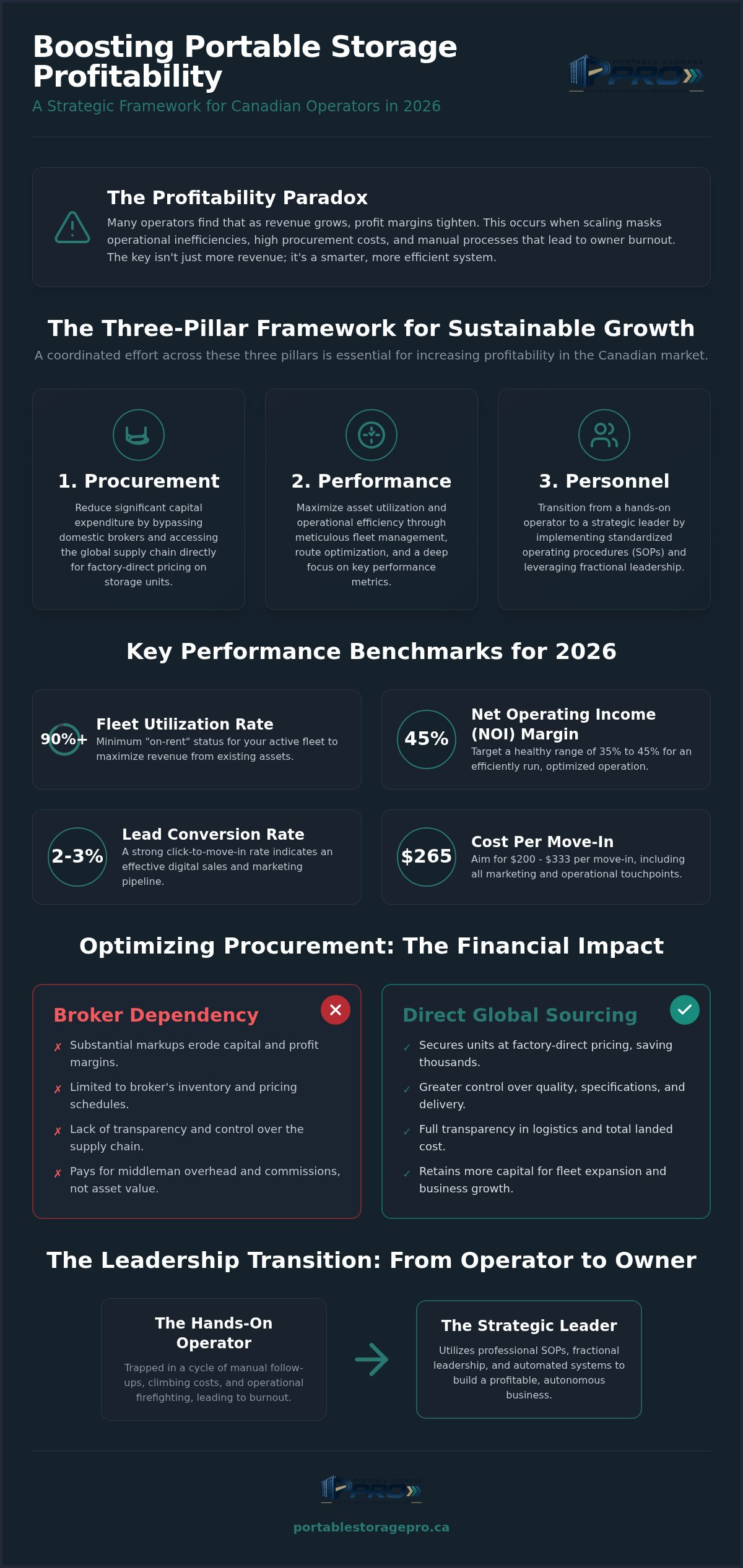
Profitability in this sector isn't a static number. It's the result of a coordinated effort across three distinct pillars: Procurement, Performance, and Personnel. While monthly rental fees provide the top-line revenue, increasing portable storage business profitability requires a rigorous focus on the backend expenses that often go unnoticed during periods of rapid growth. Many independent operators find that as they scale, their margins actually tighten. This paradox occurs because revenue growth can mask operational inefficiencies. Without a "Three-Pillar" framework, you're likely overpaying for units, underutilizing your fleet, or relying on manual processes that burn out your staff. In regional Canadian markets, where logistics costs are high due to distance and seasonal weather, asset utilization becomes the primary driver of success.
Revenue vs. Profit: The Portable Storage Distinction
To calculate the true cost of a unit, you must look beyond the purchase price. You have to factor in depreciation, routine maintenance, and the total logistics cost of the delivery and retrieval cycle. Hidden costs like fuel surcharges, driver downtime, and specialized insurance for rented containers can quickly erase your gains. While the self-storage industry often focuses on real estate metrics, portable storage is an asset-heavy logistics business that requires a different analytical approach. For 2026, the net profit margin for a well-run portable storage enterprise typically ranges from 35 per cent to 45 per cent, depending on the efficiency of the delivery model and the removal of middleman procurement costs.
Benchmarking Your Storage Business Performance
Independent Canadian operators should benchmark their performance against industry standards to identify where they're leaving money on the table. A healthy cost per move-in for 2026 sits between $200 and $333, a figure that includes both marketing and operational touchpoints. Local competition often dictates pricing ceilings, so your primary lever for increasing portable storage business profitability is reducing internal operational costs rather than simply raising rates. Key metrics to monitor include:
- Utilization Rate: Aim for a minimum of 90 per cent "on-rent" status for your active fleet.
- Net Operating Income (NOI) Margins: Target 35 to 45 per cent for optimized facilities.
- Lead Conversion Rate: A 2 to 3 per cent click-to-move-in rate indicates a strong digital sales pipeline.
- Procurement Efficiency: The percentage of unit cost saved by bypassing brokers for direct global sourcing.
By focusing on these specific data points, you can organize your business to thrive even when market demand fluctuates. This logical progression from raw revenue to refined profit margins is what separates seasonal operators from scalable enterprises.
Optimizing Procurement: Removing Middleman Markups
Procurement is often the most significant capital expenditure for any storage operator. However, many independent businesses rely on domestic brokers who add substantial markups to every unit purchased. These markups don't represent added value; they're simply the price of access. By bypassing these intermediaries, you can retain more capital for increasing portable storage business profitability. Accessing the global supply chain directly allows you to secure units at factory-direct pricing, which can save thousands of dollars on a single fleet expansion. In a volatile market, these savings provide the necessary buffer to navigate fluctuating interest rates and seasonal demand shifts.
Direct Sourcing vs. Broker Dependency
Relying on brokers often means you're at the mercy of their inventory and pricing schedules. Direct sourcing requires a deeper understanding of international logistics, but it offers far greater transparency and control. You don't need massive volume to benefit from direct factory relationships if you leverage professional procurement consulting. This approach ensures you aren't paying for a broker's overhead or commissions. According to an SBA industry overview of self-storage, understanding market segments and supply chains is vital for long-term viability. For independent operators, this means moving toward a model where every dollar spent on a container is an investment in a high-quality asset rather than a fee paid to a middleman. If you're looking to refine your acquisition strategy, our Procurement & Sourcing experts can help you establish these direct connections.
Total Cost of Ownership (TCO) in Fleet Expansion
Strategic procurement also involves looking at the total cost of ownership over a ten-year horizon. It's not just about the initial purchase price. You must account for transport costs, port fees, and the specific build quality required for the Canadian climate. Using high-specification units with proper ventilation and rust-resistant coatings reduces long-term maintenance expenses. Implementing strict quality control measures during international sourcing prevents the arrival of substandard units that require immediate repair. Maintaining asset value requires a disciplined approach to maintenance SOPs. Regular inspections for floor integrity and door seal performance ensure your fleet remains on-rent longer, directly increasing portable storage business profitability. By timing your fleet expansion to avoid peak shipping seasons, you can further reduce your per-unit capital expenditure and improve your overall return on investment.
Maximizing Fleet Utilization and Operational Efficiency
Every day a container sits empty in your yard, it's costing you money. We call this "idle iron." In a traditional self-storage facility, an empty unit just waits for a tenant. In the portable sector, an empty unit represents a failure in logistics. Maintaining a utilization rate of 90 per cent or higher is the gold standard for increasing portable storage business profitability. Achieving this requires more than just a steady stream of customers. It demands a disciplined approach to how those units move through the field and a commitment to minimizing the time between rentals.
Logistics: The Silent Profit Killer
Logistics expenses can quickly consume your margins if you don't monitor them closely. You must calculate the exact break-even distance for every delivery. If a drop-off requires three hours of drive time but only nets a standard monthly fee, you might be losing money once you factor in fuel, vehicle wear, and labour. Densifying your service area is a key strategy for 2026. Instead of chasing single leads in outlying rural areas, focus your marketing on specific clusters. This allows one driver to handle multiple drops and pickups in a single shift. Training your staff to handle units with care is equally vital. Rough handling leads to structural damage and cosmetic issues that require expensive repairs. A well-trained team ensures the asset remains in prime condition for its entire lifecycle.
Professionalizing Operations Through SOPs
Undocumented processes are the primary cause of operational leakage. When drivers or office staff rely on memory, mistakes happen. These errors range from missed billing cycles to incorrect unit placements. Every portable storage business needs a set of core SOPs & Compliance to ensure consistency across the board. These procedures should cover everything from the initial lead intake to the final unit inspection upon retrieval. Standardizing these steps allows you to scale without the owner needing to oversee every move.
Technology now plays a central role in automating these logistics. Using GPS tracking and integrated inventory management software allows you to see exactly where your assets are in real-time. This visibility is essential for increasing portable storage business profitability because it allows you to react quickly to new opportunities. You can optimize your routes on the fly, reducing fuel consumption and ensuring your fleet is always where the demand is highest. Professionalizing your operations in this way creates a "hands-off" model that is much easier to scale.
High-Conversion Sales and Lead Generation Strategies
Generating traffic is only half the battle. If your marketing budget is spent on generic awareness without a clear path to conversion, you're effectively subsidizing your competitors' market research. To truly excel at increasing portable storage business profitability, you must pivot toward high-intent lead generation. This means targeting consumers at the exact moment they require a solution, whether they are navigating a residential move in a growing Canadian suburb or managing inventory overflow for a commercial enterprise. A well-constructed sales funnel should convert at double the industry average by addressing the specific psychological triggers of these two distinct groups.
Capturing High-Intent Leads in Your Local Market
The modern storage tech stack is the backbone of lead management. Relying on manual spreadsheets or unmonitored voicemail boxes leads to rapid lead decay. Research indicates that a healthy cost per move-in for 2026 sits between $200 and $333, but this figure assumes you are actually closing the leads you pay for. Response time is the single most critical factor in closing a rental. If you don't respond within minutes, the prospect has already called the next provider on the list. Automated follow-up systems ensure no lead is forgotten, capturing revenue that would otherwise be lost to the competition. Our Sales, Marketing & Lead Generation services help you build these automated pipelines to ensure consistent occupancy.
Sales Training for Storage Teams
Your team should not be simple order takers. They must act as proactive consultants who understand the logistical challenges your clients face. This shift in perspective is vital for increasing portable storage business profitability. When a customer raises a price objection, a trained salesperson doesn't just offer a discount. They highlight the value of high-specification units and the reliability of the delivery systems discussed in previous sections. Incentivizing your staff for long-term contract renewals and upsells, such as premium insurance coverage, turns every phone call into a growth opportunity. Handling objections with data-backed confidence allows you to maintain your price floor even in competitive secondary markets. This professionalized approach to sales ensures your marketing spend translates directly into sustained net operating income.
Scaling with Professional Operational Leadership
Transitioning from an owner-operator to a strategic business owner is the final hurdle in increasing portable storage business profitability. Most independent operators start by wearing every hat, from driver to dispatcher. While this is necessary during the initial launch, it eventually creates a ceiling for growth. True scaling requires you to step back from the daily tactical decisions and focus on the high-level systems that drive long-term value. This shift allows you to organize your enterprise around repeatable processes rather than personal effort. It's the difference between owning a job and owning a scalable asset.
The Value of Fractional Expertise
Accessing C-suite operational leadership used to be reserved for large-scale franchises with massive budgets. Today, independent fleets can utilize fractional management to gain the same level of industry-specific competence without the burden of a full-time executive salary. This model provides an objective audit of your current operations to identify immediate profit gains that you might have missed while being "in the weeds" of daily deliveries. By delegating the granular details of logistics and SOP compliance to a fractional specialist, you can focus on your primary revenue generator: the customer. This ensures your business remains responsive to market shifts while maintaining the steady reliability required for increasing portable storage business profitability.
Staying competitive in 2026 also requires representation at global industry conferences and within international supply chains. Individual operators often lack the time to maintain these high-level connections. Leveraging professional industry representation ensures your business stays ahead of emerging trends, from new container specifications to shifting federal regulations regarding hazardous materials and lithium-ion battery transport. This proactive innovation keeps your fleet relevant and your margins protected from sudden regulatory shocks.
Building a Future-Proof Storage Enterprise
A truly profitable business is one that is built to be sold, even if you have no immediate plans to exit. Preparing for an eventual acquisition requires a level of documentation and financial clarity that many independent firms lack. By adopting our Growth Engagement Model, you create a roadmap for sustainable scaling that prioritizes asset value and operational autonomy. Innovation and technology are not just tools for efficiency; they are the foundation of long-term profitability and business resilience in the Canadian market.
The ultimate goal is to move toward a model where the business functions independently of the owner’s constant presence. This level of professionalization makes your enterprise more attractive to investors and provides you with the freedom to choose your next move. If you're ready to move beyond the daily grind and secure your company's future, it's time to Scale your storage business with Portable Storage Pro.
Securing Your Competitive Advantage in 2026
The landscape of the Canadian storage market is shifting toward those who prioritize operational precision over simple expansion. By removing middleman markups and implementing rigorous fleet utilization strategies, you've already taken the first steps toward increasing portable storage business profitability. Sustainable growth isn't about working more hours. It's about building a resilient system that functions independently of the owner's constant oversight.
Professionalizing your enterprise requires a structured roadmap. Our Growth Engagement Model provides direct global supply chain access, specialized SOP templates, and fractional operational leadership to bridge the gap between owner-operator and strategic leader. You don't have to navigate complex logistics or procurement hurdles in isolation. When you align your ambition with proven systems, scaling becomes a predictable outcome rather than a daily struggle. Optimize your storage business profitability with Portable Storage Pro and take control of your company's future today.
Frequently Asked Questions
What is the average profit margin for a portable storage business?
Average profit margins for a well-run facility typically range between 35 per cent and 45 per cent. While some operators report margins as high as 60 per cent, these figures often depend on the efficiency of the delivery model and the elimination of middleman fees. Tracking your Net Operating Income (NOI) is the most reliable way to measure these gains. Smaller independent firms often see lower margins initially due to higher procurement and logistics costs.
How can I reduce my container procurement costs?
Reducing container costs requires bypassing domestic brokers who add significant markups to every unit. By leveraging a global supply chain, you can access factory-direct pricing that is otherwise unavailable to independent operators. Specialized procurement consulting helps you manage these international logistics without needing massive volume. This approach ensures your capital is invested in high-quality assets rather than paying for a middleman's overhead. It's a vital step for long-term growth.
Is it better to source containers directly or through a broker?
Sourcing containers directly is generally the superior choice for increasing portable storage business profitability because it removes unnecessary layers of cost. Brokers offer convenience but at a premium that erodes your long-term margins. Direct sourcing provides greater transparency regarding build quality and specifications. While it involves more complex logistics, professional guidance can streamline the process and ensure you receive units that meet Canadian climate standards without paying broker commissions.
What are the most important KPIs to track for storage profitability?
Focus on KPIs that reflect the movement of your assets rather than just occupancy. Key metrics include your fleet utilization rate, cost per move-in, and net operating income margin. You should also monitor your lead conversion rate to ensure your marketing spend is performing. Tracking the "break-even" distance for deliveries is another vital metric for 2026. These data points provide the clarity needed to make informed strategic decisions and identify operational leakage.
How does fleet utilization impact my bottom line?
Fleet utilization directly determines your cash-on-cash returns. An empty unit represents "idle iron" that generates no revenue while still incurring storage and depreciation costs. Aiming for a utilization rate of 90 per cent or higher ensures your assets are working at maximum capacity. High utilization offsets the fixed costs of your vehicles and staff. It is a fundamental component of increasing portable storage business profitability in competitive regional markets where logistics costs are high.
Can I manage a portable storage business "hands-off"?
You can achieve a "hands-off" model by implementing standardized operating procedures and fractional leadership. Professional SOPs ensure that every task, from lead intake to unit retrieval, is handled consistently without your direct intervention. Fractional operational management provides the C-suite expertise required to oversee the business while you focus on high-level growth. This transition allows the owner to step back from the daily grind while maintaining steady reliability and focused ambition for the enterprise.
How do I improve my lead conversion rate for storage rentals?
Improving conversion rates starts with minimizing response time. Modern consumers expect a reply within minutes, not hours. Implementing automated follow-up systems ensures that no high-intent lead is lost during the initial inquiry phase. You should also train your team to move beyond "order taking" and provide proactive sales consultation. A well-optimized digital funnel should see a 2 to 3 per cent conversion rate from clicks to move-ins in the current market.
What technology should I include in my storage business tech stack?
Your tech stack should centre on an integrated CRM and inventory management platform. GPS tracking for your fleet is essential for route optimization and real-time asset visibility. Automated billing and digital leasing platforms reduce administrative labour and improve the customer experience. Technology and innovation consulting can help you identify specific tools that integrate seamlessly. These systems provide the data-driven insights necessary to organize and scale your operations effectively while maintaining control over costs.

Article by
Paul Taylor
Paul Taylor is the founder of Portable Storage Pro, bringing more than 35 years of experience across the container, portable storage and transportation industries. His background spans executive operations, business development, global procurement, sales, marketing and operational improvement in Canada, the UK and international markets.
Paul helps independent portable storage and container rental operators increase revenue, strengthen margins and build more efficient businesses. His work connects strategy with practical implementation, including pricing, delivery operations, supplier sourcing, staff training, technology and customer experience.
His experience includes leading multi-location storage operations and serving on the National Portable Storage Association’s board along with chairing its Canadian committee. Through Portable Storage Pro, Paul shares practical insights to help owners make informed decisions, solve operational challenges and grow profitably.
Disclaimer
Content published by Portable Storage Pro Inc. (PSP) provides general business information and industry insights. It does not replace advice tailored to your business or specialist legal, tax, engineering or other regulated advice. Reading this content or contacting PSP does not, by itself, establish a consulting engagement.
Information reflects circumstances at publication and may change. Examples and potential benefits are illustrative; results depend on individual circumstances, implementation and market conditions and are not guaranteed.
Client services are governed by the signed service agreement, agreed work plan and written amendments. Website and blog content do not amend those terms. PSP’s work is subject to applicable law and the professional commitments set out in its agreement, including the CMC-Canada Code of Professional Conduct and NPSA Code of Conduct and Ethics. Copies are available on request.
Views expressed are PSP’s own. Association membership or references do not imply association endorsement or CMC certification. Nothing in this disclaimer limits PSP’s contractual responsibilities, professional duties or rights that cannot lawfully be excluded.


