
The most profitable decision for your company isn't just buying more boxes; it's often deciding how you buy them and who manages the process. To professionalize your operations and compete with national brands, you must transition from a hands-on operator to a strategic leader who masters direct procurement and standardized systems. Implementing portable storage business best practices allows you to bypass middleman markups and eliminate operational friction. You likely feel the pressure of rising unit costs and inconsistent sales results. These are symptoms of a system that needs refinement.
This article provides a high-level operational framework and the procurement secrets needed to scale your independent brand with professional authority. We'll explore how to reduce costs through direct sourcing and professionalize your sales team with automated lead management. By the end of this guide, you'll have a clear roadmap for moving beyond the owner-operator model to build a more resilient, systems-driven business.
Key Takeaways
- Identify the operational ceiling that limits independent growth and learn how to transition from a tactical operator to a strategic business leader.
- Discover how to lower unit costs by implementing portable storage business best practices through direct global supply chain relationships.
- Replace manual processes with a modern technology stack that automates lead management and optimizes fleet logistics for better utilization.
- Establish standard operating procedures to professionalize your sales team and ensure consistent service quality across your entire operation.
- Understand how the Growth Engagement Model provides the structured framework necessary to move beyond the owner-operator model.
The Operational Ceiling: Why Storage Operators Must Professionalize
Every independent founder eventually hits a plateau where manual oversight no longer supports expansion. This is the operational ceiling. It's the point where your personal capacity to manage logistics, sales, and procurement becomes the primary bottleneck for the company. Breaking through this barrier requires a fundamental shift from tactical box renting to strategic operational leadership. You're no longer just moving intermodal containers; you're managing the systems that ensure those units generate maximum yield.
Defining Operational Leadership in Storage
The industry is shifting toward a management model that prioritizes data over intuition. Independent operators don't need the massive overhead of national brands to achieve this level of sophistication. By utilizing fractional expertise in procurement and marketing, you can access the same level of professional authority as the industry giants. Operational leadership is the integration of global supply chains and local logistics. This approach allows you to step back from the yard and focus on high-level strategy and market positioning.
The Risks of Stagnant Systems
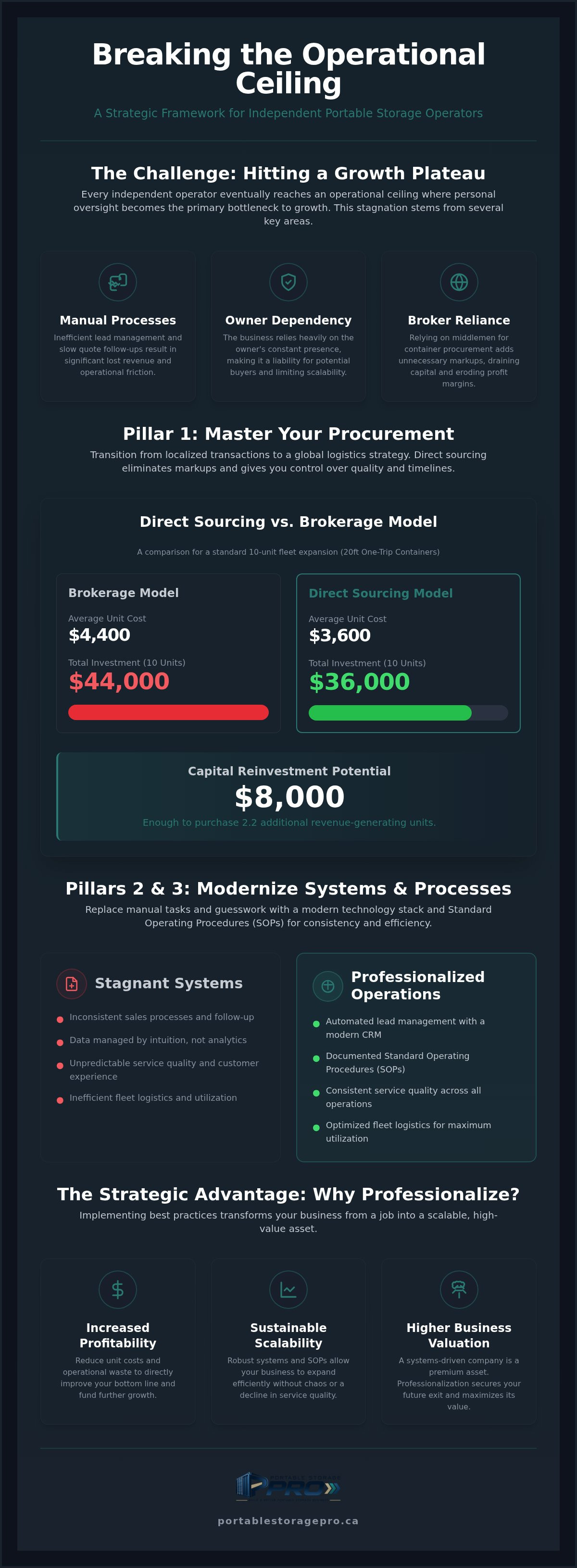
Stagnant systems carry heavy costs that aren't always visible on a balance sheet. Inefficient lead management and slow quote follow-up often result in a significant loss in potential revenue. If your team doesn't have a structured sales process, they're likely missing high-intent leads. Another risk is the reliance on third-party brokers for units. Middleman markups on container procurement drain capital that should be used for fleet expansion. Portable Storage Pro helps operators remove these unnecessary layers through direct sourcing relationships. Scaling without established standard operating procedures leads to operational friction and inconsistent service quality. Adopting portable storage business best practices is the only way to ensure your growth remains profitable.
Professionalization also secures your future exit. A business that depends on the owner's constant presence is a liability to a potential buyer. Investors and acquirers pay a premium for companies with documented SOPs, automated workflows, and direct supply chains. Implementing these portable storage business best practices transforms your business into a scalable asset. It increases your valuation and ensures that when you're ready to sell, the company can thrive without you.
Procurement Best Practices: Optimizing the Global Supply Chain
Independent operators often view procurement as a localized transaction, yet the most successful firms treat it as a global logistics exercise. To implement portable storage business best practices, you must move beyond local brokers and establish direct relationships with suppliers. In 2026, the shipping container market has stabilized, but one-trip 20-foot units still command $3,500 to $4,500. Reliance on middlemen adds unnecessary markups that erode your margins and slow your ability to reinvest in new inventory.
Direct Sourcing vs. Brokerage Models
The true cost of a brokerage model isn't just the higher unit price; it's the lack of control over quality and delivery timelines. By utilizing professional procurement services, independent Canadian and American operators gain access to global supply chains once reserved for national giants. The following table illustrates the potential capital efficiency gained by moving to a direct sourcing model for a standard 10-unit fleet expansion.
| Metric | Brokerage Model | Direct Sourcing Model |
|---|---|---|
| Avg. Unit Cost (20ft One-Trip) | $4,400 | $3,600 |
| Markup/Sourcing Fee | Included in Price | $0 Markup (Consulting Model) |
| Total Investment (10 Units) | $44,000 | $36,000 |
| Capital Reinvestment Potential | $0 | $8,000 (2.2 additional units) |
Inventory Management and Fleet Auditing
Maintaining a high-quality fleet requires more than just buying the right boxes. It involves rigorous, standardized audits to track depreciation and unit ROI across multiple locations. Organizations like the National Portable Storage Association emphasize the importance of industry standards for safety and maintenance. To ensure your fleet remains a high-yielding asset, follow this procurement readiness checklist:
- Quality Verification: Confirm units meet "Cargo Worthy" or "One-Trip" standards before final release.
- Landed Cost Analysis: Calculate total cost including ocean freight, drayage, and storage fees.
- Standardized Paint & Branding: Ensure all new units match your professional brand profile upon arrival.
- Digital Asset Tagging: Integrate unit serial numbers into your logistics software immediately.
- Maintenance Scheduling: Document a 12-month inspection cycle for door seals and floor integrity.
Standardizing your procurement process through these portable storage business best practices professionalizes your brand identity. When every unit in your yard meets a specific quality threshold, it signals professional authority to your customers. Proper tracking of unit-level ROI helps you decide exactly when to retire older assets and reinvest in newer models. This methodical approach to asset management is a cornerstone of sustainable growth in the portable storage sector.
Technology and Innovation: The Modern Storage Tech Stack
The transition from manual logbooks to cloud-based logistics platforms marks the divide between struggling independents and scalable enterprises. Relying on paper records or basic spreadsheets introduces human error and limits your ability to manage a growing fleet. Modern portable storage business best practices dictate the use of integrated software that handles inventory, yard flow, and customer billing within a single environment. This digital shift allows operators to automate the customer journey from the initial lead generation to the final container pickup.
Core Systems for Scalable Logistics
Scalable operations require software that provides real-time visibility into fleet utilization. When sales and operations are integrated, you reduce the friction of manual communication and minimize empty repositioning trips. This connectivity ensures that your dispatchers know exactly which units are ready for deployment without calling the yard manager. Technology is the bridge between a local yard and a national operation. By adopting digital supply chain best practices, you can ensure that your logistical technology supports broader business efficiency and sustainability goals.
Implementing IoT and GPS tracking is no longer optional for high-value assets. Cellular trackers typically cost between $100 and $400 per unit, with monthly service fees ranging from $7 to $25 per device. These tools provide geofencing capabilities that alert you if a unit moves without authorization, protecting your capital investment. Data analytics from these systems help optimize delivery routes, which directly reduces fuel costs and labour expenses. Precise tracking ensures you aren't wasting hours searching for specific units or losing track of long-term rentals.
Digital Transformation and Lead Management
Capturing high-intent leads requires automated marketing funnels and a centralized CRM. Independent operators often lose revenue because they don't have a standardized way to follow up with quotes. A professionalized sales team needs a system that tracks lead conversion metrics and identifies where potential customers drop off in the funnel. Comparing manual tracking to automated systems usually reveals a significant gap in ROI. Portable Storage Pro helps operators implement these portable storage business best practices through our Technology & Innovation Consulting, ensuring your digital infrastructure supports your growth targets.
Sales and Marketing Excellence for Portable Storage
Independent operators often fall into the trap of treating their service as a commodity. When you compete solely on price, you erode your margins and invite price-sensitive customers who offer low lifetime value. Developing portable storage business best practices in sales requires a shift toward professional authority. Your team should act as consultants who understand the logistical challenges of their clients, rather than simple order takers. This approach justifies premium pricing and builds long-term loyalty by solving complex storage problems.
Building a High-Performance Sales Team
Training your staff to handle high-intent leads is a critical component of professionalization. Most storage sales calls are treated as transactional enquiries. To improve conversion rates, you must implement rigorous scripting that addresses specific objections regarding delivery radius, site preparation, and security. Moving from a passive stance to proactive consultation allows your team to identify upsell opportunities, such as premium locks or climate-controlled units. For a deeper look at margin improvement, see our guide on Maximizing Portable Storage Profits: 2026 Canadian Guide.
Strategic Marketing and Lead Generation
Marketing for portable storage should prioritize measurable ROI over generic brand awareness. National competitors often have massive budgets for broad awareness campaigns, but independent operators can outmanoeuvre them through industry-specific SEO. By targeting localized, high-intent search terms, you can capture leads at the exact moment they realize a need for storage. Identifying your most profitable customer segments, such as restoration contractors or seasonal retail businesses, allows for more efficient capital allocation. Learn more about capturing these opportunities in our resource on Portable Storage Lead Generation: The 2026 Canadian Operator’s Guide.
The Growth Engagement Model at Portable Storage Pro integrates these sales and marketing tactics into a cohesive framework. We focus on generating high-quality leads that fit your specific operational capacity and equipment type. By standardizing your lead management process, you ensure that no enquiry is wasted and every marketing dollar contributes to fleet utilization. Adopting these portable storage business best practices ensures your marketing efforts are an investment in growth rather than a sunk cost. If you're ready to professionalize your sales process, consider how our Sales, Marketing & Lead Generation services can help you scale.
Standardizing Success: SOPs and the Growth Engagement Model
Scaling a business from 50 units to 500 requires more than just capital; it requires absolute consistency. Every expansion adds operational friction if you lack documented processes. Implementing portable storage business best practices through Standard Operating Procedures (SOPs) ensures your brand promise remains intact regardless of who is operating the tilt-deck or answering the phone. Without these systems, growth often leads to a decrease in service quality and an increase in owner burnout.
Developing Robust SOPs
Documented procedures must cover every facet of your business. This includes yard flow management, container inspection protocols, and precise delivery instructions. When you write these steps down, you create a compliance and risk mitigation framework that protects your assets and your reputation. Training staff on these safety standards ensures fleet readiness and reduces the likelihood of costly accidents or damaged units. These systems significantly reduce the labour burden on the business owner. By delegating the operational details to a manual, you enable the business to scale without your constant physical presence at the yard.
Leveraging the Growth Engagement Model
Many independent operators lack the time to develop these frameworks from scratch while managing daily logistics. The Growth Engagement Model at Portable Storage Pro provides fractional operational leadership to bridge this gap. This model allows you to access global supply chain connections and preferred supplier pricing without the logistical burden of international travel. You receive expert guidance on SOP development and staff training, which are essential portable storage business best practices for sustainable growth. This partnership provides the high-level oversight needed to move beyond the owner-operator model.
The ultimate goal of professionalization is transitioning to an executive oversight role. A hands-off management style is only possible when the business operates on a self-correcting system of procedures and data. This shift allows founders to focus on high-level acquisitions or market expansion rather than the minutiae of daily repairs or routing. It transforms a demanding job into a valuable, sellable asset. If you're ready to professionalize your operation and reclaim your time, Explore the Growth Engagement Model at Portable Storage Pro today.
Transitioning to Strategic Operational Leadership
Building a resilient storage company requires a deliberate move away from daily yard management and toward high-level strategic oversight. By adopting portable storage business best practices, you transition from a tactical operator to an executive leader who controls costs through direct procurement and scales through automated systems. Establishing documented SOPs and a centralized lead management framework ensures your business remains a valuable, sellable asset rather than a role that depends on your constant presence.
Portable Storage Pro provides the specialized consulting and fractional operational leadership needed to bridge this gap. Our partners benefit from direct access to a global supply chain without middleman markups; this ensures your capital is always working efficiently to grow your fleet. Whether you're refining your sales process or optimizing your modern tech stack, the goal is to build a predictable, professional operation that thrives in any market condition. This season of growth demands a framework that supports your ambition without increasing your personal labour burden.
If you're ready to remove operational friction and build a more profitable future, Partner with Portable Storage Pro to scale your operations. Your path to professional authority starts with a single strategic shift.
Frequently Asked Questions
What are the best practices for scaling a portable storage business?
Scaling requires a shift from manual oversight to a systems-driven framework that prioritizes operational consistency. Successful operators focus on professionalizing their sales teams, automating lead management, and securing direct supply chain access. These portable storage business best practices, supported by Portable Storage Pro, ensure that your brand promise remains intact as your fleet grows. By delegating tasks to documented procedures, you free up capacity for market expansion.
How can independent storage operators reduce container procurement costs?
Independent operators can reduce unit costs by bypassing local brokers and establishing direct relationships with global manufacturers. Working with a consultant like Portable Storage Pro provides access to these supply chain connections without the added burden of middleman markups. This approach allows you to purchase units at landed costs, significantly improving your revenue per unit. Direct sourcing also ensures better control over inventory quality and delivery timelines for your fleet.
What technology is essential for a modern portable storage business?
A modern storage business requires an integrated tech stack that includes cloud-based logistics software, a centralized CRM, and GPS tracking for high-value assets. These tools automate the customer journey from the initial quote to the final container pickup. Implementing IoT sensors for geofencing protects your capital investment and provides real-time visibility into fleet utilization. Data analytics from these systems help optimize delivery routes, which directly reduces fuel and labour expenses.
Why are Standard Operating Procedures (SOPs) critical for storage growth?
Standard Operating Procedures are essential for maintaining service quality and mitigating risk as you scale beyond a single location. Documented procedures for yard flow, container inspections, and delivery ensure that every team member follows the same safety and compliance standards. SOPs reduce the labour burden on the founder by creating a self-correcting system. This structure is necessary for business owners who want to transition to a more hands-off, executive oversight role.
What is the difference between direct container sourcing and using a broker?
Direct sourcing involves purchasing containers straight from manufacturers or global suppliers, while brokers act as intermediaries who add a markup to the unit price. Direct relationships provide lower landed costs and greater transparency regarding container quality. Brokers might offer convenience for single-unit purchases, but they lack the strategic value of a global supply chain. Portable Storage Pro helps operators navigate these international logistics to secure the best rates without added overhead.
How do I improve lead conversion for my portable storage sales team?
Improving lead conversion starts with implementing a centralized CRM to track every enquiry and automate quote follow-ups. Your sales team should be trained to move beyond order taking and act as professional consultants who address specific customer objections. Tracking conversion metrics allows you to identify where potential clients are dropping out of your marketing funnel. Using portable storage business best practices in sales ensures that high-intent leads are handled with professional authority.
What are the benefits of fractional operational leadership in this industry?
Fractional operational leadership provides independent operators with access to senior-level industry expertise without the high cost of hiring full-time executives. This model, offered by Portable Storage Pro, allows you to leverage specialist knowledge in procurement and marketing for a fraction of the overhead. It provides the strategic oversight needed to professionalize your operations while you maintain ownership. This partnership helps founders turn high-level priorities into tangible operating changes.
How does global supply chain access benefit small to mid-sized operators?
Global supply chain access allows small and mid-sized operators to compete with national brands by securing inventory at wholesale prices. It eliminates the reliance on local resellers who often have limited stock and higher markups. Through international conference representation and direct supplier connections, smaller businesses can maintain a steady flow of high-quality units. This access is a critical component of a professionalized procurement strategy, allowing for rapid fleet expansion without increasing internal staff.

Article by
Paul Taylor
Paul Taylor is the founder of Portable Storage Pro, bringing more than 35 years of experience across the container, portable storage and transportation industries. His background spans executive operations, business development, global procurement, sales, marketing and operational improvement in Canada, the UK and international markets.
Paul helps independent portable storage and container rental operators increase revenue, strengthen margins and build more efficient businesses. His work connects strategy with practical implementation, including pricing, delivery operations, supplier sourcing, staff training, technology and customer experience.
His experience includes leading multi-location storage operations and serving on the National Portable Storage Association’s board along with chairing its Canadian committee. Through Portable Storage Pro, Paul shares practical insights to help owners make informed decisions, solve operational challenges and grow profitably.
Disclaimer
Content published by Portable Storage Pro Inc. (PSP) provides general business information and industry insights. It does not replace advice tailored to your business or specialist legal, tax, engineering or other regulated advice. Reading this content or contacting PSP does not, by itself, establish a consulting engagement.
Information reflects circumstances at publication and may change. Examples and potential benefits are illustrative; results depend on individual circumstances, implementation and market conditions and are not guaranteed.
Client services are governed by the signed service agreement, agreed work plan and written amendments. Website and blog content do not amend those terms. PSP’s work is subject to applicable law and the professional commitments set out in its agreement, including the CMC-Canada Code of Professional Conduct and NPSA Code of Conduct and Ethics. Copies are available on request.
Views expressed are PSP’s own. Association membership or references do not imply association endorsement or CMC certification. Nothing in this disclaimer limits PSP’s contractual responsibilities, professional duties or rights that cannot lawfully be excluded.


