
Scaling a portable storage business is not primarily a marketing challenge; it's a procurement and systems challenge. You've likely felt the mounting pressure of high unit procurement costs and the operational bottlenecks that emerge the moment your fleet begins to grow. It's a common plateau where finding reliable staff and maintaining consistent training systems feels like a constant uphill battle. You're working harder, yet the professionalized, self-sustaining operation you envisioned remains just out of reach.
To break through this ceiling, you need a disciplined portable storage expansion strategy that prioritizes global supply chain access, operational leadership, and integrated technology. This guide will help you master the complexities of scaling while protecting your margins. We'll examine how to lower unit acquisition costs by removing middleman markups and how to implement the standard operating procedures required for sustainable growth. By the end of this roadmap, you'll have a clear path to building a professionalized business that generates revenue without requiring your presence on-site every day.
Key Takeaways
- Transition from an owner-operator model to a systems-led management structure to overcome the common scaling plateau that limits independent growth.
- Optimize your portable storage expansion strategy by bypassing local brokers and accessing global supply chains to reduce unit acquisition costs.
- Implement fractional operational leadership and standardized operating procedures to professionalize fleet management and eliminate growth-stalling bottlenecks.
- Audit manual processes and identify operational friction points before integrating new technology or expanding your container inventory.
- Utilize specialized engagement models to balance hands-on control with expert-led growth, ensuring the business operates efficiently without constant owner intervention.
Beyond the First Fleet: The Complexity of a Portable Storage Expansion Strategy
Expanding your fleet beyond the initial startup phase requires more than just capital; it demands a fundamental shift in business philosophy. True growth is a transition from an owner-operator model, where the founder handles every delivery and inquiry, to a systems-led management structure. This evolution is the cornerstone of a successful portable storage expansion strategy. Without this shift, you'll likely encounter the "scaling plateau." This is the point where manual tracking and local procurement through brokers no longer provide the margins needed to sustain a larger operation.
Within the broader self-storage industry, portable operators face unique logistical hurdles. Managing inventory requires choosing between a "just-in-time" model, which minimizes storage costs but risks stockouts, and a "just-in-case" model, which ensures availability but ties up significant capital. A disciplined strategy helps you find the middle ground, protecting your margins while your fleet grows. Relying on local brokers for one-trip 20ft containers at prices between $3,300 and $3,900 might work for five units, but it becomes a liability when you need fifty.
The Risks of Unstructured Growth
Unstructured growth often leads to capital inefficiency. Operators may feel pressured to buy used units simply to meet immediate demand, but purchasing low-quality inventory without a long-term procurement plan leads to high maintenance costs. Operational leakage is another significant risk. As you scale, lost leads and logistical errors compound, eating into the profits that a larger fleet should provide. Maintaining service quality while expanding your geographic footprint is difficult without standardized processes to ensure every customer receives the same high-level experience.
Why Independent Operators Need a Custom Roadmap
Independent operators often look at large national brands for inspiration, but copying a franchise business model is rarely effective. National entities operate with massive logistical infrastructure that an independent simply cannot replicate. Instead, you must focus on professionalizing your back-end systems while retaining your local brand identity. Customers value the personal touch of a local business, but they expect the efficiency of a major player. Achieving this balance requires expert oversight to implement robust standard operating procedures. By focusing on procurement and operational leadership, you can avoid the common pitfalls of staffing and inventory management that stall many growing businesses.
The Four Pillars of a Scalable Portable Storage Operation
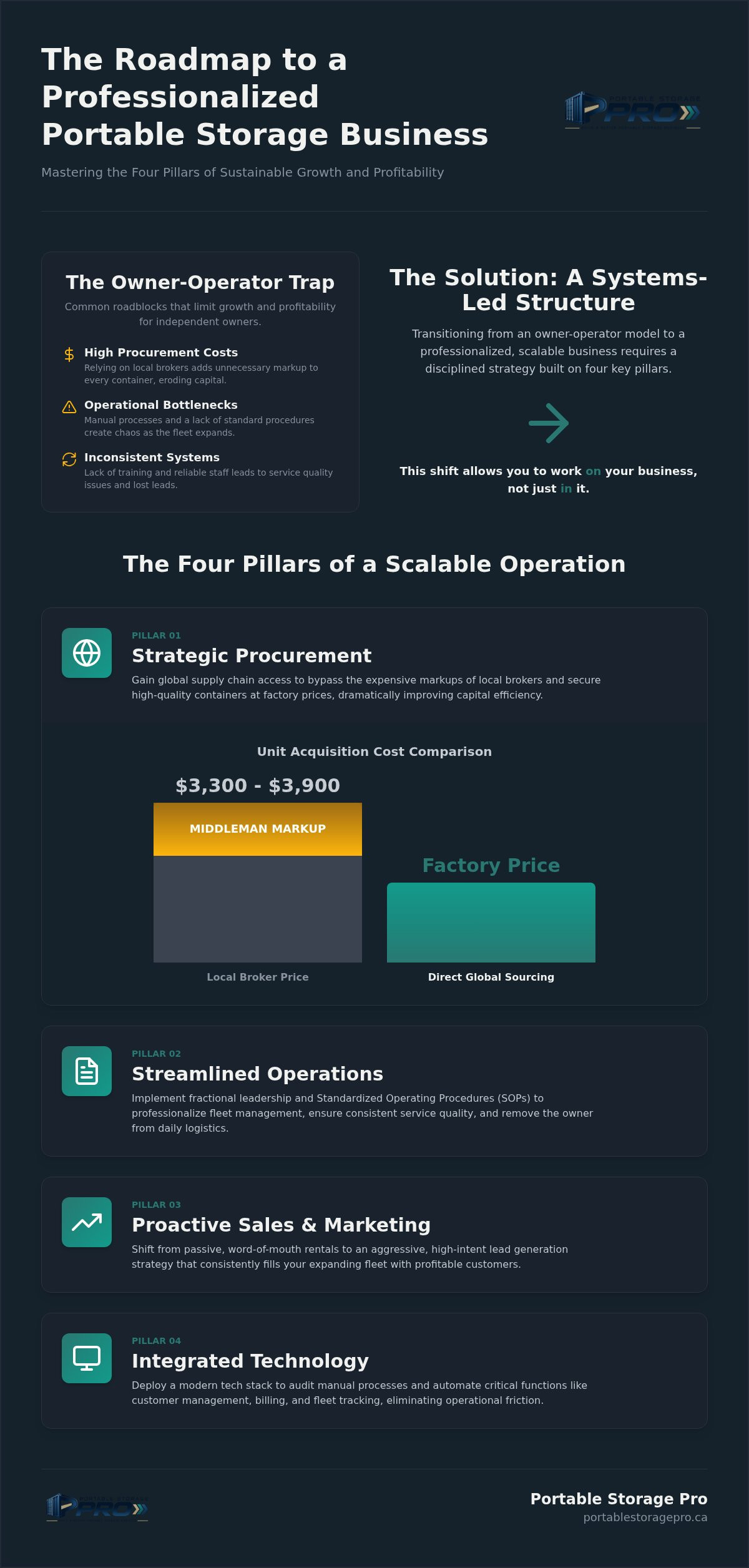
Executing a successful portable storage expansion strategy requires moving beyond reactive management. Stability comes from four structural pillars that support a growing fleet. These are not isolated departments; they are integrated functions that ensure every new container contributes to the bottom line rather than creating more work for the owner. Transitioning from a small fleet to a large-scale operation depends on how well you align these core components.
- Procurement: Gaining global supply chain access to bypass the markups of local brokers.
- Operations: Implementing fractional leadership and standardized operating procedures (SOPs) to remove the owner from daily logistics.
- Sales & Marketing: Shifting from passive, word-of-mouth rentals to aggressive, high-intent lead generation.
- Technology: Deploying a modern tech stack that automates customer management and fleet tracking.
Without these pillars, growth is often chaotic and unprofitable. Many operators find that as they add units, their overhead increases faster than their revenue. Professionalizing these four areas ensures that your business remains lean and efficient, regardless of how many containers you have in the field.
Professionalizing Your Procurement Process
Many independent operators rely on local middleman brokers for their inventory. While convenient, this approach adds unnecessary layers of cost to every unit. Direct-to-manufacturer sourcing allows you to secure containers at factory prices, significantly improving your initial capital efficiency. Beyond the purchase price, procurement impacts the longevity of your assets. Standardizing your fleet with high-quality units reduces long-term maintenance costs and ensures a professional brand image across your entire service area. Your procurement strategy serves as the foundation of your unit-level ROI.
Marketing for Expansion: Capturing High-Intent Leads
As your fleet grows, your lead generation must become more precise. Passive marketing is rarely enough to keep hundreds of units occupied. Digital transformation is essential here; you must be able to track lead conversion rates with surgical accuracy to understand your customer acquisition costs. This growth also necessitates specialized sales training for your team. Scaling requires staff who can effectively close deals and manage customer relationships, rather than just answering basic inquiries. If you are ready to professionalize these systems, exploring a Growth Engagement Model can provide the structured framework needed to scale effectively. By focusing on high-intent leads, you ensure your expansion is driven by actual market demand rather than guesswork.
Strategic Procurement: Optimizing Your Supply Chain for Growth
Procurement is the engine room of your unit-level profitability. When you scale from a handful of containers to a substantial fleet, even a 5-10% reduction in unit acquisition costs can fundamentally change your balance sheet. For an operator adding fifty new "one-trip" 20ft units, a 10% saving on a $3,500 unit price returns $17,500 to the business. This capital can then be redirected toward marketing or further inventory. A sophisticated portable storage expansion strategy recognizes that every dollar saved at the port is a dollar that compounds over the life of the asset.
Maintaining a competitive edge also requires staying informed on global supply trends. International trade conferences often dictate the price and availability of steel, yet for many independent operators, the cost and time of travel are prohibitive. Leveraging a partner who provides international conference representation ensures you have a seat at the table where supply chain decisions are made. This allows you to anticipate market shifts before they impact your local yard.
Direct Sourcing vs. Broker Markups
Traditional brokerage models often lack price transparency. While a local broker provides convenience, they frequently obscure the manufacturer's origin and the specific quality of the build. Direct sourcing eliminates these middleman markups and provides a clear window into the production process. Generic procurement often carries hidden costs that don't appear until three years into service. These include thin steel gauges or poor-quality paint that fails under the pressure of Canadian winters. By utilizing specialized Procurement & Sourcing, you can ensure your units are built to withstand harsh climates, featuring high-quality coatings and reinforced structures that protect your long-term ROI.
Navigating Port Logistics and Supply Chains
Canadian logistics present unique challenges, particularly at major hubs like Vancouver or Halifax. Seasonal fluctuations in container availability can cause lead times to balloon, often at the exact moment your expansion capital is ready to be deployed. Managing the transition from port to yard requires a deep understanding of drayage and transport logistics. Our Access Engagement Model provides independent operators with global port ties usually reserved for large national franchises. This level of access allows for precise lead-time management and reduces the administrative burden of coordinating international shipments. Professional procurement consulting ensures that your expansion doesn't stall because of logistical bottlenecks at the coast, keeping your growth trajectory consistent and predictable.
Operationalizing Growth: SOPs, Technology, and Training
Scaling a portable storage expansion strategy requires more than just adding inventory; it requires a complete overhaul of how your team functions. Many operators hit a wall because they try to manage a larger fleet using the same manual processes that worked for their first ten units. To move past this, you must follow a structured path to professionalization. This begins with a candid audit of your existing manual processes to identify precisely where bottlenecks occur, whether in delivery scheduling or billing cycles. Once these friction points are clear, you can develop robust Standard Operating Procedures (SOPs) for every customer touchpoint.
Standardization is the only way to ensure your business remains profitable as it grows. After documenting your procedures, the next step is implementing a technology stack that integrates logistics, billing, and CRM into a single source of truth. You then train your staff using a standardized model to ensure consistency across all locations. Finally, appointing fractional operational leadership allows you to bring in high-level expertise to oversee these new systems. This structure ensures the owner is no longer the single point of failure in the business.
The Role of Technology in Automated Logistics
The shift from whiteboards and spreadsheets to cloud-based logistics management is a non-negotiable part of scaling. Automated lead management allows you to improve conversion rates without increasing your administrative headcount. When your systems handle the initial inquiry and follow-up, your team can focus on high-value tasks. Technology also provides data-driven performance metrics, which are essential for tracking fleet utilization. If you don't know exactly how many days each unit sits idle, you can't accurately calculate your ROI. Modernizing your tech stack turns raw data into actionable insights, allowing you to deploy capital with confidence.
Standard Operating Procedures (SOPs) as Growth Insurance
SOPs act as insurance for your growing fleet. They mitigate risk by ensuring that every delivery and pickup is handled safely and consistently, which protects your assets and your reputation. Standardized training also reduces staff turnover; when employees have clear instructions and measurable goals, they are more likely to succeed in their roles. This professionalization directly improves customer satisfaction, as clients receive the same high-level service regardless of which staff member they encounter. The Growth Engagement Model serves as the framework for this transition, providing the disciplined structure needed to turn a collection of containers into a professionalized enterprise. To start professionalizing your internal systems, you can explore our Operations & Training services to build a foundation that supports long-term expansion.
Executing Your Expansion Strategy with Portable Storage Pro
Scaling is a complex transition. Portable Storage Pro acts as a pragmatic partner, bridging the gap between independent ambition and enterprise-level efficiency. We provide the specialized expertise needed to execute a successful portable storage expansion strategy without the overhead of a traditional franchise. Our approach focuses on removing unnecessary layers and middleman costs, ensuring that more of your rental revenue remains in your business rather than being lost to inefficient procurement or fragmented operations.
Owners can choose between "hands-on" and "hands-off" management styles depending on their long-term goals. If you prefer to stay involved in daily logistics, we provide the systems to make your work more efficient and your fleet more profitable. If your goal is to step back from the yard, our fractional operational leadership ensures the business runs smoothly without your constant intervention. This flexibility allows you to build a professionalized operation that aligns with your personal lifestyle and financial objectives.
The Growth Engagement Model in Practice
This model provides a structured framework for procurement, marketing, and operational oversight. It's designed for operators who are ready to move from a local fleet to a regional presence. Working with a straight-talking specialist ensures you receive direct, honest feedback regarding your operational health. You gain access to global supply chain ties and sophisticated lead generation tactics that are typically reserved for the largest players in the industry. We help you navigate the complexities of international shipping and port logistics while maintaining your local brand identity. For a deeper look at this framework, explore The Growth Engagement Model: Scaling Your Storage Business.
Taking the Next Step Toward a Professionalized Fleet
Your primary focus should remain on your customers and high-level growth. Portable Storage Pro manages the granular details of SOP development, technology integration, and procurement logistics. This partnership allows you to realize your expansion goals through a structured consulting engagement that prioritizes tangible outcomes over generic advice. Every engagement begins with a comprehensive performance audit. This audit identifies immediate ROI opportunities, such as reducing unit acquisition costs or plugging leaks in your sales funnel. Professionalizing your fleet is a methodical process, and we provide the roadmap to ensure your growth is both sustainable and profitable. Contact Portable Storage Pro to begin your expansion strategy today.
Realize Your Growth Potential Through Professionalized Systems
Scaling your operation beyond the initial fleet requires a disciplined shift from reactive management to a structured portable storage expansion strategy. We've explored how direct-to-manufacturer procurement and standardized operating procedures protect your margins as you grow. By professionalizing your back-end systems and leveraging global supply chain access normally reserved for the largest operators, you can compete at an enterprise level while maintaining your local brand identity.
Our specialized focus on the portable storage sector ensures you receive pragmatic advice, not generic business coaching. Implementing fractional operational leadership removes the daily burden from the owner, allowing you to focus on high-level market growth. Transitioning to a professionalized fleet is a methodical process, but it's the only way to ensure your expansion is sustainable and profitable.
Partner with Portable Storage Pro to scale your business with confidence. You have the vision for your brand; we provide the logistical and operational framework to help you realize it.
Frequently Asked Questions
What is the most critical part of a portable storage expansion strategy?
The most critical part of a portable storage expansion strategy is the transition from a hands-on owner-operator model to a systems-led management structure. You must prioritize unit-level ROI through strategic procurement and the implementation of standardized operating procedures. Without these foundations, scaling a fleet often leads to operational bottlenecks and capital inefficiency. A disciplined strategy ensures that every new container contributes to the bottom line without increasing your daily administrative burden.
How can independent operators compete with large franchises like PODS?
Independent operators compete by combining their local brand identity with enterprise-level operational efficiency. You don't need a national franchise to access global supply chains or sophisticated lead generation. By utilizing an Access Engagement Model, you can secure containers at factory prices and implement professionalized back-end systems. This approach allows you to offer the reliability of a major player while maintaining the personalized customer service that national franchises often struggle to replicate.
What are the benefits of direct container procurement over using a broker?
Direct procurement removes unnecessary middleman markups, which can reduce unit acquisition costs by 5% to 10% or more. This approach provides full transparency into unit specifications, ensuring your fleet features high-quality steel and paint suited for the Canadian climate. Brokerage models often obscure manufacturing origins, leading to hidden maintenance costs. Direct sourcing through specialized procurement services allows you to reinvest those savings into marketing or further inventory expansion to drive growth.
How much does it cost to scale a portable storage fleet in Canada?
Scaling costs vary based on fleet size and location, but one-trip 20ft containers typically range from $3,300 to $3,900 in the current market. Beyond the physical assets, you must account for delivery fees, permit costs, and the implementation of professionalized systems. Investing in a Growth Engagement Model ensures your expansion is capital-efficient. This prevents the common mistake of over-leveraging for low-quality units that carry high maintenance liabilities and lower resale value over time.
What technology is essential for a growing portable storage business?
An integrated technology stack that links logistics, automated billing, and CRM is essential for managing a growing fleet. You should move away from manual spreadsheets to cloud-based systems that track fleet utilization in real-time. This digital transformation allows you to monitor lead conversion rates and automate customer touchpoints. Data-driven performance metrics are necessary to identify idle units and optimize delivery routes, ensuring your operation remains lean as your geographic footprint expands into new territories.
Why should I use a consultant for my portable storage expansion?
A specialized consultant provides industry-specific competence that generic business coaching cannot match. Portable Storage Pro offers global supply chain ties and international conference representation, providing the benefits of global connections without the travel costs. Expert oversight helps you avoid common pitfalls in procurement, staffing, and technology implementation. This partnership allows you to navigate the granular details of operations while focusing on your primary revenue generator, which is your relationship with the customer.
What is fractional operational leadership for storage businesses?
Fractional operational leadership provides high-level management expertise without the expense of a full-time executive. This model allows independent operators to implement professionalized systems and standardized operating procedures under the guidance of a seasoned specialist. It removes the daily administrative burden from the owner, ensuring the business runs efficiently without their constant presence. You gain access to strategic oversight that professionalizes fleet management and optimizes internal workflows for sustainable, long-term revenue growth.
How do I improve lead conversion during a business expansion?
Improving lead conversion requires a shift from passive rentals to high-intent lead generation strategies. You must implement specialized sales training for your staff to ensure they can effectively close deals and manage customer relationships. Automated follow-up systems ensure that no inquiry is lost during busy periods. By tracking conversion rates with surgical accuracy, you can refine your marketing spend and ensure your portable storage expansion strategy is driven by actual market demand.

Article by
Paul Taylor
Paul Taylor is the founder of Portable Storage Pro, bringing more than 35 years of experience across the container, portable storage and transportation industries. His background spans executive operations, business development, global procurement, sales, marketing and operational improvement in Canada, the UK and international markets.
Paul helps independent portable storage and container rental operators increase revenue, strengthen margins and build more efficient businesses. His work connects strategy with practical implementation, including pricing, delivery operations, supplier sourcing, staff training, technology and customer experience.
His experience includes leading multi-location storage operations and serving on the National Portable Storage Association’s board along with chairing its Canadian committee. Through Portable Storage Pro, Paul shares practical insights to help owners make informed decisions, solve operational challenges and grow profitably.
Disclaimer
Content published by Portable Storage Pro Inc. (PSP) provides general business information and industry insights. It does not replace advice tailored to your business or specialist legal, tax, engineering or other regulated advice. Reading this content or contacting PSP does not, by itself, establish a consulting engagement.
Information reflects circumstances at publication and may change. Examples and potential benefits are illustrative; results depend on individual circumstances, implementation and market conditions and are not guaranteed.
Client services are governed by the signed service agreement, agreed work plan and written amendments. Website and blog content do not amend those terms. PSP’s work is subject to applicable law and the professional commitments set out in its agreement, including the CMC-Canada Code of Professional Conduct and NPSA Code of Conduct and Ethics. Copies are available on request.
Views expressed are PSP’s own. Association membership or references do not imply association endorsement or CMC certification. Nothing in this disclaimer limits PSP’s contractual responsibilities, professional duties or rights that cannot lawfully be excluded.


