
Why are you still paying a middleman's markup on every container when the global supply chain is more accessible than ever? Most independent operators feel the squeeze of rising broker fees and stagnant lead conversion rates while trying to keep up with national competitors. A thorough portable storage competitive analysis reveals that the gap between market leaders and local businesses isn't just about fleet size; it's about the systems at the centre of your operations. You've likely realized that working harder isn't the solution to scaling when your current model requires your constant physical presence.
It's frustrating to watch margins thin out while trying to manage a business that lacks standardized procedures. This article outlines how to professionalize your operations and optimize your supply chain using the Portable Storage Pro framework. We'll show you how to reduce unit procurement costs and implement automated lead management systems that convert inquiries into bookings. You'll get a clear look at the strategic shifts required to build a scalable business model that allows for hands-off management and sustainable growth in the 2026 market.
Key Takeaways
- Transition from a local rental operation to a global logistics framework by adopting professionalized leadership standards.
- Reduce unit procurement costs by bypassing container brokers and accessing global supply chain networks directly.
- Utilize a portable storage competitive analysis to shift focus toward high-intent commercial and industrial lead generation.
- Build a scalable business foundation with standardized operating procedures that place operational efficiency at the centre of your growth.
- Discover how the Growth Engagement Model provides fractional operational leadership to help mid-sized operators scale without excessive overhead.
Understanding the Portable Storage Pro Methodology
Scaling a portable storage business in 2026 requires more than just adding inventory to a yard. Most independent operators realize too late that owning a fleet isn't the same as running a logistics company. The Portable Storage Pro methodology is built on the reality that seasoned leadership is the primary driver of growth. While a basic overview of the self-storage industry might suggest that demand alone dictates success, a rigorous portable storage competitive analysis proves that operational efficiency is what separates market leaders from those who simply survive. This framework replaces guesswork with industry-specific oversight, moving beyond the limitations of generic business coaching.
The Shift from Operator to Strategic Owner
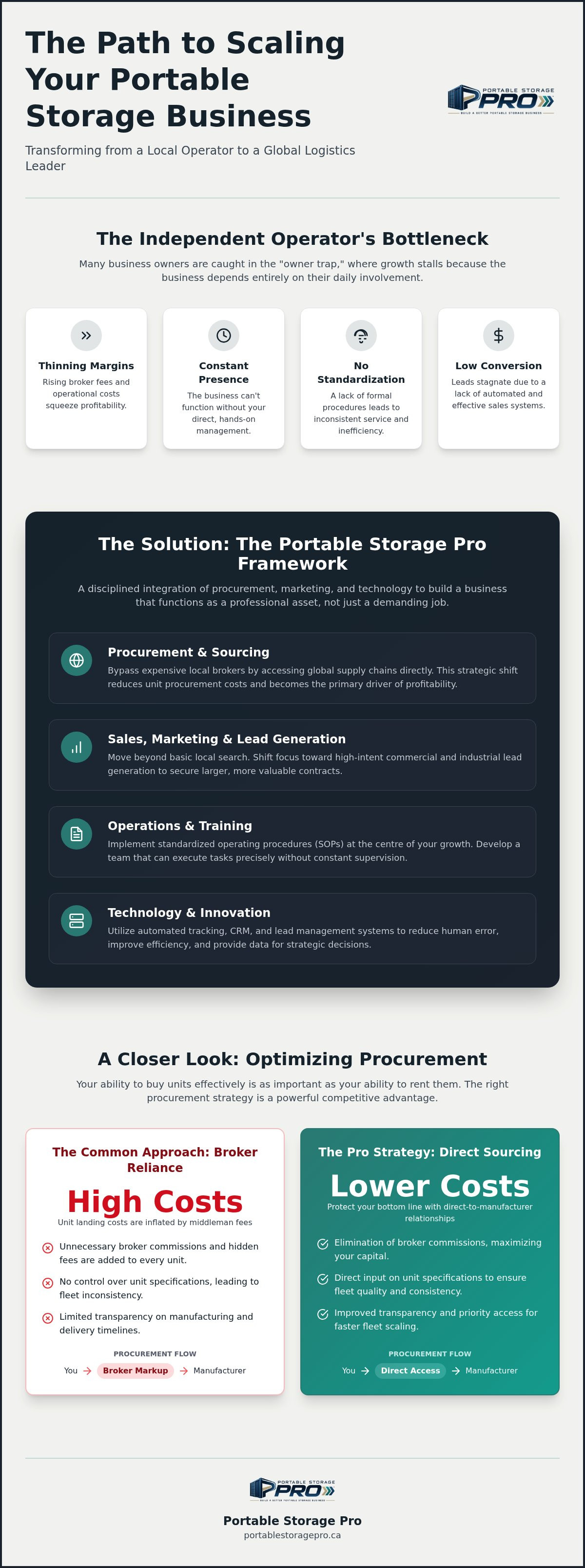
The "owner trap" is a common bottleneck where the business founder remains the primary point of contact for every delivery, maintenance issue, and customer inquiry. You can't scale while you're still micromanaging dispatch or manually tracking unit locations. Professionalizing your business means implementing systems that allow for a hands-off management style. By leveraging fractional operational leadership, you gain the ability to focus on high-level strategy while experts manage the granular details of your back-end logistics. This shift ensures that quality remains consistent even as your fleet expands, allowing you to prioritize customer relationships and market expansion without being buried in daily administrative friction.
Core Competencies of the Pro Framework
Modernizing a traditional "iron and wheels" business requires a disciplined integration of procurement, marketing, and technology. The framework doesn't treat these as isolated tasks but as a cohesive system designed to maximize your return on investment. A sophisticated portable storage competitive analysis identifies exactly where your competitors are overspending or failing to capture leads, giving you a tactical advantage. The Growth Engagement Model aligns your long-term goals with specific operational pillars:
- Procurement & Sourcing: Bypassing brokers to access global supply chains directly.
- Sales, Marketing & Lead Generation: Moving beyond local search to secure high-value industrial and commercial contracts.
- Operations & Training: Developing staff who can execute precise SOPs without constant supervision.
- Technology & Innovation: Utilizing automated tracking and lead management systems to reduce human error.
This structured approach ensures that every dollar spent on inventory or advertising is backed by a system that converts those assets into predictable revenue. It's about building a business that functions as a professional asset rather than a demanding job.
Optimizing Procurement through Global Supply Chain Access
Relying on container brokers is a common mistake for independent operators looking to expand their fleet. These middlemen add layers of markup that erode your margins before a single unit is rented. A thorough portable storage competitive analysis often reveals that market leaders aren't just better at marketing; they're better at buying. By shifting from local procurement to a global logistics mindset, you can secure assets at a fraction of the cost. This strategic sourcing becomes the primary driver of sustainable profitability, especially as the 2026 market stabilizes.
Direct Sourcing vs. Broker Markups
Establishing direct-to-manufacturer relationships is the most effective way to protect your bottom line. Most brokers simply act as a pass-through, adding zero value while increasing your unit landing costs. Portable Storage Pro provides the industry-specific connections needed to bypass these layers, representing your interests at international conferences and within global networks. Port Ties are defined as established relationships with international port authorities and manufacturers that allow Canadian operators to reduce unit landing costs through priority access and volume-based pricing. This level of access ensures that your capital goes further, allowing you to scale your fleet faster than competitors who remain tethered to domestic brokers. The benefits of this approach include:
- Elimination of unnecessary broker commissions and hidden fees.
- Direct input on unit specifications to ensure fleet consistency.
- Improved transparency regarding manufacturing timelines and delivery schedules.
Navigating International Logistics for Canadian Fleets
The logistics landscape in 2026 requires more than just reactive ordering. Canadian operators must account for fluctuating freight rates and shifting port capacities at a national level. Implementing supply chain resilience strategies is essential for maintaining a steady flow of inventory. By optimizing your procurement schedules and leveraging direct oversight, you can significantly reduce lead times. This proactive approach ensures that your fleet quality remains consistent across your entire footprint. You aren't just buying whatever is available; you're sourcing units that meet your specific operational standards.
Maintaining this level of control requires a partner who understands the physical and logistical realities of the sector. To learn more about how to integrate these connections into your business, consider exploring our Procurement & Sourcing services. Professionalizing your supply chain is the first step toward moving from a hands-on operator to a strategic owner who commands a scalable, high-margin business.
Improving Lead Conversion and Marketing ROI
Generic marketing strategies often fail because they treat every search for "storage" as equal. A professional portable storage competitive analysis reveals that many independent operators waste their budget competing for broad residential clicks that have low conversion rates. To improve your marketing ROI, you must shift your focus toward high-intent commercial and industrial leads. These customers aren't just looking for a box; they're solving specific logistical problems that require a professionalized response. Moving beyond "storage near me" allows you to capture higher-margin contracts that provide long-term stability for your fleet.
Capturing High-Intent Leads Nationally
Developing a sales strategy for independent operators requires a shift in how you view your digital presence. You shouldn't rely solely on regional bias; instead, you must optimize for national visibility in sectors like construction, retail inventory overflow, and restoration. This involves targeting the "Jobs to be Done" (JTBD) for your customers. For example, a retail manager doesn't just need a container; they need a secure way to manage seasonal stock without cluttering their shop floor. When your marketing speaks directly to these specific operational pains, your lead quality improves. You'll find that B2B leads often result in longer rental durations and more predictable revenue than one-off residential moves.
Sales Training and Staff Professionalization
Capturing a lead is only half the battle; your front-line team must be equipped to close the deal. Many independent businesses treat customer service as order-taking rather than an active sales process. Implementing a disciplined, logical sales process ensures that no inquiry is wasted. Your team should use industry-specific scripts that focus on value rather than just price. These scripts help staff handle common objections regarding delivery fees or unit security with confidence. Professionalizing your sales approach includes:
- Using standardized discovery questions to identify the customer's specific logistical needs.
- Applying objection-handling techniques that emphasize fleet quality and reliability.
- Maintaining a structured follow-up sequence for leads that don't book on the first call.
You can see a measurable difference in your lead-to-booking conversion rates within 30 days by introducing professional accountability. Track your team's performance using standardized metrics to identify where leads are dropping off. When you pair a sophisticated portable storage competitive analysis with specialized sales training, you stop competing on price and start winning on competence. This transition is essential for any operator looking to scale their revenue without simply throwing more money at generic advertising.
Professionalizing Operations with Standard Operating Procedures
Most independent operators treat their daily tasks as a series of ad-hoc decisions. This lack of structure creates a ceiling for growth that no amount of marketing can overcome. A professional portable storage competitive analysis reveals that the most successful companies operate with a level of predictability that smaller players lack. Standard Operating Procedures (SOPs) are the non-negotiable foundation of a scalable business. They remove the reliance on the owner's constant presence and ensure that every customer interaction meets a high professional standard. Without these systems, you don't own a business; you own a demanding job.
Step-by-Step SOP Development
Documenting core logistical processes is the first step toward removing operational friction. You must identify the repetitive tasks that consume your team's time and create clear, written protocols for each. This includes unit delivery workflows, site inspection checklists, and fleet maintenance schedules. Operational Discipline is the consistent execution of documented procedures to ensure fleet reliability and service quality across every transaction. To implement SOPs that your team will actually follow, you must integrate them into the daily routine. Use clear language and accessible formats to ensure that even your newest staff members can execute tasks with the same precision as a seasoned manager.
- Delivery & Pickup: Standardize the placement and orientation of units to prevent property damage.
- Maintenance: Create a rolling schedule for cleaning, painting, and structural checks.
- Customer Service: Define exactly how to handle unit returns and damage claims to protect your reputation.
Technology and Innovation Consulting
In 2026, a manual spreadsheet is no longer a viable tool for managing a growing fleet. You need a tech stack that provides real-time visibility into your assets and automates the flow of information. Selecting the right software allows you to integrate lead management with operational tracking. This ensures that when a booking is made, the delivery is automatically scheduled and the unit is tracked via GPS. Innovations like AI-driven logistics are changing the landscape by optimizing delivery routes to reduce fuel costs and vehicle wear. By leveraging these technologies, you can maintain a competitive edge over operators who are still relying on legacy systems.
Standardizing your operations also mitigates significant business risks. Clear protocols for unit inspections protect your physical assets from preventable damage and ensure you remain compliant with safety regulations. Regular operational audits allow you to identify and plug efficiency leaks before they impact your profitability. If you're ready to build a more resilient business, explore our SOPs & Compliance services to see how we can help you professionalize your team. Professionalizing the "back-end" of your business is what allows you to finally move from a hands-on operator to a strategic owner.
Leveraging the Growth Engagement Model for Success
Scaling a mid-sized portable storage operation requires a shift from reactive management to proactive growth. The Growth Engagement Model facilitates this transition by providing the specialized leadership necessary to oversee complex expansions. Most independent owners struggle to scale because they lack the bandwidth to manage global supply chains while simultaneously refining local sales processes. By adopting a framework that prioritizes professionalized systems, you can move from a single-location mindset to a strategy focused on aggressive national growth. A rigorous portable storage competitive analysis remains the starting point for this journey; it identifies the specific operational gaps that the Growth Engagement Model is designed to close.
Fractional Leadership: Expert Oversight at Scale
Accessing C-suite industry expertise shouldn't require the overhead of a full-time executive hire. Fractional operational leadership allows you to leverage seasoned professionals who understand the nuances of the storage sector. This includes having experts represent your brand at international conferences, building the global connections necessary for direct procurement. This high-level oversight ensures that your strategic decisions are backed by data and industry-specific experience. For those looking to understand the broader financial implications of these shifts, it's helpful to review our guide on maximizing portable storage profits. This context helps you realize how operational leadership directly translates to improved unit margins and higher B2B contract values.
Your Roadmap to a Professionalized Business
Realizing your business potential requires a structured 12-month growth plan. This roadmap must balance aggressive unit procurement with the operational stability provided by staff training and SOP implementation. You can't simply buy more inventory and expect your current team to handle the load without new systems in place. The roadmap involves setting realistic targets for fleet expansion, lead conversion improvements, and revenue growth. These targets ensure that your growth is sustainable and that your brand reputation remains intact as you scale.
The first step toward this professionalized future is a comprehensive operational audit. This audit identifies efficiency leaks and provides a clear path for implementing the Growth Engagement Model within your specific business structure. It's time to stop managing a job and start leading a scalable asset. Contact us for a strategic consultation to begin your transition from a local operator to a national industry leader.
Scale Your Fleet with Operational Precision
Professionalizing your portable storage business requires a shift from local, ad-hoc management to a disciplined, global logistics framework. By bypassing traditional brokers and utilizing direct port ties, you can secure inventory at a fraction of the cost. This strategic advantage, paired with industry-leading SOP and compliance development, ensures your fleet remains a high-margin asset rather than an operational burden. A comprehensive portable storage competitive analysis proves that the most resilient operators are those who prioritize scalable systems over manual daily effort. This transition is about more than just efficiency; it's about securing your brand's future in an increasingly professionalized market.
Transitioning to a "hands-off" management style is achievable through seasoned operational leadership and fractional management. You don't have to navigate these complex supply chain and marketing shifts alone. Our Growth Engagement Model provides the structure needed to move from a single-location mindset to aggressive national growth. Book Your Operational Audit with Portable Storage Pro Today to identify efficiency leaks and realize your business potential. We're ready to help you build a more profitable and professionalized enterprise.
Frequently Asked Questions
What is the Growth Engagement Model for portable storage?
The Growth Engagement Model is a specialized consulting framework designed to provide operational leadership for mid-sized storage operators. It focuses on scaling your business through professionalized systems rather than simply adding more labour. This model allows owners to transition from daily micromanagement to a strategic oversight role. By integrating procurement, marketing, and technology, it creates a cohesive path for sustainable revenue growth across your entire national footprint.
How does Portable Storage Pro help with container procurement and sourcing?
We assist with procurement and sourcing by granting you direct access to global supply chains and manufacturers. This approach allows you to bypass the high markups typically charged by container brokers and local middlemen. Our team represents your interests at international conferences to secure priority access and volume-based pricing. These established relationships, often referred to as Port Ties, significantly reduce the landing costs of new units for your fleet.
Can I improve my storage business without hiring more full-time staff?
You can scale your operations without the overhead of additional full-time executive hires by utilizing fractional operational leadership. This service provides expert industry oversight on a part-time or project basis, allowing you to leverage seasoned authority without a permanent salary commitment. When paired with automated technology and standardized operating procedures, this model enables a hands-off management style. It allows you to focus on customer acquisition while we handle back-end logistics.
What are the most important SOPs for a portable storage operator to have?
The most critical SOPs focus on standardizing your core logistical and customer-facing processes to ensure consistency. You should prioritize documented workflows for unit delivery and pickup, site safety inspections, and preventative fleet maintenance. Additionally, having clear protocols for handling damage claims and specialized sales scripts is essential for protecting your reputation. These procedures reduce human error and ensure that every staff member delivers the same high level of professional service.
How do I improve my lead conversion rate for storage rentals in Canada?
Improving lead conversion requires shifting your marketing focus from generic residential searches to high-intent commercial and industrial leads. You should implement specialized sales training that teaches your team how to handle objections and close high-margin contracts. Using a disciplined sales process that targets the specific "Jobs to be Done" for your customers will result in higher booking rates. Tracking your lead-to-booking metrics allows you to identify and fix bottlenecks within 30 days.
Does Portable Storage Pro offer technology implementation and automation services?
We provide comprehensive Technology & Innovation Consulting to help you select and implement the right tools for your business. This includes integrating lead management systems with real-time fleet tracking software to create a seamless operational flow. We also help you leverage 2026 innovations like AI-driven logistics to optimize delivery routes and reduce fuel costs. Automation reduces the administrative burden on your team and provides clear visibility into your asset utilization.
What is the benefit of international conference representation for my business?
International conference representation gives your business a seat at the table with global manufacturers and logistics leaders. We attend these events on your behalf to build the connections necessary for direct procurement and to stay ahead of industry trends. This provides you with the benefits of global networking and supply chain access at a fraction of the cost of travelling yourself. It ensures your brand remains competitive by adopting the latest operational standards.
How can I reduce the operational costs and markups of my storage fleet?
Reducing operational costs starts with a thorough portable storage competitive analysis to identify where you are overpaying for units or losing efficiency. You can lower your fleet costs by moving to direct sourcing and eliminating broker markups. Implementing automated logistics and standardized maintenance schedules also prevents costly property damage and extends the life of your containers. Professionalizing your procurement and operations is the most effective way to protect your long-term margins.

Article by
Paul Taylor
Paul Taylor is the founder of Portable Storage Pro, bringing more than 35 years of experience across the container, portable storage and transportation industries. His background spans executive operations, business development, global procurement, sales, marketing and operational improvement in Canada, the UK and international markets.
Paul helps independent portable storage and container rental operators increase revenue, strengthen margins and build more efficient businesses. His work connects strategy with practical implementation, including pricing, delivery operations, supplier sourcing, staff training, technology and customer experience.
His experience includes leading multi-location storage operations and serving on the National Portable Storage Association’s board along with chairing its Canadian committee. Through Portable Storage Pro, Paul shares practical insights to help owners make informed decisions, solve operational challenges and grow profitably.
Disclaimer
Content published by Portable Storage Pro Inc. (PSP) provides general business information and industry insights. It does not replace advice tailored to your business or specialist legal, tax, engineering or other regulated advice. Reading this content or contacting PSP does not, by itself, establish a consulting engagement.
Information reflects circumstances at publication and may change. Examples and potential benefits are illustrative; results depend on individual circumstances, implementation and market conditions and are not guaranteed.
Client services are governed by the signed service agreement, agreed work plan and written amendments. Website and blog content do not amend those terms. PSP’s work is subject to applicable law and the professional commitments set out in its agreement, including the CMC-Canada Code of Professional Conduct and NPSA Code of Conduct and Ethics. Copies are available on request.
Views expressed are PSP’s own. Association membership or references do not imply association endorsement or CMC certification. Nothing in this disclaimer limits PSP’s contractual responsibilities, professional duties or rights that cannot lawfully be excluded.


