
Scaling a portable storage business is fundamentally a logistics and procurement challenge, not a simple real estate play. While many operators focus solely on unit count, true growth is determined by the robustness of your operational systems. You likely recognize the frustration of watching high unit procurement costs eat into your margins while logistical bottlenecks stall your fleet expansion. It's a common ceiling for owner-operators who realize that the manual processes which served them early on are now the primary obstacles to professionalization.
This article provides the 2026 operational roadmap you need to bridge the gap between independent operation and corporate-level efficiency. By adopting strategic frameworks for procurement and automated lead generation, you can regain control over your bottom line. We will examine how to organize your internal procedures, leverage global supply chain access, and implement technology that secures predictable growth. You'll discover how to transition from a reactive management style to a proactive, system-driven enterprise that thrives in the complex 2026 landscape.
Key Takeaways
- Transition from a manual, reactive management style to a systematic model by establishing robust Standard Operating Procedures for every aspect of your operation.
- Identify the core technologies required to integrate logistics, billing, and customer relationship management into a single, scalable infrastructure.
- Recognize the critical role of direct global supply chain access in reducing unit procurement costs when scaling a portable storage business.
- Shift from passive referral-based growth to an active, automated sales strategy designed to convert high-intent leads with consistency.
- Learn how fractional operational leadership can provide the specialized expertise needed to navigate the complexities of multi-territory expansion.
The Fundamentals of Scaling a Portable Storage Business in 2026
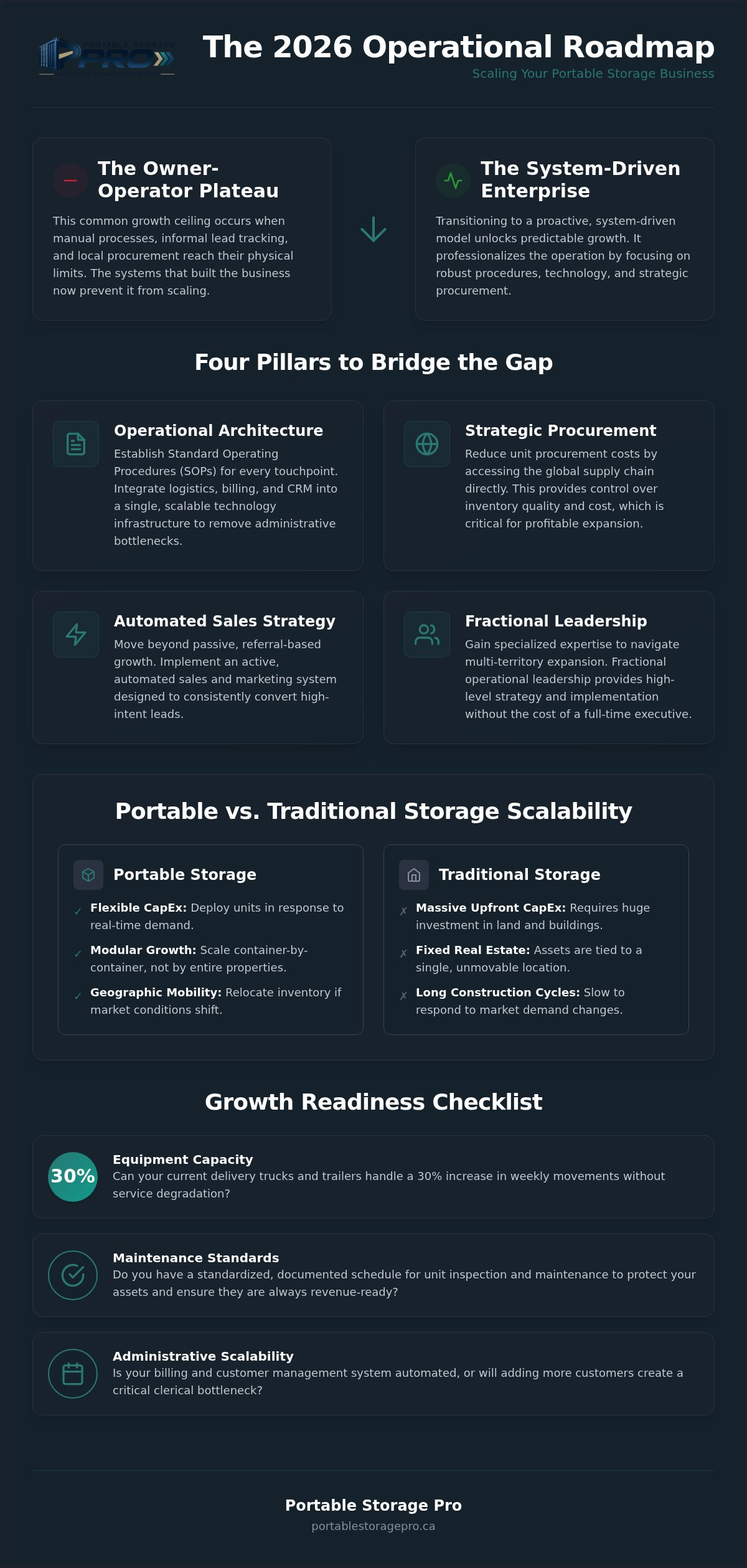
Scaling a portable storage business isn't just about buying more boxes. It's about expanding your fleet capacity while simultaneously broadening your service territory and market share. Unlike the broader self-storage industry, which relies on fixed real estate and long-term construction cycles, portable storage allows for a modular, incremental growth pattern. This "container-by-container" model provides a unique agility, but it also creates a specific trap: the Owner-Operator Plateau. This occurs when manual scheduling, informal lead tracking, and local procurement reach their physical limits, preventing the business from expanding beyond a single market.
The 2026 market is characterized by persistent inflation and a challenging housing market. These factors make operational efficiency paramount. You can't simply outspend the competition; you have to out-systematize them. Effectively scaling a portable storage business now requires a shift from "gut-feeling" management to technology-driven logistics that can handle the complexities of unit movements across multiple zones without increasing administrative overhead.
Portable vs. Traditional Storage Scalability
Traditional storage requires massive upfront capital expenditure (CapEx) for land and buildings. In contrast, portable storage offers superior CapEx flexibility. You can deploy units in response to real-time demand and relocate that inventory if market conditions shift. This geographic mobility is a significant competitive advantage. However, realizing this potential depends on increasing portable storage business profitability through meticulous fleet optimization. Every unit sitting idle in a yard is a depreciating asset. Scaling requires a system that ensures high utilization rates across your entire inventory.
Identifying Growth Readiness
Before you commit to a major fleet expansion, you must evaluate specific key performance indicators (KPIs). High occupancy rates and a consistent backlog of delivery requests are strong signals. You should also assess the health of your current portable storage expansion strategy to ensure your operational foundation is solid. Consider these three factors:
- Equipment Capacity: Can your current delivery trucks and trailers handle a 30% increase in weekly movements?
- Maintenance Standards: Do you have a standardized schedule that prevents unit degradation?
- Administrative Scalability: Is your billing system automated, or will more customers create a clerical bottleneck?
If your current procedures are already strained, adding more units will only accelerate operational failure. True scaling is about building the capacity to manage growth before that growth arrives.
Building the Operational Architecture: SOPs and Technology
Standardized procedures are the skeleton of any high-growth enterprise. When you are scaling a portable storage business, you cannot be present at every delivery or unit inspection. You need a system that ensures the work is done to your specific standards without your direct supervision. This operational architecture begins with Standard Operating Procedures (SOPs) that govern every physical and administrative touchpoint, transforming your personal expertise into a repeatable business model.
By shifting from manual oversight to system-driven management, you remove the primary bottleneck to expansion. This transition allows your team to handle a higher volume of units and customers with greater precision. It creates a predictable environment where growth is supported by infrastructure rather than just effort.
Developing Scalable SOPs
Documented processes are essential for maintaining quality as you enter new markets. Your SOP library should include detailed protocols for container maintenance, delivery safety, and compliance. These documents serve a dual purpose. First, they drastically reduce the learning curve for new hires, allowing you to onboard staff quickly without sacrificing service quality. Second, they provide a framework for risk mitigation. By using standardized inspection and compliance checklists, you protect your assets and ensure that every unit in your fleet remains revenue-ready and safe for transport. This level of professionalization is what separates a local operator from a regional leader.
The Modern Storage Tech Stack
A decentralized operation requires a sophisticated, cloud-based management system. Modern scaling is no longer just about tracking rent; it is about integrating your CRM, logistics, and billing into a single, cohesive interface. Automated logistics and delivery route optimization are crucial for maintaining margins as fuel and labour costs fluctuate. Staying ahead of these technical requirements often involves specialized technology and innovation consulting to ensure your systems remain robust as you grow. This focus on technical rigour aligns with broader federal initiatives designed to enhance supply chain and logistics for small businesses, ensuring you remain competitive in a digital-first market.
Automation should handle routine customer interactions, such as booking confirmations and billing reminders. This shift frees your staff to focus on high-value sales and complex logistical planning. Furthermore, professionalizing your staff training ensures that the brand experience remains identical across all regions. Consistency is the currency of scale, and a well-implemented tech stack is the most efficient way to achieve it.
Strategic Procurement: Optimizing Your Global Supply Chain
Procurement is often the most overlooked lever in scaling a portable storage business. While many owners focus on daily operations, the price paid for the physical asset dictates the ceiling of your growth. High unit procurement costs drain the capital reserves needed for fleet expansion, making it difficult to maintain competitive rental rates while preserving healthy margins. Professionalizing your supply chain is not merely a cost-saving exercise; it is a strategic requirement for long-term scalability.
The 2026 market demands a shift in how you view your inventory. Relying on local brokers for occasional unit additions is a reactive strategy that limits your ability to respond to market shifts. To move from an owner-operator to a high-growth enterprise, you must transition toward a proactive procurement model that treats containers as a global commodity rather than a local purchase.
Direct Sourcing vs. Broker Procurement
Most independent operators rely on local wholesale brokers to source their inventory. This approach offers convenience but includes significant middleman markups that erode your ROI. Moving toward direct factory orders allows you to bypass these layers, though it introduces new complexities such as quality control and extended shipping lead times. You must balance the immediate availability of local stock against the long-term financial benefits of direct sourcing. Transitioning to direct factory procurement typically allows an operator to realize a substantial reduction in per-unit capital expenditure, effectively lowering the barrier to fleet expansion.
Navigating the Global Supply Chain
Managing a global supply chain requires a deep understanding of port logistics and international trade. In 2026, navigating fluctuating trade tariffs and shipping schedules is a full-time operational demand. Working with specialized Procurement & Sourcing experts can help you mitigate these risks. These specialists provide the connections needed to secure better terms, often through collective buying power that an independent operator cannot achieve alone. This collective approach levels the playing field against larger corporate entities.
Effective procurement also extends to "last-mile" fleet integration. Moving containers from a port to your operating centre requires a coordinated transport strategy. This involves organizing specialized delivery equipment and ensuring units are inspected and revenue-ready upon arrival. International conference representation is a vital part of this process. It allows you to build the direct relationships with manufacturers and logistics providers that lead to more favourable contract terms and reliable delivery windows. By securing these connections, you ensure that your procurement strategy supports, rather than hinders, your expansion goals.
Lead Generation and Sales Strategy: Fueling Expansion
Scaling a portable storage business requires moving beyond the limitations of word-of-mouth referrals. While local reputations are valuable, they aren't scalable or predictable enough to support a multi-regional footprint. You need an active, high-intent lead generation engine that fuels your expansion. This involves aligning your sales and marketing efforts to ensure that every marketing dollar contributes directly to your booking conversion rates. By shifting from a passive approach to a data-driven strategy, you can secure the steady volume of inquiries needed to keep a growing fleet utilized.
A professionalized sales engine ensures that your growth is not stalled by an empty pipeline. It requires a disciplined focus on where your leads come from and how they are handled once they enter your system. This structural clarity allows you to identify which markets are ready for further investment and which require a refinement of your messaging.
Capturing High-Intent Leads
Digital marketing strategies in 2026 must be precisely tailored to the nuances of the portable storage sector. High-intent leads are often found through local search optimization, where customers are looking for immediate solutions to moving or renovation needs. While national brand awareness builds long-term trust, local search visibility captures the customer at the moment of decision. You must also distinguish between commercial and residential segments. Commercial clients often require long-term inventory management solutions, while residential users look for short-term flexibility. Targeting these segments separately allows you to optimize your ad spend and messaging. Utilizing data analytics to identify high-potential expansion markets ensures you aren't wasting resources on territories with low demand or oversaturated competition.
Professional Sales Training
Generating leads is only half the battle; your team must be equipped to close them. Professionalizing the sales process involves implementing structured sales scripts and objection-handling frameworks for your storage consultants. These tools shouldn't be rigid, but they must provide a consistent baseline for service quality. Tracking performance metrics like cost-per-lead and conversion-per-market is essential for maintaining profitability when scaling a portable storage business. If you don't know your numbers, you can't manage your expansion effectively.
The customer journey from the initial inquiry to the final container delivery must be frictionless. Any delay or confusion in the booking process is an opportunity for a competitor to step in. By refining this path, you improve the overall customer experience and increase your lifetime value per unit. If your current sales pipeline feels inconsistent or reactive, it may be time to implement professional Sales, Marketing & Lead Generation systems that provide a clear, structured path for future development. This disciplined approach ensures that your sales engine can keep pace with your fleet expansion.
The Growth Engagement Model: Professionalizing Your Path
Scaling a portable storage business requires a fundamental shift in how you view your role as an owner. Most operators start as the primary driver of every decision, from unit maintenance to customer disputes. However, this level of involvement eventually becomes the primary bottleneck to expansion. The Growth Engagement Model provides a structured path to operational excellence by offering the leadership and systems required to bridge the gap between a local operation and a high-growth enterprise. It's a pragmatic framework designed to professionalize your business without the need to reinvent every procedure from scratch.
This model allows you to balance hands-on control with hands-off management. By implementing a standardized operational architecture, you ensure that your brand's quality remains consistent even as you step away from daily oversight. It's about building a business that can sustain its own momentum through systems rather than sheer founder effort.
Fractional Operational Leadership
You don't always need a full-time executive to get C-suite results. Fractional operational leadership allows mid-sized operators to access high-level expertise on a targeted basis, providing the strategic guidance of a COO without the associated overhead. This approach is particularly effective when you've reached a plateau and need a fresh perspective to identify operational friction. Professional oversight through operational audits helps identify hidden growth inhibitors that drain your resources, such as inefficient dispatching or poor unit utilization. These audits are the first step toward maximizing portable storage profits, as they provide the data needed to make informed decisions about fleet expansion and market entry.
Transitioning to a Systems-Led Business
True scale is achieved when your business moves from founder-dependent tasks to team-driven outcomes. This transition is about building a valuable asset rather than just managing a fleet. It requires a disciplined focus on long-term value creation. When you implement the right systems, you're free to focus on strategic growth and high-level partnerships while experts manage the granular details of procurement and technology. Scaling a portable storage business successfully means realizing that your time is best spent leading the business, not just working within it. This shift ensures your operation remains resilient, profitable, and ready to transition from a local operator to a professionalized national entity.
Executing Your Strategic Expansion
The transition from an owner-operator to a regional enterprise requires a shift from manual effort to systemic efficiency. By codifying your operational architecture and leveraging direct global supply chain access, you remove the capital and logistical barriers that often stall growth. Successful scaling a portable storage business in 2026 is not about working harder; it's about implementing the specialized leadership and technology required to maintain margins at scale.
You don't have to navigate these complexities alone. Access to international industry representation and automated lead generation systems can provide the competitive edge needed to outperform larger corporate entities. Whether you require specialized SOP development or fractional operational leadership, the right framework ensures your expansion is both predictable and profitable. Our expertise in sales, marketing, and technology implementation allows you to focus on the high-level strategy of your business.
Explore the Growth Engagement Model at Portable Storage Pro to professionalize your operations and secure your market position. Your path to a high-growth storage enterprise begins with a single, strategic step toward better systems.
Frequently Asked Questions
How do I know when my portable storage business is ready to scale?
Consistent occupancy rates above 80% and a growing waiting list are clear signals that your market can support more inventory. You should also evaluate your administrative capacity. If your current billing and scheduling processes are already strained, scaling a portable storage business requires first professionalizing your back-office systems. Financial stability, specifically a healthy debt-to-equity ratio, ensures you can handle the capital expenditure of new unit procurement without overextending your cash flow.
What are the biggest challenges in scaling a portable storage fleet?
Logistical bottlenecks and procurement costs represent the primary hurdles for most operators. As your fleet grows, the complexity of tracking unit locations and maintenance schedules increases exponentially. Many owners also struggle with middleman markups from local brokers, which erode profit margins. Managing the last-mile delivery logistics across a broader territory requires specialized equipment and disciplined scheduling to maintain efficiency and prevent idle inventory from draining your monthly revenue.
Is it better to buy containers from a broker or source them directly?
Sourcing directly is generally superior for expansion because it removes unnecessary middleman markups. While local brokers offer convenience for small orders, direct factory procurement provides significant per-unit savings that are essential for large-scale fleet growth. This approach requires expertise in global supply chain management and international trade. Accessing a global supply chain through specialized procurement services allows independent operators to secure the same favourable terms as national corporate entities.
What technology is essential for managing a growing portable storage business?
You need an integrated tech stack that combines CRM, logistics, and automated billing. A cloud-based management system allows for decentralized oversight, which is vital for multi-market operations. Key features should include real-time unit tracking, automated rental agreements, and route optimization software for delivery drivers. Implementing these tools through technology and innovation consulting ensures your infrastructure can handle increased volume without a proportional increase in your administrative staff.
How do I maintain service quality while expanding into new territories?
Consistency is maintained through the rigorous application of standardized procedures. Every new territory must follow the same protocols for unit inspections, delivery safety, and customer communication. Centralizing your lead management and customer service ensures a uniform brand experience regardless of the physical unit's location. Regular operational audits help identify service gaps early, allowing you to correct issues before they impact your reputation in a new market territory.
What is the role of SOPs in scaling a storage operation?
Standard Operating Procedures (SOPs) serve as the foundation for repeatable success. They remove the reliance on the founder's personal knowledge, allowing new staff to perform complex tasks with precision. SOPs cover everything from container maintenance to safety compliance and sales scripts. When scaling a portable storage business, documenting every operational touchpoint creates a scalable model that can be deployed in any market with predictable results and minimal oversight from ownership.
Can I scale my storage business without being involved in daily operations?
Yes, by transitioning to a systems-led business model. This involves delegating granular tasks to trained staff and utilizing automated technology for routine customer interactions. Fractional operational leadership provides the C-suite expertise needed to manage growth without the owner's constant presence. This shift allows you to focus on high-level strategy and market expansion while professional managers and standardized systems handle the daily logistical and administrative requirements of the business.
How does the Growth Engagement Model differ from a standard franchise?
The Growth Engagement Model offers operational leadership and global supply chain access without the restrictive royalties or rigid territory limits of a franchise. It provides independent operators with specialized consulting in sales, marketing, and technology while allowing them to retain full ownership and brand autonomy. This model acts as a pragmatic partnership, offering the benefits of corporate-level infrastructure and procurement connections tailored specifically to the operator's unique growth goals.

Article by
Paul Taylor
Paul Taylor is the founder of Portable Storage Pro, bringing more than 35 years of experience across the container, portable storage and transportation industries. His background spans executive operations, business development, global procurement, sales, marketing and operational improvement in Canada, the UK and international markets.
Paul helps independent portable storage and container rental operators increase revenue, strengthen margins and build more efficient businesses. His work connects strategy with practical implementation, including pricing, delivery operations, supplier sourcing, staff training, technology and customer experience.
His experience includes leading multi-location storage operations and serving on the National Portable Storage Association’s board along with chairing its Canadian committee. Through Portable Storage Pro, Paul shares practical insights to help owners make informed decisions, solve operational challenges and grow profitably.
Disclaimer
Content published by Portable Storage Pro Inc. (PSP) provides general business information and industry insights. It does not replace advice tailored to your business or specialist legal, tax, engineering or other regulated advice. Reading this content or contacting PSP does not, by itself, establish a consulting engagement.
Information reflects circumstances at publication and may change. Examples and potential benefits are illustrative; results depend on individual circumstances, implementation and market conditions and are not guaranteed.
Client services are governed by the signed service agreement, agreed work plan and written amendments. Website and blog content do not amend those terms. PSP’s work is subject to applicable law and the professional commitments set out in its agreement, including the CMC-Canada Code of Professional Conduct and NPSA Code of Conduct and Ethics. Copies are available on request.
Views expressed are PSP’s own. Association membership or references do not imply association endorsement or CMC certification. Nothing in this disclaimer limits PSP’s contractual responsibilities, professional duties or rights that cannot lawfully be excluded.


