
An add-on can increase a customer’s bill and still weaken your contribution if the effort to provide it outweighs what it brings in. Portable storage add-on revenue makes commercial sense when an offer addresses a real customer need and fits your operation’s capacity to deliver it. The decision is not simply what else you can sell. It’s what you can support consistently.
Portable storage has operating demands that differ from facility-based self-storage. Containers are delivered to customer sites, so the customer’s intended use, delivery arrangements and your team’s fulfilment process all affect which offers are appropriate. A service that works well in one operating model may create extra coordination in another.
This article gives you a practical way to assess potential add-ons without assuming every option belongs in your business. You’ll consider how customer needs shape the offer, how to distinguish sales from contribution, and how to build a process for presenting, fulfilling and reviewing options. The aim is to help you make a grounded decision, based on your customers and operating evidence, about what to offer and what to leave out.
Key Takeaways
- Separate add-on sales from core rental revenue to see how each offer contributes to the business.
- Match potential offers, such as packing kits, contents insurance or monitoring, to customer needs and your team’s ability to fulfil them.
- Assess Portable storage add-on revenue by accounting for direct product, fulfilment and support costs, not sales alone.
- Use a repeatable process to identify customer needs, present relevant options, record decisions and review results.
- Get advisory and implementation support through a Consulting Partner while retaining responsibility for daily operations.
What Portable Storage Add-On Revenue Means for an Operator
Portable storage add-on revenue is income from a relevant product or service offered alongside a core container rental. The rental charge remains the main transaction; an add-on is a separate part of the customer offer. That distinction helps you see whether a sale comes from the container rental itself or from an additional option connected to how the customer plans to use it.
Keep three measures separate. Revenue records what the customer pays for an add-on. Customer value describes whether the offer addresses a need the customer recognizes. Contribution reflects what the business retains after the direct resources needed to provide the offer. These measures inform different decisions. A sale doesn’t prove the offer was useful, and positive customer feedback doesn’t by itself show that the work is commercially sound.
Portable storage adds an operational dimension. A container is used at a customer’s site, and the rental may involve coordination beyond the initial quote. Your available delivery processes, team responsibilities and customer-support capacity can shape which offers are practical. An add-on that appears simple at the point of sale may involve extra preparation or communication later. Assess the full customer relationship, not only the moment an option is accepted.
How add-ons fit the portable storage customer journey
Look for needs that emerge at different points in the relationship. An enquiry may reveal a customer’s intended use; a quote conversation may surface a request for added support; activity during the rental may prompt questions about access or visibility. The return stage can raise different service needs. An offer fits when it responds to something relevant in that context, rather than interrupting the conversation with an unrelated prompt.
Timing matters, but so does the reason for making the offer. If the customer hasn’t expressed a related need and the option doesn’t address an evident part of their use case, presenting it may add friction without improving the service. Treat the interaction as a way to clarify fit, not as an automatic sales opportunity. That keeps the offer connected to the rental rather than detached from it.
Revenue is not the same as contribution
Revenue is the amount collected for an add-on. Direct costs are the product and work directly associated with providing it, including fulfilment and support where applicable. Contribution is the amount left after those direct inputs are accounted for. It helps you assess an individual offer, but it isn’t the same as total business profit, which reflects the wider operation.
Operational effort belongs in the assessment. Staff time spent explaining an offer, coordinating its delivery or resolving customer questions can affect its commercial value. If that work isn’t visible in your records, a sale may look stronger than the result experienced by the team. Keep the distinction clear as you evaluate an offer.
Add-on revenue shows what you collected; contribution shows what remains after the direct resources required to provide it. Neither measure alone determines whether an add-on should stay in your offer. Treat each as an option to assess, not a universal requirement or a guaranteed source of growth.
Which Portable Storage Add-Ons Match Customer Needs?
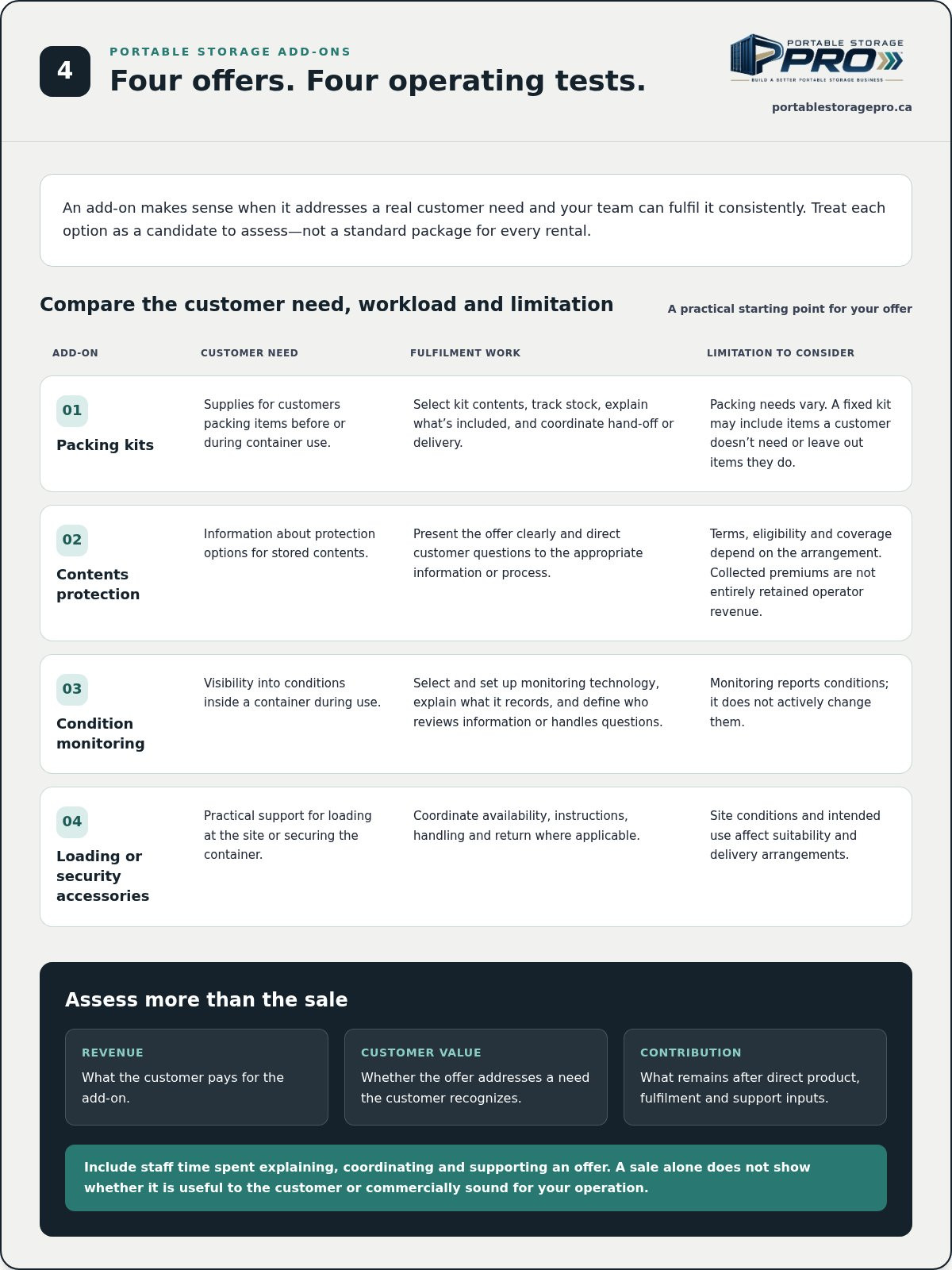
Choose an add-on by connecting a customer need to a practical offer and a fulfilment process your team can support. A product that suits a facility-based model may require different handling when it has to be coordinated with container delivery, customer-site access or return. The comparison below gives you a starting point. Treat each offer as a candidate to assess, not a standard package for every rental.
Packing kits
Customer need: Supplies for customers packing items before or during container use.
Fulfilment work: Select kit contents, track stock, explain what’s included and coordinate hand-off or delivery.
Limitation: Customers’ packing needs vary; a fixed kit may contain items they don’t need or omit what they do.
Contents protection
Customer need: Information about protection options for stored contents.
Fulfilment work: Present the offer clearly and direct customer questions to the appropriate information or process.
Limitation: Terms, eligibility and coverage depend on the specific arrangement. Don’t present collected premiums as entirely retained operator revenue.
Condition monitoring
Customer need: Visibility into conditions inside a container during use.
Fulfilment work: Select and set up monitoring technology, explain what it records and define who handles customer questions or reviews information.
Limitation: Monitoring reports conditions; it doesn’t actively change them.
Loading or security accessories
Customer need: Practical support for loading at the site or securing the container.
Fulfilment work: Coordinate availability, instructions, handling and return where applicable.
Limitation: Site conditions and the customer’s intended use affect suitability and delivery arrangements.
Match packing kits and contents protection to the use case
Packing supplies may fit when a customer says they’re preparing goods for container storage and needs a convenient way to source supplies. Keep the kit contents clear, and record which items customers request most before setting a standard offer. Contents protection is a separate decision. Describe it in plain language, avoid implying that every item or customer qualifies, and don’t make promises about coverage beyond the information provided for the offer.
Ancillary offers can include products and services alongside a business’s core service. The Ancillary Revenue Definition and Examples resource provides a general explanation of the concept. For portable storage, the operational test is whether an offer meets a customer need and can be supported through the rental journey.
Assess monitoring offers against operational capability
Monitoring may suit customers who value visibility into container conditions, but it creates requirements beyond placing a device. Decide what information you’ll provide, how customers access it and who responds to questions. Be precise about the distinction: a monitor can record or report conditions, while active control requires equipment designed to change them. Don’t imply that monitoring alone regulates temperature or humidity.
For a practical review of potential offers, Portable Storage Pro’s portable-storage consulting can help you consider customer fit, fulfilment and operating requirements together.
How to Calculate Add-On Contribution Without Guessing
Use your own transaction records and fulfilment data to assess whether an add-on is worth continuing. Start with the amount collected for the offer, then subtract the direct product, fulfilment and support costs tied to providing it. Keep the result separate from core container rental revenue and overall business profit. It’s a focused measure of one offer, not a complete view of company performance.
Add-on contribution = add-on revenue − direct product costs − fulfilment costs − support costs
Use operator-supplied figures for each line. Leave a component blank only when it doesn’t apply, and record why it was excluded.
Build an operator-specific contribution calculation
For each transaction, record the amount collected and the direct resources required to fulfil it. Include procurement, handling, delivery coordination and customer-support work where applicable. Use your actual records rather than a general estimate. If staff time is not captured by transaction, track it for a defined review period and apply your own method consistently.
Separate the add-on from the rental in your records. A simple worksheet or spreadsheet can include:
- The offer and rental or customer use case
- The amount collected for the add-on
- Product or supplier amounts directly tied to the sale
- Handling, preparation and delivery work
- Support time, including questions or follow-up
- The resulting contribution and any excluded items
For a hypothetical calculation, enter your own transaction data in the formula: add-on revenue of [operator-supplied amount], less direct product costs of [operator-supplied amount], fulfilment costs of [operator-supplied amount] and support costs of [operator-supplied amount]. The result is the contribution for that transaction. These placeholders are not benchmarks; use them only with figures from your operation.
Measure performance without unsupported benchmarks
Track how often an offer is presented, how often it’s accepted, whether fulfilment is completed as intended, and the contribution recorded. Review results by add-on and, where your records allow, by customer use case. This can show whether an offer is relevant to a particular segment or creates repeated support work.
Review the figures over a consistent period and investigate changes before acting. A rise in acceptance may reflect more offers being presented, a shift in customer mix or better fit. It doesn’t, by itself, show that the offer contributes more.
Uptake measures customer acceptance; contribution measures what remains after the direct work of fulfilling the offer. An add-on can be popular and still place a disproportionate load on staff or delivery coordination. Conversely, a less frequently accepted offer may be straightforward to provide. Use both measures to decide whether to refine the offer, adjust its process or stop presenting it.
Portable storage add-on revenue becomes more useful as a management measure when it’s paired with reliable fulfilment records. Keep the calculation simple enough for your team to maintain, and review exceptions such as returns, replacements or unusually high support demand separately. That gives you a clearer basis for comparing offers without confusing sales activity with commercial contribution.
How to Present, Fulfil and Review Portable Storage Add-Ons
A repeatable process makes an add-on easier to explain, deliver and assess. It also gives your team a clear handoff from the sales conversation to yard or delivery coordination, then to customer support. Assign an owner to each step, even if one person covers several roles in a smaller operation.
- Identify the need. Ask a relevant question about the customer’s planned use, timing or requested support. Don’t recommend an add-on until there’s a reason it may fit.
- Present the fit. Explain what the offer does, what it doesn’t do, and any customer responsibilities. Keep the explanation direct and specific to the customer’s situation.
- Record the choice. Note whether the customer accepted or declined, along with details operations needs to fulfil an accepted offer.
- Fulfil and hand off. Assign preparation, delivery coordination or follow-up to a named role. Make sure the person handling the next step can see the recorded decision.
- Review the result. Compare customer feedback, fulfilment issues and contribution before changing the offer or process.
Build an add-on offer into the sales process
Train staff to ask before recommending. For example, a question about whether a customer needs packing supplies is more useful than presenting a kit to every lead. Give the team approved, plain-language descriptions, including limitations and customer responsibilities. For offers involving protection or monitoring, staff should explain only what the offer provides and direct detailed questions through the appropriate process. Record the customer’s decision and any fulfilment details in the same place as the rental information.
Keep fulfilment and review manageable
Before introducing an offer, map its effect on stock handling, yard flow, delivery work and customer questions. Decide who prepares it, who confirms it is ready, and who responds if something changes. If fulfilment depends on a delivery, include the relevant timing and site details in the handoff. These steps help expose added work before it becomes a recurring source of confusion.
Document the process in SOPs. Include the customer-facing description, the point in the sales process when staff should raise the offer, the information to record, fulfilment responsibilities and the route for customer questions. Keep the instructions short enough to use during normal work, then update them when the offer or operating process changes. Train affected sales and operations staff against the same version.
Review the offer using both customer and operating evidence. Look for repeated questions that suggest the explanation is unclear, fulfilment delays, missing handoff details, returns or other recurring issues. Compare those findings with contribution records and customer feedback. A weak result may call for a clearer explanation or process change; persistent poor fit or avoidable friction may be reason to revise or remove the offer.
A consistent process helps you manage Portable storage add-on revenue without separating the customer promise from the work required to deliver it. Discuss your add-on sales and fulfilment process with Portable Storage Pro to assess how it fits your operation.
When Portable Storage Pro Can Support an Add-On Revenue Plan
Portable Storage Pro’s Consulting Partner model can support operators who want to turn an add-on idea into a practical business decision. The work is advisory and implementation support, not a transfer of daily management. You remain responsible for operating decisions, while the scope of support can focus on agreed priorities such as customer fit, sales practices, fulfilment requirements or internal tracking.
What a Consulting Partner can help an operator assess
Start with the evidence your business already has. Customer enquiries, quote notes, accepted offers, fulfilment records and customer questions can help indicate where demand exists. Your own transaction records and assumptions then provide the basis for assessing the work involved. This keeps recommendations tied to your customer base and operating model rather than broad benchmarks that may not reflect your service.
Support can help you:
- Compare proposed offers against recurring customer requests and intended use cases.
- Identify which roles, handoffs and resources each offer would require.
- Review sales language so staff can describe the offer clearly and consistently.
- Develop or refine training and SOPs for the agreed process.
- Set out what information your team will record to review the offer after implementation.
Implementation should fit the size and capacity of your operation. For a small team, that may mean assigning clear ownership and adapting an existing tracking process rather than introducing unnecessary administrative steps. If sourcing is part of the agreed work, supplier pricing is not marked up by Portable Storage Pro under the consulting sourcing model.
Choose a clear next step for the business
Bring one proposed add-on to your operating team and write down the decision you need to make. Identify the customer need behind it, the operational roles it would affect and the records you can use to assess it. Note any assumptions, such as which staff tasks count as fulfilment or how you will record customer questions. Consistent definitions make later review more useful.
From there, decide whether the immediate priority is evaluating the offer, preparing staff, documenting a process or coordinating implementation. A defined scope helps keep the work focused and makes responsibilities clear. Your team can then test the process within its actual operating conditions and use what it learns to decide whether to maintain or adjust the offer.
Portable storage add-on revenue is a business decision that benefits from practical evidence and clear ownership. Portable Storage Pro can work with you through a Consulting Partner engagement on agreed priorities, while you retain day-to-day management.
Set the Direction for Your Next Add-On
Your next move is to decide what role add-ons should play in your customer offer. They can support a particular use case, address a recurring request or help distinguish your service, but each choice also sets an expectation your operation must meet. Keep that connection clear as you plan what to offer next.
Portable storage add-on revenue is best approached as an ongoing business decision, not a one-time sales initiative. Customer needs, staff capacity and the way you deliver service can change. Set a point to revisit your approach, and make sure the people responsible for customer communication and operations have a voice in that discussion.
If you’re ready to consider how add-ons fit your operation’s priorities, Let’s Talk About Your Business. A clear next step can help you move forward with purpose and build an offer that makes sense for both your customers and your team.
Frequently Asked Questions
Can add-on services increase revenue per portable storage rental?
Yes. An add-on can increase the amount collected for a rental when it addresses a customer need, such as supplies requested before loading. That doesn’t show whether the offer made a sound contribution. Use actual transaction records to account for product, fulfilment and support inputs, then consider customer feedback and operational fit. Test the offer on a defined basis and review the results before expanding it.
What add-on services can a portable storage operator consider?
Operators can assess packing kits for customers preparing goods, contents insurance as a clearly described protection option, and monitoring for customers who want visibility into container conditions. Match each offer to a specific use case, such as a business storing inventory or a customer preparing for a planned load. Explain the offer accurately, including its limits and any customer responsibilities. Don’t imply insurance premiums all remain with the operator or that monitoring changes conditions.
How should an operator measure add-on revenue?
Portable storage add-on revenue is easier to assess when each sale is recorded separately from container rent. Link the add-on entry to the rental and offer type in your billing or customer records, then match it to relevant product, fulfilment and support information. Review records over a consistent period and document assumptions used to compare offers. This is an operator-specific calculation, not an industry benchmark; avoid comparing results built from different inputs.
Does monitoring equipment control the conditions inside a container?
No. Monitoring provides visibility into the conditions its documented function measures; it doesn’t itself heat, cool, dry or otherwise regulate a container. Before offering it, define what information the customer receives and who handles questions about it. Use product documentation to describe capabilities accurately. A reading or notification should not be presented as a guarantee that stored goods are protected or that the container’s conditions have been changed.
Should every portable storage operator offer the same add-ons?
No. Choose offers based on your customers and operating capacity. An operator whose customers request packing supplies may assess different options from one whose customers ask about protection or condition visibility. Map each offer to the staff responsibilities and workflow it requires. After introducing an option, review customer response alongside direct inputs and service interruptions. Use that evidence to keep, adjust or remove the offer rather than copying another operator’s catalogue.
Can a self-storage business add portable storage add-ons?
Yes. A self-storage business adding portable units can assess add-ons using customer needs and operating fit, while tracking portable activity separately from facility transactions. For example, tag portable rentals and add-on sales distinctly in sales and billing records, and account for container dispatch and site-delivery coordination. This helps you see whether a facility offer transfers effectively or needs a different explanation, handoff or fulfilment process for portable customers.
How can an operator tell whether an add-on is creating too much work?
Track the tasks each offer adds, not only completed sales. A simple log can capture extra yard preparation, delivery coordination, repeat customer questions, correction work and staff time. Review these patterns alongside customer comments and contribution records over a consistent period. If friction clusters around one step, revise its instructions or handoff and monitor the result. If the burden persists without clear customer value, reconsider keeping the offer.

Article by
Paul Taylor
Paul Taylor is the founder of Portable Storage Pro, bringing more than 35 years of experience across the container, portable storage and transportation industries. His background spans executive operations, business development, global procurement, sales, marketing and operational improvement in Canada, the UK and international markets.
Paul helps independent portable storage and container rental operators increase revenue, strengthen margins and build more efficient businesses. His work connects strategy with practical implementation, including pricing, delivery operations, supplier sourcing, staff training, technology and customer experience.
His experience includes leading multi-location storage operations and serving on the National Portable Storage Association’s board along with chairing its Canadian committee. Through Portable Storage Pro, Paul shares practical insights to help owners make informed decisions, solve operational challenges and grow profitably.
Disclaimer
Content published by Portable Storage Pro Inc. (PSP) provides general business information and industry insights. It does not replace advice tailored to your business or specialist legal, tax, engineering or other regulated advice. Reading this content or contacting PSP does not, by itself, establish a consulting engagement.
Information reflects circumstances at publication and may change. Examples and potential benefits are illustrative; results depend on individual circumstances, implementation and market conditions and are not guaranteed.
Client services are governed by the signed service agreement, agreed work plan and written amendments. Website and blog content do not amend those terms. PSP’s work is subject to applicable law and the professional commitments set out in its agreement, including the CMC-Canada Code of Professional Conduct and NPSA Code of Conduct and Ethics. Copies are available on request.
Views expressed are PSP’s own. Association membership or references do not imply association endorsement or CMC certification. Nothing in this disclaimer limits PSP’s contractual responsibilities, professional duties or rights that cannot lawfully be excluded.


