
What if the most useful packing kit for your portable storage customers isn’t the biggest one on the shelf? Packing supply kits for storage operators should meet a clear customer need while remaining practical to stock, sell and replenish. A bundle copied from a retail-focused playbook may not suit customers loading a container for a renovation, a household move or business inventory.
Convenience matters, but an assortment with slow-moving items can occupy valuable space and make replenishment harder to manage. The right approach is to start with your customer use cases, decide which supplies belong together, then test the offer against sales and stock movement. This guide explains how to select a practical assortment, compare kit formats and suppliers using consistent criteria, and use operating measures to adjust orders as demand becomes clearer. Portable Storage Pro’s Consulting Partner model supports operator-led sourcing through direct supplier relationships, without supplier markups. The aim is a repeatable process, not a generic bundle.
Key Takeaways
- Build Packing supply kits for storage operators around customer tasks and container-use contexts, rather than defaulting to a generic bundle.
- Group boxes, tape and protective materials by packing, securing or protecting needs, then tailor the assortment to your customers.
- Compare ready-made kits, operator-assembled kits and modular assortments using consistent criteria, including quality, availability and replenishment.
- Pilot the offer with a defined audience, staff briefing and tracking process; use your own sales and inventory records to guide changes.
- Use supplier communication and direct sourcing support to make procurement more repeatable and keep stock aligned with demand.
Packing supply kits for storage operators: what should the offer solve?
A packing supply kit is a grouped offer of packing and protective materials selected to address a practical customer task. For your portable storage business, that task might be getting items into boxes, securing cartons for handling or protecting belongings during storage. The offer should make those supplies easier to understand and obtain, not turn your container rental operation into a household packing guide.
Customer needs vary with what they’re storing and how the container is used. Someone storing boxed business records may have different supply needs from a customer storing furniture during a renovation. The loading and delivery context matters, too: customers may pack over time, load at different locations or need to organize items for access later. These differences are useful signals for shaping an offer, not reasons to add every product category.
Packaging serves different purposes, from containing items to protecting them during handling. The broader overview of Packaging helps distinguish those functions. For an operator, the practical question is narrower: which supplies address a recurring customer need and can be stocked and replenished without adding unnecessary complexity?
Which customer needs can a kit address?
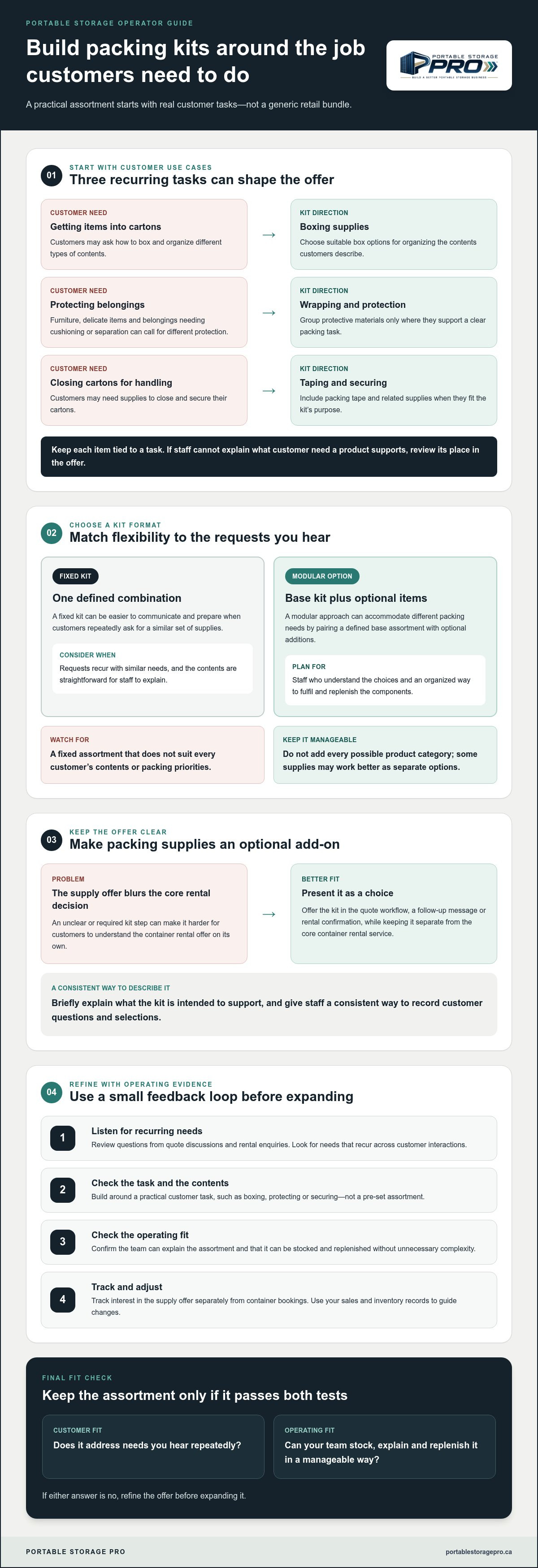
Start with the tasks customers mention, rather than a pre-set bundle. Review questions raised during quote discussions and rental enquiries, and note which needs recur. A customer asking how to box heavier items signals a different need from one asking how to protect delicate belongings or secure cartons. Treat those conversations as evidence, then check whether the same needs appear across more than one customer interaction.
- Boxing: suitable box options for organizing different types of contents.
- Wrapping and protecting: protective materials for belongings that need cushioning or separation.
- Taping and securing: packing tape and related supplies for closing cartons.
Each item should have a clear role. If staff can’t explain which customer task a product supports, its place in the offer needs a closer look. Adding items without a defined purpose can make the assortment harder to describe and manage.
How does a kit fit the portable storage offer?
Keep supplies distinct from the core container rental service. Present a kit as an optional add-on, not an automatic part of every rental. This lets customers choose based on their needs and gives you a clear way to track interest in the supply offer separately from container bookings.
You can introduce the option in the quote workflow, a follow-up message or a rental confirmation. Use a brief description of what the kit is intended to support, and give staff a consistent way to record whether customers ask about it or select it. Don’t make the offer a required step in quoting; the container rental decision should remain clear on its own.
The central test is operational as well as customer-facing: does the assortment suit the needs you hear repeatedly, and can your team stock, explain and replenish it in a manageable way? If either answer is no, refine the offer before expanding it.
Choose packing supply kit contents around real customer use cases
Choose each item for a customer task, not because it appears in a standard retail assortment. Packing supply kits for storage operators work best when the contents make sense together, are easy for staff to explain and can be stored and replenished without creating unnecessary stockkeeping work. Treat any example assortment as a starting point for testing, not a universal product specification.
Build the assortment from customer tasks
Begin with the question a customer is trying to solve. Then decide whether a kit can address that need with a small group of compatible supplies. For example, an assortment for boxing and closing items might pair boxes with packing tape. A protection-focused option could group protective materials with supplies suited to customers handling more fragile or easily marked belongings. These are illustrative combinations, not fixed prescriptions.
Some items may be better offered separately. Customer requirements can vary by the contents being packed, so including every possible protective material in one fixed kit could make the offer harder to explain and the stock harder to manage. A useful check is whether a staff member can describe the purpose of each component in one sentence. If the item has no clear role in the kit’s task, leave it out or consider it as an add-on.
For a wider view of materials used in warehouse settings, Essential Packaging Products for Warehouses offers examples of packaging products and their uses. Apply that category knowledge to your own customer requests rather than copying an assortment designed for another setting.
Compare standard kits with modular options
A fixed kit is straightforward to describe and prepare, but its contents may not suit every customer. A modular approach gives customers a defined base assortment with optional additions. It can better accommodate different needs, though staff must understand the options and fulfilment must keep the components organized.
Use the following comparison to match assortment flexibility to the customer need you observe:
- Recurring, similar requests: A fixed kit may be easier to communicate and prepare when customers consistently ask for the same combination of supplies.
- Different packing priorities: A base kit with selected add-ons can suit customers whose needs vary by the belongings they’re preparing.
- Unclear or infrequent requests: Offering items separately can help you avoid building a kit around demand you haven’t established.
Before selecting a format, check item compatibility, storage requirements and how clearly the contents can be listed in customer communications. Consider whether components can be counted and replenished individually, and whether staff can fulfil the offer without confusing similar items. Keep the assortment simple enough to explain consistently. Let observed demand, stock movement and fulfilment experience guide changes rather than expanding the contents by default.
Compare suppliers and kit formats with an operator's decision framework
A product list alone won’t tell you whether a supply arrangement will work for your operation. Compare the assortment, ordering process and replenishment requirements alongside the kit format. For packing supply kits for storage operators, the right choice depends on customer fit and whether your team can source, store and fulfil the offer consistently.
Evaluate supplier fit beyond the product list
Review product information for clear specifications and packaging details that match the offer you plan to make. Assess how the supplier communicates availability, handles order changes and provides updates when an item is delayed or unavailable. The aim is to understand how reliably you can maintain the assortment, not simply whether a product appears in a catalogue.
Compare landed cost using the same assumptions for each option. Record the product quantities, freight, handling and any other applicable charges included in the comparison. Keep the assumptions consistent, or the result won’t give you a sound basis for a sourcing decision. Also consider order flexibility and whether replenishment can fit your storage capacity and expected sales pattern.
Select the kit format that fits the operation
Ready-made kits reduce assembly work but offer less control over contents. Operator-assembled bundles give you more control, while modular assortments can offer customers choice but add picking and stockkeeping steps. Individual-item sales are straightforward to manage as separate products, though customers may need more guidance to select a useful combination.
Compare the formats against the same operating criteria:
| Format | Assortment control | Stock complexity | Customer choice |
|---|---|---|---|
| Ready-made kit | Lower; contents are set by the supplier | Potentially simpler, depending on availability and storage | Limited to the bundle offered |
| Operator-assembled kit | Higher; you select the contents | Requires tracking components and assembly | Choice depends on the bundles you define |
| Modular assortment | High; customers can select options | More items and picking steps to manage | Greater flexibility |
| Individual items | High at item level | Each product needs separate stock control | Customers choose what they need |
Include staff time in the comparison. Consider how long it takes to explain the offer, locate and pick items, assemble orders and update stock records. A format that appears simple for a customer may create extra fulfilment work behind the counter. Likewise, a tightly controlled bundle may be easier to stock but less suited to customers with different needs. Document these trade-offs before choosing, and note which operational constraint matters most so the final decision is clear to the team.
Pilot a packing kit offer and measure whether it works
A limited pilot gives you evidence about customer interest and stock performance before you commit to a wider assortment. Set the test up so you can distinguish between low demand, a kit that’s poorly presented and gaps in availability. Use your own operating records as the baseline; don’t assume an industry benchmark will reflect your rental mix or sales process.
Set up the test and staff process
Define which enquiries or rentals qualify for the offer, then keep that definition consistent throughout the test. Brief staff on the kit’s contents, intended use and how to record the interaction. A short, neutral explanation helps the team present the option without making it feel like a condition of renting a container.
Use an ordered pilot process:
- Define the audience: Specify which customer enquiries or rentals are eligible, and record the rule so staff apply it consistently.
- Choose the assortment: Select the kit or format being tested and document its contents. Avoid changing the offer midway unless you record when and why it changed.
- Brief staff: Explain how to describe the offer, answer routine questions and record an accepted or declined offer.
- Track activity: Record eligible rentals, offers made, kits sold, stockouts, returns, customer feedback and staff handling effort.
- Review the results: Compare activity with your baseline and decide whether to maintain, adjust or stop the test.
Define kit attach rate as kits sold divided by eligible rentals. Use the same definition for the numerator and denominator throughout the pilot. Also record whether the kit was offered. Without that field, a low attach rate could reflect missed staff offers rather than limited customer interest.
Use operating signals to refine replenishment
Start with your own records from before the pilot, such as supply sales, inventory counts and customer enquiries. Compare them with pilot activity using the same time periods and eligibility rules where possible. The goal is to understand what changed, not to claim that one test result will predict demand in every season or customer segment.
Read the signals together. Repeated stockouts may mean the replenishment process or order timing needs attention, but first check whether demand was recorded accurately. Slow-moving items may point to an assortment mismatch, weak visibility or a component customers don’t need. Requests for missing supplies can inform a future test, but a single request alone may not justify expanding stock. Record the request and look for a recurring pattern.
Review returns and customer comments for confusion about the contents or fit of the offer. Track staff effort, too: time spent explaining, locating, assembling and recording kits can affect whether the process is practical to maintain. Keep inventory changes tied to these observations rather than increasing orders automatically.
Before closing the review, reconcile kit sales with inventory movement and rental records. Assign one person to resolve missing or inconsistent entries, and document any exclusions from the eligible-rental count. A reliable record gives you a clearer basis for deciding what to adjust in the next review cycle.
How Portable Storage Pro can support packing supply sourcing
Packing supply kits for storage operators involve more than selecting products. You need an offer that matches your customers, a sourcing process your team can manage and a way to monitor replenishment. Portable Storage Pro provides consulting and sourcing support for portable storage operators. It does not sell packing kits.
What operator-focused sourcing support can address
Through the Consulting Partner model, you remain responsible for day-to-day operations while working with Portable Storage Pro on agreed priorities. For packing supply sourcing, that work can include defining assortment criteria, comparing supplier information and improving the procurement process. The objective is a clear decision framework, not a promised financial result.
Those decisions connect directly to daily work. An assortment affects what staff need to explain, how items are stored and picked, and how you spot replenishment needs. A sourcing review can help you align these parts by clarifying:
- Assortment requirements: Which customer tasks the offer should address and which items belong together.
- Supplier criteria: How you assess product information, availability communication, order flexibility and replenishment.
- Operating steps: How staff present the offer, fulfil orders and record stock movement.
- Review measures: Which pilot signals you’ll use to adjust the assortment or ordering process.
Portable Storage Pro supports sourcing through direct supplier relationships. Under the consulting sourcing model, supplier pricing is not marked up by Portable Storage Pro. The scope of any sourcing work is based on the priorities agreed with you, so recommendations stay tied to your operation rather than a general product list.
Turn the buying framework into an operating decision
Before making a sourcing decision, bring four pieces of information together: the customer need you’ve observed, the kit format that fits your workflow, the criteria you’ll use to assess suppliers and the measures you’ll review during a pilot. This gives you a practical basis for deciding what to test, what to track and when to adjust the offer.
For example, if customers regularly ask for help protecting stored belongings, define the relevant product categories and how staff should describe them. Then assess supplier availability and order processes against your replenishment requirements. During a pilot, record offers, sales, stockouts, returns, customer feedback and staff handling effort. Use that evidence to decide whether the assortment and sourcing process fit your operation.
Paul Taylor brings more than 35 years of experience across containers, transportation, procurement and operations. That background informs Portable Storage Pro’s operator-focused consulting and sourcing support, while your business retains control of its operating decisions.
Discuss your packing supply sourcing priorities with Portable Storage Pro.
Make your next sourcing decision with confidence
Your next step is to turn the pilot findings into a clear procurement decision. Decide who will review the results, how often stock records will be checked and what information staff should capture when customers ask about supplies. Assigning responsibility for those tasks helps keep the process active after the initial test, rather than leaving useful observations in scattered notes.
Packing supply kits for storage operators can be managed as an ongoing operating decision, informed by customer feedback and the way your team handles stock. Set a review point that fits your ordering cycle, then use it to confirm whether the current process remains workable or needs adjustment. That gives you a practical basis for maintaining the offer as your operation changes.
For support with your next sourcing decision, discuss your packing supply priorities with Portable Storage Pro. A focused conversation can help you identify the next step for your operation.
Frequently Asked Questions
Should portable storage operators offer packing supply kits or sell items individually?
Offer the format that matches how customers choose supplies, and consider keeping both options available if your operation can manage them. Packing supply kits for storage operators can simplify a purchase for customers who want a ready group of essentials, while individual items suit customers who need only a specific supply. Track which format customers select and which items they ask for separately. That evidence can help you adjust the offer without assuming every renter needs a kit.
What supplies can be included in a packing kit for storage customers?
A kit could include boxes, packing tape and protective materials, with the mix tied to the purpose you want it to serve. For instance, a basic boxing offer might group cartons and tape, while a protection-oriented option could include cushioning materials. Treat these as examples, not a fixed specification. Before offering a combination, make sure staff can describe what each component is for and customers can understand what the kit does not include.
How can an operator measure packing kit sales without using industry benchmarks?
Use your own records to set a reference point and define eligibility before tracking sales. For example, separate rentals where staff presented the kit from eligible rentals where they didn’t, so you can distinguish customer response from inconsistent offers. Review kit sales alongside returns, stockouts and customer comments. Compare like with like, and note changes to the offer or sales process so you don’t attribute a result to the kit when another part of the process changed.
Can a storage operator test a packing kit before making it a standard offer?
Yes. Treat the kit as a pilot and decide in advance what evidence will guide the next step. You might test whether customers understand the contents, whether staff can fulfil orders consistently and whether stock records remain accurate. Keep a record of customer questions and declined offers, not only completed sales. At review, decide whether to retain the offer, revise its contents or continue gathering evidence before making it a regular part of your rental workflow.
How should operators compare packing supply kit suppliers?
Compare more than the product list. Review product specifications, availability updates, ordering flexibility, replenishment communication and the assumptions included in landed cost comparisons. Check that packaging and quantities suit the offer you plan to present. Keep a written comparison so your team can see why one sourcing option was selected and what would prompt a reassessment, such as recurring availability problems or a change in the customer assortment.
What is the difference between a fixed kit and a modular packing supply offer?
A fixed kit has a set assortment, so the customer chooses the bundle as presented. A modular offer starts with a defined base and lets the customer add selected supplies. The fixed format can make the offer easier to describe; modular choices can better fit different requirements but need clear selection and fulfilment steps. Consider how customers prefer to buy and whether staff can keep each component’s inventory distinct.

Article by
Paul Taylor
Paul Taylor is the founder of Portable Storage Pro, bringing more than 35 years of experience across the container, portable storage and transportation industries. His background spans executive operations, business development, global procurement, sales, marketing and operational improvement in Canada, the UK and international markets.
Paul helps independent portable storage and container rental operators increase revenue, strengthen margins and build more efficient businesses. His work connects strategy with practical implementation, including pricing, delivery operations, supplier sourcing, staff training, technology and customer experience.
His experience includes leading multi-location storage operations and serving on the National Portable Storage Association’s board along with chairing its Canadian committee. Through Portable Storage Pro, Paul shares practical insights to help owners make informed decisions, solve operational challenges and grow profitably.
Disclaimer
Content published by Portable Storage Pro Inc. (PSP) provides general business information and industry insights. It does not replace advice tailored to your business or specialist legal, tax, engineering or other regulated advice. Reading this content or contacting PSP does not, by itself, establish a consulting engagement.
Information reflects circumstances at publication and may change. Examples and potential benefits are illustrative; results depend on individual circumstances, implementation and market conditions and are not guaranteed.
Client services are governed by the signed service agreement, agreed work plan and written amendments. Website and blog content do not amend those terms. PSP’s work is subject to applicable law and the professional commitments set out in its agreement, including the CMC-Canada Code of Professional Conduct and NPSA Code of Conduct and Ethics. Copies are available on request.
Views expressed are PSP’s own. Association membership or references do not imply association endorsement or CMC certification. Nothing in this disclaimer limits PSP’s contractual responsibilities, professional duties or rights that cannot lawfully be excluded.


