
What if offering protection creates more confusion than confidence? Portable storage contents insurance can help customers address the risk of loss or damage to belongings inside a container, but it is not the same as protection for physical damage to the container itself. When those offers are blurred, customers may misunderstand what they chose and what remains their responsibility.
A useful add-on needs clear terms and a consistent sales process. This guide explains how contents insurance can fit into a portable storage offer, which coverage boundaries to communicate, and how to record each customer’s decision without promising more than the policy wording supports. It also provides a repeatable process for presenting the offer and distinguishing contents coverage from container damage protection. Treat insurance as a customer-protection option, not as revenue your business automatically retains. The aim is clearer conversations, better records, and fewer avoidable misunderstandings.
Key Takeaways
- Portable storage contents insurance applies to customers’ stored property, subject to the specific policy. Keep it distinct from protection for physical damage to the container.
- Review how the policy addresses coverage during storage, transit, loading, and unloading before describing the offer to customers.
- Assess an insurance program for customer fit, accessible policy documents, enrolment steps, claims contact information, and the administrative work it creates.
- Use a repeatable SOP to present the offer, record the customer’s decision, and retain relevant documentation.
- Connect insurance planning with customer communication and operating procedures. Do not assume premiums are operator revenue.
Portable Storage Contents Insurance: What Operators Need to Understand
Before presenting an insurance offer, establish what the program covers, whose property it is intended to protect, and what role your business plays. Portable storage contents insurance concerns a customer’s belongings. It does not automatically protect your container or business assets. The governing policy and program documents set the actual terms.
Contents insurance is coverage intended to protect a customer’s stored property against specified losses, subject to the terms, limits, exclusions, and conditions of the applicable policy. That distinction matters in portable storage, where a container may move between locations or remain on a customer’s site. A general overview of the equipment is available in What is a Portable Storage Device?, but it cannot establish what an insurance program covers.
Keep three concepts separate in customer conversations and internal documents:
- Contents coverage concerns the customer’s belongings, as defined by the applicable policy.
- Container damage protection concerns physical damage to the rental unit. It is a separate issue and should not be presented as contents coverage.
- Service-contract or protection-plan language describes a program arrangement. It is not necessarily the same thing as an insurance policy. The label alone does not establish who provides protection or what obligations apply.
Use the program’s actual documents to determine which description is accurate. Do not rely on a sales label, shorthand in a rental agreement, or staff assumptions to explain coverage. If a customer asks whether a particular item or loss qualifies, direct them to the policy documents or the designated contact for coverage questions. Staff should not make promises on the program’s behalf.
Who is contents insurance intended to protect?
The insured interest is the customer’s property, subject to the policy wording. It is distinct from the operator’s container, fleet, equipment, and other business assets. Those assets do not become part of a contents policy simply because they are involved in the same rental. Do not describe coverage as automatic for every customer, item, event, or stage of a rental. For example, whether belongings are protected while a container is in transit depends on the specific program terms, not on the fact that the container is portable.
Why portable storage operators include it in the discussion
An optional contents-protection offer gives customers a clear way to consider protection for their stored belongings. Its value to your operation depends on customer fit, the program arrangement, and the work required to explain and administer it. Establish whether staff present information, support enrolment, or direct customers to another contact. Do not assume your business is the insurer, claims decision-maker, or policy administrator.
Clear explanations also support consistent service. Train staff to distinguish the customer’s belongings from the container, use approved descriptions, and record the customer’s decision. A consistent process helps customers make an informed choice without confusing contents coverage with responsibility for damage to the rental unit.
What Portable Storage Contents Insurance May Cover, and What It May Not
There is no single coverage description that applies to every portable storage program. Explain portable storage contents insurance using the current policy documents, not a general product label or another program’s summary. The policy determines which property and events may qualify, which exclusions and limits apply, and how a customer should raise a claim.
The policy controls coverage, exclusions, applicable limits, and claim decisions. Use this comparison as a review framework, not as a promise of coverage:
| Policy detail | What to establish before describing the offer |
|---|---|
| Insured property | How the policy identifies eligible customer belongings, and whether it treats any property categories differently. |
| Covered events | Which causes of loss are named, and what conditions must be met for a loss to qualify. |
| Exclusions | Which causes of loss, items, or circumstances the policy excludes. Do not infer exclusions from another program. |
| Limits and deductibles | How coverage limits and any deductible apply, including whether terms vary by enrolment choice or property category. |
| Claims contact | Who customers should contact, and what instructions the policy gives for reporting a loss. |
Contents coverage and container damage protection are different
Contents coverage relates to customer property, subject to policy terms. Container damage protection is a separate category concerning physical damage to the rental unit, where offered. Do not describe a damage waiver, service plan, or protection plan as equivalent to an insurance policy unless the governing documents support that description. Keep the two subjects distinct in quotes, agreements, staff scripts, and customer-facing materials. This helps prevent customers from interpreting an option for container damage as protection for belongings, or the reverse.
Questions to resolve in the actual policy documents
Review the wording for covered causes of loss, exclusions, limits, deductibles, and the claims procedure. Then establish where and when coverage applies. A container may be stored at a customer’s site, held at a yard, or moving between locations, but that alone does not establish that property is covered at each point.
Look for wording that addresses transit, loading, and unloading, as well as storage and any location conditions. Do not assume protection follows the contents through every stage of a rental. If the documents leave a boundary unclear, staff should avoid improvising an answer and route the question through the program’s designated coverage contact.
Keep a current reference copy of the policy and a short internal summary that points staff to the relevant clauses. Update the summary when the governing documents change. For a consistent method of turning policy boundaries into customer-facing procedures, Portable Storage Pro’s operator-focused consulting can support clearer communication and operating practices.
How to Assess Contents Insurance Offers for a Portable Storage Business
Assess an insurance offer as both a customer option and an operating process. Its fit depends on whether customers can understand and act on the offer, and whether your team can manage the related tasks consistently. Compare the program’s requirements with your rental workflow before deciding how to present it. If the process creates unclear hand-offs or duplicate data entry, identify the changes needed before introducing it.
Start by mapping the customer’s path from quote to enrolment. Can customers access the governing documents before deciding? Is it clear how they make a selection and receive confirmation? Can staff explain where to find answers without interpreting policy wording? Map who handles each step, including follow-up questions, so the customer is not left between your rental team and the program contact.
Compare the customer offer and operating requirements
Test the process against realistic rental scenarios. Have a staff member follow the steps as if handling a new enquiry, then note where they must switch systems, repeat information, or ask a supervisor for help. Check whether the customer’s choice can be recorded alongside the rental record and whether enrolment confirmation is accessible to the people who may need it. This can reveal practical friction that a program summary may not show.
Use a consistent set of criteria when comparing options:
- Customer fit: Does the offer address a concern relevant to the customers your business serves?
- Information access: Can customers find the applicable terms, and can staff identify the current version?
- Enrolment steps: Are the customer’s selection and confirmation captured without unnecessary duplicate work?
- Support route: Do employees know where to direct policy and claims questions?
- Administration: Are responsibilities clear, including who updates materials and trains staff?
Record unresolved issues as decision points, not informal assumptions. For example, if staff cannot locate confirmation during a routine customer-service check, determine whether the record belongs in the rental platform, the program portal, or another established location. The process should make the answer clear to the team.
Model the business case without treating premiums as retained revenue
Separate customer premiums from any income the operator may receive. Identify program fees, administrative obligations, staff time, and related business expenses using the actual arrangement. Do not count all premiums collected or processed as revenue retained by your business.
In your internal review, show revenue, contribution, and profit as distinct measures. Document assumptions, including which staff tasks are included and how you track time. Then compare the result with other add-on decisions and your wider portable storage business profitability picture. This helps you assess the offer’s operational and commercial fit without relying on generic benchmarks or treating enrolment volume as the only measure.
A Practical Workflow for Presenting and Documenting Contents Insurance
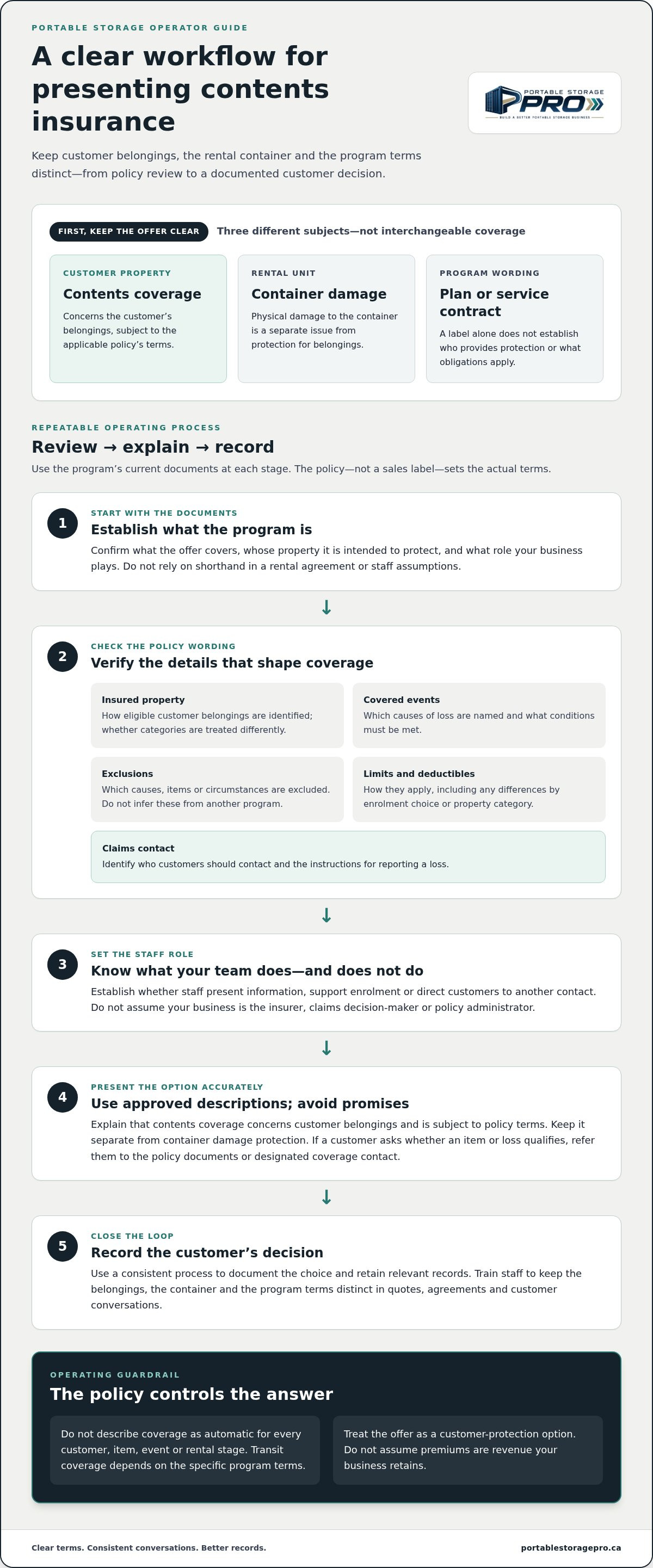
A repeatable process helps staff present an insurance option consistently without interpreting policy wording or promising a particular claim outcome. Treat each customer interaction as a sequence: explain the offer, provide access to the documents, capture the decision, and keep a record that can be retrieved later. Your SOP should identify who owns each step and what to do when a question falls outside the approved explanation.
Build a clear customer conversation
Keep the explanation short and factual. State that the offer concerns possible protection for the customer’s stored belongings, subject to the applicable terms. Do not say a customer’s property is automatically covered or suggest that a claim will be paid. Identify where the customer can review the governing documents and who can answer policy or claims questions. Staff should know the correct contact route before the offer is added to a quote or rental conversation.
Use this workflow from offer presentation through record retention:
- Present the option. Explain its purpose in plain language and distinguish it from any separate protection relating to physical damage to the container.
- Direct the customer to the terms. Provide or point to the current policy and program documents before asking for a decision. Make the designated contact for coverage questions easy to find.
- Capture the customer’s choice. Record whether the customer elected or declined the offer using the operator’s established rental or customer-record process. Do not treat silence or an incomplete form as a confirmed selection.
- Complete the relevant enrolment step. If the customer elects coverage, follow the program’s stated process and retain the available confirmation with the appropriate customer record.
- Retain and retrieve the record. Store the decision and related confirmation in the designated system so authorized staff can find them when handling a later enquiry.
The sequence matters. A customer should be able to see the terms before choosing, and your record should show what was offered and what decision was made. Describe portable storage contents insurance only as broadly as the current documents support.
Document decisions and review the process
Assign one person to maintain the approved script, document links, and staff instructions when program materials change. Make clear which version is current, and remove outdated copies from shared folders or workstations. A brief staff reference can state what employees may explain, what they must not promise, and where to route questions they cannot answer.
Review customer questions, incomplete enrolments, and missing decision records on a set schedule. Look for recurring points of confusion, such as customers mixing up contents protection with container damage protection. Use those patterns to revise the script or train staff, rather than relying on informal corrections. This is a practical application of the Portable Storage: Standard Operating Procedures Guide: documented steps should make the offer consistent and the customer’s decision traceable.
Where Portable Storage Pro Fits in Contents Insurance Planning
Portable Storage Pro helps portable storage operators assess add-on services through customer communication, staff responsibilities, and day-to-day procedures. In contents insurance planning, the work is about examining how the offer is presented and recorded, not selling a policy or making coverage decisions. Through the Consulting Partner model, operators receive expertise and support while retaining responsibility for day-to-day management.
The practical question is whether customers receive consistent information at each relevant point: when they request a quote, review rental documents, make an enrolment decision, or contact your team with a question. A clear process connects those touchpoints with current program materials and gives staff a reliable route for questions they should not answer themselves.
Connect the offer to customer experience and operating procedures
Review the offer across your customer journey. Compare the wording in quotes and rental documents with the approved policy information and the steps staff follow. Look for gaps: a script that implies broader protection than the documents describe, an unclear hand-off for coverage questions, or a decision that is not captured consistently. Addressing these gaps can improve service consistency, but it does not establish coverage or guarantee a claim outcome.
Turn the findings into practical working documents. Depending on your operation, these may include a staff explanation, a decision-recording step, a designated contact route, and guidance for keeping policy links current. Use the Portable Storage SOP guide as a reference point when documenting repeatable procedures. Keep the procedure focused on what employees do, what they record, and when they refer a question elsewhere. The policy remains the authority on coverage.
Review the process with the people who handle sales and customer service. Ask them to walk through a typical interaction and show where they would find the current information. This helps reveal whether the written procedure matches the actual rental workflow, rather than simply adding another document that staff do not use. Update training and customer-facing materials together so revised wording is reflected across the process.
Choose a useful next step for the business
Start with the issue causing the most friction. If customers misunderstand the offer, review the wording and where it appears. If staff are uncertain about their role, clarify and document the hand-off. If decisions are hard to trace, strengthen the recordkeeping step. This focused approach can improve the customer experience without assuming a particular insurance program is right for every business or asking staff to interpret policy terms.
Portable Storage Pro’s Consulting Partner support connects offer planning with SOPs, training, and implementation guidance. It does not make Portable Storage Pro an insurer or policy administrator.
Make the Offer Part of a Clear Operating Process
Use your next review to identify one practical improvement: clearer wording in the rental workflow, a more useful staff reference, or a reliable way to record customer decisions. Portable storage contents insurance should fit your customer experience and operating procedures, not sit apart from them as an unexplained add-on.
Portable Storage Pro brings portable-storage-specific consulting, training, and implementation support to operating procedures and customer experience. Through the Consulting Partner model, you receive guidance while keeping responsibility for day-to-day operations. Consulting support can help strengthen how your team presents and documents the offer, without acting as policy administration or making promises about coverage.
Choose the process issue you want to address, then make the next step clear and repeatable for your team.
Frequently Asked Questions
Is contents insurance the same as container damage coverage?
No. They address different property interests: a customer’s belongings and the operator’s container. In your quote and rental records, avoid using one umbrella label for both. If a customer asks whether selecting one option affects responsibility for the other, point to the relevant agreement and program documents. This keeps the customer’s choice clear and helps staff avoid treating separate decisions as a single selection.
Can contents insurance cover belongings while a portable storage container is in transit?
It may, depending on the applicable policy. For a practical review, compare the customer’s rental timeline with the policy’s stated coverage period, including the hand-off between storage locations and transport. If a loss is reported, accurate dates and locations can help the customer explain what happened to the designated claims contact. Do not infer transit protection from the fact that the container is part of a portable storage service.
Does a homeowner or tenant policy cover belongings stored in a portable container?
It depends on the customer’s own policy, so do not answer on their insurer’s behalf. The customer’s policy wording determines how coverage applies to belongings stored in a container, including any relevant location or movement conditions. Avoid assuming that a policy covering belongings at home applies in the same way elsewhere.
What information should portable storage customers review before enrolling?
Along with the policy documents, customers can prepare a reasonable record of the belongings they intend to store, such as an inventory or dated photographs. This gives them a clearer picture of what property they are asking about if questions arise later. They should also note where to find the enrolment confirmation and the program contact details. Make these materials easy to access without having staff interpret the policy.
What should an operator document when a customer accepts or declines coverage?
Make the record distinguish among accepted, declined, and pending decisions. A pending status is useful when a customer has not completed enrolment, because it prevents staff from treating an unfinished step as a final choice. Record the interaction date and channel, then follow your retention practices so the information remains associated with the correct rental account. Limit access to staff who need the record to handle the account or a related enquiry.
Who handles a claim under a portable storage contents insurance program?
The program documents should identify the claims contact. Your team’s role is to direct the customer using that information, not to assess the loss or suggest whether it qualifies. Keep the conversation focused on practical routing: provide the correct contact details and note that the customer was referred, following your normal customer-service process. Claims remain subject to the applicable program terms and the process set out for customers.
To discuss how your contents insurance process fits your customer communication and operating procedures, contact Portable Storage Pro.

Article by
Paul Taylor
Paul Taylor is the founder of Portable Storage Pro, bringing more than 35 years of experience across the container, portable storage and transportation industries. His background spans executive operations, business development, global procurement, sales, marketing and operational improvement in Canada, the UK and international markets.
Paul helps independent portable storage and container rental operators increase revenue, strengthen margins and build more efficient businesses. His work connects strategy with practical implementation, including pricing, delivery operations, supplier sourcing, staff training, technology and customer experience.
His experience includes leading multi-location storage operations and serving on the National Portable Storage Association’s board along with chairing its Canadian committee. Through Portable Storage Pro, Paul shares practical insights to help owners make informed decisions, solve operational challenges and grow profitably.
Disclaimer
Content published by Portable Storage Pro Inc. (PSP) provides general business information and industry insights. It does not replace advice tailored to your business or specialist legal, tax, engineering or other regulated advice. Reading this content or contacting PSP does not, by itself, establish a consulting engagement.
Information reflects circumstances at publication and may change. Examples and potential benefits are illustrative; results depend on individual circumstances, implementation and market conditions and are not guaranteed.
Client services are governed by the signed service agreement, agreed work plan and written amendments. Website and blog content do not amend those terms. PSP’s work is subject to applicable law and the professional commitments set out in its agreement, including the CMC-Canada Code of Professional Conduct and NPSA Code of Conduct and Ethics. Copies are available on request.
Views expressed are PSP’s own. Association membership or references do not imply association endorsement or CMC certification. Nothing in this disclaimer limits PSP’s contractual responsibilities, professional duties or rights that cannot lawfully be excluded.


