
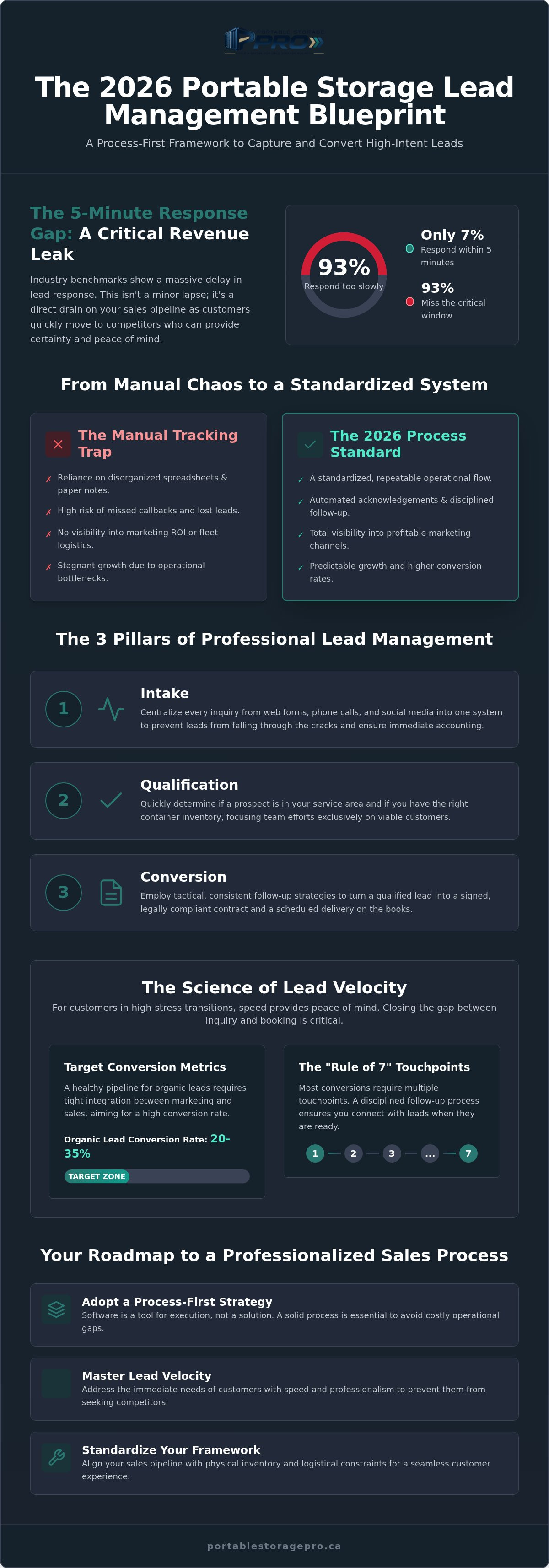
If industry benchmarks hold true, only 7% of storage operators respond to new inquiries within the critical five-minute window. This delay isn't just a minor lapse; it's a direct leak in your revenue stream. Effective portable storage lead management requires more than just a contact form. It demands a disciplined system that replaces disorganized spreadsheets and fading Post-it notes with a standardized operational flow. You likely realize that your current manual processes can't keep pace with the speed of modern consumer behaviour.
We've designed this 2026 strategy template to help you reclaim control over your sales pipeline. You'll master the exact frameworks and workflows required to capture and convert high-intent leads without the risk of human error. We'll move beyond the idea of software as a silver bullet, focusing instead on the standard operating procedures that drive higher conversion rates from your existing lead volume. This guide provides a clear roadmap to professionalize your sales process, ensuring you gain total visibility into which marketing channels actually generate profit and which are simply wasting your budget.
Key Takeaways
- Realize that software is a tool for execution rather than a standalone solution; a process-first strategy is essential to avoid costly operational gaps.
- Master the science of lead velocity to address the immediate requirements of storage customers and prevent them from seeking alternative providers.
- Adopt a standardized framework for portable storage lead management that aligns your sales pipeline with physical inventory and logistical constraints.
- Utilize a structured 2026 workflow template to automate initial acknowledgments and maintain clear visibility over every inquiry in your funnel.
- Learn how to professionalize your internal sales team by bridging the gap between technology implementation and daily operational habits.
Defining Portable Storage Lead Management for Modern Operators
Portable storage lead management is the systematic process of capturing, qualifying, and nurturing inquiries into paying storage tenants. It's more than just a digital filing cabinet for names and numbers. For modern operators, it represents the backbone of an efficient sales engine. Unlike traditional self-storage where a customer simply walks into a facility, portable storage involves complex logistical variables. You aren't just selling a square metre of space; you're selling a delivery service. This requires a deeper level of coordination between sales and operations to ensure your fleet is utilized effectively.
Effective lead management methodologies ensure that every inquiry is accounted for from the moment it hits your inbox until the container is dropped at the customer's property. In the Canadian market, the financial impact of a leaky pipeline is severe. High acquisition costs mean that every missed lead is a direct hit to your bottom line. Professionalizing an independent operation requires moving away from the "owner-operator" hustle toward a process-driven model where growth is predictable rather than accidental.
The Three Pillars of Lead Management
Professionalizing your operation starts with a clear understanding of the three core stages of the sales funnel. This structured approach helps you organize your team's daily activities and realize better outcomes.
- Intake: Leads come from varied sources. Whether it's a web form, a phone call, or a social media message, your system must centralize these data points immediately to prevent information silos.
- Qualification: Not every lead is a good fit. You must quickly determine if the prospect resides within your service area and if you have the appropriate container inventory available for their specific dates.
- Conversion: This is where the tactical follow-up occurs. It's the process of turning a vague quote request into a signed, legally compliant contract.
Why Manual Tracking Fails in 2026
Relying on memory or paper notes is a recipe for stagnation. The "Speed to Lead" problem is now a defining factor in the industry. If you don't respond within five minutes, your competitor likely will. A robust portable storage lead management system allows you to meet this expectation without being glued to your phone 24 hours a day.
Disorganized spreadsheets create hidden costs that eat into your margins. When callbacks are missed, you aren't just losing a single rental. You're losing the lifetime value of that customer and the potential for future referrals. Manual systems also prevent you from scaling your fleet effectively. Without clear data on where leads are coming from, you can't make informed decisions about container procurement or marketing spend. You need a system that grows with your ambitions, not one that holds them back.
The Science of Lead Velocity and Conversion in Mobile Storage
Lead velocity is the rate at which a prospect travels from their initial inquiry to a confirmed booking. In the context of portable storage lead management, this metric is critical because your customers are often in high-stress transitions. Whether they are renovating a home or managing a complex move, their anxiety levels are elevated. They don't just want a container; they want the peace of mind that their logistics are handled. If you can't provide that certainty quickly, they will move to a competitor who can.
For independent operators in 2026, a "good" conversion rate typically falls between 20% and 35% for organic leads, though this varies by market. Achieving these numbers requires a tight integration with your portable storage lead generation efforts. If your marketing brings in the wrong type of traffic, your sales team will waste hours on dead-end calls that never result in a delivery. You must align your messaging with the specific logistical capabilities of your fleet to ensure you're attracting leads you can actually service.
Optimizing the Customer Response Loop
Speed is essential, but it shouldn't come at the cost of professionalism. While automated responses ensure immediate acknowledgment, a personal follow-up within the first hour provides the premium feel that justifies higher rental rates. Most operators stop after one or two attempts, yet the "Rule of 7" suggests that many conversions require multiple touchpoints. Lead velocity is the primary indicator of operational health because it tracks how efficiently your business converts interest into cash flow. Consistent follow-up across email, SMS, and phone calls ensures that your portable storage lead management system remains effective during peak moving seasons.
Tracking High-Intent vs. Low-Intent Leads
Not every inquiry deserves equal attention. High-intent signals, such as specific delivery dates or mentions of competitor pricing, should trigger an immediate priority status. Low-intent leads, like those looking for "general pricing" six months in advance, can be placed into automated nurturing sequences. By scoring leads based on their urgency and fit, you can focus your human resources where they have the highest impact. Integrating a refined mobile storage sales strategy into your triage process allows your team to handle objections effectively before they become deal-breakers. If you're looking to refine these internal processes, exploring our specialized operational leadership can help align your sales and logistics teams.
Software vs. Strategy: Auditing Your Current Intake Process
Buying a Customer Relationship Management (CRM) platform before defining your internal strategy is an expensive way to automate operational failure. Software should execute your plan, not be the plan itself. Many independent operators invest in high-end tools only to realize their team still relies on memory or scattered emails to manage inquiries. A proper audit of your portable storage lead management starts with identifying where prospects exit your funnel. Are they dropping off after receiving an automated quote, or is the friction occurring during the contract signing phase? You must pinpoint these leaks before investing in new technology.
Your software must do more than just store contact details. In the mobile storage sector, your CRM needs deep integration with logistics and inventory. If your sales team can't see real-time container availability or delivery schedules while they're on a call, they can't close deals with confidence. This lack of visibility leads to overbooking or, conversely, turning away profitable business because of perceived inventory shortages that don't actually exist.
The "Process First" Framework
Mapping the customer journey is the first step toward a professionalized operation. You need to visualize every touchpoint from the initial Google search to the moment the empty box is picked up. Aligning your team with portable storage sales training ensures that every staff member follows the same protocol for every inquiry. Documenting these Standard Operating Procedures (SOPs) creates a repeatable system. It removes the guesswork for new hires and ensures a consistent experience for every customer, regardless of which employee answers the phone.
Technology as an Enabler, Not a Solution
When you're ready to select a platform, look for tools that support the specific needs of the Canadian market. This includes the ability to handle GST/HST calculations and postal code logic for delivery zones. Centralizing your communication—SMS, email, and phone logs—into a single dashboard is essential for maintaining a clear history of every lead. Evaluating the ROI of your portable storage lead management automation shouldn't just focus on time saved. It should measure the increase in your conversion rate and the reduction in manual data entry errors. If you need help evaluating your current stack, our technology and innovation consulting can provide a clear path forward.
The 2026 Portable Storage Lead Management Workflow Template
Operational excellence is built on repeatable patterns. To master portable storage lead management, you must move beyond reactive habits and implement a structured workflow that guides every prospect through a defined journey. This template serves as your operational blueprint, ensuring no inquiry is ignored and every interaction adds value to the customer experience. By standardizing your approach, you remove the variability that leads to lost revenue and frustrated staff.
Phase 1 focuses on immediate capture. Your system must automatically acknowledge the lead via SMS or email within seconds of submission. In Phase 2, your team transitions to discovery. This is where you qualify the lead based on delivery zones and site access. Phase 3 involves delivering a professional quote followed by a disciplined cadence. Finally, Phase 4 covers the closing process, where payment is secured and the tenant is officially onboarded into your system. Implementing this portable storage lead management framework ensures your team remains focused on conversion rather than administration.
The Discovery Call Checklist
A discovery call isn't just a sales pitch; it's a technical audit. Asking the right questions early prevents delivery day failures that can erode your margins. You need to confirm the surface type, overhead clearance, and any potential obstacles like low-hanging branches or narrow gates. This conversation also provides a natural opening to up-sell packing supplies or premium insurance coverage. For a more comprehensive look at these tactics, consult our guide on how to improve storage lead conversion.
The Ideal Follow-Up Cadence
Persistence is the key to conversion. On Day 0, an immediate call or text is non-negotiable. By Day 1, send a value-add email that addresses common customer concerns, such as container security or packing tips. If you haven't received a response by Day 3, a brief check-in to see if the project is still a priority helps clear your pipeline of stale leads. Using automation for this "grunt work" allows your staff to focus on high-value conversations while maintaining a personal tone. The perfect quote addresses logistics, price, and trust simultaneously. If your current workflow feels fragmented, our Operations & Training programs can help you implement these SOPs effectively.
Scaling Your Pipeline with Expert Operational Leadership
Software is a functional tool for execution, but it cannot replace the strategic oversight required to scale a mobile storage business. Many operators reach a plateau where their manual efforts no longer suffice, yet they aren't ready for the overhead of a full-time executive team. This is where portable storage lead management shifts from a tactical task to a leadership discipline. Portable Storage Pro bridges this gap by providing the operational leadership necessary to turn raw inquiries into a predictable revenue stream. Our Growth Engagement Model offers a hands-on approach to professionalizing your sales team, ensuring that the frameworks we've discussed are actually implemented on the shop floor.
Utilizing fractional leadership allows you to access expert-level oversight without the burden of a full-time salary. This model provides an objective perspective on your current workflows, helping you identify and remove unnecessary layers or costs that eat into your margins. The goal is to move from being an "owner-operator" who handles every phone call to a "business owner" who manages a self-sustaining system. When you delegate through structured systems, you gain the freedom to focus on high-level procurement and market expansion rather than daily firefighting.
Professionalizing Your Sales Force
A professional sales force requires more than just a list of containers and prices. We provide customized training programs specifically tailored to the nuances of the Canadian portable storage market. This includes implementing clear accountability metrics and performance tracking for your staff. By optimizing your internal processes, you can reduce reliance on expensive third-party lead aggregators. This removes middleman markups and puts more profit back into your operation. Your team will learn to treat every inquiry with the same level of disciplined portable storage lead management, regardless of the season or current inventory levels.
Next Steps: Auditing Your Operation
Transformation begins with a strategic operational review. This audit evaluates your current lead-to-lease workflow to find the bottlenecks that software alone cannot fix. Beyond immediate conversion gains, a professionalized lead management system significantly increases your business valuation. Potential buyers or partners look for operations that are process-driven rather than personality-dependent. A business that runs on systems is far more valuable than one that relies on the owner's constant presence to function. Partner with Portable Storage Pro to organize your growth.
Future-Proofing Your Mobile Storage Sales Engine
Mastering portable storage lead management is a continuous process of refinement rather than a one-time software installation. You've seen that success in the 2026 market depends on a process-first strategy that prioritizes lead velocity and rigorous discovery. By moving away from manual tracking and adopting a standardized workflow, you ensure that your fleet remains active and your revenue streams remain predictable. Professionalizing your intake process is the most direct route to sustainable growth.
Scaling an independent operation requires more than just high-intent inquiries; it demands the operational maturity to handle them with precision. Portable Storage Pro provides the specialized consulting for portable storage operators you need to bridge the gap between technology and daily execution. Through our proven Growth Engagement Model and access to global supply chain insights, we help you remove the unnecessary layers that hinder your progress. It's time to transition from the daily grind of an owner-operator to the strategic oversight of a business owner.
Professionalize your storage operations with Portable Storage Pro and take the first step toward a more resilient, systems-driven future. Your growth is within reach when you have the right frameworks in place.
Frequently Asked Questions
What is the most important metric to track in portable storage lead management?
Lead velocity is the most critical metric because it measures the speed at which an inquiry moves from initial contact to a confirmed rental. Tracking this allows you to identify exactly where prospects stall in your sales process. You should also monitor your conversion rate by lead source to realize which marketing channels provide the highest return on investment. This data ensures your team stays focused on high-intent opportunities rather than chasing cold leads.
Can I use a generic CRM for my portable storage business?
You can use a generic CRM, but it often lacks the specialized logistical fields required for container management. A standard system won't naturally track delivery zones, site access requirements, or real-time container inventory without significant and costly customization. Effective portable storage lead management requires a platform that bridges the gap between sales and operations. Without this integration, your sales team will struggle to provide accurate delivery windows or availability during discovery calls.
How quickly should my team follow up with a web lead?
Your team should aim to respond within five minutes of receiving a web inquiry. Industry data suggests that the likelihood of qualifying a lead drops significantly after this initial window passes. If you can't provide a human response immediately, use automated SMS or email acknowledgments to start the conversation. This immediate engagement satisfies the customer's need for a quick solution and prevents them from reaching out to your competitors while they wait for your call.
What is a "good" conversion rate for portable storage leads?
A healthy conversion rate for organic leads typically ranges between 20% and 35% in a competitive market. This number fluctuates based on lead quality and your team's ability to handle logistical objections during the discovery phase. If your conversion rate falls below 15%, it's usually a sign of a breakdown in your follow-up cadence or a mismatch between your marketing message and your actual service capabilities. Regular audits of your sales pipeline help maintain these benchmarks.
Do I need a dedicated salesperson to manage my leads?
A dedicated salesperson isn't always necessary for smaller fleets, but a dedicated process is non-negotiable. Many independent operators use fractional leadership or specialized training to professionalize their existing staff. As your container count grows, you might find that a focused sales role allows your operations manager to concentrate on logistics and procurement. The key is ensuring that whoever handles the phones follows a standardized set of operating procedures to ensure consistency and accountability.
How does lead management impact my overall business profitability?
Professionalized portable storage lead management directly increases profitability by lowering your customer acquisition costs and maximizing fleet utilization. When you convert a higher percentage of existing inquiries, you don't have to spend as much on aggressive marketing to hit your rental targets. It also reduces the administrative overhead associated with manual data entry and missed callbacks. Efficient systems ensure your containers are out in the field generating revenue rather than sitting idle in your yard.
What happens if I don’t have a formal lead management system?
Without a formal system, you'll likely suffer from a leaky pipeline where high-intent leads are lost to slow follow-up times or simple human error. Disorganized tracking via spreadsheets or paper notes makes it impossible to scale your operation predictably. You won't have clear visibility into your sales funnel, which leads to poor decision-making regarding container procurement and marketing spend. Eventually, this lack of structure limits your business valuation and makes daily operations feel chaotic and reactive.
How can I automate follow-ups without sounding like a robot?
You can maintain a personal tone by using automation to handle the initial outreach while leaving the complex discovery to your team. Use personalization tokens to include the customer's name and specific project details in your automated messages. Instead of generic sales pitches, send value-add content like packing checklists or delivery preparation guides. This approach positions your brand as a helpful partner rather than a robotic solicitor, building the trust necessary to close the deal.

Article by
Paul Taylor
Paul Taylor is the founder of Portable Storage Pro, bringing more than 35 years of experience across the container, portable storage and transportation industries. His background spans executive operations, business development, global procurement, sales, marketing and operational improvement in Canada, the UK and international markets.
Paul helps independent portable storage and container rental operators increase revenue, strengthen margins and build more efficient businesses. His work connects strategy with practical implementation, including pricing, delivery operations, supplier sourcing, staff training, technology and customer experience.
His experience includes leading multi-location storage operations and serving on the National Portable Storage Association’s board along with chairing its Canadian committee. Through Portable Storage Pro, Paul shares practical insights to help owners make informed decisions, solve operational challenges and grow profitably.
Disclaimer
Content published by Portable Storage Pro Inc. (PSP) provides general business information and industry insights. It does not replace advice tailored to your business or specialist legal, tax, engineering or other regulated advice. Reading this content or contacting PSP does not, by itself, establish a consulting engagement.
Information reflects circumstances at publication and may change. Examples and potential benefits are illustrative; results depend on individual circumstances, implementation and market conditions and are not guaranteed.
Client services are governed by the signed service agreement, agreed work plan and written amendments. Website and blog content do not amend those terms. PSP’s work is subject to applicable law and the professional commitments set out in its agreement, including the CMC-Canada Code of Professional Conduct and NPSA Code of Conduct and Ethics. Copies are available on request.
Views expressed are PSP’s own. Association membership or references do not imply association endorsement or CMC certification. Nothing in this disclaimer limits PSP’s contractual responsibilities, professional duties or rights that cannot lawfully be excluded.


