
Is your sales team actually closing deals, or are they simply reading a price list to every caller who asks for a quote? In a Canadian market where self-storage capacity remains under three square feet per capita, every inquiry represents a high-value opportunity that your staff can't afford to waste. You likely recognize the frustration of watching potential revenue slip away because a lead treated your service like a generic retail commodity instead of a complex logistics solution. It's a common pain point for operators who struggle to justify premium pricing against cut-rate container brokers.
Specialized portable storage sales training is the bridge between being a passive order-taker and a high-converting consultant. This guide provides the strategic framework to professionalize your sales operations and realize higher margins. We will examine how to build a structured sales process, equip your team to dismantle pricing objections, and establish scalable training SOPs that ensure consistent growth across your entire organization. By implementing these systems, you can transform your front-line staff into experts who sell value rather than just square footage.
Key Takeaways
- Shift your team’s perspective from passive retail order-taking to proactive logistics consulting to better serve a sophisticated Canadian market.
- Implement a structured portable storage sales training program that replaces generic quotes with a multi-touch funnel designed to increase revenue per lead.
- Master the balance of technical proficiency and empathy to effectively handle pricing objections and justify premium service levels.
- Develop scalable standard operating procedures that ensure sales performance remains consistent as you grow and onboard new staff.
- Learn how fractional operational leadership can professionalize your sales desk and align your team with a broader Growth Engagement Model.
From Order-Takers to Solutions Experts: The New Sales Reality
The portable storage sector has evolved into a sophisticated segment of the self-storage industry, where success depends on operational precision rather than just having inventory. Many Canadian operators still treat their service as a commodity, essentially waiting for the phone to ring so they can read off a price list. This "order-taker" mindset is a liability in a market where consumers are increasingly cautious and well-informed. Effective portable storage sales training reframes the conversation, moving your staff away from simple transactions and toward consultative logistics management.
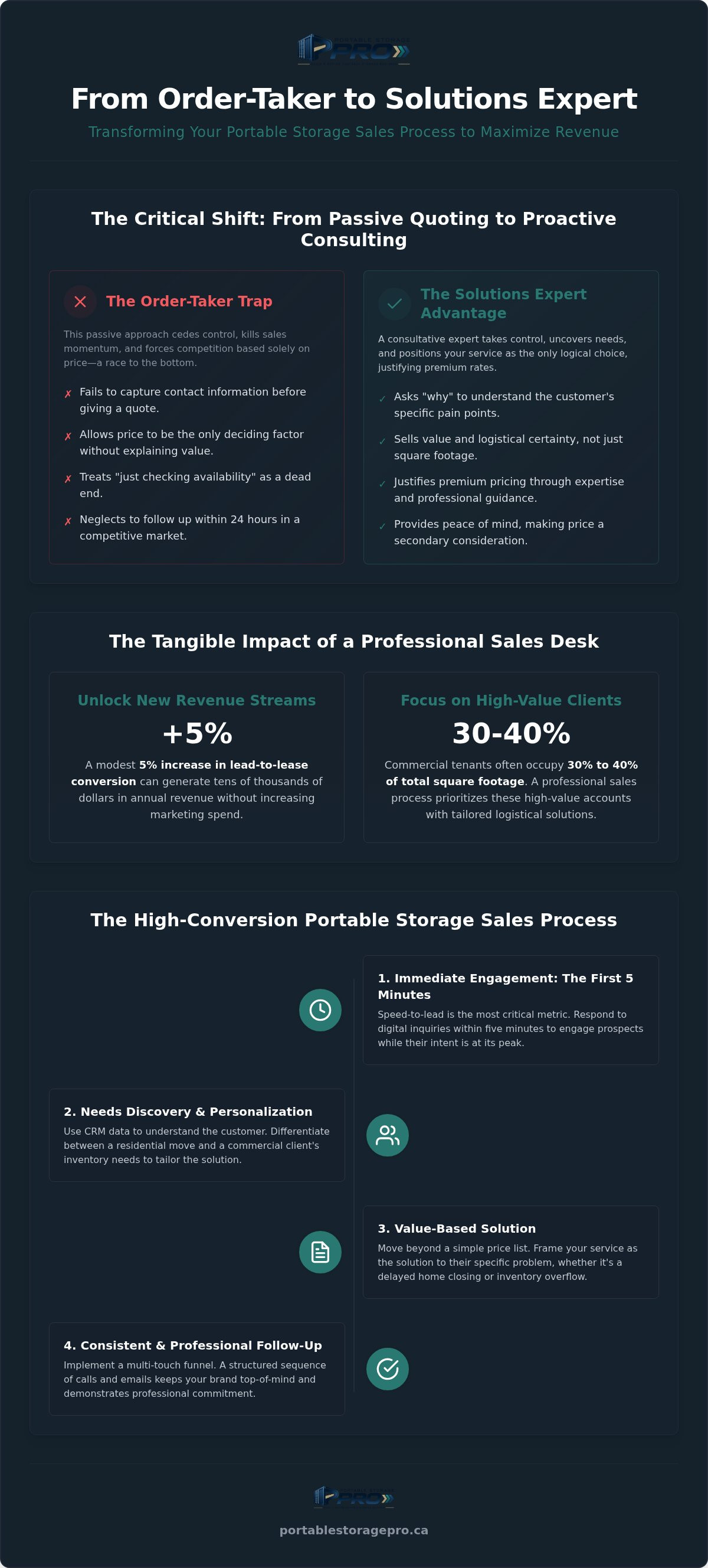
In 2026, Canadian customers expect more than a quote. They are often dealing with the high-pressure environment of a real estate closing or a major renovation. They demand transparency and professional guidance to ensure their belongings remain safe and accessible. For a typical Canadian fleet, even a modest 5% increase in lead-to-lease conversion rates can generate tens of thousands of dollars in annual revenue without increasing your marketing spend. Professionalizing the sales desk is the most direct path to improving your bottom line.
Identifying the Order-Taker Trap
An order-taker follows the customer's lead, answering only the questions asked. If a caller asks, "How much for a 20-foot container?" and your staff simply gives a price and hangs up, you've fallen into the trap. This approach ignores the nuances of the Canadian market, where delivery logistics and site requirements are often complex. Common signs of an order-taker include:
- Failing to capture contact information before providing a quote.
- Treating "just checking availability" as a dead end instead of a starting point.
- Allowing price to be the only deciding factor without explaining value.
- Neglecting to follow up within 24 hours in a competitive national environment.
When sales staff act as order-takers, they cede control of the process. This passivity kills sales momentum and forces your business to compete solely on price, which is a race to the bottom you don't want to win.
The Consultative Sales Advantage
A solutions expert takes control by asking "why." They understand that a container is a tool to solve a specific problem, whether it's a delayed home closing or a commercial inventory overflow. By uncovering the customer’s specific pain points, your team can position your service as the only logical choice, justifying premium rates over generic brokers. This transition requires portable storage sales training that emphasizes active listening and technical authority. Consultative storage sales is the bridge between customer anxiety and logistical certainty. When your team provides that certainty, price becomes a secondary consideration to the peace of mind they offer.
Structuring Your Portable Storage Sales Process for 2026
A high-performing sales desk doesn't operate on intuition alone. It requires a standardized, multi-touch funnel that ensures no inquiry is left to chance. In Canada's competitive 2026 landscape, speed-to-lead is the most critical metric. If your team doesn't respond to a digital inquiry within five minutes, the prospect has likely moved on to the next provider. This responsiveness must be tightly integrated with your portable storage lead generation efforts to ensure your team is engaging with qualified prospects while their intent is at its peak.
Effective portable storage sales training teaches staff to utilize CRM data to personalize the pitch. A residential customer moving a three-bedroom home has vastly different needs than a commercial client managing seasonal inventory. Since commercial tenants often occupy 30% to 40% of an operator's total square footage, your sales process must prioritize these high-value accounts with tailored logistical solutions and volume-based pricing structures. Professionalizing these systems is a core pillar of our Growth Engagement Model, which helps operators scale through operational discipline.
Mapping the Journey from Inquiry to Lease
The first five minutes of any interaction set the professional tone for the entire relationship. During this window, your staff should focus on gathering essential logistics data while establishing themselves as an authority. Following the initial quote, a structured sequence of follow-up calls and emails keeps your brand top-of-mind without becoming intrusive. This disciplined approach is a hallmark of modern sales management training, where the goal is to move the prospect from a vague quote to a signed rental agreement through clear, incremental steps. Closing the deal requires a firm "ask" and a friction-free digital signature process to lock in the lease before the customer shops around.
Integrating Sales with Lead Management Technology
Automation should handle mundane tasks like initial email confirmations and lead categorization so your staff can focus on high-value conversations. Implementing how to improve storage lead conversion techniques within your tech stack allows for real-time tracking of performance. By analyzing conversion rates by lead source, you can identify which marketing channels provide the best return on investment. This data-driven approach ensures that your sales team spends their time on the leads most likely to convert, maximizing the efficiency of your entire operation.
Essential Sales Skills for High-Conversion Storage Teams
Closing a lease in the Canadian market requires more than a friendly voice; it demands a sophisticated blend of technical knowledge and emotional intelligence. Moving is often cited as one of the most stressful life events for homeowners and business managers alike. Effective portable storage sales training must include empathy as a core competency, allowing staff to acknowledge a customer's anxiety while providing concrete logistical solutions. Active listening is the tool that uncovers unstated needs, such as a homeowner’s underlying fear regarding the security of their valuables or a contractor’s concern about site access during a tight renovation window. When a salesperson hears what isn't being said, they can pivot the conversation toward the technical facts that provide peace of mind, such as precise container dimensions and weight limits.
Mastering Logical Logistics and Delivery Feasibility
Your sales staff should be able to visualize a customer’s driveway or job site during the initial discovery call. This requires a deep understanding of logistics, specifically how different delivery systems like tilt-bed or horizontal-lift trucks operate in real-world conditions. Training your team to explain these mechanics manages customer expectations and significantly reduces the frequency of failed delivery attempts, which are costly to your operations. When a representative confidently explains why a specific unit size requires a certain amount of clearance for a horizontal drop, they build immediate authority. This technical expertise transforms the salesperson from a mere clerk into a trusted advisor, ensuring the customer feels confident in the logistical certainty of the plan.
Handling the Price Objection in a Competitive Market
Price objections are inevitable, especially when your team is competing against generic container brokers who prioritize volume over service quality. High-conversion teams are trained to move the conversation from "How much?" to "What is the value?" by highlighting the quality of the fleet and the reliability of the local service. Brokers often lack control over the final mile, whereas an asset-based operator provides a level of certainty that brokers cannot match. Your team should be prepared to explain that a lower price from a broker often carries hidden risks, such as weathered units or unpredictable delivery windows. By focusing on the total cost of a failed move versus the value of a professional, local partnership, your staff can maintain healthy margins even when the market feels crowded.
Implementing a Sustainable Training Framework and SOPs
Training isn't a one-off event; it's a continuous operational requirement. Many operators treat portable storage sales training as a single seminar, but real performance gains come from consistent repetition and refinement. As the Canadian market shifts from rapid expansion to facility optimization in 2026, the consistency of your sales desk becomes a primary competitive advantage. Without a system to reinforce skills, staff eventually revert to the path of least resistance, which usually means falling back into the order-taker trap.
Building this consistency starts with developing robust storage business standard operating procedures. These SOPs act as the foundation for your Sales Playbook, a living document that contains verified scripts, technical data, and objection-handling guides. Integrating role-playing into your weekly routine is also essential for refining your mobile storage sales strategy. It allows staff to practice high-stakes conversations in a low-risk environment, ensuring they remain calm when facing difficult logistical questions or aggressive pricing pushback.
Building Script Frameworks that Sound Human
A common mistake is forcing staff to follow robotic, rigid scripts. This approach alienates Canadian consumers who value transparency and genuine interaction. Instead, provide a framework that includes key phrases to build rapport, such as "I want to make sure we have the right clearance for your driveway so there are no surprises on delivery day." This demonstrates professional care rather than just a desire to close. A script is a map, not a cage, for a professional salesperson. It provides the route to a successful close while allowing the representative to navigate the unique emotional landscape of each caller.
Continuous Coaching and Performance Metrics
To maintain high standards, you must implement a system for reviewing call recordings. This allows managers to identify specific coaching opportunities, such as missed upsell moments or hesitation during price reveals. Your performance metrics should look beyond simple total sales figures. Track KPIs like average response time, lead-to-lease conversion by source, and protection plan attachment rates. Incentivizing these specific behaviours encourages long-term staff retention and professional pride. If you are ready to implement a professionalized sales framework, our SOPs and Compliance services provide the structure needed to scale your operations effectively.
Professionalizing Your Sales Through Operational Leadership
Business owners often manage every aspect of their operations, from fleet maintenance to marketing. This leaves little room for the granular oversight required to maintain a high-converting sales desk. Fractional operational leadership offers a practical solution, implementing structured portable storage sales training faster than an overstretched owner can manage alone. When you professionalize your staff, you aren't just increasing conversion rates; you are building enterprise value. A business with documented, scalable sales systems is far more attractive to investors or potential buyers than one dependent on the owner's personal involvement in every quote.
Scaling your sales team as you expand your fleet across the country requires a shift in perspective. You must move from managing people to managing systems. This transition ensures that your growth is sustainable and that your revenue per lead remains high even as your volume increases. Professionalizing the sales function is the first step toward transforming a local operation into a national competitor.
Scaling with the Growth Engagement Model
The Growth Engagement Model begins by auditing your existing sales processes to find "leaks" where potential revenue is slipping away. Many operators find that simple gaps in follow-up or inconsistent pricing justifications are costing them significant monthly revenue. By implementing top-tier portable storage sales training through a fractional model, you gain the expertise of a seasoned leader without the overhead of a full-time Sales Manager. This approach ensures your sales efforts support your broader procurement and operational goals, such as prioritizing the lease of specific container types to balance your yard inventory.
Leveraging Global Industry Best Practices Locally
The Canadian market is distinct, yet applying global industry insights allows you to stay ahead of domestic competitors. We help operators apply international storage trends to the local landscape, ensuring you adopt modern sales technologies before they become the industry standard. Staying ahead of the curve requires proactive innovation and a commitment to tactical proficiency. By professionalizing your sales desk now, you prepare your business for the consolidation trends expected in the 2026 market. Professionalize your sales team with Portable Storage Pro today.
Scaling Your Fleet Through Sales Excellence
Professionalizing your sales desk is no longer optional in the 2026 Canadian market; it's the difference between merely surviving and dominating your territory. By moving away from passive order-taking and toward a consultative, logistics-first approach, you justify your pricing and build lasting customer trust. These systems ensure that every inquiry is treated as a high-value opportunity rather than a generic transaction. This shift in mindset doesn't just improve your daily conversion rates; it builds a scalable foundation that increases the overall valuation of your business.
Implementing portable storage sales training as part of a broader Growth Engagement Model provides the structure your team needs to handle complex objections. We offer expert operational leadership for Canadian operators and specialized sales and marketing lead generation strategies designed to scale your storage business effectively. Our proven systems remove the guesswork, allowing you to focus on strategic expansion while we professionalize your front-line operations. You have the inventory and the ambition to grow. Now is the time to equip your team with the tools they need to close every high-value opportunity with confidence.
Maximize your conversion rates with Portable Storage Pro’s Growth Engagement Model.
Frequently Asked Questions
Why is sales training different for portable storage compared to traditional self-storage?
Portable storage involves logistical complexities like delivery site feasibility and tilt-bed mechanics that traditional storage doesn't face. Your team must sell a logistics solution rather than just a space solution. This requires technical authority and the ability to visualize a customer’s driveway during a call. It is a consultative process that demands higher technical proficiency than simply showing a fixed unit at a facility.
How long does it take to see results from a new sales training program?
You can often see a measurable lift in lead-to-lease conversion rates within the first 30 to 60 days of implementing a structured program. Initial improvements usually stem from faster response times and better lead categorization. Long-term gains in revenue per lead and protection plan attachment rates typically stabilize after three months of consistent coaching and regular role-playing sessions with your staff.
Should I use scripts for my portable storage sales team?
You should use script frameworks that provide a map for the conversation without sounding robotic. Effective portable storage sales training utilizes these frameworks to ensure brand consistency and technical accuracy regarding container dimensions. These guides help staff handle common objections while allowing them the flexibility to build genuine rapport with customers who are often facing stressful life events like moving or renovations.
What are the most important KPIs to track for storage sales staff?
Focus on metrics that reflect operational efficiency and revenue quality rather than just total volume. Key performance indicators should include your speed-to-lead, lead-to-lease conversion rate by source, and protection plan attachment rates. Tracking these specific data points allows you to identify coaching opportunities for individual team members. It also helps you understand which marketing channels are providing the most qualified prospects for your team.
How do I handle customers who are only shopping for the lowest price?
Shift the conversation from price to logistical certainty and value. Explain the risks associated with low-cost brokers, such as unpredictable delivery windows or poor unit quality. Highlight your local operational control and the reliability of your fleet. By positioning your service as a stress-reduction tool rather than a commodity, you can often justify a premium rate to customers who prioritize the safety of their belongings.
Can sales training help reduce operational issues like failed deliveries?
Professional sales training directly reduces failed deliveries by teaching staff to verify site feasibility during the initial discovery call. When a salesperson understands the clearance needed for a tilt-bed delivery, they can ask the right questions about overhead wires or narrow driveways. This technical proficiency ensures that expectations are managed before the truck leaves the yard, saving significant operational costs and preventing customer frustration.
Is it better to train in-house or hire a portable storage consultant?
Hiring a specialized consultant often yields faster results because they bring industry-specific SOPs and global best practices. Many owners are too overstretched to maintain the consistent coaching required for high performance. A consultant provides the operational leadership needed to professionalize the sales desk without the long-term overhead of a full-time manager. This allows you to leverage expert systems while focusing on high-level growth.
How often should we update our sales SOPs and scripts?
You should review your sales SOPs and scripts at least twice a year to account for shifts in the Canadian market. Adjustments may be necessary based on seasonal peaks, new technology implementations, or changes in competitor strategies. Regular reviews ensure your team remains proactive and that your sales frameworks stay aligned with your current operational goals, fleet capabilities, and the evolving needs of your customers.

Article by
Paul Taylor
Paul Taylor is the founder of Portable Storage Pro, bringing more than 35 years of experience across the container, portable storage and transportation industries. His background spans executive operations, business development, global procurement, sales, marketing and operational improvement in Canada, the UK and international markets.
Paul helps independent portable storage and container rental operators increase revenue, strengthen margins and build more efficient businesses. His work connects strategy with practical implementation, including pricing, delivery operations, supplier sourcing, staff training, technology and customer experience.
His experience includes leading multi-location storage operations and serving on the National Portable Storage Association’s board along with chairing its Canadian committee. Through Portable Storage Pro, Paul shares practical insights to help owners make informed decisions, solve operational challenges and grow profitably.
Disclaimer
Content published by Portable Storage Pro Inc. (PSP) provides general business information and industry insights. It does not replace advice tailored to your business or specialist legal, tax, engineering or other regulated advice. Reading this content or contacting PSP does not, by itself, establish a consulting engagement.
Information reflects circumstances at publication and may change. Examples and potential benefits are illustrative; results depend on individual circumstances, implementation and market conditions and are not guaranteed.
Client services are governed by the signed service agreement, agreed work plan and written amendments. Website and blog content do not amend those terms. PSP’s work is subject to applicable law and the professional commitments set out in its agreement, including the CMC-Canada Code of Professional Conduct and NPSA Code of Conduct and Ethics. Copies are available on request.
Views expressed are PSP’s own. Association membership or references do not imply association endorsement or CMC certification. Nothing in this disclaimer limits PSP’s contractual responsibilities, professional duties or rights that cannot lawfully be excluded.


