
With the supply of new self-storage space in Canada projected to double in 2026, can your independent operation survive a market that's suddenly twice as crowded? Most operators realize that relying on local reputation is no longer enough to counter the aggressive digital presence of national brands. You've likely felt the pressure of a high cost per lead that doesn't translate into rentals, often due to a fragmented mobile storage sales strategy. It's a common struggle to maintain consistent follow-up when daily operations demand your full attention; however, these inefficiencies are solvable through better systems.
We understand that the transition from a hands-on owner to a systems-driven business is a complex shift. This article provides a professional sales framework designed to stabilize your pipeline and increase conversion rates through disciplined, tech-enabled procedures. We'll examine how to organize your sales staff, implement logical follow-up sequences, and leverage the latest industry trends to ensure your revenue growth remains predictable. By the end of this guide, you'll have the tactical tools needed to compete with institutional-quality facilities while maintaining your independent edge.
Key Takeaways
- Transition from passive order-taking to a consultative sales approach to differentiate your business from national franchises.
- Leverage the 2026 tech stack to automate routine inquiries, allowing your team to focus on closing complex deals.
- Establish a resilient mobile storage sales strategy by adopting the "Three-Touch Rule" for disciplined lead management and follow-up.
- Utilize specialized SOPs to professionalize your sales force and provide consistent responses to logistical or pricing objections.
- Integrate your sales goals with procurement strategies via the Growth Engagement Model to maintain adequate container inventory as you scale.
The Evolution of the Mobile Storage Sales Landscape in 2026
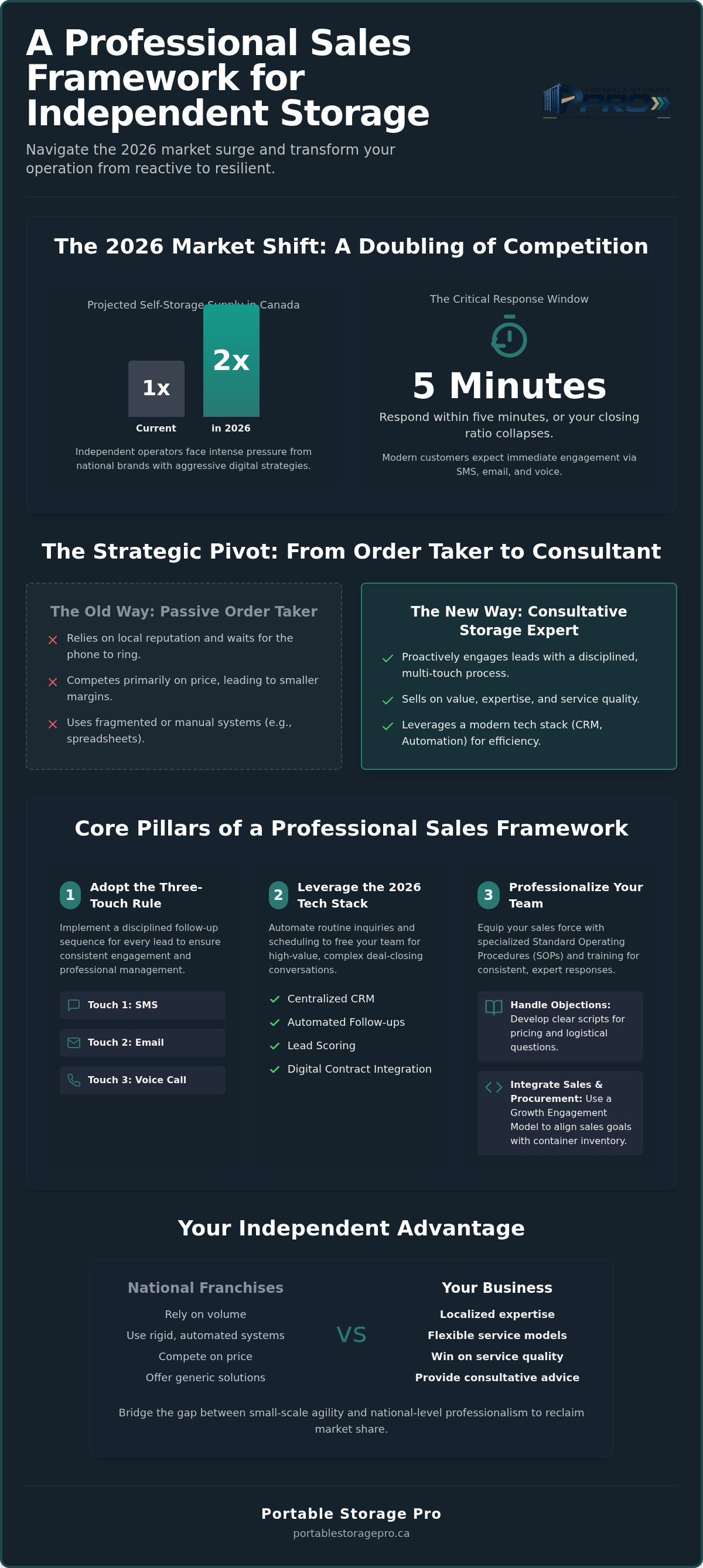
The landscape has changed. In 2026, the evolution of the self-storage industry has reached a tipping point where passive lead generation no longer sustains a healthy bottom line. With the supply of new self-storage space in Canada projected to double this year, the competition for every qualified lead is fierce. National franchises have refined their digital funnels to capture high-intent traffic, which means independent operators can't simply wait for the phone to ring. You must transition from being a unit order taker to a consultative storage expert. This shift requires a deep understanding of your client's logistical pain points. A modern mobile storage sales strategy is a data-driven, multi-touch process that prioritizes immediate engagement and systematic follow-up over simple inquiry volume. Canadian customers now demand peak transparency regarding delivery fees and rapid response times.
From Lead Generation to Lead Engagement
Engagement is the primary metric for success in the current market. If you don't respond to an inquiry within the first five minutes, your closing ratio effectively collapses. Customers move to the next search result within seconds if they don't feel heard. Modern engagement requires multi-channel communication including SMS, email, and voice. It's about being present where the customer is. Move beyond price-focused selling. Instead, use value-added service positioning to explain why your container's structural integrity or your precision delivery system justifies the investment. This consultative approach builds trust that a generic quote never will.
The Impact of National Franchises on Independent Sales
Big-box brands use automated pricing to aggressively undercut independents on high-visibility platforms. They rely on volume and rigid systems. Your independent advantage lies in localized expertise and flexible service models that a franchise cannot replicate. You know the local terrain and the specific needs of your community. Professionalizing your sales voice is the first step to reclaiming market share. When you adopt a disciplined mobile storage sales strategy, you bridge the gap between small-scale agility and national-level professionalism. This allows you to articulate your value clearly and win deals based on service quality rather than just being the cheapest option on the map. Implementing the Growth Engagement Model ensures your sales team has the training to handle objections while maintaining this professional edge.
Integrating Technology into Your Sales Pipeline
Technology is the backbone of a modern mobile storage sales strategy. In 2026, relying on memory-based systems or manual data entry is a significant operational liability. A robust tech stack allows you to automate mundane tasks like initial inquiry responses and delivery scheduling. This frees your staff to focus on high-value interactions that require a human touch. Your website shouldn't just be an online flyer; it must function as a 24/7 virtual sales representative capable of capturing data and providing instant utility. By tracking lead sources through integrated lead management systems, you can precisely organize your marketing spend toward the channels that actually yield a return on investment.
Data is no longer a byproduct of your business; it's a primary sales tool. Successful Canadian operators use cloud-based management systems to monitor inventory levels and customer behaviour in real time. This allows for the implementation of dynamic pricing tools that adjust based on seasonal demand or fleet availability. When your technology handles the routine logistics, your sales team can transition into the consultative storage expert role we discussed previously. This professionalized approach ensures that every dollar spent on marketing is tracked and every lead is nurtured through a logical, tech-enabled pipeline.
CRM Implementation for Storage Operators
A spreadsheet is a static document, not a scalable sales strategy. As your fleet grows, you need a centralized hub that provides real-time visibility into your pipeline. Essential CRM features for 2026 include automated follow-up sequences, lead scoring to prioritize hot inquiries, and seamless digital contract integration to close deals faster. By linking your portable storage lead generation efforts directly to a sales dashboard, you eliminate the data silos that cause leads to fall through the cracks. This level of structural clarity is a hallmark of professionalized operations.
Automation vs. Personal Touch
Automation is excellent for confirmations and reminders, but it has distinct limits. It can hinder the sales process when applied to complex quotes or nuanced customer concerns that require empathy. AI-driven chatbots are highly effective for qualifying leads before they reach your human team, ensuring that your staff only spends time on viable prospects. The goal is to maintain a professional brand voice across all automated touchpoints so the customer experience feels cohesive and intentional. If you're looking to refine your digital tools, our Technology & Innovation Consulting can help audit your current systems for maximum efficiency.
Strategic Lead Management: Beyond Basic Inquiries
Effective lead management is the bridge between a high-traffic website and a growing fleet. While the technology discussed earlier captures the data, your team's execution determines the final conversion rate. A professional mobile storage sales strategy requires a repeatable process for every inbound lead, ensuring no prospect is ignored during busy operational periods. We recommend implementing the "Three-Touch Rule" as a baseline for persistent follow-up. This involves an immediate response via the customer's preferred channel, a secondary check-in within 24 hours, and a final follow-up on day four. Consistency here prevents leads from cooling off and moving to a competitor. Lead conversion is a metric of operational health, not just sales luck.
Categorizing your leads by intent allows you to tailor your communication style and resource allocation. Residential moving leads typically require speed and empathy, while commercial renovation prospects value reliability and specific delivery windows. Long-term storage inquiries are the foundation of stable monthly revenue. By identifying the specific needs of these three groups, you can provide the consultative expertise that differentiates an independent operator from a rigid national franchise.
Lead Scoring and Prioritization
Not all leads are created equal. You must identify high-value commercial leads early because they offer the most significant potential for recurring revenue and long-term partnerships. You can improve storage lead conversion by focusing your team's best energy on high-intent inquiries that match your ideal customer profile. It's equally vital to set up "red flags" for leads that show signs of being problematic. Prospects with vague timelines, a lack of verifiable business credentials, or a history of payment disputes in other sectors can drain your operational resources. Prioritizing quality over quantity ensures your sales team remains efficient and your fleet stays profitable.
Managing the Sales Cycle Length
The sales cycle for a 24-hour residential move is vastly different from a three-month commercial bid. Understanding these timelines helps you manage your inventory and staff expectations. You can shorten the consideration phase for residential clients by using social proof, such as localized reviews, and creating a sense of urgency around unit availability. For longer cycles, move away from verbal or handwritten quotes. Use professional, digital proposals that include clear terms and conditions. This level of detail instills confidence and positions your business as a sophisticated partner, making it easier for commercial clients to approve the expenditure without unnecessary delays.
Professionalizing the Sales Force: SOPs and Training
A scalable sales team is built on the foundation of Standard Operating Procedures (SOPs). Without these documented systems, your mobile storage sales strategy relies on the individual talent of your staff rather than a repeatable business process. SOPs ensure that every inquiry receives the same high-level professional response, regardless of who answers the phone. This structural clarity is what allows independent operators to maintain a professionalized operation that rivals national franchises. It moves the business away from "winging it" and toward a disciplined framework where success is predictable and measurable.
Training your staff to handle common objections is a core component of this professionalization. When a prospect questions the price or the logistics of a delivery, your team shouldn't hesitate. They need to be equipped with the specific language required to pivot the conversation from cost to value. For instance, explaining the structural superiority of your containers or the precision of your delivery system can justify a higher price point than a budget competitor. Operational leadership plays a vital role here by reinforcing these standards and ensuring that the team doesn't revert to price-slashing as a default closing tactic.
Developing a Sales Playbook
Your sales playbook should begin with a standardized discovery call. This process ensures that every logistical detail, from overhead clearance to surface stability, is captured during the first interaction. You should also maintain a library of responses for common hurdles. When a customer claims they can get a unit cheaper elsewhere, your team must be prepared to discuss hidden fees, delivery reliability, and local accountability. Every team member needs to realize the physical nuances of container logistics; a sales rep who understands the turning radius of a delivery truck is far more effective than one who only knows the monthly rental rate.
Operational Leadership and Accountability
Many independent operators find that fractional management provides the necessary oversight for a sales department without the overhead of a full-time executive. This leadership model focuses on setting and monitoring Key Performance Indicators (KPIs) such as lead conversion rates and average order values. Regular sales audits are essential to identify bottlenecks in your communication flow and ensure that follow-up sequences are being followed. If you're ready to professionalize your team's output, our Operations & Training services provide the specialized SOP development needed for sustainable growth. Incentivizing performance through structured commissions ensures that your staff's goals remain aligned with the long-term profitability of the fleet.
Scaling Growth Through the Growth Engagement Model
The Growth Engagement Model acts as the ultimate integrator for independent operators. While earlier sections focused on technology and staff training, this model ensures that your mobile storage sales strategy is grounded in operational reality. It's ineffective to have a high-performing sales team if your fleet capacity is stagnant or your unit costs are too high to remain competitive. Scaling requires a holistic view where marketing, sales, and procurement move in unison to support predictable revenue growth. This framework provides the structural clarity needed to align your sales ambitions with your physical inventory.
Transitioning from a hands-on owner-operator to a strategic leader is the final stage of professionalization. It involves stepping back from the daily logistics of delivery and lead follow-up to focus on high-level procurement and market positioning. By implementing the systems we've discussed, you gain the calm control necessary to oversee complex operations without being buried by them. This shift allows you to lead with focused ambition rather than reactive stress, moving the business toward a hands-off management style that still delivers tangible outcomes.
Procurement Strategy as a Sales Driver
Your sales team cannot succeed if your procurement process is reactive. In the Canadian market, waiting until you're at full occupancy to order more containers results in lost revenue and frustrated prospects. A proactive mobile storage sales strategy relies on having inventory ready before demand peaks. By leveraging global supply chain access, you can significantly reduce the unit costs of your containers. Lowering your procurement "markup" gives you the room to offer more competitive pricing or invest more heavily in lead generation without sacrificing your margins. This vital link between sales and sourcing is what separates stagnant businesses from scaling ones.
Your Path to Professionalization
Generic business coaching often fails because it lacks industry-specific depth. Real growth comes from operational leadership that understands the physical realities of container logistics and international procurement. You can leverage global conference representation and niche industry insights through the Growth Engagement Model without the travel costs associated with international trade shows. This partnership provides the specialized SOPs and technology consulting needed to transform your business into a market leader. It's about removing unnecessary layers of cost while professionalizing every touchpoint of your customer journey.
Ready to professionalize your operation? Explore the Growth Engagement Model with Portable Storage Pro.
Professionalizing Your Path to 2026 Growth
The transition from a manual operation to a scalable business requires more than just marketing; it demands a comprehensive mobile storage sales strategy that aligns your technology, staff, and inventory. By moving toward a consultative sales model and implementing disciplined lead management, you create a resilient barrier against national franchise competition. We've seen how integrating robust SOPs and automated follow-ups ensures that no inquiry is wasted, while strategic procurement keeps your fleet ready for peak demand. This structural clarity is the hallmark of an operator who has successfully shifted from daily logistics to strategic leadership.
Professionalizing your operation doesn't have to be a solitary challenge. Our specialized operational leadership provides the systems you need to reclaim your time and stabilize your revenue. Through the proven Growth Engagement Model, you gain access to global supply chains and industry-specific expertise that drives tangible outcomes. It's time to move beyond reactive management and build the resilient business your community relies on. Discover the Growth Engagement Model for Storage Operators and take the first step toward a more predictable and profitable future.
Frequently Asked Questions
What is the most effective sales channel for portable storage in 2026?
The most effective sales channel in 2026 is a combination of integrated digital platforms and rapid response systems. While digital marketing drives initial traffic, the channel that closes deals is the one that allows for immediate lead engagement via SMS or voice. Canadian operators find that responding within five minutes is vital. This speed maintains momentum before a prospect moves on to a national franchise competitor.
How do I compete with national portable storage brands on price?
You compete with national brands by leveraging localized expertise and reducing your unit costs through global procurement. National brands rely on volume and rigid automated pricing. By utilizing global supply chain access through specialized sourcing, you can reduce unit markups. This allows you to offer competitive rates while highlighting service advantages like flexible delivery windows that big-box franchises often struggle to provide.
What technologies are essential for a mobile storage sales strategy?
A modern mobile storage sales strategy requires a cloud-based CRM, automated lead management systems, and dynamic pricing tools. These technologies handle initial inquiries and scheduling, which allows your team to focus on high-value consultative selling. Tracking lead sources through a digital dashboard is also vital to organize your marketing spend. Your website must act as a virtual sales representative, capturing data and providing utility 24/7.
How can I improve my storage lead conversion rates quickly?
You can improve lead conversion rates quickly by implementing a "Three-Touch Rule" for persistent follow-up and prioritizing high-intent inquiries through lead scoring. Speed is the most critical factor; responding to an inquiry within five minutes significantly increases your closing ratio. You should also replace verbal quotes with professional digital proposals. These steps provide the structural clarity needed to professionalize your sales process in a crowded market.
Do I need a dedicated sales person for my portable storage business?
A dedicated salesperson isn't always necessary if you have robust SOPs and automated systems to manage your pipeline. Many operators benefit more from fractional management or specialized training for existing staff. The goal is to ensure that lead management is a disciplined process rather than a secondary task. Professionalizing your current team's output through a structured framework is often more cost-effective than a full-time hire.
How does procurement impact my ability to sell storage services?
Procurement impacts sales by ensuring you have the physical inventory to fulfill the contracts your team closes. Your mobile storage sales strategy will fail if you don't have units ready before demand peaks. Accessing global supply chains allows you to reduce unit costs and maintain inventory levels during busy Canadian moving seasons. This proactive approach ensures your sales team can be aggressive without worrying about fleet capacity.
What are the most common sales objections in the portable storage industry?
Common sales objections in the portable storage industry typically focus on price, container dimensions, and delivery logistics. Customers often claim they can find a cheaper option or worry about a container fitting in their driveway. Your team must be trained to pivot from cost to value, explaining the structural integrity of your units and your precision delivery systems. Standardizing these responses in a sales playbook ensures confidence.
Why are SOPs important for a small storage sales team?
SOPs are important because they provide a repeatable framework that ensures consistent performance across your entire sales team. They remove the guesswork from daily tasks and ensure every customer receives a professional experience. Documented procedures for discovery calls and follow-up sequences allow you to maintain a high standard of operational health. This structural clarity enables independent operators to compete successfully with institutional-quality national brands.

Article by
Paul Taylor
Paul Taylor is the founder of Portable Storage Pro, bringing more than 35 years of experience across the container, portable storage and transportation industries. His background spans executive operations, business development, global procurement, sales, marketing and operational improvement in Canada, the UK and international markets.
Paul helps independent portable storage and container rental operators increase revenue, strengthen margins and build more efficient businesses. His work connects strategy with practical implementation, including pricing, delivery operations, supplier sourcing, staff training, technology and customer experience.
His experience includes leading multi-location storage operations and serving on the National Portable Storage Association’s board along with chairing its Canadian committee. Through Portable Storage Pro, Paul shares practical insights to help owners make informed decisions, solve operational challenges and grow profitably.
Disclaimer
Content published by Portable Storage Pro Inc. (PSP) provides general business information and industry insights. It does not replace advice tailored to your business or specialist legal, tax, engineering or other regulated advice. Reading this content or contacting PSP does not, by itself, establish a consulting engagement.
Information reflects circumstances at publication and may change. Examples and potential benefits are illustrative; results depend on individual circumstances, implementation and market conditions and are not guaranteed.
Client services are governed by the signed service agreement, agreed work plan and written amendments. Website and blog content do not amend those terms. PSP’s work is subject to applicable law and the professional commitments set out in its agreement, including the CMC-Canada Code of Professional Conduct and NPSA Code of Conduct and Ethics. Copies are available on request.
Views expressed are PSP’s own. Association membership or references do not imply association endorsement or CMC certification. Nothing in this disclaimer limits PSP’s contractual responsibilities, professional duties or rights that cannot lawfully be excluded.


