
Lead conversion in the portable storage industry isn't a marketing metric; it's a direct result of your operational discipline. If you're tired of watching inquiries vanish into a black hole of inconsistent follow-ups, you're likely searching for how to improve storage lead conversion without simply increasing your ad spend. Most operators realize that throwing more money at lead generation won't fix a broken sales process. You've felt the frustration of paying for traffic only to see a high bounce rate on your rental forms. It's an expensive gap in your system that separates stagnant businesses from those that truly scale.
This guide provides a repeatable framework to turn those inquiries into high-margin rentals. We'll move past generic advice to show you how a structured Growth Engagement Model utilizes specialized training and refined SOPs to ensure no lead is left behind. This checklist covers the tactical shifts required for 2026, from optimizing your digital storefront to implementing rigorous sales follow-up sequences. You'll learn to align your marketing and operations to close deals faster and maximize your ROI, ensuring your team is equipped to handle the logistical realities of the current market.
Key Takeaways
- Define lead conversion as an operational outcome rather than a marketing metric to better distinguish between raw inquiries and sales-qualified leads.
- Implement a rigorous lead scoring system that prioritizes inquiries based on move dates and location feasibility to optimize your sales team's capacity.
- Discover how to improve storage lead conversion by adopting a "First Five Minutes" response rule and a structured multi-channel follow-up cadence.
- Streamline your digital storefront with mobile-first quote forms that reduce friction and lower bounce rates for on-the-go customers.
- Leverage professionalized training and standardized operating procedures to turn operational excellence into a repeatable sales engine.
Benchmarking Your Portable Storage Lead Conversion Rates
Benchmarking is the first step in understanding how to improve storage lead conversion. Without a clear baseline, you're guessing at which levers to pull. In the portable storage sector, conversion isn't a single event; it's a series of operational hand-offs that move a prospect from curiosity to a signed rental agreement. If your team treats every phone call like a guaranteed sale, they'll burn out. If they treat every sales-qualified lead like a generic inquiry, you'll lose money.
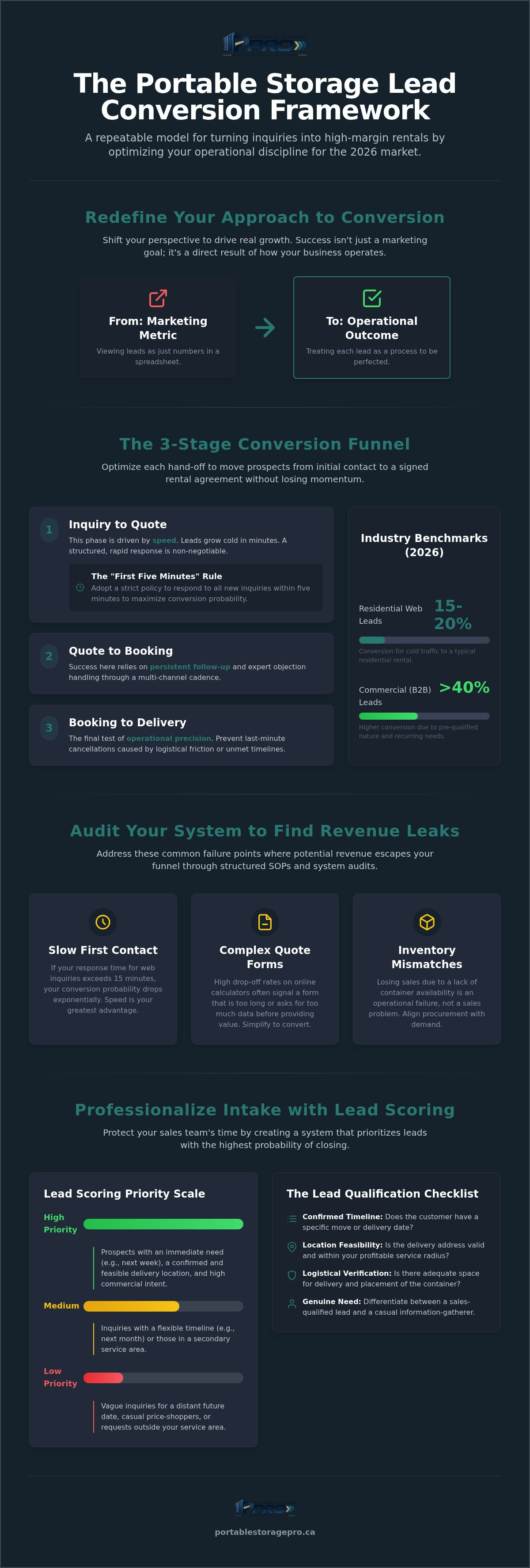
A marketing lead is often just a curiosity seeker or someone outside your service area. A Sales-Qualified Lead (SQL), however, has a confirmed timeline, a valid delivery address, and a genuine need for your equipment. Efficiency is measured across three distinct stages. First is the Inquiry-to-Quote phase, where speed is the primary driver. Second is the Quote-to-Booking phase, which relies on sales follow-up and objection handling. Finally, the Booking-to-Delivery phase ensures that logistical hurdles don't cause a cancellation before the unit hits the ground. This final stage is where operational precision is tested. A customer who cancels because your dispatch team can't meet their timeline is a failed conversion that costs more than a lost inquiry, as it consumes administrative resources without generating revenue.
The Formula for Portable Storage Conversion
The lead conversion rate is calculated by dividing the total number of completed rentals by the total number of unique inquiries received over a specific timeframe.
Tracking "lost leads" with specific reason codes is a core component of operational leadership. You need to know if you're losing business due to price, lack of container availability, or simple lack of follow-up. While residential benchmarks in the 2026 Canadian market often hover around 15 to 20 percent for cold web traffic, commercial conversion rates should be significantly higher. B2B relationships often yield conversion rates exceeding 40 percent due to the pre-qualified nature of the inquiries and the recurring need for storage solutions.
Identifying Conversion Leaks in Your Funnel
To find where your revenue is escaping, conduct a thorough audit of your current systems. This process is essential for anyone looking at how to improve storage lead conversion through structured SOPs and better alignment between departments.
- Audit your "Time to First Contact" for web inquiries: Leads grow cold in minutes, not hours. If your response time exceeds 15 minutes, your conversion probability drops exponentially.
- Review the drop-off rate on your online quote calculator: If users start the process but don't finish, your form is likely too complex or asks for too much personal data before providing value.
- Assess the impact of container availability on lost sales: You can't convert what you don't have. Procurement and sourcing issues often masquerade as sales problems when the reality is a lack of localized inventory.
Professionalizing the Intake: Lead Qualification and Scoring
Effective intake is the filter that protects your sales team's time and your company's bottom line. If your staff treats a high-intent commercial lead the same as a casual price-shopper, your ROI will suffer. Understanding how to improve storage lead conversion starts with distinguishing between these profiles during the very first contact. A standardized intake process ensures that every inquiry is captured in a centralized system, preventing leads from slipping through the cracks of sticky notes or unmonitored inboxes.
To scale efficiently, you must implement a lead scoring system. This system assigns value based on intent, timeline, and location feasibility. A prospect requiring a container for a move next week in a high-margin service area should always take priority over a vague inquiry for next season. By utilizing portable storage lead generation best practices, you can filter out low-intent traffic before it even reaches your sales desk. This allows your team to focus their energy on leads with the highest probability of closing, rather than chasing dead ends.
The Lead Qualification Checklist
Qualification in the portable storage industry is as much about logistics as it is about sales. Your intake staff must be trained to verify the physical realities of the delivery before promising a quote. This prevents operational friction and cancelled bookings later in the funnel.
- Verify delivery site suitability: Ask about overhead wires, tight corners, and surface types like gravel or soft grass.
- Confirm rental duration: Identify if the lead is a short-term residential move or a long-term commercial project with recurring revenue potential.
- Determine equipment needs: Check if the customer requires specialized delivery systems or specific container sizes that may have limited availability.
Training Your Staff for High-Value Intake
The most successful operators move away from "order taking" and toward consultative selling. Your staff shouldn't just provide a price; they should provide a solution. This transition requires professionalizing the initial discovery questions to build immediate trust and authority. When a prospect calls, the greeting should be disciplined and the questions should be designed to uncover the customer's true pain points.
Staff must be able to confidently explain why your container quality justifies the investment over cheaper, less reliable competitors. This level of expertise is a core part of professionalized sales and marketing training, which helps teams organize their approach around value rather than just cost. When your team acts as a partner in the customer's moving or storage project, conversion rates naturally rise because the prospect feels a sense of calm control over their logistical challenges.
Optimizing the Sales Cadence: Timing and Personalization
Speed is a competitive advantage in the logistical sector. When a prospect searches for how to improve storage lead conversion, the answer often starts with the "First Five Minutes" rule. Responding to digital inquiries within this window is non-negotiable for high-performing operators. A rapid response signals reliability and professionalism before a single word is exchanged. Integrating these cadences into a broader portable storage business profitability strategy ensures that your marketing spend isn't wasted on leads that go cold while waiting for a callback. A multi-channel approach that combines phone, email, and SMS creates a persistent yet professional presence in the prospect's decision-making process.
Personalization is the second pillar of an effective cadence. Your follow-up should reflect the specific needs of the use case, whether it's a residential move, a home renovation, or a commercial job site. A contractor needs to know about delivery precision and weight limits, while a homeowner may be more concerned about driveway protection and aesthetic impact. By tailoring your message, you demonstrate the industry-specific competence that builds trust and moves the lead toward a booking.
The 72-Hour Conversion Window
The decision-making cycle for portable storage is remarkably compressed. Approximately 80 percent of storage rentals are decided within the first 72 hours of the initial search. If you haven't secured a commitment or built a strong rapport within this window, the prospect has likely moved on to a competitor. Your sales process must be front-loaded to capture this urgency without appearing desperate or disorganized.
- Automate an immediate "Thank You" email: This should include a clear next step, such as a link to book a site survey or a preliminary quote based on their input.
- Schedule a day-two follow-up call: Use this touchpoint to address logistical concerns or site-specific constraints that might be holding up the decision.
- Track engagement: Monitor which leads are opening emails multiple times, as this indicates high intent and a need for a direct phone call.
Using SMS for Instant Engagement
SMS has become a primary channel for operational efficiency in 2026. With open rates that dwarf traditional email, text messaging allows for instant engagement that feels personal. It's an ideal tool for confirming delivery details or clarifying site access issues. Ensure your SMS templates are professional and offer a direct line to a human representative to maintain a high level of service.
- Use SMS for site surveys: Ask customers to text photos of their delivery location to confirm feasibility and surface type.
- Confirm delivery windows: Send a quick text 24 hours before a scheduled drop-off to ensure the site is clear and ready.
- Offer a "Text-to-Book" option: Simplify the final step for returning commercial clients who already know your equipment and pricing.
Digital Conversion Rate Optimization (CRO) for Storage Websites
Your website acts as the primary gateway for your sales funnel. If the interface is clunky or the quote request process is cumbersome, you've lost the lead before your sales team even has a chance to engage. Understanding how to improve storage lead conversion requires a technical audit of your digital storefront. Since most moving-related searches happen on mobile devices while customers are on-site or in transit, a mobile-first design is a baseline requirement. A site that doesn't load quickly or display correctly on a smartphone will see high bounce rates, regardless of how much you spend on marketing.
For independent operators, your website must also work harder to establish credibility. Highlighting your status as a Canadian-owned business appeals to national consumer preferences for local expertise and accountability. This transparency, combined with a frictionless user experience, creates the "calm control" prospects seek during a stressful move or renovation. By optimizing these digital touchpoints, you ensure your technology supports your operational goals rather than hindering them.
The High-Converting Quote Page
Friction is the enemy of conversion. Every unnecessary field on your quote request form increases the likelihood that a prospect will abandon the page. Your goal is to capture the minimum amount of data required to initiate a high-value sales conversation. You can always gather granular details once you have them on the phone.
- Remove unnecessary fields: Eliminate secondary phone numbers, fax lines, or "how did you hear about us" questions from the initial form.
- Incorporate a "Quick Quote" feature: Provide a preliminary price range or a "starting at" figure to manage expectations before the full sales call.
- Use high-contrast Call to Action (CTA) buttons: Ensure your "Reserve Your Container" or "Get My Quote" buttons stand out visually and use urgent, action-oriented language.
Building Trust Through Transparency
Transparency reduces purchase anxiety. In an industry often plagued by brokers and hidden fees, being direct about your capabilities sets you apart. Use your website to answer the logistical questions that often stall a booking. When you provide clear information upfront, you're not just providing data; you're building a foundation for a professional partnership.
- Clearly display delivery areas: Use a map or a list of postal code prefixes to show exactly where you operate.
- Use actual equipment photos: Avoid stock photography. High-quality images of your actual containers and delivery systems prove you're a real operator with tangible assets.
- Display real-time Canadian reviews: Feature testimonials from customers in similar regions to validate your reliability and service quality.
If your digital presence isn't generating the volume you expect, it's time to professionalize your sales and marketing systems to ensure your website converts traffic into tangible revenue.
Leveraging Operational Leadership to Close the Performance Gap
Operational leadership is the final, essential component for anyone seeking how to improve storage lead conversion. While marketing generates interest, your internal logistics determine whether that interest turns into a high-margin rental or a lost opportunity. Conversion excellence requires a shift in perspective; you must view your operations not as a cost centre, but as a sales engine. When you implement rigid Standard Operating Procedures (SOPs), you ensure that every customer receives a consistent, high-register experience. This reliability builds the trust necessary to turn a single inquiry into a long-term contract or a valuable referral.
The Growth Engagement Model provides the necessary framework to professionalize these systems. It moves the business away from reactive "firefighting" and toward a proactive model where inventory management and sales efforts are perfectly aligned. Sound operational leadership allows you to identify specific bottlenecks, such as losing leads because containers aren't being refurbished quickly enough or because procurement hasn't kept pace with localized demand. By addressing these logistical realities, you remove the friction that often kills a deal before the sales team can finalize the booking.
Closing the Feedback Loop Between Sales and Ops
A disconnect between the sales desk and the yard is a primary cause of revenue leakage. If your sales team doesn't have real-time visibility into container availability, they risk over-promising or missing opportunities to close a lead on the spot. Aligning these departments ensures that the promises made during the intake process are physically achievable by the logistics team.
- Conduct a weekly review of "Lost Lead" data: Bring both sales and logistics teams together to identify patterns, such as leads lost due to specific delivery window constraints or equipment shortages.
- Maintain real-time inventory visibility: Ensure the sales team can see exactly which units are clean, staged, and ready for dispatch at any given moment.
- Train drivers as brand ambassadors: Your drivers are often the only staff members a customer meets in person. Train them to facilitate on-site upsells or secure referrals through professionalized service.
The Path to Professionalized Scaling
Scaling an independent storage brand requires moving beyond the daily grind of manual tasks. Professionalizing every touchpoint creates a "Conversion Engine" that outpaces competitors who rely on ad-hoc processes. This level of maturity is often achieved through access to global supply chains, ensuring your fleet remains conversion-ready even during periods of peak demand. When you have the right equipment in the right place at the right time, your sales team can stop making excuses and start closing more deals.
By aligning procurement, training, and logistics under a single strategic umbrella, you turn your operational proficiency into a tangible market advantage. This holistic approach is the definitive way to realize long-term growth. When your systems are disciplined and functional, you gain the calm control needed to focus on strategic expansion rather than daily survival. This is how to improve storage lead conversion while simultaneously building a more resilient and profitable business.
Standardizing Your Path to Scalable Growth
Mastering how to improve storage lead conversion requires a shift from reactive management to disciplined, system-driven operations. By professionalizing your intake process and optimizing your sales cadence, you ensure that every inquiry is treated as a high-value opportunity. Transitioning your website into a frictionless digital storefront and aligning your logistics with your sales desk creates a conversion engine that functions independently of ownership's constant oversight. This structural clarity allows you to move beyond the daily friction of lost leads and focus on the strategic expansion of your fleet.
As a seasoned authority in the Canadian portable storage sector, Portable Storage Pro provides the specialized operational leadership independent operators need to thrive. Our approach removes unnecessary layers and gives you access to global supply chain connections that keep your business competitive. Discover how our Growth Engagement Model professionalizes your sales and operations. We're committed to helping you turn complex operational challenges into a steady, reliable path for growth. It's time to take control of your performance and build the resilient business you've envisioned.
Frequently Asked Questions
What is a good conversion rate for a portable storage business?
A healthy conversion rate for cold web traffic in the Canadian portable storage sector typically ranges from 15 to 20 percent. However, businesses utilizing a professionalized Growth Engagement Model often see rates exceeding 40 percent for commercial inquiries. Tracking these metrics specifically by lead source allows you to identify which channels provide the highest quality traffic. It's essential to distinguish between raw inquiries and sales-qualified leads to get an accurate picture of your performance.
How can I improve my response time to new storage leads?
Improving response time requires a combination of automation and disciplined sales SOPs. You should implement an immediate automated email or SMS confirmation to acknowledge the inquiry instantly. Following this, your sales team must aim for a "First Five Minutes" rule for direct contact. This rapid engagement is a core part of how to improve storage lead conversion, as it captures the prospect while their intent is at its highest point during their search.
Should I use an automated quote system or a manual sales call?
A hybrid approach is most effective for portable storage operators. An automated system can provide a "Quick Quote" range to satisfy immediate curiosity and filter out price-shoppers. However, a manual sales call is necessary to verify delivery site suitability and handle complex logistical requirements. This personal touch allows your staff to transition from simple order taking to consultative selling, which significantly increases the likelihood of a high-margin booking and long-term rental.
How do I handle price objections from storage leads?
Handling price objections effectively involves shifting the conversation from cost to value. Your staff should be trained to highlight the quality of your equipment, such as weatherproofing and security features, which cheaper competitors may lack. Emphasize your operational reliability and "Canadian-owned" accountability. When prospects realize that a lower price often comes with higher logistical risks, they are more likely to choose the professionalized option that offers them calm control over their move.
Does website speed really affect storage lead conversion?
Website speed is a critical factor in digital conversion rate optimization. Most moving-related searches in 2026 occur on mobile devices where users expect near-instant loading times. A delay of even a few seconds can lead to high bounce rates as prospects move to the next competitor in their search results. Ensuring your site is mobile-first and technically sound is a foundational step for anyone looking for how to improve storage lead conversion through digital channels.
How do I track which marketing channels produce the highest converting leads?
Tracking channel performance requires a centralized CRM system that logs the source of every inquiry. You should categorize leads by their point of entry, such as organic search, paid ads, or social media, and follow them through to the final rental agreement. This data allows you to calculate the ROI of your marketing spend accurately. By identifying which channels produce sales-qualified leads rather than just high volumes of traffic, you can better align your marketing and operations.
Can professionalizing my SOPs actually increase my rental volume?
Professionalizing your Standard Operating Procedures (SOPs) directly impacts rental volume by creating a repeatable and scalable sales engine. Consistent processes for lead intake, follow-up, and delivery ensure that no opportunities are missed due to staff inconsistency. These systems also improve the customer experience, leading to higher referral rates and repeat commercial business. Using a structured framework like the Partner Engagement Model helps owners move away from daily firefighting to focus on strategic customer growth.

Article by
Paul Taylor
Paul Taylor is the founder of Portable Storage Pro, bringing more than 35 years of experience across the container, portable storage and transportation industries. His background spans executive operations, business development, global procurement, sales, marketing and operational improvement in Canada, the UK and international markets.
Paul helps independent portable storage and container rental operators increase revenue, strengthen margins and build more efficient businesses. His work connects strategy with practical implementation, including pricing, delivery operations, supplier sourcing, staff training, technology and customer experience.
His experience includes leading multi-location storage operations and serving on the National Portable Storage Association’s board along with chairing its Canadian committee. Through Portable Storage Pro, Paul shares practical insights to help owners make informed decisions, solve operational challenges and grow profitably.
Disclaimer
Content published by Portable Storage Pro Inc. (PSP) provides general business information and industry insights. It does not replace advice tailored to your business or specialist legal, tax, engineering or other regulated advice. Reading this content or contacting PSP does not, by itself, establish a consulting engagement.
Information reflects circumstances at publication and may change. Examples and potential benefits are illustrative; results depend on individual circumstances, implementation and market conditions and are not guaranteed.
Client services are governed by the signed service agreement, agreed work plan and written amendments. Website and blog content do not amend those terms. PSP’s work is subject to applicable law and the professional commitments set out in its agreement, including the CMC-Canada Code of Professional Conduct and NPSA Code of Conduct and Ethics. Copies are available on request.
Views expressed are PSP’s own. Association membership or references do not imply association endorsement or CMC certification. Nothing in this disclaimer limits PSP’s contractual responsibilities, professional duties or rights that cannot lawfully be excluded.


