
The middleman you rely on for container inventory isn't just a convenience; they're often a structural vulnerability in your business model. As geopolitical tensions continue to divert maritime routes and cause localized shortages in 2026, relying on third-party brokers leaves your growth at the mercy of someone else’s margins. You've likely felt the frustration of unpredictable unit costs and the silence that follows a delayed shipment from an international port. It's a common reality for independent operators who feel stuck between rising demand and an opaque supply chain.
We understand that a lack of transparency in supplier quality isn't just an annoyance; it’s a threat to your operational scaling. This strategic guide provides a framework for portable storage supply chain risk management that shifts your position from a passive buyer to a global procurement leader. You'll learn how to professionalize your sourcing and protect your fleet from volatility by securing direct access to manufacturers. We'll outline how to eliminate unnecessary layers of cost, reduce lead times, and implement the systems required to realize a predictable, high-margin procurement pipeline for steady growth.
Key Takeaways
- Identify the three critical pillars of portable storage supply chain risk management: financial, physical, and digital, to build a robust operational foundation.
- Realize significant margin improvements by transitioning from high-premium brokerage models to direct global sourcing strategies that remove unnecessary middleman costs.
- Learn to audit supplier manufacturing capacity and leverage strategic port ties to secure priority loading for inventory bound for Canadian distribution centres.
- Implement standardized operating procedures and tracking technology to protect your business against internal failures and maintain visibility over procurement status.
- Discover how the Growth Engagement Model provides fractional operational leadership to professionalize your procurement pipeline without the overhead of a full-time executive.
The Landscape of Portable Storage Supply Chain Risk in 2026
Effective supply chain risk management in the portable storage industry involves more than just tracking a shipment from a factory to a yard. It is the systematic process of identifying, assessing, and mitigating threats within the end-to-end procurement cycle. In 2026, this discipline rests on three critical pillars: financial stability, physical inventory security, and digital data integrity. Traditional handshake agreements and informal procurement models are failing because they cannot withstand the current market's complexity. Global port volatility, driven by maritime route diversions and shifting trade alliances, creates a ripple effect that directly impacts Canadian national operations. When an international hub experiences a backlog, the delay isn't just a line item; it is a disruption that stalls your ability to meet local rental demand and maintain fleet parity.
The digital pillar has become increasingly vital as operators integrate IoT sensors and AI-driven inventory tracking. A failure in data transparency can lead to "ghost inventory" where units are manufactured but lost in the logistical shuffle. Without a robust strategy, independent operators find themselves reacting to crises rather than executing a growth plan. Professionalizing your portable storage supply chain risk management ensures that your business remains resilient even when global logistics networks are under strain.
Financial Risks and the Cost of Inaction
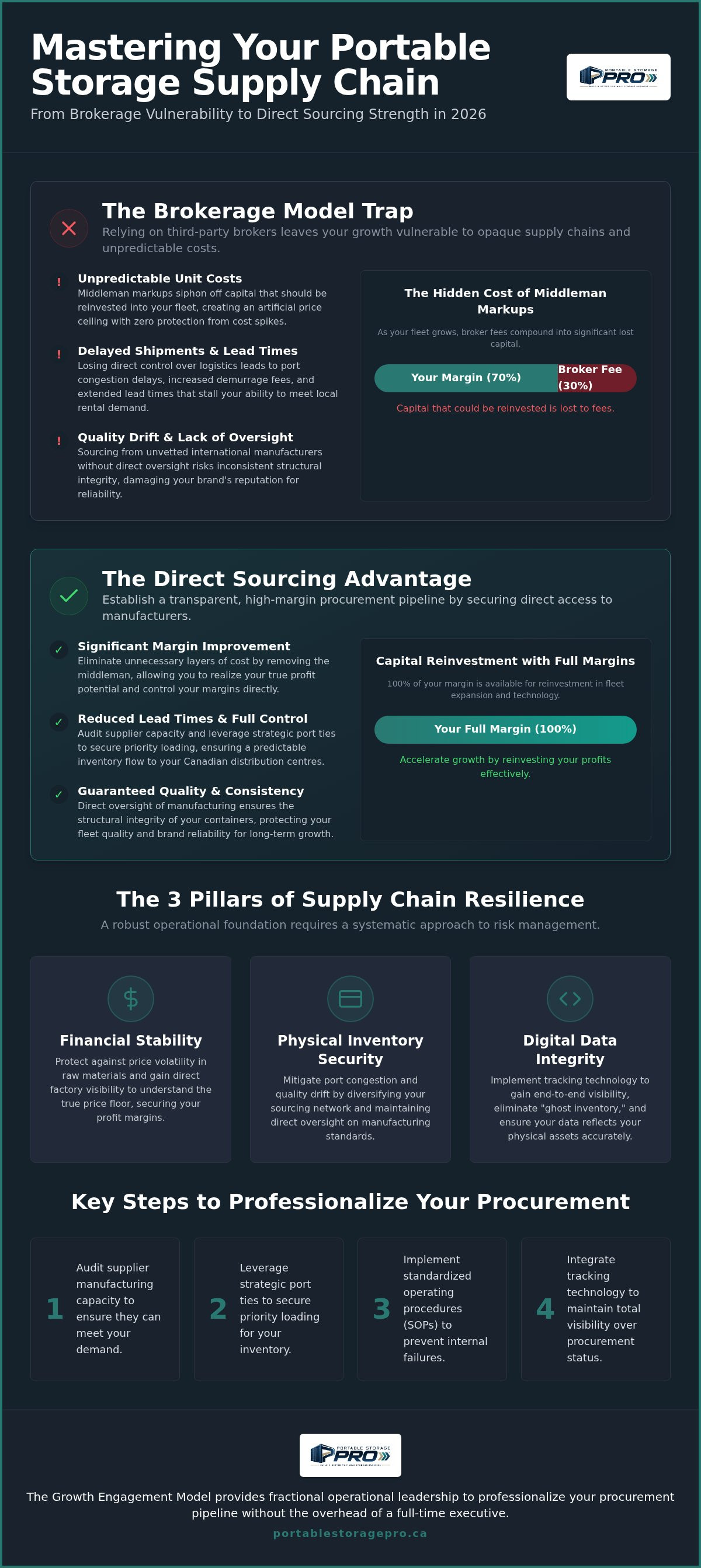
Price volatility in raw materials, specifically the specialized steel used in container manufacturing, continues to fluctuate based on global trade policies. These shifts directly influence unit manufacturing costs. Many operators remain unaware of the true price floor because they lack direct factory visibility. Middleman markups represent a significant drain on annual growth capital, siphoning off margins that should be reinvested into fleet expansion or operational technology. The brokerage trap is a primary financial risk for independents because it creates an artificial price ceiling while offering zero protection against manufacturer-level cost spikes. When you don't control the source, you don't control your profit margins.
Physical Inventory and Lead Time Disruptions
Port congestion at major coastal gateways causes significant delays in secondary Canadian transport. This congestion forces inventory to sit idle, which increases demurrage fees and extends lead times beyond manageable windows. There is also the growing risk of quality drift. When operators source from unvetted international manufacturers without direct oversight, the structural integrity of the containers often suffers over time. Relying on a single supplier is no longer a viable strategy for national growth. A diversified sourcing network is the only way to ensure operational continuity when a primary link in the chain fails. Consistency in your fleet's physical quality is the foundation of your brand's reliability.
Strategic Procurement: Direct Sourcing vs. The Brokerage Model
Selecting a procurement strategy is a pivotal decision that determines your company's long-term margin potential. Many independent operators default to the broker model for its perceived convenience. Brokers act as intermediaries, handling the logistics and communication with factories in exchange for a markup. While this reduces the immediate administrative burden, it creates a structural disadvantage. You lose direct control over lead times and quality assurance. In contrast, direct sourcing establishes a transparent link between your business and the manufacturer. This approach aligns with NIST's definition of SCRM, which emphasizes the need for visibility and control across the entire lifecycle of a product.
The Hidden Costs of Middleman Markups
The financial impact of the brokerage model is often underestimated until an operator attempts to scale. A broker's fee structure usually includes a per-unit premium that covers their overhead and profit. When purchasing a small number of containers, this cost might seem negligible. However, as your fleet grows from 50 to 500 units, these fees compound into significant lost capital. This capital could otherwise be realized as profit or reinvested into operational technology. High middleman markups make it difficult to compete with larger firms that leverage direct factory pricing. For a detailed breakdown of how procurement choices influence your financial health, consider our guide on increasing portable storage business profitability.
Gaining Direct Access to Global Manufacturers
Global supply chain access serves as a powerful risk mitigation tool. By bypassing intermediaries, you gain direct insight into manufacturing schedules and material availability. This level of transparency is essential for robust portable storage supply chain risk management. Professionalizing your sourcing involves a rigorous vetting process. You must evaluate international partners based on their financial stability, manufacturing capacity, and adherence to ISO standards. Building these relationships often requires representation at international trade conferences, where you can establish direct ties with factory leadership. This hands-on approach ensures that quality control standards are met at the point of origin rather than discovered upon delivery. Operators who invest in direct relationships often find they can secure better priority during periods of global port congestion. If you want to professionalize your procurement pipeline, exploring a global sourcing strategy is the most effective way to protect your margins.
Evaluating Supplier Reliability and Port Logistics
Professionalizing your portable storage supply chain risk management requires a transition from reactive purchasing to proactive auditing. It isn't enough to secure a lower price; you must verify that your manufacturer has the financial stability to survive market downturns and the capacity to meet your scaling requirements. A comprehensive supply chain risk management (SCRM) framework categorizes these variables into supply, demand, and process risks. By analyzing these pillars, operators can identify where a single point of failure might halt their growth. Establishing "Port Ties" with freight forwarders and port authorities is equally vital. These relationships ensure your Canadian-bound inventory receives priority loading, which is a critical advantage when global congestion threatens to extend lead times by weeks or months.
The Supplier Audit Checklist
A rigorous audit goes beyond a simple price comparison. You need to evaluate production lead times, material grade consistency, and the factory's historical warranty responsiveness. Standardizing your audit process creates a predictable baseline for quality across your entire fleet. The cheapest container often carries the highest risk over the long-term fleet lifecycle; poor weld quality or inferior paint applications lead to premature rust and increased maintenance costs. Third-party operational leadership provides an objective layer of oversight in this vetting process, ensuring that manufacturers adhere to strict quality standards before a single unit leaves the factory floor. This level of due diligence prevents "quality drift" and protects the residual value of your assets.
Navigating Canadian National Logistics
Once your units arrive at national ports, the challenge shifts to inland coordination. Managing the hand-off between ocean freight and national trucking networks requires precise timing to avoid expensive storage fees. Effective risk mitigation involves securing secondary transport options for last-mile delivery to your yards. You can optimize this process by using portable storage lead generation data to forecast where demand is peaking. Aligning your inventory arrivals with these high-growth regions allows you to reduce internal transport costs and deploy assets faster. Maintaining a strategic buffer stock is a core component of portable storage supply chain risk management, allowing you to handle unexpected spikes in demand without over-leveraging your operational capital.
Operational Resilience: SOPs and Technology Implementation
Operational resilience is the internal capacity of your business to maintain performance despite external disruptions. While global port volatility is outside your control, your internal response is not. Independent operators often struggle with supply chain shocks because their internal processes are informal or reactive. Professionalizing your portable storage supply chain risk management requires a shift toward standardized systems that remove individual guesswork. By implementing rigorous procedures and modern technology, you create a buffer against the unpredictability of the 2026 market. This structural discipline ensures that your team can recognize vulnerabilities early and execute pre-planned mitigation strategies without hesitation.
Professionalizing Operations with SOPs
Standard Operating Procedures (SOPs) are the primary tool for protecting your business against internal supply chain failures. A rigorous intake process for new inventory is essential to ensure that every unit entering your fleet meets the quality standards established during the supplier audit. This process should include a physical inspection for weld integrity and paint consistency to prevent quality drift from degrading your assets. Furthermore, a standardized response plan for shipping delays allows your team to manage customer expectations and adjust marketing spend before a stockout occurs. For example, a sample SOP for supplier communication might state: "Logistics personnel shall update the central procurement ledger within four hours of receiving a Revised Estimated Time of Arrival from any ocean carrier to ensure fleet availability forecasts remain accurate."
Training staff to identify red flags in the procurement cycle is equally important. When employees understand the "why" behind an SOP, they become active participants in risk mitigation. This level of operational training is a core component of our Operations and Training services, designed to professionalize every layer of your business.
Technology for Supply Chain Visibility
Relying on fragmented spreadsheets to track hundreds of units creates dangerous data silos. Modern fleet management requires an integrated tech stack that provides real-time visibility into unit movement and procurement status. Moving away from manual entry reduces human error and allows for data-driven forecasting. By analyzing historical lead times and seasonal demand spikes, you can time your procurement cycles more effectively to avoid over-leveraging capital. This visibility also extends to fleet health; tracking the age and maintenance history of each unit helps you realize the maximum residual value of your containers.
Securing your digital supply chain is a critical but often overlooked aspect of resilience. As you integrate more technology, protecting your procurement data and customer information from cybersecurity threats becomes vital. A breach in your digital systems can lead to physical operational shutdowns, making digital security a mandatory pillar of your risk management strategy. Implementing these technological safeguards ensures that your data remains an asset rather than a liability. If you are ready to modernize your systems, our Technology and Innovation Consulting can help you build a resilient digital foundation.
The Growth Engagement Model: Your Partner in Risk Mitigation
Managing a fleet in 2026 requires more than just reactive adjustments to port delays. The Growth Engagement Model provides a holistic solution by integrating specialized operational leadership directly into your business structure. Unlike generic business coaching, this model focuses on the physical and logistical realities of the storage sector. It positions your company as a peer to global manufacturers, ensuring that your portable storage supply chain risk management is handled with the same level of sophistication as a multinational enterprise. You gain the benefit of fractional operational leadership, which offers expert oversight and strategic planning without the prohibitive cost of a full-time executive. This approach allows independent operators to implement high-level systems that were previously only accessible to the largest industry players.
Professionalizing Your Procurement Strategy
Portable Storage Pro acts as your representative in international markets, which is a critical shift for any operator looking to professionalize their procurement. This representation eliminates the dependency on high-premium brokers who often prioritize their own margins over your fleet's health. By leveraging established global connections and international conference representation, you can secure direct manufacturer pricing and priority loading at the source. This peer-level expertise ensures that your sourcing and logistics are managed with a focus on long-term margin protection and asset quality. Having a partner who understands the granular details of container manufacturing allows you to realize significant savings while maintaining a superior product standard. For more insights on optimizing your financial performance, read our guide on Maximizing Portable Storage Profits: 2026 Canadian Guide.
Next Steps: Securing Your Future Fleet
2026 is the year to transition from surviving market volatility to scaling your operations with confidence. The first step in this evolution is a thorough audit of your current supply chain to identify hidden risks and cost leaks that may be hindering your expansion. Our Partner Engagement Model provides the hands-on management necessary to realize sustainable growth through consistent, disciplined execution. A proactive approach to portable storage supply chain risk management is no longer optional for those who intend to lead the market. By removing unnecessary layers of cost and implementing the SOPs discussed in previous sections, you protect your future fleet from the unpredictability of global trade routes. We invite you to schedule a strategic consultation to evaluate your current procurement pipeline and realize your full growth potential.
Securing Your Competitive Edge in a Volatile Market
Success in the 2026 storage market requires a fundamental shift from reactive purchasing to strategic leadership. You've seen how direct sourcing and standardized operating procedures provide the structural resilience needed to thrive amidst global port volatility. By professionalizing your portable storage supply chain risk management, you transform your procurement pipeline from a source of anxiety into a primary driver of operational growth. You don't have to navigate these complexities alone or settle for the high markups of traditional brokers. Establishing control over your inventory is the most effective way to protect your long-term margins.
Our team is ready to help you implement these frameworks and realize your full scaling potential. We provide global supply chain access at a fraction of the cost, paired with expert operational leadership tailored specifically for storage operators. By establishing direct manufacturer ties, we help you eliminate middleman markups and secure the future of your fleet. Professionalize your procurement with the Growth Engagement Model and take control of your margins today. Your business has the potential to lead the industry; it's time to build the foundation that makes it possible.
Frequently Asked Questions
What are the primary supply chain risks for portable storage businesses in 2026?
The primary risks involve financial volatility in raw materials, physical delays from global port congestion, and digital vulnerabilities in inventory tracking. In 2026, maritime route diversions have created localized shortages that directly impact procurement costs. Relying on opaque brokerage models adds another layer of risk, as independent operators lose visibility into factory-level production schedules and quality control standards. Addressing these threats requires a proactive approach to portable storage supply chain risk management.
How does direct sourcing reduce supply chain risk compared to using a broker?
Direct sourcing eliminates the brokerage trap by establishing a transparent link between the operator and the manufacturer. This model reduces risk by providing real-time data on production capacity and material availability. Brokers often prioritize their own margins, which can lead to unexpected price spikes or quality drift during periods of high demand. By removing these intermediaries, you gain direct oversight of the manufacturing process and realize significant savings on per-unit costs.
Can an independent storage operator really access a global supply chain?
Independent operators can access a global supply chain by leveraging specialized operational leadership and established industry networks. You don't need the overhead of a massive corporation to secure direct manufacturer ties. Models that provide international conference representation allow you to build the same connections as national firms. This approach grants you the benefits of global scale and factory-direct pricing without the prohibitive travel costs or administrative burden of managing international logistics alone.
What role does technology play in managing storage unit procurement?
Technology provides the real-time visibility required to manage complex procurement cycles. Moving away from manual spreadsheets to integrated fleet management systems allows for data-driven forecasting based on historical lead times. This digital infrastructure helps identify potential stockouts before they occur, allowing you to time your orders more effectively. It also secures your digital supply chain against emerging cybersecurity threats that could disrupt physical operations or compromise sensitive procurement data.
How often should I audit my portable storage supply chain SOPs?
You should audit your supply chain SOPs at least bi-annually to ensure they remain aligned with shifting market conditions. These reviews help identify inefficiencies in your intake process or gaps in your supplier communication protocols. Regular audits are especially important when onboarding new technology or expanding into new regions. Continuous refinement of these procedures ensures that your team remains prepared for the logistical challenges that characterize the 2026 storage landscape.
What is the "Growth Engagement Model" and how does it help with risk?
The Growth Engagement Model is a specialized framework that provides independent operators with fractional operational leadership and global supply chain access. It mitigates risk by implementing standardized operating procedures and professionalizing your procurement pipeline. By acting as a peer-level partner, this model helps you eliminate unnecessary middleman costs and secure direct pricing from vetted manufacturers. This structural support allows you to scale your business while maintaining a high level of operational resilience.
Is it better to have a single supplier or multiple sources for containers?
Relying on multiple sources is the superior strategy for long-term operational resilience. While a single supplier might offer short-term convenience, it creates a dangerous point of failure if that manufacturer faces financial instability or production delays. Diversifying your sourcing network ensures that your fleet growth isn't halted by a single factory's disruption. This strategy is a core component of effective portable storage supply chain risk management, providing you with alternative inventory channels during global shortages.
How do global port ties affect my national storage operations in Canada?
Global port ties directly influence the predictability of your lead times in Canada. Establishing relationships with freight forwarders and port authorities ensures your inventory receives priority loading at international hubs. This is critical for national operations because delays at coastal gateways often create a ripple effect that stalls inland transport networks. Securing these ties helps you avoid expensive demurrage fees and ensures that your new units arrive exactly when your local yards need them most.

Article by
Paul Taylor
Paul Taylor is the founder of Portable Storage Pro, bringing more than 35 years of experience across the container, portable storage and transportation industries. His background spans executive operations, business development, global procurement, sales, marketing and operational improvement in Canada, the UK and international markets.
Paul helps independent portable storage and container rental operators increase revenue, strengthen margins and build more efficient businesses. His work connects strategy with practical implementation, including pricing, delivery operations, supplier sourcing, staff training, technology and customer experience.
His experience includes leading multi-location storage operations and serving on the National Portable Storage Association’s board along with chairing its Canadian committee. Through Portable Storage Pro, Paul shares practical insights to help owners make informed decisions, solve operational challenges and grow profitably.
Disclaimer
Content published by Portable Storage Pro Inc. (PSP) provides general business information and industry insights. It does not replace advice tailored to your business or specialist legal, tax, engineering or other regulated advice. Reading this content or contacting PSP does not, by itself, establish a consulting engagement.
Information reflects circumstances at publication and may change. Examples and potential benefits are illustrative; results depend on individual circumstances, implementation and market conditions and are not guaranteed.
Client services are governed by the signed service agreement, agreed work plan and written amendments. Website and blog content do not amend those terms. PSP’s work is subject to applicable law and the professional commitments set out in its agreement, including the CMC-Canada Code of Professional Conduct and NPSA Code of Conduct and Ethics. Copies are available on request.
Views expressed are PSP’s own. Association membership or references do not imply association endorsement or CMC certification. Nothing in this disclaimer limits PSP’s contractual responsibilities, professional duties or rights that cannot lawfully be excluded.


