
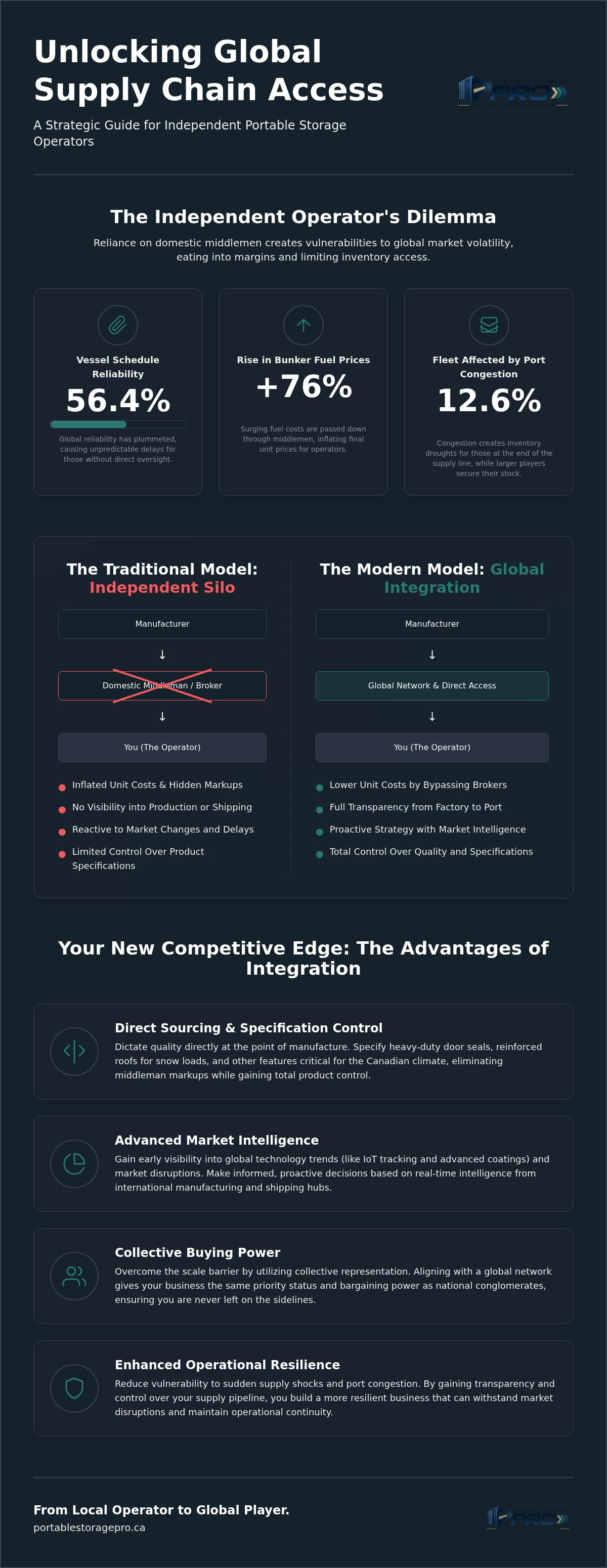
Why should an independent portable storage operator settle for domestic middleman markups when global container supply chain access is finally within reach? As of September 2026, global vessel schedule reliability has dropped to 56.4 percent; meanwhile, the largest players continue to secure inventory while smaller firms wait on the sidelines. It's a frustrating reality that many independent owners accept as the cost of doing business. You likely recognize that relying on secondary brokers eats your margins, but the travel costs and time required to build direct international relationships often feel prohibitive.
This reference guide bridges that gap, showing you how to leverage international networks and procurement strategies to compete with global conglomerates. You'll learn how to bypass high markups and gain the market intelligence needed to navigate current disruptions, such as the 76 percent rise in bunker fuel prices. We will outline a path to lower unit costs and better operational resilience, helping you organize your business to match the standards of industry leaders without needing a massive corporate headquarters.
Key Takeaways
- Define global container supply chain access as a strategic tool to influence procurement and specifications directly at the source, bypassing traditional domestic middlemen.
- Discover how international network integration provides early visibility into global technology trends and market disruptions before they impact the Canadian landscape.
- Learn how to overcome the scale barrier by utilizing collective representation to navigate complex international logistics, port ties, and customs requirements.
- Realize the benefits of insights from major global industry conferences through a representation model that eliminates high travel costs and time commitments.
- Understand how to use the Growth Engagement Model to organize and professionalize your procurement and operational arms to match global industry leaders.
Defining Global Container Supply Chain Access for Modern Operators
For years, independent storage owners operated in a silo. They bought from domestic wholesalers and accepted whatever inventory was on the ground. This "independent silo" model is failing in the 2026 market because it leaves operators vulnerable to price spikes and inventory droughts. True global container supply chain access means moving beyond the role of a passive customer. It's the ability to influence procurement, timing, and technical specifications directly at the point of manufacture. You aren't just buying a box; you're managing a pipeline.
The modern global container supply chain relies on a highly integrated network of intermodal transport. Relying on a domestic broker who simply adds a markup without providing visibility is no longer a viable strategy. Integration allows you to see disruptions before they arrive at your gate. When you understand the flow of goods from the factory to the port, you can make informed decisions about when to buy and when to hold. This strategic value of real-time intelligence from international shipping hubs separates market leaders from those who are constantly reacting to the next crisis.
The Evolution of Portable Storage Procurement
The industry has shifted from local reselling to sophisticated global sourcing. In the past, you might have looked for used units from shipping lines. Today, the demand for specialized portable storage requires new-build inventory tailored to specific operational needs. Independent operators must now think like international logistics firms. They need to understand vessel schedule reliability, which dropped to 56.4 percent in July 2026, and how those delays impact local inventory levels. Standardized units provide the trade fluidity required to move assets across borders, but you need the right access to secure them before they're spoken for by larger competitors.
Why "Access" is the New Competitive Advantage
Having "eyes on the ground" in manufacturing centres provides a level of intelligence that domestic brokers cannot match. When you have direct access, you aren't just waiting for a delivery; you're monitoring production schedules and shipping windows. This transparency reduces the risk of sudden supply shocks. It also helps you bypass port congestion, which recently surpassed pandemic highs with 12.6 percent of the global fleet affected. By removing unnecessary middleman layers, you don't just save on unit costs. You gain operational resilience. You can realize better margins by professionalizing your procurement and treating it as a core strategic function rather than an administrative task.
The Strategic Advantages of International Network Integration
Integrating your operations into a broader network transforms your business from a local player into a globally informed entity. This integration rests on three pillars: procurement, intelligence, and benchmarking. By securing global container supply chain access, independent operators can see technology trends, such as advanced IoT tracking and specialized anti-condensation coatings, months or even years before they become standard in the Canadian market. This foresight allows for proactive fleet upgrades rather than reactive purchases made during a crisis.
Even with a modest fleet, participating in a global network provides collective bargaining power. Manufacturers prioritize high-volume, consistent partners; by aligning with a network, you gain the same priority status as national conglomerates. This level of integration is a core component of portable storage supply chain risk management. It ensures that your business remains operational even when regional markets tighten. You aren't just buying containers; you're securing a position in the global market.
Direct Sourcing and Unit Specification Control
Direct factory relationships allow you to dictate quality rather than accepting whatever inventory is available at the nearest port. For the Canadian climate, this means specifying heavy-duty door seals and reinforced roof structures that can handle significant snow loads. When you remove the domestic broker, you eliminate the middleman markup while gaining total control over the finished product. You can learn more about professionalizing these processes through our Procurement & Sourcing services. This control ensures that your fleet remains a premium asset rather than a commodity subject to the whims of a third party.
Market Intelligence and Trend Forecasting
Success in 2026 requires tracking more than just local demand. You must monitor global steel price fluctuations and international shipping lane capacity to predict when domestic unit availability will drop. Maintaining global container supply chain access allows you to anticipate these shifts. Organizations like the U.S. International Trade Administration emphasize that resiliency is built on this type of diverse market intelligence. Benchmarking your operational efficiency against global leaders helps you identify where your costs are out of alignment with the industry standard. This data-driven approach replaces guesswork with tactical precision, allowing you to organize your growth with confidence.
Overcoming Barriers to Global Sourcing and Procurement
The most common objection independent owners raise regarding global container supply chain access is the belief that they're simply too small to buy direct. This perception often stems from a history of being turned away by large manufacturers or feeling overwhelmed by the administrative burden of international trade. However, the barrier isn't your fleet size; it's the lack of a structured procurement system. By shifting from a reactive buying model to a strategic sourcing approach, smaller firms can bypass domestic wholesalers and the associated 20 to 30 percent markups that erode their bottom line.
Navigating international logistics requires a deep understanding of evolving trade regulations. For example, the September 2026 implementation of retaliatory tariffs between Canada and the U.S. has added a new layer of complexity to transborder movements. Operators must also account for container security best practices to ensure their assets aren't delayed by customs inspections or compliance failures. Bridging this expertise gap no longer requires hiring a full-time logistics department. Fractional operational leadership allows independent businesses to access high-level supply chain expertise on a project-by-project basis, providing the same tactical advantages enjoyed by national conglomerates.
Navigating Minimum Order Quantities (MOQs)
Factories typically require a minimum order to initiate a production run, which can be a significant hurdle for operators with limited yard space or capital. You can overcome this by utilizing procurement consulting to consolidate orders with other independent businesses. This collective approach meets factory MOQs without forcing you to over-leverage your balance sheet. It allows for a steady inventory flow that matches your actual rental demand rather than forcing you to store excess units that aren't generating revenue. Proper inventory management ensures you don't tie up cash flow in stagnant assets while waiting for market shifts.
Managing Logistics and Port Complexity
Moving units from an international factory to a Canadian depot involves more than just booking a ship. It requires managing port ties and understanding the "last-mile" challenges unique to the Canadian landscape. With global port congestion affecting over 12 percent of the fleet as of September 2026, timing your shipments is critical. Delays at major hubs can quickly spiral into missed delivery windows for your customers. Focusing on logistics efficiency is a primary driver for increasing portable storage business profitability. When you control the logistics chain, you gain the ability to reroute shipments or adjust schedules based on real-time data from international shipping hubs, ensuring your operations remain resilient despite global volatility.
Leveraging Industry Representation and Conference Insights
Conferences like TOC Europe and Intermodal Asia provide a window into the future of the global container supply chain. These events are where manufacturers debut new unit specifications and where shipping lines outline their capacity strategies for the coming year. For an independent operator, attending these summits in person often costs upwards of $10,000 when accounting for flights, accommodation, and lost operational time. However, the intelligence shared at these events is too critical to ignore. This is where the representation model changes the equation for smaller firms.
By utilizing a specialized consultant as your "global envoy," you gain global container supply chain access without leaving your primary service area. This model allows you to receive the same high-level insights as the largest conglomerates at a fraction of the cost. Instead of sifting through generic industry news, you receive curated whitepapers and networking data that directly impact your specific procurement and operational goals. This proactive approach turns global industry movement into local competitive advantage, ensuring you aren't the last to know about shifting standards.
Fractional Representation: A New Model for 2026
Hiring experts to represent your interests at international summits ensures your business has a seat at the table. These representatives don't just collect brochures; they engage with manufacturers and logistics providers to advocate for independent operators. You receive curated intelligence reports that filter out the noise, focusing only on the trends that affect Canadian storage operations. This builds a global brand presence for your company. It signals to suppliers and competitors alike that you are a sophisticated player with eyes on the international market, even if you only operate in a single region.
Implementing Global Best Practices Locally
The true value of conference insights lies in their application. Translating international operational standards into Canadian staff training programs helps professionalize your business. For instance, global trends in digital customer journeys can be adapted for portable storage lead generation, ensuring your marketing matches the sophistication of industry leaders. Continuous improvement is driven by these global peer-group insights, allowing you to adopt efficient SOPs before your local competitors even realize the market has shifted. To see how this representation can transform your business, explore our Access Engagement Model today.
Navigating the Global Market with the Growth Engagement Model
The Growth Engagement Model offers a structured pathway for independent owners to move from fragmented procurement to a professionalized supply chain strategy. It serves as a comprehensive solution for those seeking reliable global container supply chain access without the overhead of a dedicated international logistics department. This model focuses on the removal of operational friction, allowing owners to choose between hands-on participation in strategic decisions or a more hands-off approach led by seasoned specialists. By standardizing the way units are sourced and managed, businesses can realize a level of predictability that was previously reserved for national franchises.
This transition is essential for maintaining long-term portable storage business profitability. As regional markets become more saturated and global volatility remains high, the ability to control your inventory pipeline becomes your most significant asset. Professionalizing these arms of your business doesn't just lower costs; it increases the valuation of your company by replacing "just-in-time" guesswork with a resilient, documented system.
Operational Leadership and Procurement Sourcing
Under this model, you gain direct access to a network of vetted global manufacturers. This isn't a simple list of suppliers; it's a managed relationship where expert oversight ensures every unit meets specific quality benchmarks before it ever leaves the factory floor. This oversight is critical for reducing unit costs and improving the overall lifespan of your fleet. Integrating global container supply chain access into your daily operations means you no longer wait for a domestic broker to call with available stock. Instead, you operate with a clear view of production timelines and shipping windows, allowing you to align your sales and marketing efforts with actual inventory arrivals.
Strategic Growth and Future-Proofing
Preparing your business for the next decade of containerized trade requires a partner who understands the nuance of the Canadian market while maintaining a presence in the global chain. The Growth Engagement Model provides this dual perspective. It allows you to focus on scaling your local operations while we manage the complexities of international sourcing, port logistics, and regulatory compliance. This partnership ensures your business remains resilient against future supply shocks and technological shifts. Discover how Portable Storage Pro can transform your procurement and provide the operational leadership needed to scale with confidence in an increasingly complex global environment.
Securing Your Position in the Global Market
The transition from a passive consumer to a proactive market participant is no longer optional for independent storage operators. By integrating your business into international networks, you gain the visibility needed to navigate port congestion and shipping disruptions before they impact your local yard. You've seen how direct factory sourcing and collective bargaining can lower unit costs while improving asset quality. These strategic shifts allow you to compete with national conglomerates on a level playing field.
Securing global container supply chain access doesn't require a massive corporate infrastructure or an expensive travel budget. It requires a disciplined approach to procurement and the right operational leadership. With the right representation at international summits, you can realize the benefits of global intelligence without leaving your primary service area. This professionalization of your supply chain ensures you aren't just reacting to the market; you're anticipating it.
Professionalize your procurement with the Growth Engagement Model to access global supply chain networks, international conference representation, and specialized operational leadership tailored for storage operators. Taking control of your supply chain is the most effective way to ensure your business remains resilient and profitable for the decade ahead.
Frequently Asked Questions
What is global container supply chain access for a portable storage operator?
It represents the strategic ability to manage procurement, timing, and technical specifications directly with international manufacturers rather than relying on domestic intermediaries. For a portable storage operator, this access provides visibility into production schedules and shipping windows. It ensures that your inventory pipeline remains resilient against regional shortages. By professionalizing this arm of your business, you transition from being a passive buyer to an active participant in the international logistics network.
How much can I save by sourcing containers directly from international manufacturers?
Sourcing directly allows you to eliminate the domestic middleman markups that typically range from 15 to 30 percent per unit. While exact savings depend on order volume and shipping rates, removing these layers significantly improves your per-unit cost basis. These savings can be reinvested into fleet expansion or marketing efforts. Beyond the initial price, direct sourcing ensures you aren't paying a premium for inventory that doesn't meet your specific climate or durability requirements.
Do I need to travel to international conferences to stay competitive in the storage industry?
Physical travel to international summits is no longer a requirement for staying competitive. You can utilize a representation model where specialized consultants act as your global envoy at events like TOC Europe or Intermodal Asia. This approach provides you with curated intelligence reports and networking benefits at a fraction of the cost of a $10,000 travel bill. It allows you to focus on daily operations while still benefiting from the latest global technology and market trends.
What are the biggest risks in the global container supply chain for 2026?
Current data for September 2026 indicates that port congestion and vessel reliability are the primary risks. Global congestion has affected 12.6 percent of the fleet; meanwhile, vessel schedule reliability has dropped to 56.4 percent. Additionally, bunker fuel prices have risen by approximately 76 percent due to regional disruptions. These factors contribute to volatile freight rates and potential inventory delays. Maintaining global container supply chain access is essential for monitoring these risks and adjusting your procurement strategy in real time.
How does fractional operational leadership help with container procurement?
Fractional operational leadership provides high-level supply chain expertise without the overhead of a full-time executive salary. These specialists manage the complexities of international sourcing, factory vetting, and logistics coordination on your behalf. They implement standardized SOPs that professionalize your procurement arm. This model allows independent owners to leverage the same tactical advantages as national brands, ensuring that inventory arrives on schedule and meets all technical specifications for the Canadian market.
Can a small independent storage business really compete with national brands on pricing?
Small operators can compete effectively by utilizing collective bargaining power and removing unnecessary middleman layers. When you bypass domestic brokers, your cost structure often aligns more closely with larger competitors who buy in bulk. Professionalizing your operations through the Growth Engagement Model allows you to match the efficiency of national brands. By focusing on logistics efficiency and direct sourcing, you can maintain healthy margins while offering competitive rental rates to your local customers.
What is the role of technology in managing a global supply chain for storage units?
Technology provides the visibility required to track assets across international shipping lanes and manage inventory flow. Advanced tracking systems and data-driven forecasting tools allow you to predict arrivals and manage customer expectations more accurately. Utilizing global container supply chain access through integrated platforms ensures that you can monitor production and shipping milestones in real time. This digital oversight reduces administrative errors and helps you identify potential disruptions before they impact your domestic bottom line.

Article by
Paul Taylor
Paul Taylor is the founder of Portable Storage Pro, bringing more than 35 years of experience across the container, portable storage and transportation industries. His background spans executive operations, business development, global procurement, sales, marketing and operational improvement in Canada, the UK and international markets.
Paul helps independent portable storage and container rental operators increase revenue, strengthen margins and build more efficient businesses. His work connects strategy with practical implementation, including pricing, delivery operations, supplier sourcing, staff training, technology and customer experience.
His experience includes leading multi-location storage operations and serving on the National Portable Storage Association’s board along with chairing its Canadian committee. Through Portable Storage Pro, Paul shares practical insights to help owners make informed decisions, solve operational challenges and grow profitably.
Disclaimer
Content published by Portable Storage Pro Inc. (PSP) provides general business information and industry insights. It does not replace advice tailored to your business or specialist legal, tax, engineering or other regulated advice. Reading this content or contacting PSP does not, by itself, establish a consulting engagement.
Information reflects circumstances at publication and may change. Examples and potential benefits are illustrative; results depend on individual circumstances, implementation and market conditions and are not guaranteed.
Client services are governed by the signed service agreement, agreed work plan and written amendments. Website and blog content do not amend those terms. PSP’s work is subject to applicable law and the professional commitments set out in its agreement, including the CMC-Canada Code of Professional Conduct and NPSA Code of Conduct and Ethics. Copies are available on request.
Views expressed are PSP’s own. Association membership or references do not imply association endorsement or CMC certification. Nothing in this disclaimer limits PSP’s contractual responsibilities, professional duties or rights that cannot lawfully be excluded.


