
Relying on traditional container brokers in 2026 isn't just a matter of convenience; it's a structural leak in your profit margins that many operators have come to accept as an unavoidable cost of doing business. You likely realize that the volatility of global shipping, coupled with new green surcharges of up to $400 per container and shifting tariff landscapes, makes fleet scaling feel like a constant gamble. It’s frustrating to watch your unit costs climb while you lack direct access to the manufacturers who actually build your assets.
This is where specialized mobile storage procurement consulting transitions from a secondary consideration to a core strategic requirement. By professionalizing your sourcing and removing unnecessary middleman layers, you can regain control over your capital expenditures. This guide will show you how to establish a direct, repeatable pipeline to global suppliers while implementing the same quality control standards used by the industry's largest players. We'll outline a framework for better inventory forecasting and explain how to leverage international supply chain networks to secure a predictable, high-quality fleet at a fraction of the cost of traditional brokerage models.
Key Takeaways
- Understand why professional mobile storage procurement consulting is essential for shifting from a transactional brokerage model to a strategic, long-term supply chain partnership.
- Discover how to bypass middleman markups by establishing direct connections with global manufacturers and leveraging international supply chain access.
- Learn to organize a repeatable sourcing strategy through comprehensive fleet audits and the development of standardized quality control specifications.
- Explore how the Growth Engagement Model provides fractional operational leadership to streamline your procurement processes at a fraction of the cost of a full-time hire.
- Identify the key steps to professionalize your inventory forecasting, ensuring your fleet scales efficiently while maintaining strict control over per-unit capital expenditures.
What is Mobile Storage Procurement Consulting?
Mobile storage procurement consulting is the strategic oversight of the entire lifecycle of your fleet assets. It involves much more than simply placing an order for a dozen containers. It encompasses the methodical sourcing, purchasing, and complex logistics required to move units from a global factory floor to your local yard. While a traditional broker focuses on the immediate transaction, a consultant prioritizes the long-term health and stability of your supply chain. The primary objective of this partnership is to reduce the total cost of ownership (TCO) for every unit in your inventory, ensuring that your capital is deployed as efficiently as possible.
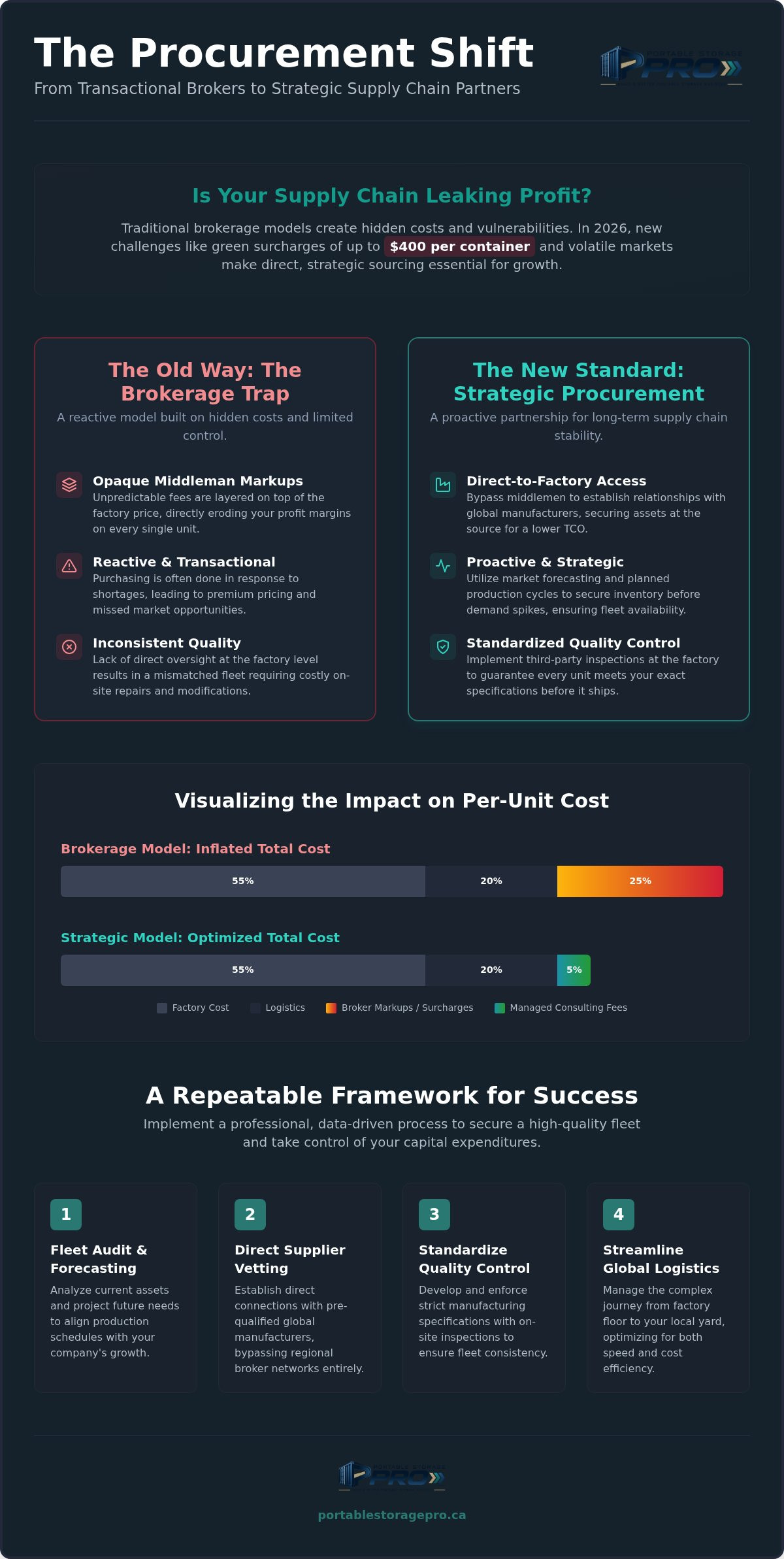
In 2026, the market has moved decisively away from the opaque brokerage models of the past. Professional operators now recognize that unpredictable markups and a lack of transparency are significant barriers to growth. By utilizing Strategic sourcing, businesses can professionalize their procurement processes. This shift toward direct-to-factory relationships allows you to bypass the layers of hidden costs that traditionally inflated unit prices. It's about moving from a reactive "buying" mindset to a proactive "procurement" strategy that anticipates market shifts and secures inventory before shortages occur.
The Role of a Procurement Consultant
A consultant acts as a fractional extension of your management team, providing the high-level expertise needed to navigate international trade without the expense of a full-time executive hire. They manage the granular details of the global supply chain, from analyzing supplier reliability to verifying that container manufacturing standards meet your specific requirements. In 2026, this role is vital for evaluating how new regulations, such as the EU ETS maritime carbon allowances or IMO decarbonization targets, impact your bottom line. They also monitor currency fluctuations and green surcharges, which can add hundreds of dollars to the cost of a single unit if not managed correctly. This level of oversight provides a sense of calm control over complex operational challenges.
Why Independent Operators Need Strategic Sourcing
Independent operators often struggle to compete with national franchises that leverage massive buying power to suppress unit costs. Strategic sourcing levels the playing field by giving smaller businesses direct access to the same global manufacturers used by industry giants. This approach helps remove the "middleman tax" that often eats into rental margins, allowing you to retain more profit from every lease. Consistency is another critical factor; a structured procurement plan ensures that unit quality remains identical across different production runs. This prevents the operational inefficiencies that arise when your team has to manage a mismatched fleet. By adopting these professional systems, you can scale your operations with confidence and tactical proficiency.
The Mechanics of Global Container Sourcing in 2026
The journey of a storage unit from the factory floor to your yard is a complex logistical sequence that requires disciplined management. It begins with the selection of a tier-one manufacturer, where production schedules must be aligned with your growth projections. In 2026, maintaining inventory levels depends heavily on global container supply chain access. Utilizing professional mobile storage procurement consulting ensures that you aren't left waiting for units while competitors capture market share. Securing these relationships often happens at international conferences, where professional representation allows you to vet suppliers in person. Once produced, units move through critical logistics hubs where port ties and local handling efficiencies significantly impact your landed costs. It is vital to realize how these variables influence your overall capital expenditure.
Navigating Factory Relationships
Successful procurement requires a deep understanding of minimum order quantities (MOQs) and production cycles. You can't expect a factory to pivot to your needs without prior planning. Specialized mobile storage procurement consulting helps you organize these schedules while ensuring third-party quality inspections occur at the source. This step is non-negotiable; it prevents the arrival of substandard units that require expensive onsite repairs. By bypassing traditional regional brokers, you remove a layer of markup that often adds significant expense without adding value. This direct approach allows you to secure better terms and higher-quality assets while maintaining steady reliability in your fleet expansion.
Managing Supply Chain Risk
The 2026 global shipping landscape is defined by volatility. Vessel rerouting around the Cape of Good Hope has become a semi-permanent reality, adding transit time and affecting container availability. Implementing portable storage supply chain risk management is essential for any operator planning to scale. You must identify potential bottlenecks, such as port congestion or the impact of FuelEU Maritime regulations, before they disrupt your operations. Even with a vessel overcapacity of 10 per cent on main routes, localized shortages can still occur. Diversifying your sourcing across different geographic regions protects your fleet from regional instability. To navigate these complexities with expert guidance, many operators utilize the Growth Engagement Model to stabilize their expansion plans.
Comparing Procurement Models: Brokerage vs. Strategic Consulting
Choosing between a container broker and professional mobile storage procurement consulting represents a fundamental decision about how you view your fleet assets. A broker operates on a transactional basis; they are motivated to move existing inventory quickly to realize a commission. This often results in a "take what's available" scenario that ignores your specific long-term operational requirements. In contrast, a strategic consultant acts as a partner, aligning sourcing decisions with your portable storage business profitability. This model ensures that every acquisition contributes to a cohesive fleet strategy rather than just filling a temporary gap in inventory.
Fee transparency is another area where these models diverge. Brokers typically hide their margins within the unit price, making it difficult for you to understand the true cost of the asset. You might pay a premium without realizing it, as shipping surcharges and storage fees are often bundled into a single, opaque figure. Strategic consulting utilizes a flat-fee or retainer-based structure, removing the incentive for the consultant to push higher-priced units. This clarity allows you to see exactly where your capital is going, from the factory gate to the final delivery at your facility. It also uncovers hidden costs like "green surcharges" that now range from $150 to $400 per container, ensuring these are managed rather than simply passed on with an additional markup.
The Broker Model: Pros and Cons
The primary advantage of the broker model is speed of acquisition. If you need a handful of units immediately to satisfy a sudden rental demand, a broker can often find them within their existing network. However, this convenience comes with long-term cost inefficiencies. Your access is limited to the broker’s specific supplier ties, which may not offer the best price discovery in a market currently seeing 10 percent vessel overcapacity. Additionally, brokers rarely provide post-purchase support. Once the unit is delivered, the relationship ends, leaving you to manage quality issues or fleet integration on your own.
The Strategic Consulting Model: A Holistic Approach
A holistic approach focuses on the entire unit lifecycle and long-term rental ROI. By utilizing mobile storage procurement consulting, you gain access to a broader global supply chain, allowing for more competitive bidding among manufacturers. This model also integrates procurement with your broader business goals, such as portable storage lead generation. By matching supply with anticipated demand, you ensure that new units aren't sitting idle in your yard. This synchronization between marketing and operations is what separates high-growth operators from those who are simply surviving. It's a disciplined way to manage growth while keeping unit costs predictable and quality standards high.
Step-by-Step: Implementing a Professional Procurement Strategy
Implementing a professional procurement strategy begins with a rigorous audit of your existing fleet. You must identify which units are nearing the end of their operational life and where expansion is required to meet your 2026 growth targets. Professional mobile storage procurement consulting provides the framework to establish clear quality specifications for every unit type in your inventory. This prevents the common mistake of accepting generic units that don't meet your specific durability or branding requirements. By standardizing your equipment, you reduce long-term maintenance costs and simplify your operational training.
A 12-month procurement calendar is essential for maintaining operational momentum. It should be synchronized with seasonal demand peaks to ensure inventory arrives exactly when needed. You must also analyze the landed cost of each unit, accounting for freight, taxes, and green surcharges, to ensure these assets align with your revenue targets. Vetting potential suppliers using a standardized compliance checklist ensures that your partners meet the same professional standards you expect from your own team. This methodical approach removes the guesswork from fleet scaling and instills a sense of calm control over your capital expenditures.
Phase 1: Demand Forecasting and Budgeting
Procurement must align directly with your increasing portable storage business profitability goals. By forecasting demand early, you can set aside capital for bulk orders that qualify for volume discounts. It's vital to factor in current lead times, which are influenced by vessel rerouting and port congestion trends. This foresight prevents out-of-stock scenarios during the peak spring and summer moving seasons when rental rates are at their highest. A disciplined budget allows you to realize significant savings by avoiding the last-minute, high-premium purchases that often occur when operators are caught unprepared.
Phase 2: Sourcing and Negotiation
Once your budget is set, transition to drafting professional Requests for Proposals (RFPs) for international manufacturers. Your negotiation strategy should extend beyond the unit price to include warranty protections and delivery guarantees. Leveraging industry representation is a key component of effective mobile storage procurement consulting. It allows independent operators to gain preferential treatment that is typically reserved for massive national brands. This tactical proficiency ensures you aren't just a number in a factory's production queue. To begin professionalizing your fleet management, explore how our Procurement & Sourcing services can streamline your global supply chain and reduce your per-unit costs.
Leveraging Operational Leadership for Sustainable Growth
The transition from a reactive purchasing habit to a disciplined procurement system requires more than just a checklist; it demands experienced leadership. For many independent operators, hiring a full-time procurement executive is financially out of reach. This is where fractional operational leadership becomes a catalyst for success. By utilizing specialized mobile storage procurement consulting, you can access high-level expertise that manages the complexities of global sourcing on a part-time basis. This approach ensures that your fleet strategy is managed by a straight-talking specialist who values transparency and tangible outcomes. It removes the stress of negotiating with international manufacturers and provides a sense of calm control over your capital-intensive operations.
Professionalizing these relationships allows you to remove the unnecessary layers that often inflate unit costs. Instead of being a distant observer of the global market, you become an active participant with the tactical proficiency to secure better terms. This leadership model doesn't just focus on the purchase; it integrates procurement into your overall business systems. By aligning sourcing with your operational capacity, you ensure that every new asset is ready to generate revenue immediately upon arrival. This level of organization is what separates a localized rental yard from a sophisticated, scalable storage enterprise.
The Growth Engagement Model Advantage
The Growth Engagement Model is designed to professionalize your sourcing without the overhead of international travel or full-time salaries. It provides direct global supply chain access, allowing you to bypass the middleman markups that often erode profit margins. A key component of this model is the implementation of Standard Operating Procedures (SOPs) for the receiving and inspection of new inventory. These systems ensure that every unit entering your yard meets your established quality specifications before it is accepted into the fleet. Additionally, the model involves the continuous monitoring of global market trends, enabling you to capitalize on price dips caused by the current vessel overcapacity. This proactive stance protects your margins and ensures you are always buying at the most advantageous time.
Moving Toward a Hands-Off Management Style
Professionalizing your procurement allows you to shift toward a hands-off management style. When experts handle the granular details of the supply chain, owners can refocus their energy on customer acquisition and local market expansion. This transition is essential for building a scalable infrastructure that attracts potential investors or future buyers. A business that relies on a repeatable, documented sourcing process is far more valuable than one dependent on the owner's personal contacts or ad-hoc broker deals. You aren't just buying containers; you're building a professional asset management system that supports sustainable, long-term growth. Discover how the Growth Engagement Model can optimize your procurement today.
Professionalizing Your Path to Fleet Expansion
Success in the 2026 storage market requires a disciplined departure from the opaque, high-markup brokerage models of the past. By professionalizing your sourcing through mobile storage procurement consulting, you gain the tactical proficiency needed to navigate global supply chain volatility. You've learned that direct factory relationships and rigorous quality control standards are no longer exclusive to national franchises; they're accessible to any operator willing to implement a structured, strategic approach.
Establishing this level of operational control doesn't require the overhead of a full-time executive or the burden of international travel. Leveraging fractional leadership allows you to focus on localized growth while experts manage the granular details of your fleet's lifecycle. With direct access to global supply chain networks and niche expertise in portable storage logistics, you can stabilize your unit costs and build a more resilient, scalable enterprise. It's time to move beyond transactional buying and start building a professional asset management system that secures your long-term profitability.
Scale your storage business with the Growth Engagement Model and secure the professional operational leadership your fleet deserves. Your next phase of growth is within reach.
Frequently Asked Questions
What exactly does a mobile storage procurement consultant do?
A consultant provides strategic oversight of the entire acquisition lifecycle for your storage assets. They manage factory selection, international trade logistics, and quality assurance protocols. By acting as a fractional extension of your management team, they help you organize production schedules and navigate 2026 maritime regulations. This specialized mobile storage procurement consulting ensures that your fleet expansion is based on data and long-term supply chain health rather than reactive, one-off purchases.
How can consulting help reduce my per-unit container costs?
Consulting reduces per-unit costs by removing the opaque markups typically embedded in broker-led transactions. By establishing direct relationships with tier-one manufacturers, you bypass the middleman tax that eats into your capital. Specialists also help you realize savings through better price discovery and by identifying green surcharges before they are passed on with additional fees. This disciplined approach ensures your capital expenditure remains predictable while maximizing your volume-based negotiation power.
Is procurement consulting worth it for smaller independent operators?
Yes, independent operators often realize the most significant benefits from professionalized sourcing. It allows you to compete with national franchises by granting you global supply chain access at a fraction of the cost of international travel or full-time hires. Professional mobile storage procurement consulting levels the playing field, ensuring you aren't paying a premium for smaller order volumes. It provides the tactical proficiency needed to scale your fleet without the overhead of a large corporate procurement department.
What are the common hidden costs in container procurement?
Common hidden costs include green surcharges, which can range from $150 to $400 per container in 2026, and unexpected port storage fees. You might also encounter currency adjustment factors and destination handling charges that brokers often fail to disclose upfront. Substandard unit quality is another hidden expense; if a container arrives damaged, the cost of onsite repairs quickly negates any initial savings. Professional consulting identifies these variables early to ensure your landed cost remains accurate.
How does global supply chain access differ from buying through a local broker?
Global access provides direct transparency and a wider selection of manufacturing partners compared to a broker's limited regional network. Brokers typically move existing inventory and hide their commissions within the final price. Strategic access allows you to customize unit specifications and align production with your specific growth timeline. This model prioritizes your business's long-term stability by ensuring you aren't reliant on the fluctuating stock levels of a third-party intermediary.
Can a consultant help with fleet quality control and inspections?
A consultant facilitates third-party quality inspections at the factory before your units are even loaded onto a vessel. This prevents the arrival of containers that don't meet your durability or aesthetic standards. They also help you implement Standard Operating Procedures (SOPs) for receiving and inspecting inventory at your own yard. This rigorous oversight ensures that every asset in your fleet is consistent, reducing future maintenance costs and protecting your brand's reputation for reliability.
How do I know if my storage business is ready for professional procurement consulting?
Your business is ready if you are experiencing unpredictable unit costs or struggle to maintain consistent inventory levels during peak moving seasons. If managing vendor relationships and logistics is pulling you away from customer acquisition, it's time to professionalize your supply chain. Operators who plan to scale their fleet by more than 10 per cent annually often find that the Growth Engagement Model provides the necessary operational leadership to manage this expansion.
What is the typical ROI for engaging a procurement specialist?
ROI is realized through lower per-unit acquisition costs and increased rental margins. By removing middleman layers and optimizing logistics, you preserve more capital for further expansion. There is also a significant soft ROI in the form of reduced operational friction and better inventory forecasting. Professional consulting allows you to realize a more valuable, scalable infrastructure that is attractive to future buyers or investors while providing a sense of calm control over your daily operations.

Article by
Paul Taylor
Paul Taylor is the founder of Portable Storage Pro, bringing more than 35 years of experience across the container, portable storage and transportation industries. His background spans executive operations, business development, global procurement, sales, marketing and operational improvement in Canada, the UK and international markets.
Paul helps independent portable storage and container rental operators increase revenue, strengthen margins and build more efficient businesses. His work connects strategy with practical implementation, including pricing, delivery operations, supplier sourcing, staff training, technology and customer experience.
His experience includes leading multi-location storage operations and serving on the National Portable Storage Association’s board along with chairing its Canadian committee. Through Portable Storage Pro, Paul shares practical insights to help owners make informed decisions, solve operational challenges and grow profitably.
Disclaimer
Content published by Portable Storage Pro Inc. (PSP) provides general business information and industry insights. It does not replace advice tailored to your business or specialist legal, tax, engineering or other regulated advice. Reading this content or contacting PSP does not, by itself, establish a consulting engagement.
Information reflects circumstances at publication and may change. Examples and potential benefits are illustrative; results depend on individual circumstances, implementation and market conditions and are not guaranteed.
Client services are governed by the signed service agreement, agreed work plan and written amendments. Website and blog content do not amend those terms. PSP’s work is subject to applicable law and the professional commitments set out in its agreement, including the CMC-Canada Code of Professional Conduct and NPSA Code of Conduct and Ethics. Copies are available on request.
Views expressed are PSP’s own. Association membership or references do not imply association endorsement or CMC certification. Nothing in this disclaimer limits PSP’s contractual responsibilities, professional duties or rights that cannot lawfully be excluded.


