
If you're still relying on the same broker relationships that served you three years ago, you're likely overpaying for every unit while sacrificing control over your fleet's quality. In a market where global container throughput reached a record 17.3 million TEUs in July 2026, the traditional middleman model is becoming a liability for independent operators. You've likely noticed that rising procurement costs are steadily eating into your rental margins. It's frustrating to deal with inconsistent quality and a total lack of visibility into the global supply chain shifts that dictate your inventory's arrival.
We understand that securing rental-ready units at a sustainable price point feels increasingly difficult in this volatile environment. This article provides the strategic framework you need to master 2026 procurement by refining your storage container sourcing strategy. You'll learn how to move beyond simple transactions to implement a managed approach that lowers per-unit costs and ensures a predictable inventory pipeline. We will break down the specific advantages of direct, broker, and managed models so you can organize your operations for maximum growth and realize the margins your business deserves.
Key Takeaways
- Shift from viewing containers as simple commodities to treating them as strategic infrastructure to safeguard your long-term rental margins.
- Identify the most efficient storage container sourcing strategy by comparing the operational impacts of direct, broker, and managed procurement models.
- Apply a Total Cost of Ownership framework to realize the true long-term costs of units beyond the initial purchase price.
- Build a resilient inventory pipeline by diversifying supplier types and auditing current fleet conditions to mitigate supply chain disruptions.
- Leverage the Growth Engagement Model to access global supply chain connections and remove unnecessary middleman markups.
The Evolution of Container Sourcing in 2026
The days of treating procurement as a simple administrative task are over. For independent operators, a robust storage container sourcing strategy has evolved into a high-level fleet management function. In 2026, successful businesses no longer view containers as interchangeable commodities. Instead, they recognize these assets as the foundational infrastructure of their rental enterprise. This shift is necessary because the global market is increasingly complex; the shipping container industry is estimated to be valued at USD 12.55 billion in 2026. Relying on local brokers for reactive, one-off purchases is a risk that modern operators can't afford to take.
Strategic sourcing introduces the concept of optionality. In a volatile global market, optionality provides the freedom to pivot between supply channels. Whether it's navigating port-specific disruptions or manufacturer price hikes, having a diverse procurement pipeline ensures your business remains operational. Understanding the logistics of standardized intermodal containers is just the first step. You must also understand how to control the flow of these assets into your yard. Optionality allows you to organize your procurement around multiple supply nodes rather than a single point of failure.
Why Transactional Buying is Failing Operators
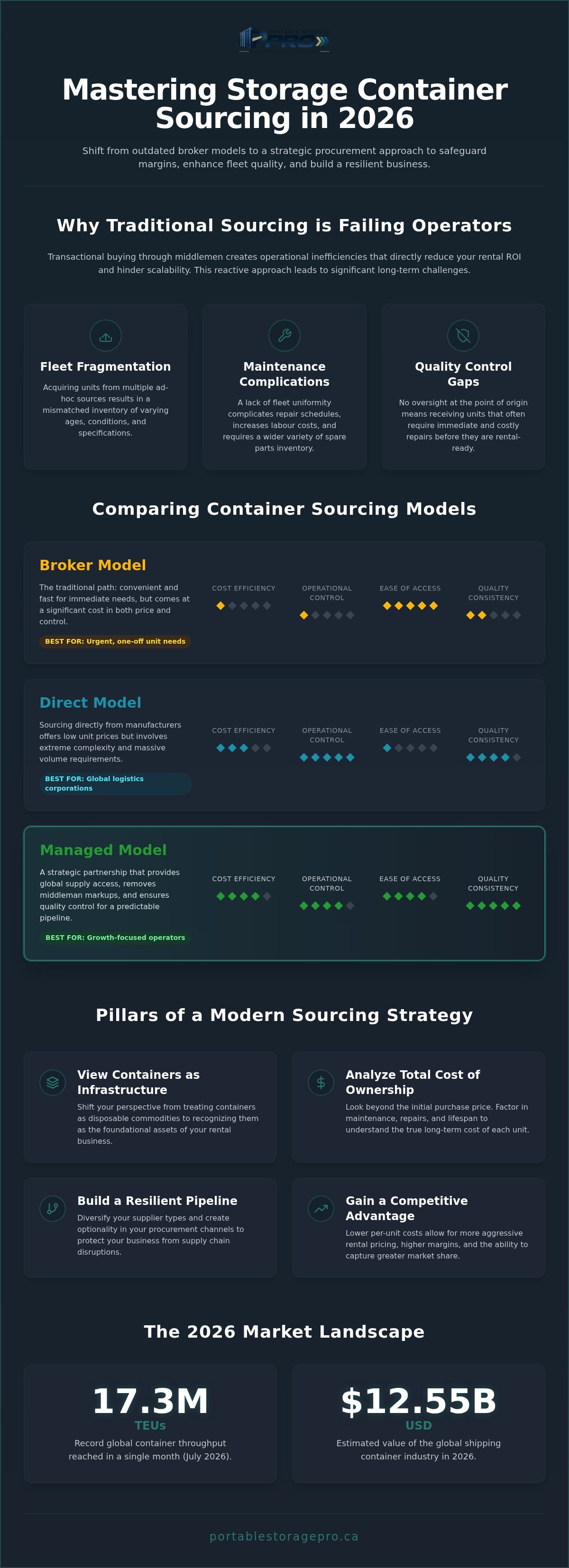
Transactional buying relies on middleman brokers who often prioritize their own margins over your long-term success. These markups directly reduce your rental ROI, making it harder to scale your fleet effectively. Beyond the price tag, transactional sourcing often leads to several operational inefficiencies:
- Fleet Fragmentation: Buying units from various sources without a cohesive plan results in a mismatched inventory of different ages and conditions.
- Maintenance Complications: A lack of uniformity in your fleet complicates repair schedules and increases the need for varied spare parts.
- Quality Control Gaps: Poor oversight at the point of origin often results in receiving units that require immediate repair before they are rental-ready.
Sourcing as a Competitive Advantage
Operators who master their storage container sourcing strategy gain a significant edge in their local markets. By reducing per-unit procurement costs, you can offer more aggressive rental pricing to capture market share. This allows you to realize higher margins while your competitors struggle with rising unit costs. Higher quality units also lead to lower maintenance labour costs over the life of the asset. Strategic sourcing is the disciplined process of aligning procurement with long-term business goals to protect margins and ensure fleet reliability. It's about taking control of the supply chain rather than being a victim of its fluctuations.
Comparing Sourcing Models: Direct, Broker, and Managed
Selecting the right storage container sourcing strategy requires a balance between capital availability and operational control. Most independent operators find themselves at a crossroads between three distinct paths. You can buy through a traditional broker, attempt to navigate the hurdles of direct manufacturing, or utilize a managed procurement model. As containers are increasingly recognized as a structurally important asset class, the method you choose to acquire them will ultimately dictate your ability to scale. Each model offers different levels of transparency, risk, and long-term cost efficiency.
Direct manufacturing is often the most enticing model due to the low per-unit price. However, the barriers to entry are significant for smaller operators. Manufacturers in China typically require massive volume commitments, often hundreds of units per order. Beyond the volume, you must manage international logistics, customs clearance, and credit facilities. For most, these requirements make direct sourcing an impractical burden that distracts from core rental operations.
The Broker Model: Convenience at a Cost
The broker model remains the most common storage container sourcing strategy for local businesses. It offers immediate speed and local availability, which is useful when you need to fill a sudden rental order. You simply call a middleman, and they deliver a unit from their existing yard stock. This convenience, however, comes with a "Middleman Tax" that is often baked into the price without transparency. You rarely know the true history or origin of the unit, and you are essentially paying a premium for the broker's ability to hold inventory. While brokers are useful for tactical, short-term needs, relying on them for fleet expansion often leads to eroded margins over time.
Managed Procurement: Global Access for Independents
Managed procurement serves as a hybrid solution that provides independent operators with port-level access without the typical overhead. This model leverages fractional operational leadership to bridge the gap between small-scale buying and the global supply chain. By using a managed approach, you benefit from international industry representation and established relationships with manufacturers. It allows you to remove unnecessary layers of cost while maintaining strict quality control at the source.
This strategy ensures that your fleet remains uniform and rental-ready upon arrival. You gain deeper context into global container supply chain access, allowing you to plan inventory cycles months in advance rather than reacting to local shortages. If you want to realize better margins through a more disciplined approach, seeking specialized procurement support can help you organize your growth more effectively. This model provides the steady reliability needed to maintain a predictable inventory pipeline in a volatile market.
Beyond Unit Price: Analyzing Total Cost of Fleet Ownership
Operators often fall into the trap of prioritizing the sticker price above all else. This approach is fundamentally flawed because the cheapest box frequently becomes the most expensive asset over its operational life. A sophisticated storage container sourcing strategy utilizes a total cost of ownership (TCO) framework to evaluate the true economic impact of an acquisition. This framework accounts for procurement, positioning, maintenance, and the eventual residual value of the unit.
Manufacturing specifications are the primary driver of asset longevity. Units constructed with high-grade Corten steel and superior door hardware resist the corrosive effects of weather and frequent use. These decisions don't just reduce repair costs; they safeguard the unit's future resale value. A well-maintained, premium-spec container remains a liquid asset that can be sold for a significant portion of its original cost even after a decade of service. When you organize your fleet around quality, you realize better long-term returns compared to those chasing the lowest entry price.
The Logistics and Positioning Factor
Logistics and positioning represent a significant portion of the TCO. Drayage fees and port-to-yard transport can quickly inflate the cost of a unit if you haven't accounted for the "Last Mile" problem. Strategic sourcing requires you to centre your procurement around your primary service area to minimize deadhead miles. If a unit is cheap at the port but costs a fortune to move to your yard, the initial savings are illusory. Efficient logistics planning ensures that your assets are positioned where they can generate revenue immediately without heavy transport overhead.
Maintenance and Refurbishment Costs
Maintenance and refurbishment requirements vary wildly based on the sourcing model you choose. While "One-Trip" units are generally ready for immediate deployment, "Wind and Water Tight" (WWT) units often require significant labour to become rental-ready. You must account for the cost of patching holes, grinding rust, and applying fresh coats of paint before a used unit can represent your brand. These hidden labour costs can easily bridge the price gap between a used unit and a new one. For more detailed cost-reduction tips, consult our mobile storage procurement consulting guide to help refine your storage container sourcing strategy and improve your bottom line.
Developing a Resilient Multi-Channel Sourcing Strategy
Building a resilient storage container sourcing strategy is not a static task; it's a continuous operational requirement. To move from reactive buying to proactive fleet management, you must follow a disciplined roadmap. Start by auditing your current fleet's age and condition. This allows you to realize exactly which units are nearing the end of their profitable life and require replacement. Next, diversify your supplier types. Relying solely on local brokers leaves you vulnerable to regional inventory droughts and price spikes. You should also implement standardized quality inspections at every point of transfer. Don't accept a unit until it meets your specific rental-ready criteria, as this prevents unexpected refurbishment costs from eating your margins.
Timing is equally critical. You must align your procurement cycles with seasonal demand peaks to avoid paying a premium during the busy spring and summer months. Finally, leverage technology to track the lifecycle and ROI of every unit in your yard. When you can see which units require the most maintenance, you can make better decisions about future acquisitions. This data-driven approach ensures you organize your capital around the assets that deliver the highest long-term value. It's about moving away from guesswork and toward a structured, repeatable procurement process.
Supply Chain Risk Mitigation
A major gap in many independent operations is the lack of formal risk management. You must identify any single-point-of-failure suppliers in your current strategy. If a single port disruption or broker bankruptcy can halt your growth, your business is at risk. Maintaining a calculated level of "Safety Stock" ensures you can still fulfill rental orders when the global supply chain tightens. For a deeper dive into these tactics, read our guide on portable storage supply chain risk management. This proactive approach helps you maintain control even when external factors shift. It allows you to centre your operations on stability rather than crisis management.
Leveraging Industry Representation
Independent operators often lack a voice at international trade events where major supply decisions are made. Having representation allows you to use global market insights to time your bulk purchases effectively. This is where "Port Ties" and direct manufacturer relationships become invaluable. When you understand the macro trends, such as the entry of significant new vessel capacity in 2026, you can make better-informed decisions. You don't have to navigate these complexities alone. If you're ready to optimize your procurement and sourcing, our team can help you build the connections needed for a more resilient fleet. This level of representation ensures you aren't just a passenger in the global market.
Optimizing Procurement Through the Growth Engagement Model
The Growth Engagement Model is not merely a buying service; it is a strategic framework designed to align your storage container sourcing strategy with your long-term expansion goals. Instead of reacting to market shortages or broker availability, you organize your capital around a proactive acquisition schedule. This model offers both hands-on and hands-off management options to suit your operational needs. You can choose to be involved in every logistical detail or delegate the entire procurement process to our specialists. This flexibility allows you to focus on customer acquisition and sales while we handle the complexities of the global supply chain.
By positioning ourselves as a pragmatic partner, we help you navigate the granular details of fleet management. We don't just find boxes; we ensure those assets are integrated into a broader growth plan. This approach suggests a high level of industry-specific competence, allowing you to move from a distant observer of market trends to an active participant. You gain the steady reliability of a predictable inventory pipeline, ensuring that your growth is never stalled by a lack of rental-ready units.
Removing the Middleman Markup
The financial impact of gaining direct access to the global supply chain is immediate and significant. Traditional brokers add layers of cost that don't contribute to the physical value of the unit. Managed procurement removes these unnecessary markups, often paying for itself through the resulting unit cost savings. You realize better margins because you're buying at or near port-level pricing. This shift ensures that your capital goes further, allowing you to acquire a larger fleet for the same investment. Operational leadership transforms procurement from a cost centre to a profit driver. By treating sourcing as a strategic lever, you turn a logistical necessity into a significant competitive advantage.
Scaling with Confidence
Sustainable growth requires more than just more boxes; it requires the right boxes. We use standardized SOPs to ensure every new unit meets your fleet's specific requirements before it even leaves the port. This consistency is vital for maintaining a professional brand image and keeping maintenance costs low over the asset's lifecycle. The Growth Engagement Model provides the infrastructure needed for rapid inventory expansion without the typical growing pains associated with fragmented sourcing. You don't have to worry about inconsistent quality or hidden refurbishment costs. Instead, you can scale with the certainty that every asset is rental-ready and built to last. If you are ready to take control of your fleet's future, Explore the Growth Engagement Model today to see how we can support your expansion.
Secure Your Fleet’s Future for 2026 and Beyond
Mastering your storage container sourcing strategy is no longer optional for independent operators who want to protect their rental margins in a volatile market. By shifting from reactive buying to a managed procurement model, you move beyond the limitations of local brokers and the high barriers of direct manufacturing. You now understand that analyzing the total cost of ownership is essential to realize long-term profitability and that a multi-channel approach provides the resiliency needed to navigate global supply chain shifts.
Taking control of your fleet requires a blend of industry-specific competence and strategic foresight. Our team provides fractional operational leadership and direct global supply chain access for independent operators, ensuring you have the expert-level representation needed to remove unnecessary middleman markups. We are here to help you organize your procurement for maximum growth and operational efficiency. This proactive approach ensures your yard remains stocked with rental-ready units regardless of market fluctuations.
Download our 2026 Procurement Strategy Guide or learn about the Growth Engagement Model to begin optimizing your fleet today. Your path to a predictable inventory pipeline starts with a single strategic decision. We look forward to helping you build a more resilient and profitable business.
Frequently Asked Questions
What is the difference between direct and broker container sourcing?
Direct sourcing involves purchasing units straight from manufacturers, typically in China, to secure the lowest possible price. Broker sourcing relies on middlemen who stock inventory in local yards for faster delivery. While brokers offer convenience, they add significant markups that eat into your margins. Direct sourcing requires managing complex international logistics and high volume commitments, which is why many independent operators now choose managed procurement as a strategic middle ground.
How can I reduce the per-unit cost of my storage fleet?
Reducing per-unit costs starts with removing unnecessary middleman markups from your acquisition process. By implementing a managed storage container sourcing strategy, you can access global supply chain connections at port-level pricing. You should also focus on units with superior manufacturing specifications to reduce long-term maintenance labour. Investing in higher-quality assets lowers your total cost of ownership and ensures your fleet remains rental-ready without constant, expensive repairs or refurbishments.
What are the risks of buying containers "sight unseen" from brokers?
Buying "sight unseen" from brokers often leads to receiving units with structural rust, floor delamination, or compromised door seals. You lack visibility into the unit's true history or quality control at the point of origin. This creates fleet fragmentation where units vary widely in condition. You might save time initially, but the hidden costs of repairing these containers to make them rental-ready often exceed the savings gained from a quick broker purchase.
Is it better to buy one-trip or used containers for a rental fleet?
One-trip containers are usually the superior choice for rental fleets because they offer the best balance of longevity and resale value. These units require minimal refurbishment labour compared to used wind and water tight containers. While used units have a lower initial purchase price, their maintenance costs and shorter operational life often make them more expensive in the long run. Choosing one-trip units helps you maintain a professional brand image and consistent fleet quality.
How does global supply chain access benefit a small storage operator?
Global supply chain access allows small operators to compete with national brands by securing port-level pricing. It provides the ability to time purchases based on international market trends rather than local shortages. Through fractional operational leadership, independent businesses gain representation at international trade events and connections to manufacturers. This level of access ensures a predictable inventory pipeline and removes the layers of cost that typically burden smaller businesses relying on local retail brokers.
Can I source containers directly from manufacturers without a massive volume?
Sourcing directly from manufacturers usually requires order volumes that exceed the needs of most independent operators. However, you can achieve similar results through a managed procurement model. This approach leverages established industry connections to bridge the gap between small-scale buying and global manufacturers. It allows you to realize the cost benefits of direct access without the logistical burden or the requirement to purchase hundreds of units at a single time.
What is the impact of Chinese manufacturing on container prices in 2026?
A small number of Chinese manufacturers control the majority of the world's new-build supply, giving them immense pricing power. In 2026, this concentration of manufacturing combines with geopolitical impacts on trade routes to keep unit prices volatile. Operators must use sophisticated sourcing strategies to navigate these shifts. Understanding these macro-economic factors allows you to time your inventory expansion to avoid peak price cycles and maintain your competitive edge in the local market.
How do I identify hidden costs in a container procurement quote?
To identify hidden costs, you must look past the base unit price and audit the logistics expenses. Common unseen charges include drayage fees, port storage costs, and broker commissions. You should also account for the labour and materials required to bring used units up to your fleet's SOP standards. A robust storage container sourcing strategy uses a total cost of ownership framework to ensure every quote is transparent and reflects the final landed cost.

Article by
Paul Taylor
Paul Taylor is the founder of Portable Storage Pro, bringing more than 35 years of experience across the container, portable storage and transportation industries. His background spans executive operations, business development, global procurement, sales, marketing and operational improvement in Canada, the UK and international markets.
Paul helps independent portable storage and container rental operators increase revenue, strengthen margins and build more efficient businesses. His work connects strategy with practical implementation, including pricing, delivery operations, supplier sourcing, staff training, technology and customer experience.
His experience includes leading multi-location storage operations and serving on the National Portable Storage Association’s board along with chairing its Canadian committee. Through Portable Storage Pro, Paul shares practical insights to help owners make informed decisions, solve operational challenges and grow profitably.
Disclaimer
Content published by Portable Storage Pro Inc. (PSP) provides general business information and industry insights. It does not replace advice tailored to your business or specialist legal, tax, engineering or other regulated advice. Reading this content or contacting PSP does not, by itself, establish a consulting engagement.
Information reflects circumstances at publication and may change. Examples and potential benefits are illustrative; results depend on individual circumstances, implementation and market conditions and are not guaranteed.
Client services are governed by the signed service agreement, agreed work plan and written amendments. Website and blog content do not amend those terms. PSP’s work is subject to applicable law and the professional commitments set out in its agreement, including the CMC-Canada Code of Professional Conduct and NPSA Code of Conduct and Ethics. Copies are available on request.
Views expressed are PSP’s own. Association membership or references do not imply association endorsement or CMC certification. Nothing in this disclaimer limits PSP’s contractual responsibilities, professional duties or rights that cannot lawfully be excluded.


