
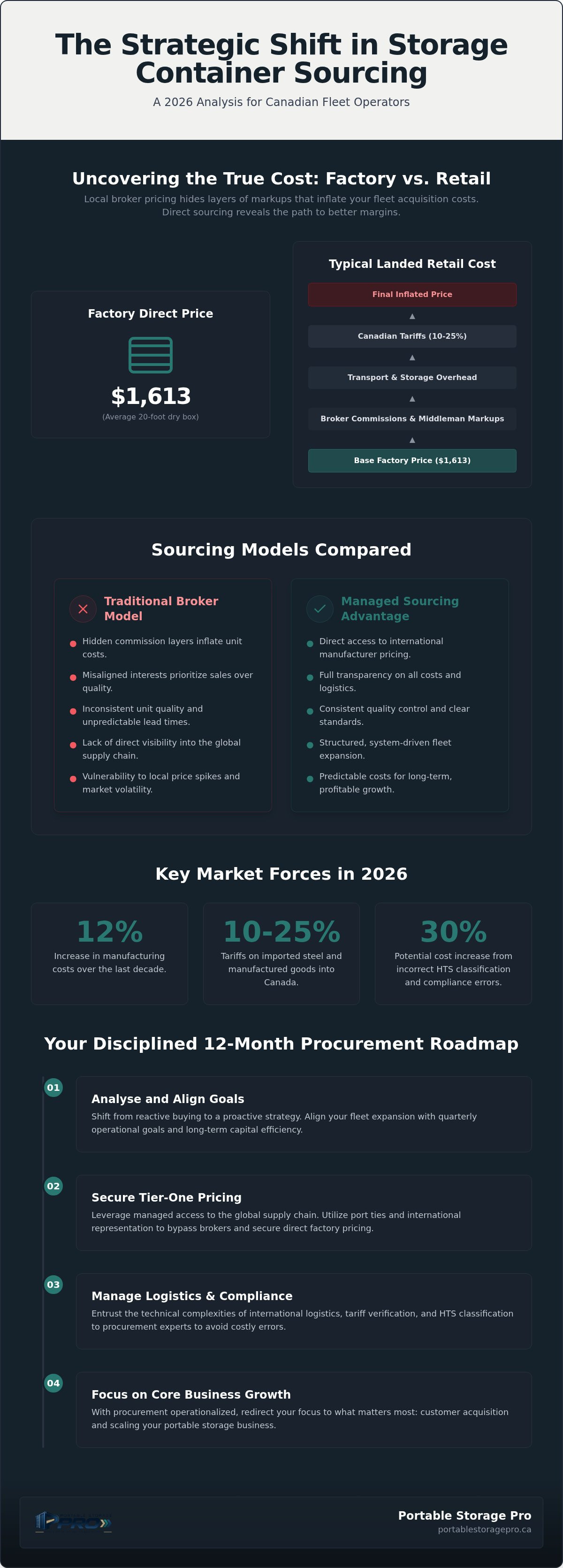
In 2026, paying retail prices for fleet expansion isn't just an expense; it's a structural failure in your procurement strategy. While factory prices for new 20-foot dry boxes have dipped to an average of $1,613, many Canadian operators remain trapped by middleman markups and the 10% to 25% tariffs on imported steel. You likely realize that relying on local brokers often leads to unpredictable lead times and inconsistent unit quality. It's frustrating to manage complex logistics when you lack direct visibility into the global supply chain.
This article provides a clear roadmap to bypass these unnecessary layers by utilizing strategic storage container wholesale sourcing. You'll discover how to secure direct access to international manufacturers and implement a structured system for fleet expansion that prioritizes transparency. We will analyze the current divergence between factory and retail pricing while providing a disciplined framework for procurement. This approach ensures your growth remains profitable, professional, and entirely under your control.
Key Takeaways
- Identify the structural shift in storage container wholesale sourcing as the industry moves away from high-markup local brokers toward direct global manufacturing ties.
- Recognize how hidden commission layers inflate unit costs and learn to leverage managed access to the global supply chain to improve your margins.
- Discover the mechanics of port ties and how international representation at industry conferences secures tier-one pricing for your fleet.
- Create a disciplined 12-month procurement roadmap that aligns your fleet expansion with quarterly operational goals and professional sourcing expertise.
- Shift your focus back to customer acquisition by utilizing the Growth Engagement Model to handle the technical complexities of international logistics and compliance.
The 2026 Landscape of Storage Container Wholesale Sourcing
Success in the portable storage industry depends on your ability to secure assets without absorbing the inefficiencies of a bloated supply chain. Wholesale sourcing is a strategic operational function designed to align fleet acquisition with long-term capital efficiency rather than a simple purchase. Many operators mistakenly believe that buying from a nearby depot is the most cost-effective route because it feels accessible. However, this "buy near you" approach frequently hides tiered commission structures and localized logistics markups. When a unit sits at a regional centre, you're paying for the broker's margin, the initial transport, and the storage overhead. These layers can easily inflate your per-unit cost by hundreds of dollars before the container even reaches your yard.
In 2026, the market is dictated by a 12% increase in manufacturing costs over the last decade and complex tariff structures. While factory prices for a new 20-foot dry box averaged $1,613 in early 2026, the landed cost in Canada involves navigating 10% to 25% tariffs on steel and manufactured goods. Understanding these macro-economic drivers is essential for effective storage container wholesale sourcing. Relying on local brokers often means you're the last to benefit from factory price drops and the first to feel the sting of retail price hikes. You need a procurement strategy that bypasses these local bottlenecks.
Current Trends in Global Container Manufacturing
The industry is currently witnessing a significant divergence in product standards. While the standard intermodal container remains the backbone of global trade, we see a rise in units engineered specifically for the portable storage sector. These specialized boxes prioritize user-friendly features, such as easy-open doors and improved ventilation, over the high-stacking requirements of ocean freight. Canadian procurement is also feeling the weight of evolving trade agreements that demand more rigorous HTS classification and tariff verification. Operators who fail to account for these technical details often face unexpected 30% increases in total landed costs. Wholesale sourcing is a strategic operational function designed to align fleet acquisition with long-term capital efficiency rather than a simple purchase.
The Shift Toward Managed Procurement Models
Independent operators are moving away from one-off, transactional buys. The volatility of the 2026 market makes spot buying a high-risk strategy that leaves your fleet growth vulnerable to sudden price spikes. Instead, the industry is adopting operationalized sourcing. This model uses technology to track global inventory in real-time, allowing businesses to secure fleet inventory before it hits the high-markup retail market. By integrating professional procurement consulting into quarterly planning, companies can scale their fleets with predictable costs. It's about moving from a reactive mindset to a proactive, system-driven approach for long-term expansion. This shift allows you to maintain steady growth regardless of local market fluctuations.
Broker vs. Managed Sourcing: Exposing Hidden Markups
Traditional storage container wholesale sourcing is frequently obscured by a labyrinth of brokerage fees. When you purchase through a standard broker, you aren't just paying for the steel; you're funding a chain of intermediaries who each take a cut of the transaction. This model creates a fundamental misalignment of interests. A broker's primary objective is to close the sale and collect a commission, which often leads them to overlook minor structural defects or compromised paint systems that will cost you more in maintenance later. Transparency in the supply chain is the primary differentiator for profitable operators who want to scale their fleets with confidence.
The Cost of the Middleman
In the Canadian market, hidden markups can quietly erode your margins. Brokers often add layers of commission that are bundled into the final invoice, making it difficult to discern the true factory price. These markups don't just cover logistics; they represent a premium for access that you can secure more efficiently through other channels. Because brokers prioritize their own commission, they may steer you toward inventory that is convenient for them to move rather than units that meet your specific quality standards. This lack of oversight has a direct, negative impact on your overall portable storage business profitability. You end up paying more for a product that may require premature refurbishment or repairs.
Managed Procurement: A Strategic Alternative
Managed sourcing offers a disciplined alternative by providing global container supply chain access without the parasitic broker fees. Instead of a one-off transaction, this model provides operational leadership that functions as an extension of your own team. It aligns procurement goals with your broader business growth objectives by ensuring you have a steady, predictable supply of high-quality inventory. Removing even a single layer of the supply chain allows you to realize a significant ROI that can be reinvested into customer acquisition or facility upgrades. This shift from a transactional to a strategic model gives you the calm control necessary to manage complex operational challenges.
The quality control gap in traditional wholesale is substantial. Brokers rarely inspect units at the factory or the port; they rely on third-party reports that may not prioritize your long-term needs. By taking a managed approach, you ensure that every unit is vetted before it ever reaches a Canadian port. To see how this level of transparency can stabilize your procurement, consider the specialized sourcing consulting available through a managed model. This approach ensures your fleet expansion is built on a foundation of tangible outcomes and direct manufacturing ties.
Navigating Port Ties and Global Supply Chain Access
Strategic storage container wholesale sourcing is built on the strength of port ties. These aren't merely physical locations where units arrive; they are complex networks of relationships with terminal operators and drayage providers. For an independent operator, local availability is often a byproduct of these port-level dynamics. If you lack direct visibility into which vessels are berthing and when, you're essentially waiting for the scraps of the retail market. When you operationalize your supply chain, you gain the ability to navigate these ties with precision. It's the difference between reacting to a shortage and anticipating a surplus. Diversified port access is a cornerstone of portable storage supply chain risk management. By spreading your procurement across multiple entry points, you insulate your business from localized labour disruptions or specific terminal congestion that can stall fleet growth for weeks.
Leveraging International Industry Representation
Securing tier-one pricing requires being "at the table" in global manufacturing hubs. International industry conferences serve as the primary venue for these negotiations; it's where manufacturers and large-scale buyers finalize terms that never reach the public market. For most Canadian business owners, the expense and time required for global travel are prohibitive. Professional representation provides the benefits of these global connections without the overhead. Having "feet on the ground" in international shipping centres allows for the early identification of supply disruptions, such as raw material shortages or factory backlogs, before they manifest as price hikes in the Canadian market. This representation ensures you aren't just a number in a manufacturer's queue; it builds the rapport necessary to secure priority production slots during high-demand cycles.
Optimizing Port Logistics
Managing the transition from the vessel to your yard is where many operators lose their margin. Drayage and port storage fees can escalate quickly if your logistics aren't tightly synchronized with vessel arrivals. Effective storage container wholesale sourcing involves using port-level data to time your fleet expansions. By monitoring vessel dwell times and terminal fluidness, you can avoid ordering inventory during periods of peak congestion. This data-driven approach allows you to minimize the time a unit spends sitting at a port, directly reducing the non-value-added costs that often plague unmanaged procurement models. Timing your pulls based on real-time port capacity ensures that your capital isn't tied up in units waiting for a chassis or a gate opening.
Operationalizing Your Sourcing Strategy for Fleet Growth
Effective storage container wholesale sourcing requires moving beyond reactive, spot-market purchases. To maintain a competitive edge in 2026, you must treat procurement as a core operational system rather than a series of one-off transactions. This involves building a 12-month roadmap that anticipates market volatility and aligns with your internal growth targets. By integrating mobile storage procurement consulting into your quarterly planning, you can move from high-stress, last-minute orders to a disciplined acquisition schedule. This transition allows you to balance just-in-time delivery for immediate needs with strategic inventory stockpiling when factory prices are favourable. Strategic stockpiling is particularly effective when manufacturing costs dip, allowing you to lock in lower rates before retail prices inevitably climb.
Developing Your Procurement Roadmap
Your roadmap should align directly with your sales and marketing lead generation cycles. If your peak demand occurs in the spring, your procurement cycle must begin months earlier to account for the 8 to 16 month lag often seen between manufacturing cost shifts and retail availability. Forecasting fleet needs based on historical utilization rates ensures you aren't over-leveraged or caught without inventory during a surge. Budgeting for the true cost of a unit is also critical. This includes the factory base price, which for a new 20-foot box has recently averaged $1,613, plus tariffs, international logistics, and the labour required for intake preparation. When you account for every dollar from the factory floor to your yard, you gain a clear picture of your actual ROI. A structured storage container wholesale sourcing strategy is the only way to protect your margins against these fluctuating variables.
Quality Assurance and Compliance
Verifying unit specifications before an order leaves the factory is the only way to ensure fleet consistency. You need a standardized system for inspections that prioritizes the durability required for the portable storage industry. This includes checking weld integrity, paint thickness, and door seal tolerances to ensure units remain weather-tight for years. Implementing rigorous SOPs for the intake process ensures that every container added to your fleet meets your brand's standards for quality and security. This structured approach prevents the maintenance headaches that often accompany unvetted wholesale orders. You can secure high-quality inventory and eliminate middleman markups through managed procurement and sourcing.
The Managed Advantage: Scaling with the Growth Engagement Model
The Growth Engagement Model represents a fundamental shift from transactional support to comprehensive operational leadership. While previous sections outlined the technicalities of port ties and 12-month roadmaps, this model integrates those components into a unified system. By utilizing a managed approach, you delegate the complexities of global logistics and manufacturer relations to specialists with seasoned authority. This allows you to refocus your internal resources on customer acquisition and market penetration rather than chasing lead times. A professional storage container sourcing strategy is the bedrock of any scalable business. Without it, your expansion is perpetually limited by the availability and cost of your primary asset. True synergy occurs when your procurement, marketing, and technology implementation work in parallel to drive predictable growth.
Strategic Operational Leadership
The primary differentiator here is the move from a traditional consultant-based relationship to fractional operational leadership. A consultant offers advice, but a fractional leader provides the actual infrastructure and execution needed for rapid scaling. Portable Storage Pro functions as an extension of your own team, managing the granular details of storage container wholesale sourcing while you maintain strategic oversight. This partnership is particularly valuable when you're entering new markets. The Access Engagement Model provides the necessary supply chain foundation to establish a presence in a new region without the high overhead typically associated with geographic expansion. It's about building a system that remains robust even as your fleet size doubles or triples.
Securing Your Competitive Edge
Direct access to the global supply chain provides a mathematical advantage that your competitors cannot easily replicate. When you remove the broker's margin, you gain the flexibility to either undercut local competitors on price or maintain significantly higher margins at market rates. This financial buffer is essential for future-proofing your business against the volatility of global trade. By securing your inventory at factory-level pricing, you insulate your operation from the sudden retail price hikes that often cripple unmanaged fleets. You don't have to navigate these complexities alone. To see how this model can be applied to your specific growth goals, inquire about our Growth Engagement Model today. This is the final step in moving from a reactive business to a proactive, market-leading operation that values transparency and tangible outcomes.
Strategic Fleet Growth in a Volatile Market
Navigating the complexities of the 2026 market requires a fundamental shift from reactive buying to disciplined, system-driven procurement. You've seen how removing the middleman layer and leveraging direct port ties can protect your margins from rising retail prices and unpredictable lead times. By operationalizing your storage container wholesale sourcing, you gain the transparency needed to scale with confidence. This transition ensures your fleet remains a high-performing asset rather than a persistent logistical bottleneck.
Expert operational leadership and global supply chain access are no longer reserved for the industry's largest players. You can secure these strategic advantages and benefit from international conference representation without the time or expense of global travel. Optimize your procurement with the Growth Engagement Model to build a more resilient and profitable operation. Your business has the potential to lead your local market; a structured procurement system is the tool that makes that vision a reality.
Frequently Asked Questions
What is the difference between a container broker and a managed procurement service?
A container broker acts as a commissioned intermediary for one-off transactions; however, a managed procurement service provides strategic operational leadership. Brokers often prioritize closing a sale over your long-term fleet quality. Managed services, such as those within the Growth Engagement Model, align with your business goals to eliminate hidden commissions. This approach ensures that storage container wholesale sourcing becomes a predictable, integrated system rather than a series of high-markup spot buys.
How does wholesale sourcing impact my portable storage business margins?
Wholesale sourcing impacts your margins by removing the tiered commission structures common in the brokerage market. By securing direct ties to international manufacturers, you bypass the localized markups that inflate retail prices at regional centres. This strategic shift allows you to reinvest saved capital into customer acquisition or facility upgrades. A disciplined procurement roadmap stabilizes your per-unit costs, protecting your profitability from the 10% to 25% tariffs currently impacting the Canadian sector.
Why should I consider direct global sourcing instead of local vendors?
Direct global sourcing allows you to bypass the inventory bottlenecks and price hikes associated with local vendors. Local suppliers often function as secondary or tertiary sellers; this means you pay for their storage overhead and logistics markups. Accessing the global supply chain directly ensures you receive priority production slots and tier-one pricing. It's about securing assets before they enter the high-margin retail market, giving you a significant competitive edge in your regional operations.
What are the risks of wholesale container sourcing without industry representation?
Sourcing without industry representation exposes you to significant quality control gaps and logistical volatility. Without "feet on the ground" in global manufacturing hubs, you lack the leverage to resolve factory defects or production delays before units ship. International conference representation ensures your interests are protected at the source. Professional oversight mitigates risks such as incorrect HTS classifications or unexpected port congestion, which can increase your total landed costs by as much as 30%.
How much can I save on unit costs by optimizing my supply chain?
Optimizing your supply chain allows you to capture the spread between factory prices and local retail rates. While specific savings vary based on volume and timing, removing a single layer of the brokerage chain can realize substantial ROI. By timing your fleet expansions with port-level data and factory price dips, you avoid the premium costs of urgent, last-minute purchases. This systematic approach ensures you aren't paying for a broker's markup or unnecessary regional transport fees.
What role does technology play in modern container procurement?
Technology provides the real-time visibility necessary to track global inventory and monitor vessel dwell times at major ports. Modern procurement utilizes data-driven forecasting to identify supply disruptions before they manifest as local shortages. By integrating technology into your quarterly planning, you can synchronize vessel arrivals with your drayage providers. This reduces non-value-added costs like port storage fees and ensures your capital isn't tied up in units sitting idle at a terminal.
Is international sourcing feasible for independent Canadian operators?
International sourcing is entirely feasible for independent Canadian operators when utilized through a managed access model. You don't need to manage the complexities of global logistics or travel to manufacturing hubs yourself. Professional representation provides the infrastructure for direct procurement; this allows smaller businesses to compete with national players on unit quality and cost. This model makes global connections accessible at a fraction of the cost of independent travel or high-risk unmanaged importing.
How does the Growth Engagement Model help with container procurement?
The Growth Engagement Model provides the operational leadership needed to handle the technical complexities of international logistics and manufacturer relations. It functions as an extension of your team, managing storage container wholesale sourcing so you can focus on primary revenue generators. This model integrates procurement with your marketing and technology systems, creating a unified path for fleet expansion. It provides the necessary infrastructure to scale rapidly without the overhead of an internal logistics department.

Article by
Paul Taylor
Paul Taylor is the founder of Portable Storage Pro, bringing more than 35 years of experience across the container, portable storage and transportation industries. His background spans executive operations, business development, global procurement, sales, marketing and operational improvement in Canada, the UK and international markets.
Paul helps independent portable storage and container rental operators increase revenue, strengthen margins and build more efficient businesses. His work connects strategy with practical implementation, including pricing, delivery operations, supplier sourcing, staff training, technology and customer experience.
His experience includes leading multi-location storage operations and serving on the National Portable Storage Association’s board along with chairing its Canadian committee. Through Portable Storage Pro, Paul shares practical insights to help owners make informed decisions, solve operational challenges and grow profitably.
Disclaimer
Content published by Portable Storage Pro Inc. (PSP) provides general business information and industry insights. It does not replace advice tailored to your business or specialist legal, tax, engineering or other regulated advice. Reading this content or contacting PSP does not, by itself, establish a consulting engagement.
Information reflects circumstances at publication and may change. Examples and potential benefits are illustrative; results depend on individual circumstances, implementation and market conditions and are not guaranteed.
Client services are governed by the signed service agreement, agreed work plan and written amendments. Website and blog content do not amend those terms. PSP’s work is subject to applicable law and the professional commitments set out in its agreement, including the CMC-Canada Code of Professional Conduct and NPSA Code of Conduct and Ethics. Copies are available on request.
Views expressed are PSP’s own. Association membership or references do not imply association endorsement or CMC certification. Nothing in this disclaimer limits PSP’s contractual responsibilities, professional duties or rights that cannot lawfully be excluded.


