
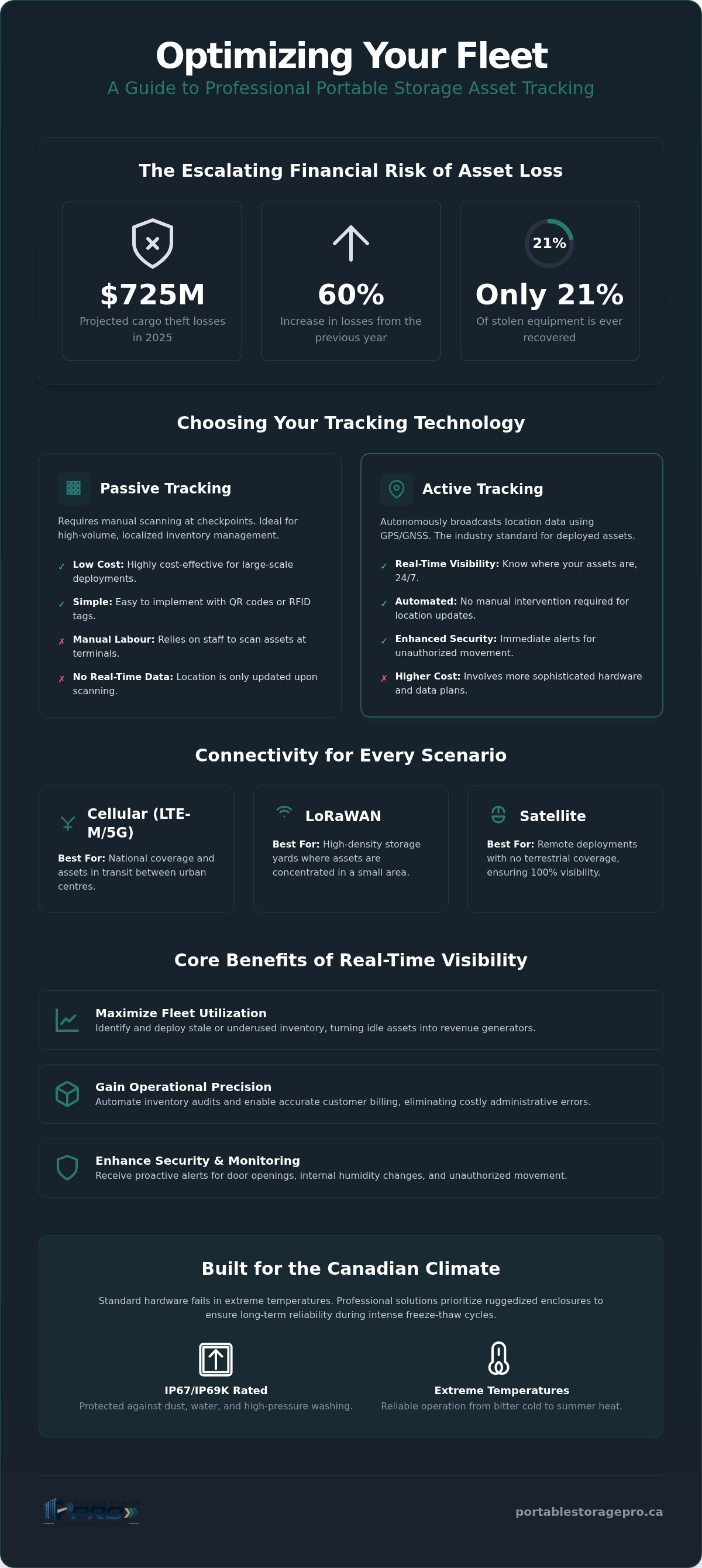
With cargo theft losses surging to nearly $725 million in 2025, a 60% increase from the previous year, the financial risk of losing sight of your fleet has never been higher. For operators in 2026, implementing professional portable storage asset tracking solutions is no longer a secondary security concern; it's a core operational necessity. Industry data shows that only 21% of stolen equipment is ever recovered, making proactive visibility the only reliable defence against permanent asset loss.
You likely realize that manual inventory audits and misplaced containers do more than just cause administrative headaches. They lead to low fleet utilization rates and inaccurate customer billing that directly erode your profit margins. It's frustrating to know you have inventory available but cannot deploy it because of data gaps or logistical friction. You need a system that offers steady reliability and total control over your physical assets without unnecessary complexity.
This guide explores how to organize your fleet and maximize utilization through sophisticated tracking strategies tailored for portable storage operators. We will examine the shift toward LTE-M and 5G RedCap technologies, the role of AI in predictive loss prevention, and the practical implementation of automated reporting. By the end of this article, you'll have a clear path to achieving real-time visibility and improved operational precision across your entire inventory.
Key Takeaways
- Learn to evaluate the trade-offs between battery longevity and ping frequency to select ruggedized hardware capable of withstanding the Canadian climate.
- Discover how portable storage asset tracking solutions identify stale inventory and improve fleet utilization rates by providing real-time visibility across multiple yards.
- Distinguish between passive and active tracking systems to build a technology stack that balances upfront procurement costs with long-term data accuracy.
- Follow a structured roadmap to audit your existing fleet and prioritize high-value assets for immediate digital integration.
- Understand how to integrate asset data into a broader Growth Engagement Model to streamline operations and remove the complexity of global hardware sourcing.
What Are Portable Storage Asset Tracking Solutions?
Professional portable storage asset tracking solutions represent a convergence of three distinct technological layers: ruggedized hardware, reliable data connectivity, and centralized management software. For a modern operator, this system replaces the fragmented, error-prone nature of manual spreadsheets with a synchronized digital record. In 2026, the transition to automation is driven by the need for total operational precision. As legacy 2G and 3G networks finish their sunset phases, operators are migrating toward sophisticated LTE-M and 5G RedCap sensors that offer superior battery life and deeper signal penetration through steel container walls.
The fundamental choice for any operator lies in the distinction between passive and active systems. Asset tracking technologies range from simple QR codes and passive RFID tags, which require manual scanning at a terminal, to active GPS/GNSS trackers that broadcast location data autonomously. While passive systems are cost-effective for internal inventory, active tracking is the industry standard for portable storage containers. These units utilize internal power sources to provide real-time updates, ensuring that a container is never truly lost, even when it's off-site or in transit between regional hubs.
The core components of a professional setup include:
- GPS/GNSS Sensors: High-sensitivity receivers that determine precise coordinates globally.
- Long-Range Connectivity: Low-power wide-area networks (LPWAN) that transmit data with minimal battery drain.
- Cloud-Based Dashboards: Centralized interfaces that turn raw data into actionable insights for fleet managers.
The Role of IoT in Modern Storage Operations
The Internet of Things (IoT) has transformed trackers from simple beacons into comprehensive diagnostic tools. Modern sensors provide high-fidelity data that goes beyond geographic coordinates. Operators now monitor internal humidity levels to protect climate-sensitive cargo and receive immediate alerts for door-opening events. This shift enables a proactive management style. You can address security breaches or environmental risks before they result in insurance claims or customer dissatisfaction, moving the business from reactive recovery to strategic asset oversight.
Connectivity Standards: Cellular vs. LoRaWAN
Selecting a connectivity standard depends on your specific operational footprint. Cellular networks, specifically LTE-M and NB-IoT, are the preferred choice for national coverage. They provide the reach necessary to track containers as they move between urban centres. Conversely, LoRaWAN is an effective solution for high-density storage yards where hundreds of assets are concentrated in a small area. It offers lower operational costs but lacks the wide-area mobility of cellular. For remote deployments in regions without terrestrial coverage, satellite-enabled trackers serve as a vital fail-safe, ensuring visibility remains consistent regardless of location.
Comparing Tracking Technologies: Finding the Right Fit
Selecting the appropriate hardware requires a pragmatic evaluation of your operational environment. While connectivity standards were addressed previously, the physical durability of the device is equally critical. In Canada, trackers must withstand extreme temperature swings that can compromise battery chemistry and structural integrity. Professional portable storage asset tracking solutions prioritize ruggedized enclosures with IP67 or IP69K ratings. These ratings ensure the hardware remains functional during intense freeze-thaw cycles and high-pressure washdowns. Ruggedized hardware is non-negotiable for long-term reliability.
Every tracking strategy involves a calculated trade-off between ping frequency, battery life, and hardware cost. High-frequency pings provide granular visibility but accelerate battery depletion, leading to increased long-term maintenance costs. Conversely, a device that pings once every 24 hours offers exceptional longevity but may miss critical movement events. Over-the-air (OTA) updates are essential for managing these settings remotely. This allows you to increase ping frequency for a high-risk asset without physically accessing the unit, saving significant labour costs.
Battery Life and Power Management Strategies
In 2026, a 7 to 10 year battery life has become the industry benchmark for unpowered assets. Achieving this requires disciplined power management. Many operators now utilize motion-activated pings, where the device remains dormant until it senses movement. This preserves energy while ensuring immediate notification of unauthorized transport. Solar-assisted tracking options are also gaining traction for high-utilization assets, providing a self-sustaining power source that supports more frequent data transmissions without the need for manual battery swaps.
Software Integration and Data Centralization
True operational efficiency is found when tracking data is integrated into a unified Modern Storage Tech Stack. Standalone tracking apps create information silos that slow down decision-making. Data shouldn't live in a silo. By choosing API-first platforms, you can link location data directly to your CRM and billing systems. This automation ensures that customer invoices are triggered accurately based on delivery and pickup timestamps. Operators looking to modernize their infrastructure often start with Technology & Innovation Consulting to identify the hardware and software configurations that best fit their growth goals. Centralizing this data allows for national fleet oversight, giving you the ability to rebalance inventory between yards based on real-time demand rather than guesswork.
The Operational Benefits of Real-Time Asset Visibility
Real-time visibility serves as a catalyst for high-level financial performance. It moves the conversation from "where is my container?" to "how much revenue is this container generating?". Professional portable storage asset tracking solutions provide the granular data necessary to eliminate the "invisible" costs of idle inventory. When an operator can see every asset in their fleet simultaneously, they can address the primary drain on profitability: stale assets sitting in secondary yards or customer sites beyond their contract terms. This transparency ensures that no unit is left forgotten or underutilized.
Optimizing existing inventory is the most effective way to reduce capital expenditure. Before committing to a new procurement cycle, data-driven operators use tracking insights to reallocate underutilized units from low-demand regions to high-growth areas. This level of oversight ensures that every piece of steel in the fleet is working toward a return on investment. Additionally, this transparency extends to the customer experience. Providing precise delivery windows and automated status updates builds a level of professional trust that generic service providers cannot match. It transforms a simple rental into a managed logistics service.
Improving Fleet Utilization and Turnover
Data allows you to realize which container sizes or configurations are underperforming in specific markets. For example, you might find that 20-foot units have a significantly higher turnover rate in urban centres compared to rural hubs. By identifying these patterns, you can adjust your regional inventory mix to match historical demand heat maps. This strategy effectively removes the bottlenecks in the rent-to-return cycle, ensuring that units are cleaned, serviced, and redeployed with minimal downtime. High turnover is the primary driver of a healthy, scalable storage operation.
Geofencing for Automated Yard Management
Geofencing technology transforms your physical locations into intelligent hubs. By setting up virtual perimeters around your yards, you can trigger automated check-in and check-out alerts the moment a container crosses the boundary. This automation significantly reduces the manual labour costs associated with physical inventory counts and gate logs. Beyond administrative efficiency, geofencing is a critical security layer. Any unauthorized movement outside of business hours triggers an instant notification, allowing for immediate intervention. This proactive approach is essential for recovering stolen units before they are moved across borders or into remote areas where recovery becomes nearly impossible.
Implementing Asset Tracking: A Strategic Roadmap
Success with portable storage asset tracking solutions depends on a disciplined implementation strategy rather than a simple hardware purchase. Rushing to equip an entire fleet without a plan often leads to data fatigue and technical friction. Begin with a thorough audit of your current inventory to categorize assets by value, usage frequency, and geographic risk. This allows you to prioritize high-margin containers or those deployed in high-theft areas for the first phase of integration. By focusing on critical assets first, you can demonstrate immediate ROI while refining your internal processes.
Selecting the right hardware involves balancing initial procurement costs with long-term operational reliability. As established, 2026 standards prioritize devices with extended battery life and OTA update capabilities. Once hardware is selected, a phased rollout is the most effective way to minimize disruption. Start with a pilot group of units in a single yard. This controlled environment allows your team to troubleshoot installation methods and dashboard configurations before scaling across the entire national network. A steady, methodical pace ensures that the technology integrates seamlessly into your daily workflow.
Developing SOPs for Technology Integration
Technology often fails in the storage sector not because of the hardware, but because of a lack of disciplined operational procedures. You must establish clear protocols for sensor installation, activation, and ongoing health checks. A sensor that isn't reporting is a liability, not an asset. Integrating these tasks into your existing maintenance cycles ensures that your tracking system remains robust over time. For a deeper look at building these frameworks, consult our guide on Storage Business SOP Development: A Core Requirement. Standardizing these actions removes the guesswork from fleet management and creates a reliable baseline for growth.
Staff Training and Change Management
The human element is the most common hurdle in tech adoption. Drivers and yard staff may initially view tracking as a form of oversight rather than a tool for efficiency. Overcoming this resistance requires clear communication regarding how real-time data simplifies their roles. When staff realize that automated inventory reports eliminate the need for manual yard counts in the rain, buy-in increases significantly. Empower your team by training them to use the dashboards for daily decision-making, such as identifying the closest available unit for a rush delivery. Measuring the success of the rollout through specific KPIs, such as reduced search times or improved billing accuracy, provides the transparency needed to justify the investment. If you are ready to professionalize your operations, our Operations & Training consulting can help align your team with these new digital standards.
Professionalizing Your Fleet with Portable Storage Pro
Scaling a portable storage business requires more than just increasing your unit count. It demands a sophisticated operational framework that integrates technology into every layer of the business. Our Growth Engagement Model is designed to help operators transition from manual oversight to automated precision. By implementing professional portable storage asset tracking solutions, we help you build a fleet that is visible, manageable, and highly utilized. This transformation allows independent operators to compete effectively with national franchises by offering the same level of digital transparency and logistical reliability.
A primary hurdle in modernizing a fleet is the complexity of global procurement. Many operators face significant markups when purchasing hardware through domestic resellers. We leverage our access to global supply chains to remove these middleman costs, ensuring you receive the highest grade of ruggedized sensors at the best possible value. This strategic approach to procurement and sourcing allows you to allocate more capital toward fleet expansion rather than hardware overhead. We provide the operational leadership required to ensure that your chosen portable storage asset tracking solutions deliver a tangible ROI from the first day of deployment.
Technology & Innovation Consulting
Selecting the right hardware is only half the battle. You must also ensure that your software choices are scalable and future-proof. Our Technology & Innovation Consulting provides expert guidance on vendor selection, focusing on platforms that offer API integration and long-term network compatibility. We help you avoid the pitfalls of proprietary systems that lock you into expensive, inflexible contracts. For a detailed breakdown of this process, see our article on Portable Storage Technology Implementation: A Step-by-Step. This ensures your tech stack evolves alongside your business without creating unnecessary administrative labour.
Operational Oversight and Strategic Growth
Asset data is most valuable when it informs your broader business strategy. By analyzing utilization rates and geographic demand, we help you make informed procurement and marketing decisions. If your data shows a consistent shortage of 20-foot units in a specific region, you can pivot your marketing spend to capture that demand immediately. Our fractional leadership model allows you to focus on customer acquisition while we manage the granular details of your tech stack and SOPs. You can find more strategies for driving revenue in our Maximizing Portable Storage Profits: 2026 Canadian Guide. This partnership provides the steady reliability needed to achieve focused ambition in a competitive market.
Securing the Future of Your Fleet
Implementing professional portable storage asset tracking solutions is a strategic shift from reactive security to proactive fleet management. By adopting modern connectivity standards and integrating these tools into disciplined Standard Operating Procedures, you ensure every container in your fleet is a high-utilization asset. This transition removes the administrative burden of manual inventory audits and provides the real-time visibility required to scale in a competitive market.
Professionalizing your operation doesn't have to be an isolated challenge. We provide specialized operational leadership for storage operators, offering global supply chain access for procurement and deep expertise in SOP development and compliance. This approach ensures your technology investments deliver a tangible return while you focus on customer acquisition. It's time to scale your operations with the Growth Engagement Model and take full command of your business's trajectory. You've built a strong foundation; now it's time to optimize it for the long term.
Frequently Asked Questions
What is the typical battery life for portable storage trackers in 2026?
Typical battery life for professional trackers in 2026 ranges from 7 to 10 years depending on ping frequency. These devices utilize LTE-M or NB-IoT networks to minimize power consumption while maintaining reliable connectivity. Factors like extreme Canadian temperatures can impact chemistry; therefore, selecting ruggedized hardware is essential. Modern power management strategies, such as motion-activated reporting, help extend this lifespan by keeping the device dormant when the asset is stationary.
How much does it cost to implement asset tracking across a fleet?
Implementation costs generally include an initial hardware investment and a recurring monthly service fee. Industry benchmarks for 2026 place hardware between $99 and $349 per unit, while monthly monitoring fees often range from $10 to $33 per asset. These costs vary based on the required ping frequency and data granularity. Professional consulting helps operators navigate these options to remove middleman markups and ensure the chosen portable storage asset tracking solutions align with their budget.
Can tracking solutions work in remote areas with poor cellular coverage?
Tracking solutions remain functional in remote areas through the use of hybrid connectivity models. While cellular LTE-M covers the majority of national transport routes, satellite-enabled trackers provide a vital fail-safe for deployments in regions without terrestrial network access. For high-density storage centres in isolated locations, a local LoRaWAN network can provide comprehensive yard visibility. This multi-layered approach ensures that your fleet remains visible regardless of the geographic challenges of the deployment site.
Is it better to use GPS or LoRaWAN for container tracking?
The choice between GPS and LoRaWAN depends on whether you prioritize wide-area mobility or high-density yard management. GPS is the superior choice for tracking assets in transit across the country because it utilizes national cellular networks. LoRaWAN is often more cost-effective for monitoring a large volume of containers within a fixed perimeter, such as a primary storage hub. Many successful operators utilize a hybrid strategy to balance coverage and operational costs effectively.
How do I integrate tracking data with my existing management software?
Integration is achieved through API-first tracking platforms that synchronize location data with your existing CRM or billing software. This allows for automated invoicing triggered by delivery or pickup events, which significantly improves billing accuracy. If your current tech stack lacks native integration, specialized Technology & Innovation Consulting can help bridge the gap. Establishing these digital links ensures that asset data flows directly into your daily management workflows without the need for manual data entry.
Will asset tracking help reduce my insurance premiums for the fleet?
Many insurance providers offer premium reductions for fleets equipped with active tracking and theft recovery systems. These portable storage asset tracking solutions significantly increase the likelihood of asset recovery, which reduces the total risk profile of your business. Cargo theft losses reached nearly $725 million in 2025, so insurers increasingly value proactive visibility. You should consult with your specific insurance provider to determine the exact impact on your policy rates and requirements.
What happens if a tracker is tampered with or removed?
Modern trackers are equipped with light sensors and removal alerts that trigger immediate notifications if a device is tampered with. These anti-tamper features allow yard managers to intervene before an asset is compromised. Additionally, geofencing protocols provide an extra layer of security by alerting you the moment an asset leaves a designated virtual perimeter without authorization. This immediate feedback loop is critical for recovering stolen units before they are moved to remote or untrackable locations.
Do I need to track every container, or just a portion of my fleet?
You don't necessarily need to track every container immediately; a phased rollout often starts with your most critical assets. High-value units, climate-controlled containers, or those deployed in high-theft regions should be prioritized during the initial implementation. Conducting a fleet audit helps identify which assets will deliver the highest ROI through tracking data. Over time, many operators find that the operational benefits of total fleet visibility justify a comprehensive deployment across all inventory units.

Article by
Paul Taylor
Paul Taylor is the founder of Portable Storage Pro, bringing more than 35 years of experience across the container, portable storage and transportation industries. His background spans executive operations, business development, global procurement, sales, marketing and operational improvement in Canada, the UK and international markets.
Paul helps independent portable storage and container rental operators increase revenue, strengthen margins and build more efficient businesses. His work connects strategy with practical implementation, including pricing, delivery operations, supplier sourcing, staff training, technology and customer experience.
His experience includes leading multi-location storage operations and serving on the National Portable Storage Association’s board along with chairing its Canadian committee. Through Portable Storage Pro, Paul shares practical insights to help owners make informed decisions, solve operational challenges and grow profitably.
Disclaimer
Content published by Portable Storage Pro Inc. (PSP) provides general business information and industry insights. It does not replace advice tailored to your business or specialist legal, tax, engineering or other regulated advice. Reading this content or contacting PSP does not, by itself, establish a consulting engagement.
Information reflects circumstances at publication and may change. Examples and potential benefits are illustrative; results depend on individual circumstances, implementation and market conditions and are not guaranteed.
Client services are governed by the signed service agreement, agreed work plan and written amendments. Website and blog content do not amend those terms. PSP’s work is subject to applicable law and the professional commitments set out in its agreement, including the CMC-Canada Code of Professional Conduct and NPSA Code of Conduct and Ethics. Copies are available on request.
Views expressed are PSP’s own. Association membership or references do not imply association endorsement or CMC certification. Nothing in this disclaimer limits PSP’s contractual responsibilities, professional duties or rights that cannot lawfully be excluded.


