
In 2026, the Canadian self-storage market is shifting from rapid expansion toward asset optimization, making a robust storage business compliance checklist your most valuable competitive advantage. You likely feel the constant pressure of fragmented provincial transport regulations and the fear that one improper container placement could result in a significant liability claim. It's a common frustration for operators who want to scale but feel tethered to the granular details of risk mitigation and inconsistent quality control.
This guide helps you protect your portable storage fleet and establish the professional standards required to reduce insurance premiums and ensure your business is audit-ready. We'll break down the essential regulatory requirements, including the latest PIPEDA privacy standards and provincial workplace safety protocols. This guide provides the tactical framework for standardized operating procedures that allow you to step back from day-to-day management and lead your organization with strategic confidence.
Key Takeaways
- Shift your focus from reactive day-to-day management to asset ownership by establishing a foundation of rigorous operational standards.
- Navigate provincial transport regulations and municipal zoning bylaws with precision to mitigate liability and protect your portable storage fleet.
- Use a structured storage business compliance checklist to ensure your administrative, tax, and fleet maintenance records meet 2026 audit requirements.
- Document the "Critical Seven" operational workflows to create a repeatable system that supports long-term scaling and consistent service quality.
- Professionalize your growth through fractional operational leadership to reduce insurance premiums and eliminate unnecessary operational costs.
Why Compliance and SOPs are the Foundation of Storage Growth
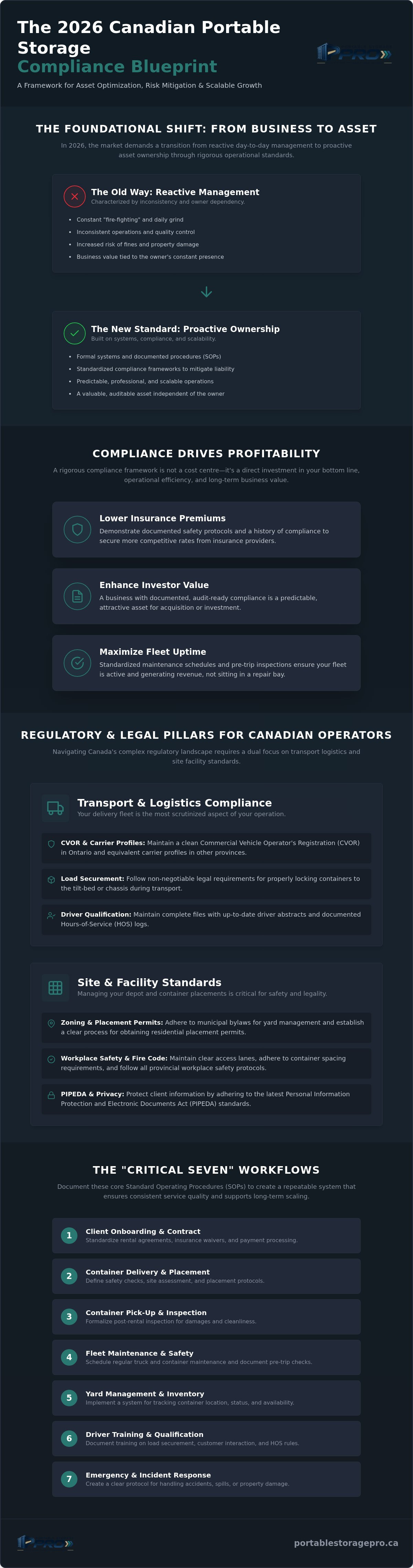
Professionalizing a portable storage operation requires a fundamental shift in perspective. Many owners spend years "running a business" through sheer force of will, but they fail to build an asset that can function without their constant presence. This distinction depends entirely on the implementation of formal systems. A comprehensive storage business compliance checklist serves as the blueprint for this transition, moving the company from reactive fire-fighting to proactive management. It allows you to step away from the daily grind while maintaining full control over the quality and safety of your fleet.
Inconsistent operations create a "chaos tax" that erodes margins. When container placement protocols or transport safety checks vary between staff members, the risk of property damage or regulatory fines increases. Standardized compliance frameworks eliminate these variables. Formal SOPs mitigate liability during container transport and placement by ensuring every driver follows the same safety protocols regardless of the site conditions. They ensure that every delivery, pick-up, and maintenance check follows a validated sequence, which significantly reduces the likelihood of costly errors. This level of operational maturity is exactly what investors look for when evaluating an acquisition. A business with documented compliance is a predictable asset; a business without it is a liability.
The Link Between Compliance and Profitability
Profitability in this sector is often won or lost in the details of risk management. Insurance providers look favourably on operators who can demonstrate a history of documented safety protocols, often leading to more competitive premiums. Additionally, standardizing maintenance schedules ensures that your fleet remains active rather than sitting in a repair bay. Increasing portable storage business profitability depends on operational consistency that only a rigorous compliance framework can provide.
Transitioning from Independent Operator to Industry Peer
Scaling beyond a local footprint requires moving away from "gut feeling" management. Data-driven oversight allows you to identify bottlenecks and optimize container utilization rates. As you professionalize, you gain the credibility needed to participate in global supply chain discussions and secure commercial contracts. These clients prioritize reliability and legal adherence. By using a storage business compliance checklist as your operational foundation, you signal that your brand is a stable partner capable of meeting the demands of modern logistics.
Essential Regulatory and Legal Pillars for Canadian Operators
Operating a portable storage business in Canada places you at the intersection of transportation logistics and property management. This dual identity necessitates a rigorous approach to a storage business compliance checklist that accounts for both road safety and land-use bylaws. Unlike fixed-facility storage, your assets move. This mobility introduces complex liability and regulatory layers that vary significantly between provinces. Failing to harmonize these requirements can lead to more than just fines; it can result in the suspension of your operating authorities or the loss of your yard's zoning status.
Transport and Logistics Compliance
Your delivery fleet is the backbone of the operation and remains the most scrutinized aspect of compliance. In Ontario, maintaining a clean Commercial Vehicle Operator's Registration (CVOR) is mandatory, while other provinces require equivalent carrier profiles. Compliance here focuses heavily on load securement standards. Ensuring that a container is properly locked to the tilt-bed or chassis is a non-negotiable legal requirement. Driver qualification files must include up-to-date abstracts and documented hours-of-service (HOS) logs to avoid heavy penalties during roadside inspections. Standardizing a pre-trip inspection specifically for specialized delivery trucks ensures mechanical issues don't become legal liabilities.
Site and Facility Standards
Managing a storage depot involves more than just stacking units. Zoning bylaws often dictate fencing height, lighting levels, and the maximum height for stacked containers. Fire code compliance is particularly critical when containers are stored in proximity. You must maintain clear access lanes for emergency vehicles and adhere to specific spacing requirements. For residential deliveries, you need a clear process for obtaining municipal placement permits. Many jurisdictions require these for containers placed on public streets or even private driveways for extended periods. If these operational complexities feel overwhelming, seeking specialized operational leadership can help you implement these pillars without slowing your growth.
Consumer protection laws also govern how you handle delinquent accounts. Understanding storage lien rights is essential before you attempt to seize or sell the contents of a non-paying customer's unit. Additionally, federal privacy laws like PIPEDA require strict record-keeping for customer data. Knowingly contravening PIPEDA's breach reporting rules can result in fines of up to $100,000 per violation. From an environmental perspective, your yard must manage runoff from container washing and strictly prohibit the storage of hazardous materials to remain compliant with provincial environmental protection acts.
Building Standard Operating Procedures (SOPs) that Ensure Compliance
SOPs transform your storage business compliance checklist from a static document into a living operational framework. Effective documentation starts with identifying the "Critical Seven" operational areas: unit intake, yard organization, transport logistics, customer engagement, preventive maintenance, administrative records, and incident response. To document these workflows, you must observe the current field reality, record each step without ambiguity, and then stress-test the procedure against real-world constraints. This disciplined approach ensures that your staff doesn't just know what to do, but understands the exact sequence required to maintain regulatory adherence.
Integrating these checks into daily routines requires a shift toward technology. Modern platforms allow for automated reporting, where a driver cannot complete a delivery in the system without first checking off a digital safety list. This creates a transparent audit trail that protects the business from liability claims and ensures that every container placement meets municipal standards. Automation removes the burden of manual record-keeping and allows you to focus on high-level operational leadership.
Mapping the Container Lifecycle
The lifecycle of an asset begins long before it reaches a customer's driveway. Developing SOPs for unit procurement and intake ensures that every container enters your fleet in a condition that meets safety and structural standards. During the intake process, staff should perform a multi-point quality control check to verify door functionality, seal integrity, and floor strength. Standardizing the "Rental-to-Delivery" workflow eliminates logistics errors that lead to missed windows or improper placements. Integrating portable storage asset tracking solutions allows for real-time compliance monitoring, ensuring that every unit is accounted for and maintained according to its specific service history.
Staff Training and Accountability
A "Compliance-First" onboarding program is essential for new drivers and yard staff. Training isn't a one-time event; it's a continuous process of reinforcement and verification. Conduct regular operational audits to ensure that the documented SOPs are actually being followed in the field. These audits reveal where procedures might be too cumbersome or where staff need additional support. Establishing feedback loops is equally important. When a driver reports a near-miss during a delivery, use that data to refine your placement protocols. This proactive adjustment prevents future incidents and keeps your operational standards aligned with the practical realities of the trade.
The Comprehensive Portable Storage Compliance Checklist
A robust storage business compliance checklist is the primary tool for mitigating operational risk. It transforms abstract regulatory requirements into a series of binary checks that staff can execute with precision. Administrative compliance requires valid business licenses and current tax registrations. In Ontario, for example, failure to pay Workplace Safety and Insurance Act (WSIA) premiums can result in fines up to $750,000 for multiple convictions. Legal protections must include rental agreements with specific liability waivers and privacy policies that align with PIPEDA. Knowingly failing to report a data breach can lead to fines of $100,000 per violation. Safety standards should mandate specific PPE for yard staff and clear emergency response plans for equipment failure or site injuries.
Fleet compliance remains a critical focus for portable storage operators. This includes maintaining annual inspections and detailed maintenance logs for every specialized delivery vehicle. GPS tracking compliance is also essential for both logistics efficiency and insurance requirements. By centralizing these records, you ensure the business remains audit-ready at all times. If you need assistance building these frameworks, our SOPs and compliance experts can help you professionalize your operations.
Daily and Weekly Operational Checks
Logbook audits ensure drivers remain within hours-of-service limits, while vehicle inspections catch mechanical wear before it leads to a roadside failure. Container integrity is a weekly priority. Checking for rust, seal degradation, and door alignment ensures the unit remains weather-tight for the next client. Yard security testing, including surveillance system checks and perimeter fencing inspections, protects your physical assets from theft or vandalism. These frequent touches prevent small issues from escalating into major operational disruptions.
Quarterly and Annual Strategic Audits
Strategic audits move beyond the yard and into the boardroom. Reviewing portable storage supply chain risk management protocols allows you to identify vulnerabilities in unit procurement or parts availability. Annually, you must update insurance coverage based on current fleet valuation and the risk profile of your service area. This is also the time to evaluate your storage business compliance checklist to ensure it reflects current provincial transport laws and environmental regulations. Evaluating procurement strategies ensures your units meet evolving safety standards and that you are not overpaying for equipment that lacks the necessary compliance certifications.
Scaling Your Business through Operational Leadership
Scaling a portable storage operation is impossible if the owner remains the only person capable of making a compliance decision. To move beyond local boundaries, you must view your storage business compliance checklist as the gatekeeper to the Growth Engagement Model. This model aligns your operational foundation with sales and marketing efforts, ensuring that growth doesn't outpace your ability to manage risk. Many independent operators struggle to bridge this gap alone. Leveraging fractional operational leadership allows you to implement high-level SOPs without the overhead of a full-time executive. This specialized expertise provides the strategic oversight needed to professionalize the business while you focus on market expansion.
Procurement plays a vital role in this scaling process. A compliant fleet starts with sourcing units that meet current structural and safety standards from the outset. By utilizing global supply chain connections, independent operators can access the same high-quality equipment as national franchises. This levels the playing field, allowing you to offer a premium product backed by rigorous operational standards. When your procurement strategy is linked to your compliance framework, you eliminate the risk of acquiring sub-standard units that require costly retrofitting or fail roadside inspections.
The Growth Engagement Model Approach
Scaling requires a holistic view of the organization. Integrating sales, marketing, and technology consulting with a solid compliance foundation creates a resilient business structure. Maximizing portable storage profits in the 2026 market requires this type of professionalized management. The transition from "Owner-Operator" to "Strategic Leader" is marked by your ability to delegate day-to-day decisions to established systems. Outsourced operational expertise provides the framework for this delegation, ensuring that your standards are maintained even as the fleet doubles or triples in size.
Next Steps for Professionalizing Your Fleet
The path to professionalization begins with an honest assessment of your current state. Conduct an initial operational audit to identify specific gaps in your storage business compliance checklist. Once these vulnerabilities are mapped, set a clear timeline for SOP development and staff training. This methodical rollout ensures that changes are absorbed into the company culture rather than being ignored. If you are ready to move beyond reactive management, learn how Portable Storage Pro can professionalize your operations and provide the leadership needed to scale with confidence.
Securing Your Operational Future
Compliance is the framework that transforms a collection of containers into a scalable business asset. By implementing a rigorous storage business compliance checklist, you mitigate liability and create the consistency required to attract high-value commercial clients. Moving from reactive oversight to a system-driven model ensures that your fleet remains safe, legal, and profitable without requiring your constant intervention. You've built a business; now it's time to build a professionalized organization that can thrive independently.
We provide a pragmatic operational partnership to help you navigate these complexities. With seasoned industry authority and global supply chain access, we ensure your business remains at the forefront of the Canadian sector. Professionalize your operations with our Growth Engagement Model to eliminate inefficiencies and focus on strategic expansion. Taking these steps today protects your investment and sets the stage for sustainable growth in the years ahead.
Frequently Asked Questions
What are the mandatory insurance requirements for a portable storage business in Canada?
Mandatory insurance includes Commercial General Liability (CGL), usually with a minimum $2 million limit, and specialized cargo insurance to protect assets during transit. You must also maintain property insurance for your storage depot and commercial auto coverage for your delivery fleet. In most provinces, workers' compensation coverage through provincial boards is a legal requirement. These policies ensure your storage business compliance checklist addresses the financial risks of property damage and personal injury.
Do I need a special permit to place a storage container on a residential street?
Most Canadian municipalities require a temporary occupancy permit or street use permit for container placement on public property. Bylaws vary by jurisdiction, but placement on a public road without a permit often results in immediate fines or unit impoundment. If the container is on a private driveway, permits are less common. However, some regions still have temporary structure bylaws that limit the duration of stay to 30 days or less.
How often should I conduct safety inspections on my portable storage containers?
You should perform a basic structural inspection every time a unit returns to the yard and a comprehensive multi-point inspection annually. The annual check focuses on seal integrity, floor strength, and door alignment. Fleet vehicles require daily pre-trip inspections by the driver and formal mechanical inspections according to provincial transport schedules. Maintaining a documented history of these checks is a core component of any effective storage business compliance checklist.
What is the difference between a generic business SOP and a storage-specific SOP?
Generic SOPs focus on broad administrative tasks, whereas storage-specific SOPs address the physical and logistical realities of container management. A storage-specific procedure includes detailed protocols for tilt-bed delivery, load securement, and container stacking safety. These specialized documents account for soil compaction at delivery sites and overhead clearance requirements. While a generic SOP might cover general customer service, a storage-specific version handles the legal complexities of lien rights and hazardous material exclusions.
How does compliance impact the resale value of my portable storage company?
Compliance significantly increases resale value by proving the business is a stable, low-risk asset rather than a liability. Prospective buyers and investors prioritize companies with documented SOPs and a clean regulatory history because they are easier to integrate and scale. A business that can demonstrate full adherence to transport and privacy laws commands a higher multiple. It signals that the revenue is sustainable and that the operational foundation is professionalized rather than dependent on the owner.
Are there specific Canadian regulations for transporting shipping containers on public roads?
Transporting containers on public roads is governed by the National Safety Code (NSC) and provincial Highway Traffic Acts. Key regulations include strict load securement standards where containers must be fastened to the chassis using approved hardware. You must also comply with weight restrictions and axle-load limits that vary by province. Drivers must maintain valid commercial licences and adhere to federal hours-of-service (HOS) regulations. These legal pillars are essential for maintaining your carrier safety rating.
Can I use digital signatures for rental agreements and compliance waivers?
Digital signatures are legally binding in Canada under the Uniform Electronic Commerce Act (UECA) and provincial equivalents like Ontario's Electronic Commerce Act. They are highly efficient for rental agreements and liability waivers. Digital platforms provide a secure audit trail, including timestamps and IP tracking, which can be more robust than traditional paper records. Using electronic documentation ensures your compliance records are easily searchable and protected from physical loss or damage in the yard.
What happens if a customer stores prohibited items in a portable container?
Your rental agreement must clearly define prohibited items, such as explosives, flammable liquids, and perishable goods. If a customer violates these terms, the liability usually shifts to them, provided your documentation is clear and signed. You should have an incident response SOP that includes notifying local authorities if hazardous materials are discovered. Failure to enforce these restrictions can void your insurance coverage and lead to environmental fines if leaks occur at your storage facility.

Article by
Paul Taylor
Paul Taylor is the founder of Portable Storage Pro, bringing more than 35 years of experience across the container, portable storage and transportation industries. His background spans executive operations, business development, global procurement, sales, marketing and operational improvement in Canada, the UK and international markets.
Paul helps independent portable storage and container rental operators increase revenue, strengthen margins and build more efficient businesses. His work connects strategy with practical implementation, including pricing, delivery operations, supplier sourcing, staff training, technology and customer experience.
His experience includes leading multi-location storage operations and serving on the National Portable Storage Association’s board along with chairing its Canadian committee. Through Portable Storage Pro, Paul shares practical insights to help owners make informed decisions, solve operational challenges and grow profitably.
Disclaimer
Content published by Portable Storage Pro Inc. (PSP) provides general business information and industry insights. It does not replace advice tailored to your business or specialist legal, tax, engineering or other regulated advice. Reading this content or contacting PSP does not, by itself, establish a consulting engagement.
Information reflects circumstances at publication and may change. Examples and potential benefits are illustrative; results depend on individual circumstances, implementation and market conditions and are not guaranteed.
Client services are governed by the signed service agreement, agreed work plan and written amendments. Website and blog content do not amend those terms. PSP’s work is subject to applicable law and the professional commitments set out in its agreement, including the CMC-Canada Code of Professional Conduct and NPSA Code of Conduct and Ethics. Copies are available on request.
Views expressed are PSP’s own. Association membership or references do not imply association endorsement or CMC certification. Nothing in this disclaimer limits PSP’s contractual responsibilities, professional duties or rights that cannot lawfully be excluded.


