
With one in four Americans now utilizing self-storage, the operational pressure on portable providers has reached a critical threshold. Many operators realize that legacy systems can no longer handle the complexity of 2026 logistics, yet they continue to pay for fragmented software that doesn't talk to their hardware. A high-performance storage business tech stack is no longer an optional upgrade for the tech-savvy. It's the baseline for survival in a market where 51.1 million square feet of new inventory is projected to enter the landscape this year alone.
You likely recognize that manual logistics tracking and disconnected marketing data are costing you more in lost conversions than any software subscription ever could. We'll show you how to build a cohesive digital ecosystem that synchronizes your physical assets with high-performance management software. This reference outlines how to automate workflows, achieve real-time visibility into container locations, and optimize your SaaS spend to ensure every tool in your arsenal drives a tangible rental yield.
Key Takeaways
- Recognize why portable storage requires a specialized storage business tech stack compared to traditional self-storage, focusing on asset mobility and remote oversight.
- Identify the three essential pillars of a digital ecosystem, consisting of Management, Logistics, and Marketing, to ensure seamless data flow from initial lead to container delivery.
- Evaluate the strategic trade-offs between all-in-one software platforms and a modular, best-of-breed approach to find the right balance of simplicity and specialized functionality.
- Implement a structured audit process to inventory your current digital tools and map the customer journey to identify manual gaps that hinder your ability to scale.
- Discover how specialized Technology & Innovation Consulting can help you professionalize your operations and fund system upgrades through realized operational savings.
Understanding the Modern Portable Storage Tech Stack
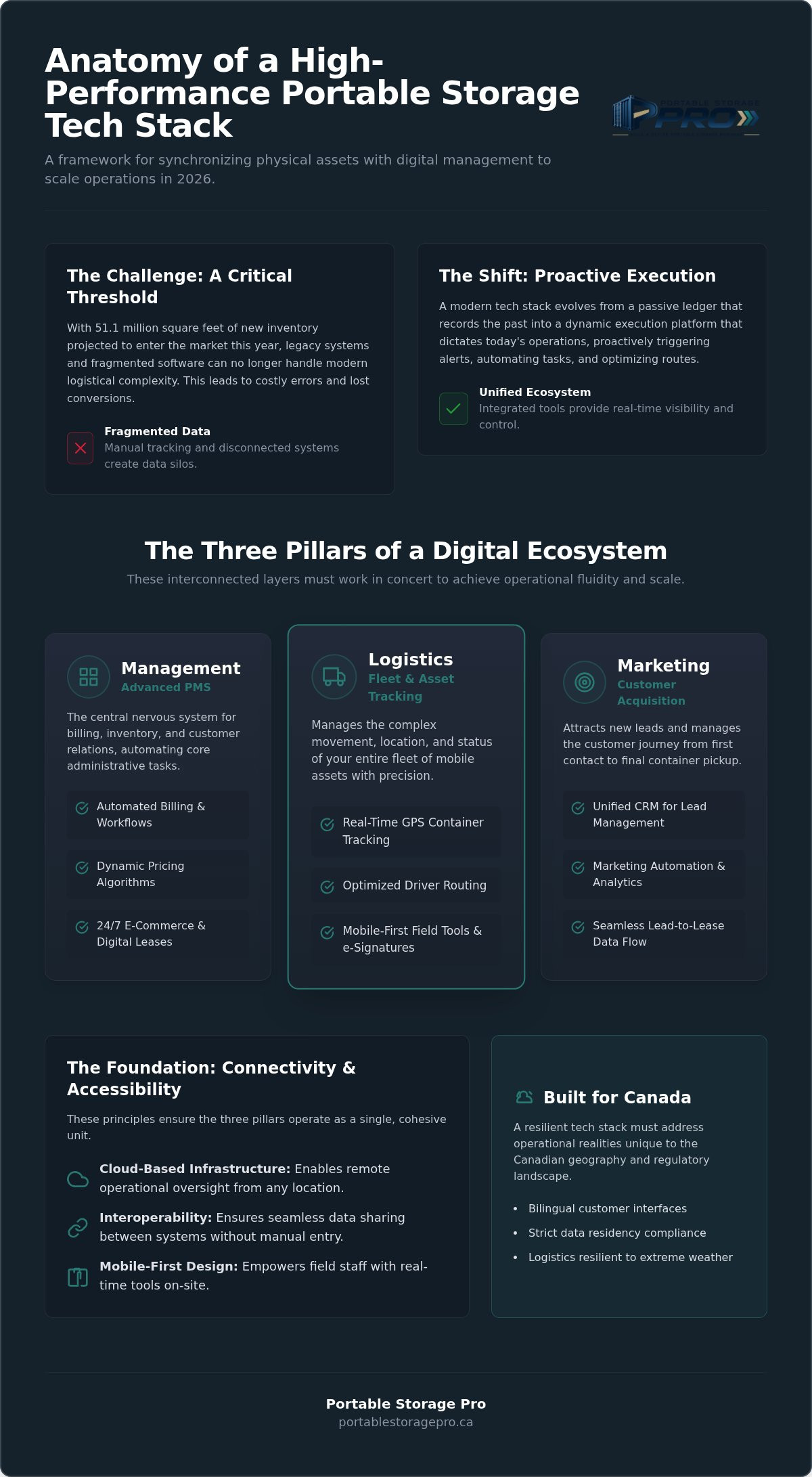
At its core, a technology stack is the integrated ecosystem of digital tools that allows an operator to manage the entire customer journey alongside physical assets. In 2026, a high-performance storage business tech stack has evolved from a simple database into a dynamic execution platform. Modern operators realize that software shouldn't just record what happened yesterday; it must dictate what happens today. This shift toward execution means your systems should proactively trigger delivery alerts, automate late-fee notifications, and optimize driver routes without constant manual intervention.
Portable storage requires a fundamentally different approach than traditional self-storage. While fixed-unit facilities focus on property maintenance and static occupancy, portable operators must manage a fleet of mobile assets. This necessitates sophisticated portable storage operational management that accounts for container locations, transit times, and complex delivery scheduling. Without a unified stack, these moving parts quickly become logistical liabilities. Professionalizing your systems allows you to scale without a linear increase in headcount, as automated triggers replace the need for manual oversight.
Beyond Property Management Software
A standard Property Management Software (PMS) functions as a ledger, but it often lacks the specialized logic needed for container logistics. Relying solely on a PMS creates fragmented data silos that force staff to double-enter information. Modern operators use middleware to bridge the gap between their financial records and real-time field operations to better organize their data flow. This integration removes unnecessary administrative layers, allowing a leaner team to manage a larger fleet with higher precision and fewer errors.
The Canadian Operational Context
Operating within Canada introduces unique technical requirements that a standard storage business tech stack must address. Systems should support bilingual customer interfaces to serve diverse markets effectively, particularly in regions where French and English services are expected. Business records must also adhere to strict data residency standards to ensure compliance with national privacy laws. Furthermore, logistics software must be resilient enough to handle extreme weather variables, ensuring that route optimization remains accurate whether a driver is navigating a coastal storm or a prairie blizzard. Technical resilience is not just about uptime; it's about ensuring your digital infrastructure can withstand the logistical pressures unique to the Canadian geography.
Core Components of a High-Performance Digital Ecosystem
A robust storage business tech stack rests on three distinct pillars: Management, Logistics, and Marketing. These are not isolated silos but interconnected layers that must operate in concert to maintain operational fluidity. Cloud-based infrastructure is the essential prerequisite for this ecosystem, as it allows for remote operational oversight from any location. This level of visibility is vital for owners who need to monitor fleet health and occupancy without being physically present at a facility. Interoperability is the ability for these various systems to share data without manual entry.
Field staff and drivers require a mobile-first design to maintain efficiency. Tools that only function on a desktop are ineffective in a container yard or at a customer delivery site. Mobile interfaces ensure that drivers can update delivery statuses, capture photos of container placement, and collect digital signatures in real-time. This immediate data entry prevents the information lag that often leads to scheduling errors and customer disputes.
Advanced Property Management Systems (PMS)
Selecting an Advanced Property Management System (PMS) requires looking beyond basic billing functions. High-performance platforms automate move-ins, move-outs, and recurring billing cycles, which reduces the administrative burden on your office staff. Modern systems utilize dynamic pricing algorithms to adjust rental rates based on real-time occupancy and seasonal demand. Integrating e-commerce portals and digital lease signing allows for a 24/7 rental experience, meeting the convenience expectations of the 2026 consumer. If you are looking to refine these internal systems, Technology & Innovation Consulting can help align your tools with your specific growth goals.
Real-Time Asset Tracking and Fleet Logistics
For portable operators, visibility is the primary driver of profitability. Utilizing specialized portable storage asset tracking solutions provides real-time fleet visibility across vast distances. GPS and IoT sensors monitor container health and precise locations, preventing lost assets and unauthorized movements. This data feeds directly into route optimization software, which reduces fuel consumption and labour costs by identifying the most efficient delivery sequences for your drivers.
Automated Lead Generation and CRM Integration
A robust CRM is the engine of your sales funnel. It captures high-intent leads from portable storage lead generation efforts and ensures no prospect is overlooked. Automating follow-up sequences can significantly increase lead-to-rental conversion rates by reaching customers when their intent is highest. Advanced data analytics then help identify which customer segments provide the highest lifetime value, allowing you to focus your marketing budget where it generates the best return.
Evaluating Integrated Platforms vs. Best-of-Breed Solutions
Selecting the architecture for your storage business tech stack involves a fundamental choice between operational simplicity and specialized capability. Many operators initially gravitate toward integrated platforms because they promise a single source of truth. While this approach reduces the number of vendors to manage, it often forces compromises in critical areas like logistics or advanced procurement. You must decide if the convenience of a unified interface outweighs the high performance of tools built for specific tasks.
Total cost of ownership (TCO) extends far beyond the monthly subscription fee. A cheaper, all-in-one system might actually be more expensive if it lacks the automated triggers discussed in previous sections. If your staff must manually reconcile container locations because your software doesn't integrate with your GPS sensors, you're paying for that inefficiency in labour hours. True TCO includes the cost of manual workarounds, lost leads from poor CRM follow-up, and the long-term impact of vendor lock-in.
The Case for All-in-One End-to-End Platforms
End-to-end platforms offer a unified database that simplifies staff training and customer support. When your billing, digital leases, and gate access live in one ecosystem, the risk of data mismatch is significantly reduced. This structure is often ideal for smaller operations or those just beginning to professionalize their systems. However, these platforms can struggle with the unique complexities of portable storage, such as multi-stop route optimization or specialized asset procurement. Operators must weigh the benefit of a single login against the potential for technical stagnation if the vendor fails to innovate.
Creating a Custom Stack via API Integrations
A best-of-breed approach allows you to select the highest-performing tool for every specific function. By using Application Programming Interfaces (APIs), you can connect a specialized CRM to a dedicated logistics engine and a robust accounting platform. This modularity ensures you aren't limited by the weakest link in a single vendor's software suite. An integration-first mindset is particularly important for procurement and sourcing, where specialized data is required to manage global supply chains. This strategy future-proofs your business; it allows you to swap out individual components as new technologies emerge without disrupting your entire operational flow.
Auditing and Implementing Your Technology Transformation
Auditing your current storage business tech stack is a prerequisite for any meaningful transformation. You cannot optimize what you haven't quantified. Begin by listing every digital subscription, from your primary PMS to small utilities like e-signature tools. Record the monthly cost and user count for each. Once inventoried, map the customer and container journey from the first inquiry to the final pickup. This exercise reveals manual gaps where staff are forced to bridge disconnected systems with spreadsheets or phone calls. Mapping the container journey is particularly critical for portable operators. You must track the asset from the yard to the customer site, then to a storage facility, and eventually back to the yard. If your current systems require manual status updates at each of these touchpoints, you have a significant opportunity for automation.
Evaluate utilization with a critical eye. Are you paying for a premium CRM tier just to send basic emails? Prioritize your upgrades based on immediate revenue yield. If your lead-to-rental conversion is low, fix the marketing automation before investing in advanced route optimization. This logical approach ensures that your technology spend directly supports your bottom line. Every dollar saved on redundant software is a dollar that can be reinvested into higher-yielding logistics hardware or marketing campaigns.
Identifying Redundancies in SaaS Spend
Look for overlapping features between your CRM and PMS. Many modern property management systems now include basic lead tracking; if you are also paying for a standalone CRM, you may be doubling your costs for the same functionality. Consolidating communication tools into a single platform helps to centre staff collaboration and reduces the context switching that drains productivity. Cut the shelfware. These are the tools purchased with good intentions that no longer serve your operational goals. Audit your user seats to find active subscriptions for former employees or underutilized licenses that can be downgraded immediately to realize instant savings.
The Step-by-Step Implementation Roadmap
Successful implementation follows a disciplined progression. Start with the Core PMS to establish your financial and rental foundation before adding specialized logistics layers. This sequence ensures that your data flows from a stable, verified source. Pair every new rollout with comprehensive staff training to ensure high adoption rates. If the team doesn't understand the tool, they will revert to manual workarounds. Finally, set specific KPIs to measure the success of your storage business tech stack, such as a reduction in manual data entry hours or an increase in container utilization rates. If you need assistance structuring this transition, our Technology & Innovation Consulting provides the specialized leadership required to navigate these complexities.
Professionalizing Operations with Portable Storage Pro
Transitioning from a collection of fragmented tools to a professionalized operation requires more than just purchasing software. It requires a cohesive strategy. Specialized Technology & Innovation Consulting removes the guesswork from the selection process by aligning digital tools with specific business outcomes. By leveraging the Growth Engagement Model, operators can fund their digital transformation through the very operational savings these systems generate. This approach ensures that your storage business tech stack becomes a self-funding engine for growth rather than a static overhead cost.
Automation is the essential bridge that allows a business owner to transition from the constant demands of "owner-operator" status into the role of a "strategic leader." When your billing, asset tracking, and lead follow-ups are synchronized, you're no longer spending your day reacting to minor operational crises. Instead, you're analyzing real-time data to make informed procurement and expansion decisions. This structural evolution is the only way to scale a portable storage fleet without a linear and costly increase in administrative headcount.
Fractional Leadership for Tech Implementation
Independent operators often lack the internal resources to manage a complex software rollout while maintaining daily operations. Fractional operational leadership provides the seasoned expertise needed to bridge the gap between a high-level strategic vision and the granular tactical setup of a new platform. This specialized guidance reduces the risk of failed implementations, which are frequently caused by poor initial configuration or low staff adoption rates. Seasoned leaders ensure that every tool in your stack is fully utilized and properly integrated from day one.
Leveraging Global Supply Chain Tech
A sophisticated storage business tech stack must extend its reach beyond local delivery routes and into the complexities of the global supply chain. High-performance stacks facilitate better container sourcing by integrating procurement software with real-time market data. This allows operators to navigate port ties and identify wholesale container sourcing opportunities with greater precision. Data-driven procurement ensures you maintain the inventory levels needed for growth without overpaying during market volatility. To realize your business growth potential, Partner with Portable Storage Pro and professionalize your digital ecosystem today.
Securing Your Operational Future
Building a modern storage business tech stack is a strategic investment in your company's longevity and scalability. We've detailed how a unified digital ecosystem synchronizes physical assets with management software to remove manual errors and redundant costs. By auditing your current SaaS spend and mapping the container journey, you can identify the gaps that prevent your fleet from reaching its full revenue potential. This transition from manual tracking to automated execution is what separates market leaders from those struggling with stagnant growth.
To navigate these technical complexities, you need a partner who understands the logistical realities of the sector. Optimize your storage tech stack with Portable Storage Pro to leverage our specialized portable storage operational expertise and global supply chain access. Our scalable Growth Engagement Model is designed to help you realize tangible yield through systematic improvement rather than just adding headcount. Professionalizing your operations today ensures you stay ahead of market consolidation and rising consumer expectations. You have the tools and the framework to transform your business into a high-performance leader in the portable storage industry.
Frequently Asked Questions
What is a storage business tech stack?
A storage business tech stack is the unified collection of digital tools and hardware used to manage the customer lifecycle and physical container assets. It typically includes property management software (PMS), customer relationship management (CRM) tools, and logistics tracking hardware. This ecosystem ensures that data flows seamlessly between marketing efforts, billing cycles, and field operations without requiring manual intervention or double-entry by staff members. It's the digital backbone that supports professionalized operational management.
How much should a portable storage business spend on technology?
Technology spending should be viewed through the lens of operational yield rather than just a fixed overhead cost. While specific dollar amounts vary based on fleet size and market complexity, most high-performance operators allocate a percentage of their revenue to ensure their systems scale without increasing administrative headcount. The goal is to fund these upgrades through realized operational savings, such as reduced fuel costs from route optimization and higher lead-to-rental conversion rates.
Can I integrate my existing accounting software with a storage PMS?
Yes, most modern property management systems utilize APIs to synchronize with standard Canadian accounting platforms. This integration allows for the automatic reconciliation of rental payments, late fees, and tax records. Ensuring your PMS talks to your accounting software is a critical step in removing manual administrative layers. It provides real-time financial visibility, allowing you to monitor cash flow and profitability without waiting for end-of-month manual reports or spreadsheet reconciliations.
Is cloud-based software secure for customer data?
Cloud-based platforms are generally more secure than on-premise servers because they utilize advanced encryption and redundant backups. For Canadian operators, it's essential to ensure your software provider adheres to national data residency requirements and privacy standards. Modern cloud infrastructure allows for secure, remote access to business records, ensuring that sensitive customer information is protected by enterprise-level security protocols that individual operators typically cannot maintain on their own without significant capital investment.
What is the most important piece of technology for a new storage operator?
The Property Management System (PMS) serves as the foundational core of your storage business tech stack. It handles the primary functions of billing, digital lease signing, and inventory management. For a new operator, selecting a PMS that offers specialized logic for portable assets is more important than choosing a generic self-storage platform. This choice ensures that you can manage container movements and logistics from the first day of your operations without costly manual workarounds.
How does AI improve storage operations in 2026?
In 2026, AI is primarily used for dynamic pricing and predictive maintenance of your container fleet. These algorithms analyze local market demand and historical occupancy to adjust rental rates automatically, maximizing your revenue yield. AI also powers automated lead follow-ups, ensuring that inquiries are answered instantly. This technology allows smaller teams to compete with larger REITs by providing a level of responsiveness and pricing precision that was previously only available to major corporations with deep pockets.
Do I need a separate CRM if my PMS has marketing features?
You might need a standalone CRM if your PMS lacks advanced automation for lead nurturing and attribution tracking. While many property management systems include basic marketing tools, a specialized CRM allows you to segment high-intent leads more effectively. This distinction is vital for optimizing your sales funnel and increasing conversion rates. If your current PMS marketing features create manual gaps in your sales process, a dedicated CRM integration is often a high-yield investment for your fleet.
How long does it take to implement a new tech stack?
A full technology transformation typically takes between three to six months, depending on the complexity of your existing data. This timeline includes the initial audit, software selection, data migration, and comprehensive staff training. Rushing this process often leads to poor adoption or technical errors that disrupt your daily operations. A phased approach allows you to stabilize your core property management functions before layering on specialized logistics and marketing automation tools to scale your business.

Article by
Paul Taylor
Paul Taylor is the founder of Portable Storage Pro, bringing more than 35 years of experience across the container, portable storage and transportation industries. His background spans executive operations, business development, global procurement, sales, marketing and operational improvement in Canada, the UK and international markets.
Paul helps independent portable storage and container rental operators increase revenue, strengthen margins and build more efficient businesses. His work connects strategy with practical implementation, including pricing, delivery operations, supplier sourcing, staff training, technology and customer experience.
His experience includes leading multi-location storage operations and serving on the National Portable Storage Association’s board along with chairing its Canadian committee. Through Portable Storage Pro, Paul shares practical insights to help owners make informed decisions, solve operational challenges and grow profitably.
Disclaimer
Content published by Portable Storage Pro Inc. (PSP) provides general business information and industry insights. It does not replace advice tailored to your business or specialist legal, tax, engineering or other regulated advice. Reading this content or contacting PSP does not, by itself, establish a consulting engagement.
Information reflects circumstances at publication and may change. Examples and potential benefits are illustrative; results depend on individual circumstances, implementation and market conditions and are not guaranteed.
Client services are governed by the signed service agreement, agreed work plan and written amendments. Website and blog content do not amend those terms. PSP’s work is subject to applicable law and the professional commitments set out in its agreement, including the CMC-Canada Code of Professional Conduct and NPSA Code of Conduct and Ethics. Copies are available on request.
Views expressed are PSP’s own. Association membership or references do not imply association endorsement or CMC certification. Nothing in this disclaimer limits PSP’s contractual responsibilities, professional duties or rights that cannot lawfully be excluded.


