
The most expensive insurance policy you can buy is often the one you actually have to use. While many Canadian operators believe that high-limit coverage is the gold standard for storage business risk mitigation, the reality of 2026 suggests otherwise. You've likely noticed that commercial property premiums rose by 5.69% in August, and you're right to feel that simply paying more for protection isn't a sustainable strategy. It's a common frustration to see fleet maintenance costs fluctuate or to worry about legal disputes over customer goods despite having what you thought was comprehensive coverage.
This article promises to show you why insurance is only half the battle and how operational excellence serves as your ultimate shield against storage business risks. We'll move past the myths of the industry to focus on the pragmatic realities of professionalized management. You'll discover how implementing rigorous SOPs and advanced procurement strategies can lower your liability exposure and create the predictable cost structure required for a successful future exit. We will examine the specific roles of technology and compliance in building a business that is both resilient and highly scalable.
Key Takeaways
- Shift your perspective from reactive insurance claims to proactive storage business risk mitigation to stabilize rising premiums and protect your bottom line.
- Implement rigorous Standard Operating Procedures (SOPs) as your primary line of defence to realize stronger legal protection and operational consistency.
- Replace manual tracking with integrated IoT and GPS technology to maintain precise asset control and reduce unpredictable fleet maintenance costs.
- Adopt a strategic procurement approach to avoid the financial drain of "zombie inventory" that costs more to maintain than it earns in rent.
- Learn how the Growth Engagement Model helps you scale your business while embedding safety and compliance into your daily operational framework.
The Myth of the "Insurance Safety Net": Why Policies Aren’t Enough
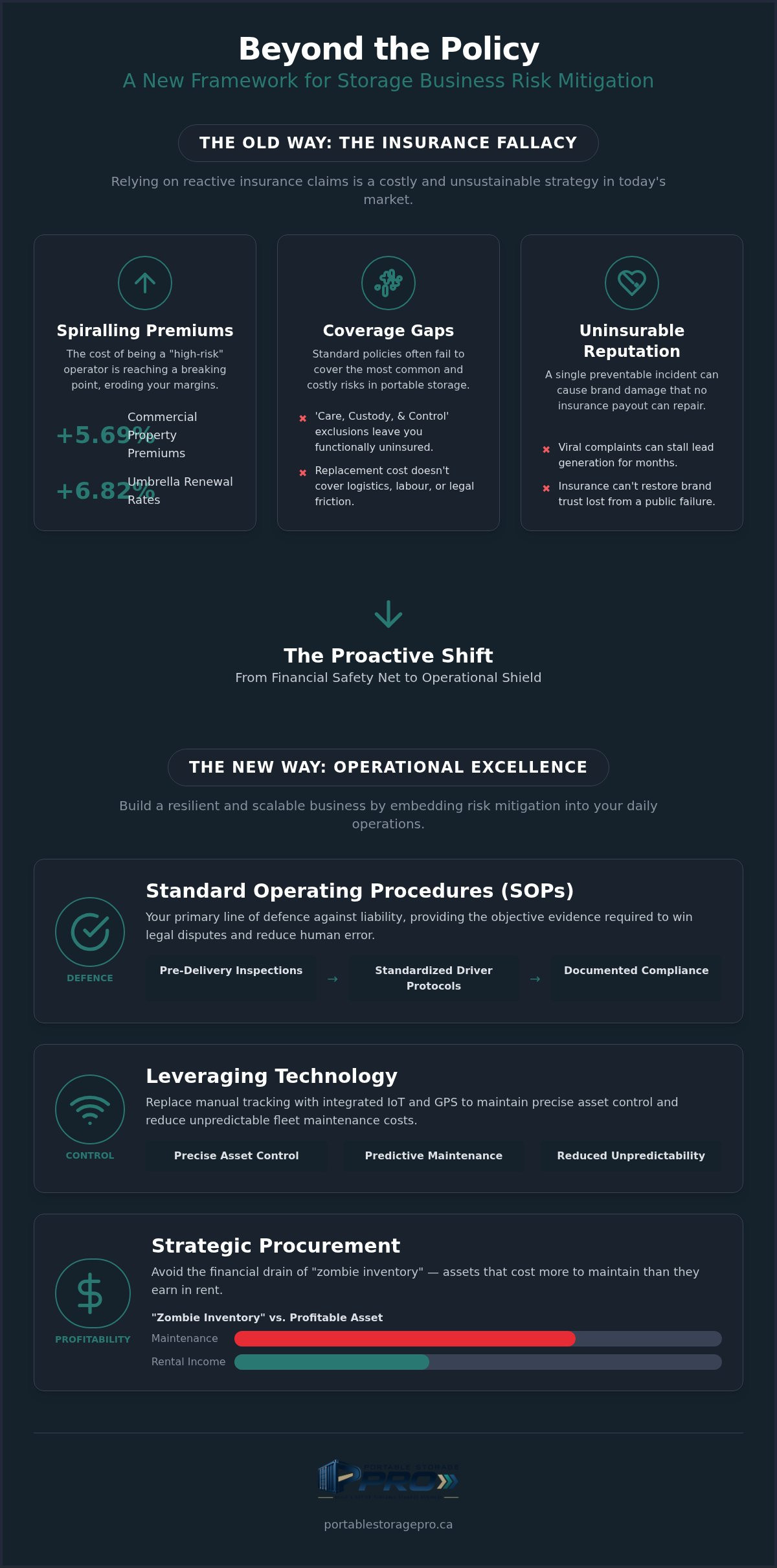
Real storage business risk mitigation is a proactive operational strategy, not a reactive financial safety net. Many operators view insurance as a "fix-all" solution, but this "claim-first" mentality is becoming a liability in its own right. In the Canadian market, relying on claims to solve problems leads to spiralling premiums that can quickly erode your margins. With August 2026 data showing umbrella renewal rates at 6.82% and commercial property at 5.69%, the cost of being a "high-risk" operator is reaching a breaking point. You might soon find your fleet is uninsurable if you don't have the systems to prevent losses before they occur. Professional underwriters in 2026 are no longer just looking at your loss history; they prioritize operators who can demonstrate documented safety systems and rigorous oversight.
The Limitations of Standard Liability Coverage
Standard policies often miss the mark on portable storage nuances. The "care, custody, and control" clause is a frequent point of failure in legal disputes. If your policy excludes damage to property in your care, you're functionally uninsured for the most common risks your customers face. There is also a significant gap between "replacement cost" and the actual logistical cost of a unit failure. While a cheque might cover a new container, it doesn't account for the emergency transport, the labour to move goods, or the legal friction of a settlement. Middleman markups in the insurance chain often inflate your costs without adding a single layer of actual protection to your physical assets. You need to organize your operations to minimize the need for these expensive, reactive layers.
Reputational Risk: The Uninsurable Asset
Your reputation is an uninsurable asset that requires constant maintenance. In a digital-first market, a single viral complaint about a preventable incident can outweigh any insurance payout you receive. This is particularly critical in the middle of the customer journey, where potential clients are comparing your reliability against competitors. One bad review regarding water damage or a security breach can stall your lead generation efforts for months. Operational consistency across your Canadian footprint is what protects your market position and ensures long-term growth. Insurance can eventually replace a box; it cannot restore the brand trust lost when a lack of procedures leads to a public failure. High-level storage business risk mitigation focuses on protecting the brand name as much as the physical inventory.
Operational SOPs: Your First Line of Defence Against Liability
Many independent operators believe that rigorous Standard Operating Procedures (SOPs) are only necessary for massive franchises like PODS. This is a dangerous misconception. In reality, SOPs are the most effective tool for storage business risk mitigation because they provide the objective evidence required to win legal disputes. Without documented proof that a specific procedure was followed, a signed lease agreement often lacks the teeth to defend your business against claims of negligence or property damage. Professionalizing your operations through storage business standard operating procedures significantly reduces human error and creates a culture of accountability that insurance alone cannot provide.
Standardizing the Rental and Delivery Cycle
The delivery phase is where most liability occurs. You must document pre-delivery inspections to prevent customers from claiming pre-existing damage on their driveways or the units themselves. Standardized driver protocols are essential when navigating tight Canadian residential spaces, especially during winter months when ice and snow increase the risk of property damage. Utilizing a centralized storage business compliance checklist ensures that every driver, regardless of experience, follows the same safety steps. This consistency is what transforms a loose collection of assets into a professionalized enterprise that can withstand legal scrutiny.
Professionalizing Staff and Contractor Training
Relying on "shadowing" as a primary training method is a recipe for operational drift. You need to move toward documented competency testing to ensure that every team member understands their role in safety and compliance. This shift reduces workplace injury claims and minimizes "key man risk" by codifying business knowledge into accessible systems. It allows you to delegate daily tasks without losing control over the quality of service. With OSHA renewing its National Emphasis Program on warehousing in 2026, having documented training on powered industrial vehicles and material handling is no longer optional. If you want to scale your business while keeping liability low, investing in fractional operational leadership can help you build these systems without the cost of a full-time executive. Professionalizing your staff ensures that your business remains attractive for a future exit or expansion.
Leveraging Technology to Mitigate Fleet and Asset Risks
It's a common belief that a whiteboard or a basic spreadsheet is sufficient for tracking a few dozen containers. This myth ignores the logistical reality of modern fleet management. For effective storage business risk mitigation, you need real-time data that manual systems simply cannot provide. In 2026, 80% of fleet professionals utilize GPS tracking because they realize that "lost" or underutilized inventory is a direct hit to the bottom line. By implementing portable storage asset tracking solutions, you gain a clear view of your entire inventory, reducing the time spent on manual audits and unnecessary phone calls to drivers.
A modern storage business tech stack does more than just show dots on a map. It automates risk alerts based on specific triggers, such as a unit sitting idle for too long or a vehicle exceeding safe speed limits. You can also use this data for preventative maintenance scheduling. Instead of waiting for a truck to break down on a busy Canadian highway, you can use engine hour data to schedule service during off-peak times. This shift from reactive to proactive maintenance stabilizes your operational costs and ensures your fleet remains in peak condition for customer deliveries.
Real-Time Visibility and Loss Prevention
Geofencing acts as a digital perimeter for your assets. If a trailer or container leaves a designated zone without authorization, you get an immediate alert on your phone. This rapid response capability is vital for theft prevention and recovery in a market where replacement costs are rising. Additionally, high-value units can be equipped with sensors that monitor for moisture or light, flagging unauthorized access or seal failures instantly. Asset tracking serves as a powerful tool that reduces both insurance premiums and capital expenditure by protecting your physical inventory.
Data Integrity and Cybersecurity for Small Operators
Protecting your business also means protecting your digital assets. You must ensure that Canadian customer data is handled in compliance with privacy regulations to avoid legal disputes. Many small operators fall into the trap of "cloud silos," where customer information is fragmented across different platforms, making it harder to secure. Our Technology & Innovation Consulting helps you organize these systems into a unified, secure architecture. This integration reduces the risk of data breaches and ensures that your business information remains accurate and accessible when you need to defend your operational decisions. Moving toward an integrated system allows you to maintain professional standards while scaling your fleet.
Procurement Strategy: Mitigating Supply Chain and Quality Risks
Many operators believe that buying the cheapest possible containers is the fastest route to profitability. This is a significant myth that often leads to the creation of "zombie inventory." These are units that require so much maintenance and repair that they eventually cost more than they earn in rental income. Effective storage business risk mitigation requires a shift from price-focused buying to a strategy centred on asset quality and longevity. Relying solely on brokers can expose you to fraud and extreme quality variance, whereas direct sourcing provides a clearer line of sight into the manufacturing process. By prioritizing portable storage supply chain risk management, you prevent growth bottlenecks caused by faulty equipment or sudden supply shortages.
Global Sourcing and Quality Assurance
Securing high-quality assets starts at the factory level. You shouldn't wait until a container arrives at your yard to realize it has structural defects or poor-quality seals. Factory-level inspections are essential to ensure every unit meets your specific standards before it ever leaves the port. Navigating international logistics and port ties is complex, and without professional oversight, your capital can easily get stuck in "customs limbo" for weeks. Our Procurement & Sourcing services provide local operators with the same leverage and supply chain visibility as a global firm. We help you bypass middleman markups and ensure your assets are delivered on time and to specification.
Asset Longevity and Lifecycle Management
Calculating the True Cost of Ownership (TCO) is a fundamental part of risk management. A lower-grade container might save you money upfront, but it often leads to higher liability and repair costs over its lifecycle. Scaling a fleet too quickly with low-quality assets creates a risk of under-capitalization, as your maintenance budget swells unexpectedly. Standardizing your procurement ensures fleet uniformity, which makes maintenance more predictable and training much simpler for your team. This disciplined approach to asset management protects your margins and ensures your business remains attractive for a future exit. If you are ready to professionalize your inventory, explore our Procurement & Sourcing solutions to build a more resilient fleet.
The Growth Engagement Model: A Holistic Approach to Safety
There is a persistent myth in the portable storage industry that you must choose between aggressive growth and operational safety. This binary choice is a false one. In reality, the Growth Engagement Model is designed to prove that storage business risk mitigation is actually a catalyst for expansion, not a bottleneck. If your sales and marketing efforts aren't backed by a professionalized operational core, you aren't just growing; you're accumulating liability. By integrating risk oversight into every stage of the business lifecycle, we ensure that your brand promise is matched by your team's ability to deliver safely and consistently.
Closing the gap between where your business sits today and where it needs to be to scale securely requires a shift in perspective. Many owners find themselves trapped in a cycle of reactive management, constantly putting out operational fires that could've been prevented with better systems. Fractional operational leadership provides the expert oversight you need without the overhead of a full-time executive. This allows you to focus on high-level strategy while we handle the granular details of SOPs, compliance, and technology implementation. It's about building a business that's not only profitable but also attractive for a future exit or national scaling.
From Owner-Operator to Strategic Leader
The transition from a hands-on owner-operator to a strategic leader is the ultimate form of risk mitigation against burnout. When you codify your business knowledge into repeatable systems, the business no longer depends on your physical presence to function safely. We act as a peer partner to Canadian business owners, offering seasoned authority and pragmatic solutions that reflect the physical realities of the sector. Through our industry representation at international conferences, we stay ahead of regulatory changes and emerging trends, ensuring your business remains compliant and competitive in an evolving market.
Next Steps: Auditing Your Risk Profile
Professionalizing your portable storage business today starts with an honest audit of your current operations. You should look for "red flags" such as inconsistent delivery logs, aging assets with high maintenance costs, or a lack of documented training for your staff. These are the areas where claims are born. Identifying these gaps now allows you to implement corrective measures before they impact your bottom line or your reputation. If you're ready to secure your business's future, contact Portable Storage Pro to learn how our Growth Engagement Model mitigates your operational risks.
Securing Your Operational Future
Managing a portable storage fleet in 2026 requires more than just high-limit insurance policies and a signed lease. True storage business risk mitigation is built on a foundation of operational excellence, standardized SOPs, and precision technology. You've seen how reactive claims lead to spiralling premiums, while proactive systems like GPS tracking and factory-level procurement inspections stabilize your costs. By professionalizing these granular details, you transform your business from a collection of assets into a resilient, scalable enterprise.
You don't have to navigate these complex logistical challenges alone. Our Growth Engagement Model provides independent operators with specialized portable storage operational leadership and direct access to global supply chain networks. This partnership allows you to focus on high-level strategy while we help you implement the systems that protect your brand. It's time to close the gap between where your operations are and where they need to be for a successful future exit. Book a Consultation to Professionalize Your Storage Operations and start building your ultimate operational shield today. You have the ambition to grow; we have the framework to make it secure.
Frequently Asked Questions
What are the most common risks for a portable storage business in Canada?
Common risks include fleet damage from harsh Canadian winters, liability for customer property, and escalating commercial insurance premiums. You also face supply chain volatility and the potential for legal disputes over "care, custody, and control" clauses. Effective storage business risk mitigation involves shifting from reactive insurance claims to proactive operational oversight. This protects your brand reputation and ensures your business remains viable in a market where property insurance rates rose 5.69% in August 2026.
How do Standard Operating Procedures (SOPs) actually reduce my insurance costs?
SOPs provide the documented evidence needed to defend your business against negligence claims. When you can prove that every delivery followed a standardized safety checklist, you reduce your liability exposure. Practically speaking, underwriters in 2026 prioritize operators who use documented systems, often leading to more favourable renewal rates. By lowering the frequency of preventable incidents, you avoid the high-risk pool and keep your operational costs more predictable over the long term.
Can I mitigate risk without hiring a full-time operations manager?
You don't need a full-time executive to professionalize your business. Fractional operational leadership offers a pragmatic middle ground, giving you access to expert guidance on SOPs and compliance at a fraction of the cost. This model allows you to focus on high-level strategy while a specialist manages the granular details of your fleet. It's an effective way to implement sophisticated risk management strategies without increasing your permanent headcount or payroll overhead.
What is the biggest mistake independent storage operators make with risk management?
The most significant error is treating insurance as a "fix-all" safety net. This reactive mindset ignores the hidden costs of downtime, legal friction, and brand damage. Comprehensive storage business risk mitigation requires you to prevent losses before they happen through better procurement and staff training. Relying on claims eventually makes a fleet uninsurable. You must view risk management as an operational discipline that adds value, rather than just a monthly premium expense.
How does procurement consulting help with business risk?
Procurement consulting mitigates risk by removing middleman markups and ensuring factory-level quality control. It prevents the acquisition of "zombie inventory" that costs more to maintain than it earns. By establishing direct sourcing lines, you avoid the quality variance and fraud risks associated with broker reliance. This strategic approach ensures your fleet is uniform and durable, which simplifies maintenance and reduces the likelihood of unit failure during a customer's rental period.
Is asset tracking technology worth the investment for a small fleet?
Yes, GPS and IoT technology are essential for fleets of any size. Asset tracking allows for geofencing, providing immediate alerts if a unit is moved without authorization. It also automates preventative maintenance schedules based on real-time data, preventing expensive breakdowns on Canadian highways. In an era where 80% of professionals use tracking, staying manual is a competitive risk. The investment pays for itself through extended asset longevity and significantly lower theft recovery costs.
What should be included in a storage business compliance checklist?
A robust checklist should include several critical safety components:
- Pre-delivery structural and seal inspections
- Driver safety protocols for tight residential spaces
- Moisture sensor audits for high-value units
- Documented training records for powered industrial vehicles
This document serves as your primary evidence in legal disputes. It ensures every team member follows the same safety steps, reducing human error and protecting your business from claims of negligence.
How does the Growth Engagement Model differ from generic business coaching?
Unlike generic business coaching, the Growth Engagement Model is a specialized operational framework built specifically for portable storage. It doesn't just offer advice; it provides a structured path for procurement, technology implementation, and staff training. This model integrates safety and compliance into your sales and marketing efforts. It is designed to professionalize independent operators, making them more attractive for future exits while ensuring they can scale securely without increasing their liability profile.

Article by
Paul Taylor
Paul Taylor is the founder of Portable Storage Pro, bringing more than 35 years of experience across the container, portable storage and transportation industries. His background spans executive operations, business development, global procurement, sales, marketing and operational improvement in Canada, the UK and international markets.
Paul helps independent portable storage and container rental operators increase revenue, strengthen margins and build more efficient businesses. His work connects strategy with practical implementation, including pricing, delivery operations, supplier sourcing, staff training, technology and customer experience.
His experience includes leading multi-location storage operations and serving on the National Portable Storage Association’s board along with chairing its Canadian committee. Through Portable Storage Pro, Paul shares practical insights to help owners make informed decisions, solve operational challenges and grow profitably.
Disclaimer
Content published by Portable Storage Pro Inc. (PSP) provides general business information and industry insights. It does not replace advice tailored to your business or specialist legal, tax, engineering or other regulated advice. Reading this content or contacting PSP does not, by itself, establish a consulting engagement.
Information reflects circumstances at publication and may change. Examples and potential benefits are illustrative; results depend on individual circumstances, implementation and market conditions and are not guaranteed.
Client services are governed by the signed service agreement, agreed work plan and written amendments. Website and blog content do not amend those terms. PSP’s work is subject to applicable law and the professional commitments set out in its agreement, including the CMC-Canada Code of Professional Conduct and NPSA Code of Conduct and Ethics. Copies are available on request.
Views expressed are PSP’s own. Association membership or references do not imply association endorsement or CMC certification. Nothing in this disclaimer limits PSP’s contractual responsibilities, professional duties or rights that cannot lawfully be excluded.


