
A storage company’s culture is not built by a values statement on the wall. It shows up in whether every employee handles a customer enquiry, prepares a delivery, and completes a yard task to the same standard. That’s the practical starting point for creating a positive company culture in a storage business.
You already know inconsistent work creates friction for customers and staff. But correcting performance without clear expectations can undermine trust, especially in a small team where everyone works close to the operation. A workable culture connects standards with the training, communication, and fair accountability employees need to meet them.
This article sets out how to define daily expectations, reinforce them through simple leadership routines, and address problems directly without making feedback personal. It also explains what to measure, from repeat errors and handoff gaps to customer feedback and safety practices, so you can judge whether changes are helping. Start with the work employees actually do, then make the standards clear enough to apply across customer service, deliveries, and yard operations. The aim is a culture that supports consistent service and sustainable performance, grounded in the realities of portable storage work.
Key Takeaways
- Creating a positive company culture in a storage business starts with the shared behaviours and routines that shape customer handoffs, delivery coordination, and yard work.
- Turn company values into observable role expectations, with clear ownership for lead intake, quote follow-up, deliveries, yard tasks, and customer updates.
- Choose check-ins, team huddles, onboarding, recognition, and SOP reviews to address your team’s actual structure and recurring friction.
- Build a practical improvement plan by listening to employees, selecting one recurring issue, assigning an owner, and reviewing evidence of change.
- Portable Storage Pro can support agreed operating and training priorities through specialist advisory expertise, while you retain day-to-day operational responsibility as the owner.
What a Positive Company Culture Looks Like in a Storage Business
Company culture is the shared behaviours, expectations, and routines that shape how people do their daily work and respond to one another. In a portable storage operation, it affects customer handoffs, delivery coordination, yard flow, and whether employees raise problems early. Creating a positive company culture in a storage business means making these everyday expectations clear and workable, not relying on slogans or assuming everyone will interpret values the same way.
Organizational culture is often discussed as a broad influence on how people work together. For a storage operator, it becomes more useful when connected to specific decisions: who updates a customer about a delay, how a delivery change reaches the yard, and what an employee should do when a container isn’t ready.
How company culture appears in everyday storage operations
Culture is visible in the way staff communicate when plans change. An office employee handling a new lead knows what information to record and who owns the next response. A dispatcher shares delivery updates with the field team, while a yard employee flags an equipment issue before the container is assigned. After delivery, the customer receives a clear follow-up rather than being left to wonder what happens next.
These examples depend on consistent expectations across roles. If the office, yard, and field teams use different assumptions about container readiness or customer updates, information can fall between them. Clear handoffs make responsibilities visible: what must be communicated, to whom, and when. That gives employees a practical way to raise delays, safety concerns, customer requests, or equipment problems without treating every issue as a personal failure.
Why culture is more than morale or employee perks
A positive workplace atmosphere matters, but culture also includes the routines and decisions that guide behaviour under pressure. A team can be friendly and still leave quote follow-up unclear, overlook a delivery handoff, or avoid raising a recurring yard concern. Perks and recognition don’t replace defined roles, useful training, or fair accountability.
Recognition has a practical role when it reinforces a behaviour the team needs, such as flagging a readiness issue promptly or giving a customer a clear update. Performance conversations matter too. Addressing a missed expectation directly and respectfully helps employees understand the standard and what needs to change. The aim isn’t to avoid correction; it’s to make expectations consistent and feedback fair.
Keep changes proportionate to your team size, workload, and operating priorities. A smaller operation may need a brief shift check-in and a clear handoff procedure, while a busier team may need written standard operating procedures and scheduled reviews. Choose routines that address actual friction. That makes creating a positive company culture in a storage business part of running the operation, rather than a separate initiative that adds work without clarifying how the team should work together.
Build a Positive Storage-Business Culture Around Clear Expectations
Company values only guide work when employees can see what those values require in their roles. For a portable storage operator, “reliable service” could mean recording a new lead in the lead management system, assigning quote follow-up, confirming delivery details with the field team, and updating the customer when plans change. Clear ownership prevents tasks from being assumed rather than completed.
Translate values into behaviours employees can follow
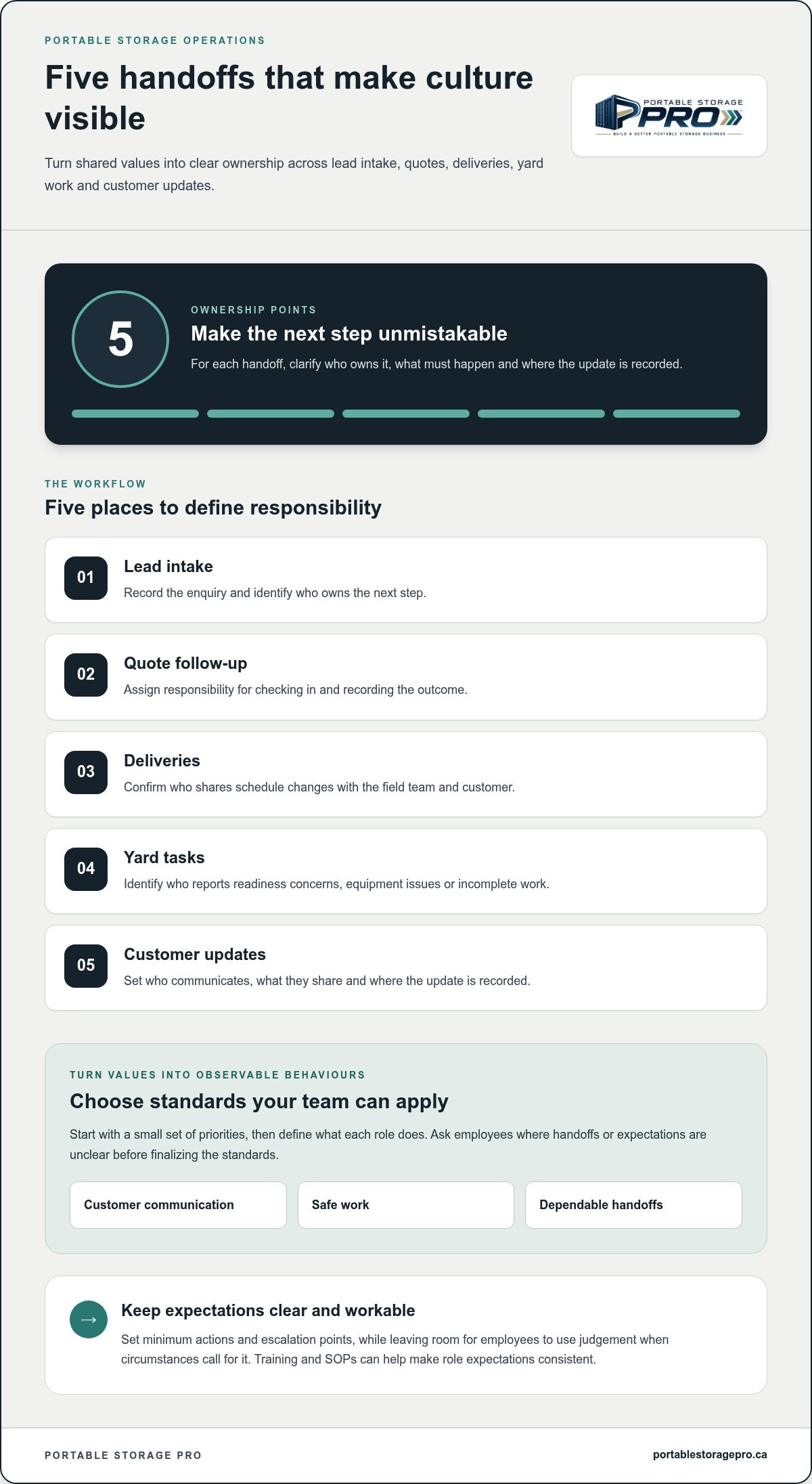
Choose a small set of principles that reflect your priorities, such as customer communication, safe work, and dependable handoffs. Then define behaviours for the roles involved. For example, the person receiving a lead records the customer’s request and next action; the yard team flags a container that isn’t ready; the delivery coordinator passes along a schedule change. Ask employees where handoffs or expectations are unclear before you finalize the standards.
Make responsibility explicit across the workflow:
- Lead intake: Record the enquiry and identify who owns the next step.
- Quote follow-up: Assign responsibility for checking in and recording the outcome.
- Deliveries: Confirm who shares schedule changes with the field team and customer.
- Yard tasks: Identify who reports readiness concerns, equipment issues, or incomplete work.
- Customer updates: Set expectations for who communicates, what they share, and where the update is recorded.
These standards shouldn’t require employees to follow a script when circumstances call for judgement. They should clarify the minimum actions and escalation points, while allowing staff to respond sensibly to the situation in front of them.
Use training and SOPs to make expectations consistent
Onboarding introduces role expectations; practical, role-specific training lets employees apply them to actual tasks. An SOP can document how to record a lead, prepare a container for dispatch, or pass a delivery update between the office and field. Keep instructions easy to find, assign responsibility for reviewing them, and revise them when the process changes or staff identify a gap.
Recognition and accountability support the same standards. Acknowledge employees who communicate an issue early or complete a handoff reliably. If an expectation is missed, address the specific behaviour, explain the operational impact, and agree on the next step. This keeps feedback fair and focused on the work rather than the person. Creating a positive company culture in a storage business means reinforcing good practice while correcting gaps consistently.
Portable Storage Pro’s specialist advisory support can help you work through agreed operating and training priorities while you retain day-to-day responsibility. Discuss your operating and training priorities.
Choose Culture Practices That Fit Your Storage Team
Culture practices should solve a real coordination or people-management need, not add meetings for their own sake. A team with recurring delivery changes may benefit from a short huddle; unclear role expectations may call for individual check-ins or clearer written procedures. Choose based on your team structure and the friction you can observe. Creating a positive company culture in a storage business is less about adopting every practice than selecting routines employees can sustain alongside customer, yard, and field work.
Match the practice to the work
Use a brief team huddle when office, yard, and field staff need to coordinate shared work or resolve immediate schedule conflicts. Keep it focused on decisions and handoffs. Manager-led one-to-one check-ins suit role clarity, workload concerns, and development conversations that need privacy. Written updates are useful when schedules or responsibilities must be recorded for people who aren’t in the same place at the same time.
Onboarding helps new employees learn role expectations and operating procedures. Recognition can reinforce specific behaviours, while SOP reviews help keep instructions aligned with current work. Each practice needs an owner, a clear purpose, and a signal that tells you whether it remains useful.
| Practice | Suitable situation | Owner | Signal to review |
|---|---|---|---|
| Team huddle | Daily delivery or yard coordination requires shared decisions | Operations lead or manager | Unresolved handoffs or repeated schedule questions |
| One-to-one check-in | An employee needs role clarity, workload discussion, or development support | Direct manager | Recurring concerns or unclear priorities |
| Written update | People need a durable record of schedule changes or assigned actions | Person coordinating the work | Missed updates or conflicting task information |
| Onboarding and practice | A new employee needs to learn role-specific tasks | Manager or designated trainer | Training completion and repeated process questions |
| Recognition or SOP review | Useful behaviours need reinforcement, or procedures may no longer match the work | Manager or process owner | Participation, staff feedback, and outdated instructions identified |
Review usefulness without overloading the team
Every routine takes time away from customer service, dispatch, or yard tasks. Keep a huddle short and decision-focused; don’t schedule it if a written update will handle the handoff. Check whether employees can attend, whether actions are followed through, and whether the same questions or unresolved issues keep returning.
Compare these indicators over time and note changes in workload, staffing, or operating conditions. They can show whether a practice is being used and where it needs adjustment. They don’t prove that one initiative caused a change in revenue, retention, or safety outcomes. If you want to align team routines with portable-storage operations, discuss your operating priorities with Portable Storage Pro.
Put a Culture Improvement Plan Into Practice
Culture changes are easier to manage when you treat them as operating improvements. Start with one recurring issue, such as missed quote follow-up or unclear delivery handoffs. Then use a practical sequence: listen to the people doing the work, identify where the process breaks down, choose one behaviour to change, assign an owner, and review the evidence.
Find the culture problem behind an operating symptom
Ask employees where information, decisions, or responsibilities get stuck. Be specific: does a new enquiry wait because nobody owns the next response, or does a delivery change fail to reach the yard in time? Describe what happened and where the handoff failed. Avoid labelling an individual or the whole team as careless or unmotivated.
Then identify the likely cause. A process gap may need a clearer handoff; a training need may call for role-specific practice; a capacity constraint may require a change in workload; unclear management expectations may require the manager to state who decides and communicates. The remedy should match the cause.
Make one change, then check whether it works
For a quote follow-up issue, define who owns each new enquiry, where the next action is recorded, and how the customer receives an update. Set expectations for how staff will handle enquiries, record follow-up, and raise exceptions. Keep the process workable for the people responsible for carrying it out.
Before introducing the change, explain what is changing, who owns each step, and where employees should raise problems. Invite feedback from the people handling enquiries, scheduling deliveries, and preparing containers. If the process creates extra steps without fixing the handoff, revise it rather than asking staff to follow it unchanged.
Choose a small set of observable indicators tied to the issue. For quote follow-up, review whether an owner and next action are recorded, whether enquiries remain without a response, and whether staff keep asking who should follow up. For delivery handoffs, look for missing updates or repeated clarification between office and field roles.
Review the indicators at a cadence that suits the workflow. Consider workload and other operational changes before judging whether the new practice is helping; a change in one measure doesn’t prove the initiative caused it. If the approach is workable, update the relevant training and SOPs so the expectation is available to the whole team.
If you’re working through a culture or operating-practice change, discuss your improvement priorities with Portable Storage Pro.
How Portable Storage Pro Can Support Culture and Operations
Culture goals become more useful when they connect to the work your team needs to do consistently. Portable Storage Pro provides specialist advisory support for independent portable storage and shipping container rental operators, including guidance on operations, staff training, customer experience, and operating processes. This can help you translate a broad aim, such as improving communication, into practical priorities that fit your team and current systems.
Where specialist advisory support may fit
Start with a defined operating challenge. You may need clearer ownership for customer updates, a more consistent handoff between the office and delivery team, or role-specific training for yard procedures. Advisory work can help you examine the process, identify where expectations are unclear, and determine what routine or documentation would make the work easier to follow.
The right approach depends on your team’s size, workload, and capacity. A small operation may need a straightforward responsibility map and a short training routine. A business with several roles involved in the same workflow may need clearer written procedures and a way to keep staff informed when responsibilities change. The aim is to agree on priorities that are practical to carry out, not add systems that the team cannot maintain.
The Consulting Partner model provides expertise, resources, and support while you remain responsible for day-to-day operations. It is a collaborative advisory relationship, not an automatic transfer of operational management. You and your advisers can work through agreed priorities, while decisions and daily direction remain with you as the owner.
Next steps for strengthening your company culture
Choose one point of friction to address first. For example, note where customer requests get lost between lead intake and follow-up, or where delivery information fails to reach the right person. Then identify one observable behaviour to improve, such as recording the next action for every enquiry or confirming a handoff before a delivery is dispatched. This gives your team a defined starting point for creating a positive company culture in a storage business.
Bring the issue, the affected roles, and the change you want to test into a discussion. Portable Storage Pro can help you consider how operations and training priorities fit together, without promising a particular result. Let’s Talk About Your Business.
Build Culture Through Consistent Daily Practice
Creating a positive company culture in a storage business starts with the work your team does every day. Set clear expectations for customer handoffs, delivery coordination, and yard tasks, then reinforce them through practical training, useful procedures, recognition, and fair accountability.
Choose one recurring point of friction and make a focused change. Listen to the employees involved, clarify the behaviour you want to see, assign responsibility, and review whether the new practice fits the workflow. Adjust it based on team feedback and operational evidence rather than assuming one routine will suit every part of the business.
Portable Storage Pro brings portable-storage-specific advisory expertise across operations, training, and customer experience. Through the Consulting Partner model, you receive expertise and support while retaining day-to-day responsibility for your business. Start with the team issue that matters most to your operation, and Let’s Talk About Your Business about practical next steps. Clear expectations and steady follow-through give your team a sound basis for working well together.
Frequently Asked Questions
How do you create a positive company culture in a storage business?
Start by identifying the behaviours your operation needs to work consistently, then make ownership clear for customer enquiries, quote follow-up, deliveries, and yard tasks. Train employees on role expectations, invite feedback about unclear handoffs, and address missed standards fairly. Creating a positive company culture in a storage business is an ongoing management practice, not a one-time announcement. Review how the routines work and adjust them when the team or workload changes.
What does a good company culture look like in a portable storage business?
A good culture is visible in how employees coordinate work and respond to problems. The office shares customer requests with the people planning deliveries; yard staff report readiness or equipment concerns; field employees communicate delays through an agreed process. Employees understand their responsibilities and can raise issues without being dismissed. These behaviours create clearer handoffs and more consistent expectations, while leaving room for sound judgement when a situation doesn’t fit the standard process.
Can a small storage business improve culture without adding formal programmes?
Yes. A small operator can make practical changes through existing work routines. Clarify who owns the next customer update, use a brief check-in to resolve a delivery handoff, or show a new employee how to complete a yard task. Recognize specific actions that meet the standard and discuss missed expectations directly. Choose a change that addresses a real source of friction, then check whether employees can follow it without adding unnecessary steps.
How can storage operators improve communication between office, yard, and delivery teams?
Define what information must pass between roles, who sends it, and where it’s recorded. For a delivery change, for example, identify who updates the schedule, informs the field team, and contacts the customer. Use written updates when people aren’t in the same place or need a record to refer to. Review missed handoffs with the employees involved to find whether the cause was unclear ownership, missing information, or a process that doesn’t fit the workflow.
What role do SOPs play in building a positive workplace culture?
SOPs give employees a shared reference for routine tasks, such as lead intake, container readiness, or delivery handoffs. They help make expectations less dependent on who is working that day. Keep procedures clear, accessible, and aligned with actual practice; train employees to apply them rather than simply distribute documents. An SOP should clarify required steps and when to raise an issue, while still allowing employees to use sound judgement when circumstances differ.
How can a storage business tell whether a culture initiative is working?
Choose indicators that relate directly to the change. For clearer quote follow-up, review whether enquiries have an assigned owner and next action, and whether follow-up is still missed. For delivery communication, track unresolved handoffs and repeated requests for clarification. Ask employees whether the process is workable, and compare observations over time while accounting for workload or staffing changes. These signals help guide adjustments, but alone they don’t prove the initiative caused broader business results.
How should managers address poor performance without undermining team morale?
Address the specific behaviour promptly and respectfully, in a private conversation where appropriate. Explain the expectation, describe what happened, and ask whether unclear instructions, training, workload, or another barrier contributed. Agree on the next step and follow up to confirm the standard is understood. Apply expectations consistently across roles. Recognize improvement when it occurs, but don’t avoid a necessary performance conversation; fair accountability helps employees know where they stand.

Article by
Paul Taylor
Paul Taylor is the founder of Portable Storage Pro, bringing more than 35 years of experience across the container, portable storage and transportation industries. His background spans executive operations, business development, global procurement, sales, marketing and operational improvement in Canada, the UK and international markets.
Paul helps independent portable storage and container rental operators increase revenue, strengthen margins and build more efficient businesses. His work connects strategy with practical implementation, including pricing, delivery operations, supplier sourcing, staff training, technology and customer experience.
His experience includes leading multi-location storage operations and serving on the National Portable Storage Association’s board along with chairing its Canadian committee. Through Portable Storage Pro, Paul shares practical insights to help owners make informed decisions, solve operational challenges and grow profitably.
Disclaimer
Content published by Portable Storage Pro Inc. (PSP) provides general business information and industry insights. It does not replace advice tailored to your business or specialist legal, tax, engineering or other regulated advice. Reading this content or contacting PSP does not, by itself, establish a consulting engagement.
Information reflects circumstances at publication and may change. Examples and potential benefits are illustrative; results depend on individual circumstances, implementation and market conditions and are not guaranteed.
Client services are governed by the signed service agreement, agreed work plan and written amendments. Website and blog content do not amend those terms. PSP’s work is subject to applicable law and the professional commitments set out in its agreement, including the CMC-Canada Code of Professional Conduct and NPSA Code of Conduct and Ethics. Copies are available on request.
Views expressed are PSP’s own. Association membership or references do not imply association endorsement or CMC certification. Nothing in this disclaimer limits PSP’s contractual responsibilities, professional duties or rights that cannot lawfully be excluded.


