
What if the next stage of growth depends less on adding capacity and more on fixing the way your operation works? For a portable storage business, a storage business growth engagement can connect commercial priorities with practical changes across sales, fleet, procurement, delivery and team processes.
You already know that growth competes with daily customer demands. Quotes need follow-up, containers need to be ready and deliveries need to stay coordinated. When sales, operations and purchasing aren’t aligned, it can be hard to see which constraint deserves attention first. And bringing senior expertise in-house may not suit your business’s current needs.
This guide explains how a growth engagement can help you identify the bottlenecks that matter, then link operating improvements to revenue and profitability priorities. You’ll see how Portable Storage Pro’s advisory partnership can bring portable-storage-specific expertise and practical support to agreed priorities, while you remain responsible for day-to-day operations. The aim is a clearer, more manageable path to growth, not a promise of specific results.
Key Takeaways
- Assess growth by checking whether lead volume matches container availability, delivery capacity and the customer experience you can consistently provide.
- A storage business growth engagement can organize support around agreed priorities in areas such as sales, procurement, technology and team training.
- Compare advisory support with internal hiring by considering who owns daily decisions, what expertise is needed and whether the work is ongoing.
- Build a focused agenda by naming the constraint, intended business outcome, accountable owner and measure of progress.
- Portable Storage Pro brings portable-storage-specific consulting to agreed priorities while your team retains responsibility for day-to-day operations.
Why portable storage business growth depends on more than lead volume
Portable storage growth depends on coordinating demand with fleet capacity, delivery capability and the customer experience. More inquiries can create pressure rather than progress if your team can’t quote promptly, reserve suitable containers or complete deliveries as promised. A storage business growth engagement should therefore examine how the operation turns demand into well-served, profitable rental activity, not treat lead volume as the only measure of progress.
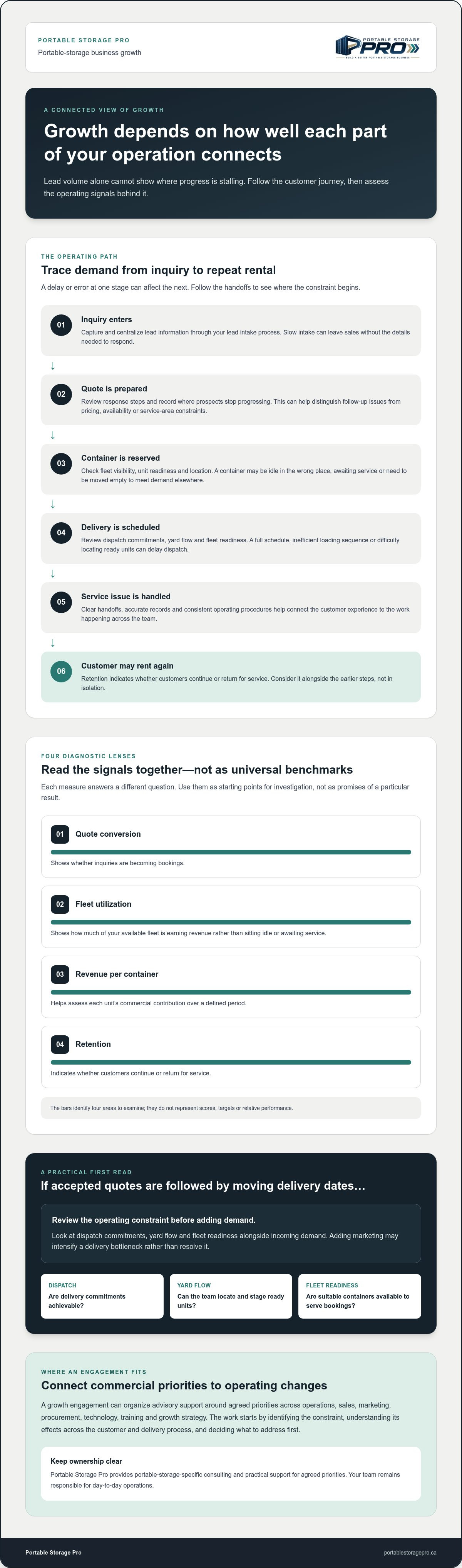
Use four diagnostic lenses, each answering a different question. Quote conversion helps you see whether inquiries are becoming bookings. Fleet utilization shows how much of your available fleet is earning revenue rather than sitting idle or awaiting service. Revenue per container helps you assess the commercial contribution of each unit over a defined period. Retention indicates whether customers continue or return for service. These measures are starting points for investigation, not universal benchmarks or promises of a particular result.
Where growth can stall in a portable storage operation
A lead can lose momentum while waiting for a quote or a clear answer about delivery timing. Reviewing response steps and recording the point where prospects stop progressing can help you distinguish a follow-up issue from a pricing, availability or service-area constraint.
Fleet productivity can also be reduced by containers that are idle in the wrong location, unavailable because they need attention, or moved empty to meet demand elsewhere. Track where containers are, their readiness and the repositioning required to serve bookings. This gives you a more useful view than fleet size alone.
Delivery and yard capacity matter, too. A full schedule, inefficient loading sequence or difficulty locating ready units can delay dispatch even when containers are available. For example, if quotes are being accepted but delivery dates keep moving, adding marketing may intensify the bottleneck. Review dispatch commitments, yard flow and fleet readiness alongside incoming demand. Portable units serve as flexible space; a general overview of the portable building concept provides broader context for this use.
Why a connected view matters more than isolated tactics
Follow one customer’s path: inquiry enters through the lead intake process, a quote is prepared, a container is reserved, delivery is scheduled, service issues are handled and the customer may rent again. A delay or error at one stage affects the next. Slow intake can leave sales without enough information; poor fleet visibility can make a valid quote difficult to fulfil; a delivery problem can weaken the chance of repeat business.
That’s why sales, operations, procurement and technology decisions need to be considered together. Procurement affects which containers are available and when. Operating procedures influence whether the team can prepare and dispatch them consistently. A CRM or scheduling tool is useful only if it supports clear handoffs and accurate records.
A growth engagement is coordinated work on agreed business priorities, connecting commercial aims with the operating changes needed to pursue them. The focus is to identify the constraint, understand its effects across the customer and delivery process, and decide what to address first. This connected view helps you direct attention to practical priorities without assuming every operator needs the same intervention.
What a storage business growth engagement can address
A storage business growth engagement gives you specialist support to assess and work on agreed business priorities. It is a structured advisory relationship, not a guarantee of growth or a transfer of your company’s daily management. The focus may span operations, sales, marketing, procurement, technology, training and growth strategy, depending on what your business needs to address.
For a portable storage operator, those areas connect closely. A sales process affects the information operations needs to schedule work. Procurement decisions affect fleet suitability and readiness. Training and clear operating processes influence whether a team can deliver the customer experience you intend. The purpose is to connect decisions across the business rather than assume one tactic will solve every constraint.
From business priorities to practical operating changes
Start by describing the constraint, not by selecting a solution. If quote follow-up is inconsistent, map how an inquiry is received, assigned and answered. If yard flow is slowing dispatch, review how containers are located, inspected and staged. If fleet readiness is uneven, clarify who records condition and identifies units that need attention. These observations help distinguish the underlying issue from its symptoms.
Once a priority is agreed, define the change in terms the team can apply. That might mean documenting the quote handoff, setting a consistent yard check or clarifying readiness responsibilities. Training and SOPs can help staff follow the agreed process across shifts and roles. Keep the process proportionate: a small team may need a clear checklist and an accountable owner, not an elaborate new system.
How expertise can support decisions across the business
Specialist input can help you weigh decisions against both commercial aims and operating requirements. For procurement, consider the container’s suitability, supplier terms, timing and fleet requirements together, rather than comparing purchase prices in isolation. Direct supplier relationships can also support sourcing without Portable Storage Pro applying supplier markups under its consulting sourcing model.
Technology decisions benefit from the same discipline. A CRM should support the sales follow-up and customer records your team needs. Dispatch or logistics tools should help coordinate assignments and container locations. Billing processes should make it easier to connect completed service with accurate account records. Each tool should address a defined decision or handoff; adding software alone doesn’t resolve unclear ownership or inconsistent procedures.
Industry context can inform planning, but it shouldn’t replace an assessment of your own operation. Mobile Storage Trends and Future Outlook discusses developments in mobile storage, including demand drivers and technology integration. Use such perspectives to shape questions for your business, then ground priorities in your service area, fleet, team and customer requirements.
In a Consulting Partner relationship, you remain responsible for day-to-day operations while receiving expertise, resources and support from Portable Storage Pro. An Operating Partner relationship is distinct; a consulting engagement doesn’t automatically include full operational management. The actual priorities depend on what you and your adviser agree your business needs. To discuss portable-storage-specific support for those priorities, talk with Portable Storage Pro.
Growth engagement or internal hiring: compare the operating fit
Choosing between a storage business growth engagement and an internal hire depends on the work you need done, how sustained that work is and who should own the decisions. An adviser can bring specialist input across several priorities without creating a senior position inside your company. An employee may be a better fit when you need one person to carry a clearly defined responsibility as part of the team over time.
Use this comparison to clarify the operating fit. The right choice depends on your priorities, existing team capacity and preferred management structure.
| Consideration | Advisory partnership | Internal hire |
|---|---|---|
| Expertise access | Can bring specialist perspective to agreed priorities across business functions. | Builds expertise around the role you recruit for; additional needs may sit outside that person’s remit. |
| Daily decisions | You retain day-to-day operational responsibility in a Consulting Partner relationship. | The employee carries decisions assigned to their position, within your management structure. |
| Continuity | Continuity depends on the agreed advisory relationship and how knowledge is documented and shared. | An employee is part of the team, though continuity also depends on retention and succession planning. |
| Internal capacity | Adds access to expertise without establishing an internal senior position. | Requires capacity to recruit, onboard, manage and support an ongoing role. |
When outside expertise may fit the business
Consider advisory support if several priorities need coordinated specialist input, but no single full-time role clearly owns them. It may also fit when managers understand the operation but lack time or relevant experience to work through recurring growth constraints. Ask whether you want outside perspective and implementation support while retaining daily management responsibility. If so, define the decisions your team will own and the support you need.
Clarifying responsibilities before work begins
Agree on the distinction between advice, support with implementation and responsibility for operating a defined area. In a Consulting Partner relationship, owners remain responsible for day-to-day operations while receiving expertise, resources and support from Portable Storage Pro. An Operating Partner relationship is separate and relates to defined operational areas. Don’t assume a consulting engagement transfers management responsibility; make ownership and decision rights explicit.
Internal hiring may suit a role with steady, ongoing responsibilities that require daily presence, direct staff oversight or continuous ownership of a function. Advisory support may suit priorities that cross departments or call for specialist input without adding an internal senior position. Some operators may also find that their needs change over time. Assess the work itself, not just the job title: list recurring responsibilities, decisions, required expertise and available team capacity before choosing an approach.
Prepare a practical growth-engagement agenda for your operation
A useful agenda turns a broad ambition, such as improving profitability or serving more customers, into a specific operating issue the team can examine. For a storage business growth engagement, begin with evidence your business already has. Then agree on the outcome you want to pursue, who will own the work and how you’ll assess progress. This keeps the work grounded in your operation instead of creating a long list of disconnected projects.
Before selecting an improvement, establish a baseline. If records are incomplete, treat that as a finding: agree on what information to capture and how before making claims about change. The initial agenda should fit your team’s capacity. A small operator may make better progress by clarifying one handoff than by starting several process changes at once.
Choose the first priority using operating evidence
Review the information available across inquiries, quotes, delivery, fleet readiness, procurement and retention. Look for repeated friction, then test whether the visible symptom points to the underlying cause. Slow quote responses, for example, may reflect limited capacity, but they may also stem from unclear lead ownership or missing information at intake.
Choose a priority that links a business objective to an observable operating change. Use questions such as:
- Constraint: Where does work stall, repeat or require avoidable follow-up?
- Business outcome: What commercial priority does resolving it support?
- Operating change: What should the team do differently?
- Owner and measure: Who will guide the change, and what evidence will show whether the process is being followed?
Keep the relationship between the measure and the objective clear. If the priority is quote follow-up, completion records can show whether the agreed process is being used. They don’t, by themselves, prove that revenue or conversion improved.
Set measures and ownership for follow-through
Assign a responsible person for each agreed change, even if several employees contribute. That person can keep the process visible, surface obstacles and bring relevant information to review. Choose measures that match the work: quote follow-up completion, units with current readiness records, or idle containers tracked by location. Use a measure your team can collect consistently.
Set a review rhythm that fits the operation and the type of change. A process affecting daily dispatch may need more frequent attention than a procurement practice tied to seasonal planning. Review the baseline and new records together, note gaps in the data, and decide whether to continue, adjust or investigate further. Don’t treat movement in a measure as proof of cause without considering other changes in demand or capacity.
Hypothetical example: An operator finds that some inquiries lack a clear follow-up owner. The agenda could assign ownership at intake, record whether follow-up is completed and review the records at an agreed interval. The example sets out a process to test, not a claim of results.
If you’re defining priorities for your portable storage operation, discuss a growth agenda with Portable Storage Pro.
How Portable Storage Pro supports a growth engagement
Portable Storage Pro works with portable storage and shipping-container rental operators on business improvement priorities specific to the sector. A storage business growth engagement gives you access to senior expertise without requiring you to build a full internal leadership team. The work starts with your business priorities, not a prescribed list of changes or a promise of specific results.
Agreed priorities may involve operations, sales, marketing, procurement, technology, training or growth strategy. The value is in connecting the business decision to the operating work required to put it into practice. If a sales process needs attention, for example, the discussion can consider how lead handling, team responsibilities and customer communication fit together. If fleet readiness is a constraint, the work can focus on the processes and training that support consistent preparation and dispatch.
What the partnership brings to the work
Portable-storage-specific perspective can help you assess an issue in the context of rental operations, rather than treating it as a generic business problem. Together, you can clarify the priority, identify the people and processes involved, and determine what practical change is appropriate for your team. Field support can help turn agreed priorities into operating changes, while your staff remain central to applying those changes in their day-to-day work.
Procurement is one area where commercial and operational considerations meet. Container selection, supplier terms, timing and the needs of your fleet all matter to a sourcing decision. Through the consulting sourcing model, supplier pricing is not marked up by Portable Storage Pro. That distinction supports direct supplier relationships without suggesting that every procurement decision will produce a particular saving.
Support can also connect sales and marketing decisions to operational capacity, or technology choices to the decisions your team needs to make. A tool should serve a defined purpose, such as organizing sales information, supporting logistics coordination or improving billing handoffs. Training and SOPs can help staff follow agreed processes consistently. The appropriate work depends on the constraints and objectives you identify together.
Discuss the priorities that matter to your business
Before discussing possible work, outline the operating constraint you’re seeing and the commercial outcome you want to pursue. Note what evidence you have, which team members are closest to the issue and what decisions you want to retain internally. You might be addressing inconsistent sales follow-up, procurement planning, yard processes or a technology decision. This context helps keep the conversation focused on your operation rather than a standard engagement agenda.
A Consulting Partner relationship provides expertise, resources and support while you retain responsibility for day-to-day operations. It is distinct from an Operating Partner relationship for defined operational areas; a consulting engagement does not automatically include full operational management. Clear priorities and responsibilities give both sides a practical basis for working together.
Document the agreed scope, the decisions your team will make and the information you’ll use to review progress. This gives your staff a clear reference as the work moves from planning into implementation, and helps keep attention on the priorities that matter to your operation.
Set a clear decision point for your next stage
Growth is not a single decision. It is a sequence of choices about where to focus, what your operation can support and what evidence would justify the next step. Before expanding an initiative, decide what you need to learn from it and when you’ll reassess. That gives you a practical way to adjust priorities as customer needs, fleet conditions and team capacity change.
A storage business growth engagement can help you bring structure to those decisions while keeping them grounded in the realities of your rental operation. You don’t need to resolve every constraint at once. Start with the question that most affects your next business decision, then build from what you learn.
Portable Storage Pro works with portable storage and container rental operators to discuss business priorities and practical ways to address them. Talk with Portable Storage Pro about your next growth decision. A focused conversation can help you set a thoughtful direction for the work ahead.
Frequently Asked Questions
What is a growth engagement for a portable storage business?
A growth engagement is specialist support focused on agreed priorities in your portable storage operation. A storage business growth engagement can help you examine a decision such as whether to expand a delivery area, adjust lead handling or improve fleet planning. Before starting work, clarify the business objective, the people involved and what information will guide decisions. The engagement supports your planning and improvement work; it doesn’t guarantee a particular business result.
Is a growth engagement the same as hiring a senior employee?
No. A growth engagement provides access to expertise without creating an internal senior position. Hiring may be a stronger fit if you need someone to own a defined function continuously, manage staff and make routine decisions as part of your organization. Consider whether the need is ongoing daily leadership or specialist input across priorities. Also assess whether your current managers have the time to coordinate the work and carry decisions forward.
Can a growth engagement help improve container utilization?
It can support an assessment of fleet utilization, but it can’t guarantee improvement. Start by agreeing on how you’ll count available units and what period you’ll review. Separate containers earning revenue from those awaiting inspection, repair, delivery or repositioning. Then compare their locations and readiness with booking patterns. This can help you identify whether underused capacity relates to demand, fleet distribution, dispatch planning or another operating constraint.
How do operators measure whether a growth initiative is working?
Choose a process measure and a business measure that match the initiative. For quote follow-up work, you might track whether assigned inquiries receive the agreed follow-up, then review quote conversion over a consistent period. Record a baseline before changing the process. Note other factors, such as shifts in lead sources or fleet availability, so you don’t treat a change in one measure as proof that the initiative caused it.
What happens if a portable storage business has several growth problems at once?
Map how the problems affect one another, then identify which issue is blocking the next decision or creating the greatest operational dependency. For example, a marketing push may be premature if the team can’t reliably confirm container readiness. Choose a first priority, assign ownership and keep the other issues visible for later review. A short, ranked list is easier to act on than several simultaneous projects competing for staff attention.
Does advisory support mean the owner gives up day-to-day control?
No. In a Consulting Partner relationship, you retain responsibility for day-to-day operations while receiving expertise, resources and support from Portable Storage Pro. You continue to make routine management decisions and oversee your team. An Operating Partner relationship is separate and concerns responsibility for defined areas. Clarify decision rights and responsibilities at the outset so your employees understand who directs daily work and who provides advice.
Can procurement support include supplier relationships?
Yes. Procurement support can involve direct supplier relationships and decisions about container suitability, timing, supplier terms and operational requirements. Under the consulting sourcing model, supplier pricing is not marked up by Portable Storage Pro. You can also assess the full landed cost and supplier reliability rather than comparing quoted unit prices alone. The appropriate procurement priorities depend on your fleet plans, service requirements and business objectives.

Article by
Paul Taylor
Paul Taylor is the founder of Portable Storage Pro, bringing more than 35 years of experience across the container, portable storage and transportation industries. His background spans executive operations, business development, global procurement, sales, marketing and operational improvement in Canada, the UK and international markets.
Paul helps independent portable storage and container rental operators increase revenue, strengthen margins and build more efficient businesses. His work connects strategy with practical implementation, including pricing, delivery operations, supplier sourcing, staff training, technology and customer experience.
His experience includes leading multi-location storage operations and serving on the National Portable Storage Association’s board along with chairing its Canadian committee. Through Portable Storage Pro, Paul shares practical insights to help owners make informed decisions, solve operational challenges and grow profitably.
Disclaimer
Content published by Portable Storage Pro Inc. (PSP) provides general business information and industry insights. It does not replace advice tailored to your business or specialist legal, tax, engineering or other regulated advice. Reading this content or contacting PSP does not, by itself, establish a consulting engagement.
Information reflects circumstances at publication and may change. Examples and potential benefits are illustrative; results depend on individual circumstances, implementation and market conditions and are not guaranteed.
Client services are governed by the signed service agreement, agreed work plan and written amendments. Website and blog content do not amend those terms. PSP’s work is subject to applicable law and the professional commitments set out in its agreement, including the CMC-Canada Code of Professional Conduct and NPSA Code of Conduct and Ethics. Copies are available on request.
Views expressed are PSP’s own. Association membership or references do not imply association endorsement or CMC certification. Nothing in this disclaimer limits PSP’s contractual responsibilities, professional duties or rights that cannot lawfully be excluded.


