
The lowest container quote can become the most expensive procurement decision. Freight, handling, delivery timing and supplier support all affect what it takes to put a unit into service. A mismatch with your fleet can create further operational strain.
It’s understandable to start by comparing purchase prices, especially when supplier quotes arrive in different formats. But effective container procurement cost reduction means comparing the full landed cost and operational fit of each offer, not just the number at the top of a quote. A low price offers little value if delivery is unreliable, quality falls short or the unit sits idle.
This guide explains how to compare offers using consistent cost categories, assess supplier reliability and align order quantities with fleet demand and yard capacity. You’ll also learn how a procurement calendar and total cost of ownership analysis can make purchasing decisions more repeatable. The goal is a practical process to protect margins while keeping the right containers ready for revenue-generating work.
Key Takeaways
- Container procurement cost reduction starts with comparing the full landed cost and operational fit, not just the quoted unit price.
- Use consistent cost categories and delivery assumptions to compare offers, then account for usable units received.
- Assess supplier availability, condition, delivery dependability and support alongside landed cost.
- Plan orders around rental history, fleet utilisation, idle inventory and expected demand using a procurement calendar.
- Portable Storage Pro supports procurement reviews and implementation priorities through its Consulting Partner model, while you retain day-to-day management.
Why Container Procurement Cost Reduction Starts Beyond the Quote
Container procurement cost reduction means removing avoidable acquisition burden while preserving the usable fleet capacity your rental operation needs. A quote is a starting point, not a complete comparison. It may show the unit price but leave freight, handling, delivery, inspection or preparation outside the stated amount. Those items can shift work and expense to your team, yard or delivery schedule.
Purchase price is the amount quoted for the container; total cost of ownership analysis considers the acquisition, delivery, readiness and ongoing operating requirements associated with that unit over its useful life. Keep these measures distinct. Landed cost shows what it takes to receive the container at its destination. Readiness and operational fit show whether it can meet your fleet’s needs.
Container specifications also affect fit. The Intermodal Container reference outlines the standardized role containers play in freight transport. For your fleet, consider whether the offered unit’s condition and configuration suit its intended use, your handling process and customer requirements.
What belongs in a container procurement cost review?
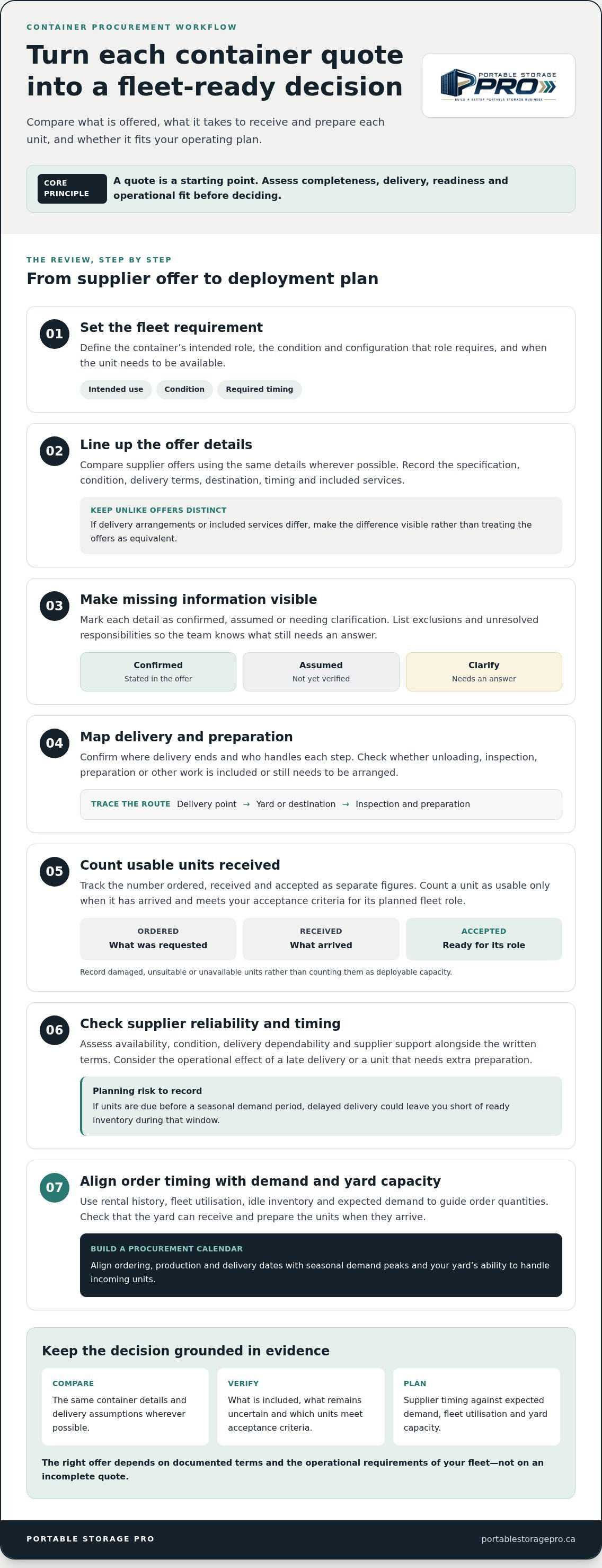
Build a comparison sheet with the same categories for each offer. Mark every entry as confirmed, assumed or requiring clarification. This makes missing information visible before you compare totals or commit to an order.
- Quoted unit price and currency
- Freight, handling and delivery charges
- Inspection and preparation requirements
- Delivery terms, timing and included services
Record whether delivery reaches your yard or another point, and who is responsible for each step. Keep assumptions separate from confirmed charges. If an offer leaves inspection, unloading or preparation unclear, flag it instead of treating it as included. Consistent records help distinguish a real supplier advantage from an incomplete quote.
Why the cheapest quote may not be the best fleet decision
A lower quoted unit price may come with a condition mismatch, uncertain availability, delivery that misses your operating window or limited support if an issue arises. None of these factors automatically makes another offer preferable. Compare them with the unit’s intended role and the capacity you need when it is due.
For example, if you plan to add units before a seasonal demand period, late delivery could leave you short of ready inventory during that window. An unsuitable unit could also require additional inspection or preparation before deployment. Record the operational consequence as a planning risk, not a guaranteed financial loss. This keeps the comparison grounded in what your business can verify.
Assess each offer across price, landed cost, condition, availability, delivery timing and support. Then ask whether the unit will be ready for the work you expect it to perform. Procurement decisions should protect fleet readiness without assuming that a higher-priced offer will provide better service or lower operating expense. The right choice depends on the documented terms and your operational requirements.
How to Calculate Landed Cost and Operational Fit for Each Container
Use one comparison worksheet for every supplier offer, then assess whether each container can be put to work as intended. This makes container procurement cost reduction a repeatable decision process rather than a choice based on an incomplete quote. Enter your actual figures in the worksheet; the method matters more than a generic market example.
Landed cost is the acquisition and delivery expense required to receive a portable storage container at its intended destination. To compare what you paid for usable capacity, calculate:
Landed cost per usable unit = total acquisition and delivery costs ÷ usable units received.
Count a unit as usable only when it has arrived and meets your acceptance criteria for its planned fleet role. If some units are damaged, unsuitable or otherwise unavailable for deployment, dividing by the total ordered quantity can understate the cost per unit you can actually use. Record the number ordered, received and accepted separately.
Normalize supplier quotes before comparing them
First, align offers as closely as possible. Record the container specification and condition, quoted scope, delivery terms, destination, timing and included support. Use the same delivery assumptions for each supplier wherever arrangements are comparable. If they aren’t, show the difference clearly instead of presenting unlike offers as equivalent.
List exclusions and variable charges separately. Mark each line as confirmed, assumed or awaiting clarification, and note who is responsible for resolving it. Don’t insert an estimated value for an unknown item just to complete the comparison. This keeps uncertainty visible and gives decision-makers a clear basis for revising the worksheet when supplier details change.
Add readiness and ownership factors to the comparison
Landed cost shows what it takes to receive the unit, but not whether the container is ready for fleet use. Add inspection, preparation, repair and deployment requirements where relevant. Keep these items distinct from acquisition and delivery so you can see which charges form the landed-cost calculation and which affect readiness or later ownership.
Then assess the unit against your operating records. Use rental history, fleet utilisation, idle inventory and the intended deployment plan to estimate expected use. A container suited to one customer segment or delivery workflow may not fit another. Record assumptions beside the figures, including expected deployment timing and any condition requirements your team applies. If demand, availability or readiness changes, update those assumptions before relying on the comparison.
- Supplier offer: Scope, condition, terms and delivery timing.
- Landed cost: Acquisition and delivery costs divided by usable units received.
- Readiness: Inspection, preparation, repair and deployment requirements.
- Operational fit: Intended use, expected demand and fleet capacity.
Keep a dated copy of each completed worksheet with the related supplier records. When circumstances change, revise the affected assumptions and note why. This creates a practical decision record and makes the next procurement review easier to compare with the last one.
How to Balance Supplier Price, Reliability, and Container Availability
A supplier comparison should show more than which offer has the lowest landed cost. For a rental fleet, the decision also depends on whether suitable units are available when required, arrive in acceptable condition and come with support that fits your operation. Supplier reliability belongs in procurement cost analysis because delivery and quality affect when a container becomes usable fleet capacity.
Use a consistent comparison framework, but keep evidence separate from judgement. A vendor reliability assessment evaluates a supplier’s track record for on-time delivery, quality and compliance. It helps you assess operating risk; it doesn’t guarantee future orders will perform the same way.
- Landed cost: Compare each offer using the same scope and delivery assumptions.
- Availability: Record confirmed quantities and expected availability against your order needs.
- Condition: Note the specified condition and what your inspection finds on receipt.
- Delivery dependability: Compare quoted and actual delivery timing using your records.
- Support: Document how delivery or quality issues are raised and resolved.
Create a vendor reliability assessment from operating records
Build the assessment from purchase orders, delivery records, receiving inspections and issue logs. For each order, record the quoted delivery timing, actual arrival, condition on receipt and how reported issues were handled. Apply the same review period and evidence standard to every supplier. That way, one vendor isn’t judged on detailed records while another is judged on recollection.
Separate documented results from assumptions and informal impressions. If your records are incomplete, mark the performance history as uncertain rather than assigning a favourable or unfavourable conclusion. Review the evidence before a new order and update it after delivery. This gives you a clearer basis for discussing terms and planning alternatives without treating past performance as a guarantee.
Choose order concentration and flexibility deliberately
Ordering through fewer suppliers can simplify coordination and reduce the number of relationships your team manages. But concentration can also leave you more exposed if one supplier, supply route or delivery schedule can’t meet your needs. Don’t assume that combining orders will produce a discount or lower total cost. Compare documented terms and operational trade-offs.
Base the decision on demand variability, required availability and the capacity your yard can receive and hold. If demand is predictable and the order fits your storage and deployment plans, a consolidated purchase may be easier to coordinate. If timing or demand is uncertain, retaining an alternative source may preserve flexibility. That option is useful only if it’s practical for your operation and the supplier can meet the relevant requirements.
For container procurement cost reduction, weigh each supplier’s record against the order’s role and timing. Review the comparison when availability, fleet demand or delivery plans change. The aim isn’t to name one supplier as best in every case; it’s to make a documented choice that fits your operational capacity and preserves access to suitable units.
Build a Procurement Calendar Around Demand and Fleet Utilization
A procurement calendar connects container orders to the fleet capacity you expect to need and the dates suppliers expect to deliver. It turns purchasing from a reaction to low inventory into a planned decision. For container procurement cost reduction, the calendar should help you avoid ordering units that sit idle and flag when usable inventory may not meet forecast demand.
Start with verifiable records: rental history, current bookings, fleet status and supplier updates. Keep forecasts separate from confirmed demand. Label estimates with their assumptions, such as expected bookings or planned business growth, and revise them as those assumptions change.
Forecast container requirements from fleet and rental records
Review your fleet by operational status rather than relying on a single total. Separate available and deployed units from idle, damaged and otherwise unavailable containers. This gives you a clearer view of capacity that can actually serve customers. Compare projected demand with usable inventory, not the number of containers listed in your asset records.
Use rental history to identify demand and utilisation patterns, then compare them with current bookings and planned growth. A forecast is a planning tool, not a commitment. Record its source and assumptions, and update it when bookings change, units become unavailable or planned deployment shifts. This helps you distinguish a potential shortfall supported by current information from one based on an outdated estimate.
Set procurement checkpoints and review measures
Work backwards from the date you expect new units to be ready for operations. Put each decision and handoff on the calendar, including quote review, purchase approval, supplier follow-up, delivery milestones, receipt, inspection and readiness checks. Use supplier updates to adjust the expected arrival date, then record the actual dates the units arrive and become ready for deployment.
- Decision: Record the planned quote review and purchase approval dates.
- Supplier updates: Log confirmed availability and changes to delivery expectations.
- Receipt and readiness: Record arrival, inspection outcome and date available for fleet use.
- Review: Compare planned timing with actual timing and update the next order plan.
Measure landed cost per usable unit and supplier delivery performance using your internal records. Pair those measures with fleet status and rental demand so a purchasing review reflects both what arrived and whether it was available when operations needed it. Don’t treat a forecast date as a verified delivery date.
Revisit the calendar when demand, container availability or supplier conditions change. If you’re adding portable storage or adjusting fleet capacity, connect order timing, supplier updates and operational priorities before committing to a purchasing decision.
Improve Procurement with Portable Storage Pro Support
A comparison is useful when it helps you decide what to do next. Portable Storage Pro provides procurement and sourcing consulting for portable storage and container rental operators. That support can help you organize supplier information around your business needs, identify unresolved questions and set a practical sequence for addressing them.
Start with the decision in front of you. Is the issue an upcoming order, an unclear supplier offer or a change in fleet requirements? Defining the question keeps the review focused on what your team needs to decide, rather than creating analysis that doesn’t inform an action.
Turn the comparison into a practical sourcing plan
Portable Storage Pro’s procurement guidance considers volume, availability, quality, landed cost and supplier support together. The review can use your operating records and priorities to identify which factors matter most for a particular order. If information is incomplete, distinguish what your team knows from what needs follow-up before moving ahead.
Translate the selected priorities into clear actions. For example, your plan might assign someone to gather missing supplier details, document the operational requirements for the order or schedule a review of the received units. Agree on responsibilities and follow-up points so the work can move forward and the decision record remains useful for future planning.
Through the Consulting Partner model, Portable Storage Pro provides advice and implementation support across agreed priorities. Under the consulting sourcing model, supplier pricing is not marked up by Portable Storage Pro. You and your team retain responsibility for day-to-day management of the business. Procurement support can help structure decisions and follow-through, but it doesn’t transfer operational control to the consultant.
When procurement consulting may fit an operator
Consider procurement consulting if you’re weighing an order and need a clearer way to organize supplier information, or if purchasing decisions are difficult to connect to fleet requirements. It may also suit operators reviewing supplier relationships or setting priorities as they add portable storage capacity.
Bring the material that best represents the decision you’re facing. That could include current supplier offers, relevant fleet records or the assumptions behind a planned order. A focused review can help you identify the next questions and actions without promising a particular reduction in acquisition burden or a specific fleet outcome.
Portable Storage Pro’s procurement consulting support can be part of a review focused on your sourcing priorities.
Make Your Next Procurement Decision More Deliberate
Use your next container order to strengthen how your business makes procurement decisions. Keep the comparison process connected to the realities of your fleet, and update it as demand and supplier information change. That discipline gives you a clearer basis for each decision without assuming one approach will fit every order.
Effective container procurement cost reduction isn’t a one-time exercise. It’s an ongoing management practice that helps you make purchasing choices with operational capacity in view. Start with the decision in front of you, identify missing information and set a clear next step for resolving it.
If you’re weighing a supplier offer, planning an order or reviewing how procurement fits your fleet, let’s discuss your container procurement priorities. A focused conversation can help identify which questions deserve attention next.
Frequently Asked Questions
Is the lowest container quote always the lowest-cost procurement option?
No. A low quote may not reflect the work needed to make a container ready for your planned use. Before deciding, check whether the offer matches your acceptance criteria and deployment requirements. After receipt, record any differences between the quoted condition and what your team found. This gives you evidence to improve the next comparison instead of relying on the headline quote or a general impression of supplier value.
How do I compare container supplier quotes with different delivery terms?
Translate each offer into a shared comparison format, but preserve the original terms so you can see what changed. Record the delivery destination, who handles each stage, timing, included services and any conditions that could alter the arrangement. Use separate columns for confirmed information and unresolved items. If offers still differ, compare them as distinct scenarios rather than filling gaps with estimates or treating them as equivalent.
Can consolidating container orders reduce procurement costs?
It can simplify order coordination, but it won’t automatically reduce total procurement costs. Compare a consolidated order with staged purchasing, including whether your yard can receive and hold the full volume and whether the units will be needed at the same time. Consider how much flexibility you would retain if demand changes or a delivery is delayed. Make the choice based on documented terms and operating capacity, not an assumed volume benefit.
What records should a portable storage operator keep for procurement reviews?
Keep the original quote and revisions, purchase order, supplier updates, receiving record and inspection findings together. Note discrepancies, follow-up actions and the final decision rationale. Link these records to fleet status and relevant rental or booking information, so a later review shows what the business expected and what occurred. Consistent records also help distinguish a one-off issue from a pattern that merits closer supplier review.
How can a procurement calendar help container rental operators?
A procurement calendar helps you see whether each order is progressing in time for its intended operational use. Include internal decision points as well as supplier milestones, and mark which dates are confirmed versus forecast. Set review triggers that fit your business, such as a change in bookings, a unit becoming unavailable or a supplier revising an update. This lets you reassess the plan before a capacity gap becomes harder to address.
Which measures help show whether container procurement is improving?
Track landed cost per usable unit alongside delivery timing, condition at receipt and the time between arrival and fleet readiness. Review fleet utilisation and idle inventory after deployment to see whether purchases fit actual demand. Compare results across similar container specifications and order conditions, and keep the review period consistent. No single measure explains performance; together, these indicators help identify where procurement decisions or assumptions may need adjustment.

Article by
Paul Taylor
Paul Taylor is the founder of Portable Storage Pro, bringing more than 35 years of experience across the container, portable storage and transportation industries. His background spans executive operations, business development, global procurement, sales, marketing and operational improvement in Canada, the UK and international markets.
Paul helps independent portable storage and container rental operators increase revenue, strengthen margins and build more efficient businesses. His work connects strategy with practical implementation, including pricing, delivery operations, supplier sourcing, staff training, technology and customer experience.
His experience includes leading multi-location storage operations and serving on the National Portable Storage Association’s board along with chairing its Canadian committee. Through Portable Storage Pro, Paul shares practical insights to help owners make informed decisions, solve operational challenges and grow profitably.
Disclaimer
Content published by Portable Storage Pro Inc. (PSP) provides general business information and industry insights. It does not replace advice tailored to your business or specialist legal, tax, engineering or other regulated advice. Reading this content or contacting PSP does not, by itself, establish a consulting engagement.
Information reflects circumstances at publication and may change. Examples and potential benefits are illustrative; results depend on individual circumstances, implementation and market conditions and are not guaranteed.
Client services are governed by the signed service agreement, agreed work plan and written amendments. Website and blog content do not amend those terms. PSP’s work is subject to applicable law and the professional commitments set out in its agreement, including the CMC-Canada Code of Professional Conduct and NPSA Code of Conduct and Ethics. Copies are available on request.
Views expressed are PSP’s own. Association membership or references do not imply association endorsement or CMC certification. Nothing in this disclaimer limits PSP’s contractual responsibilities, professional duties or rights that cannot lawfully be excluded.


