
What if the supplier connection you need isn’t the one with the broadest catalogue, but the one that best fits your fleet, delivery model and growth plans? For an independent portable storage operator, storage industry supply chain access can surface options that are difficult to find through routine purchasing channels. An introduction alone, however, doesn’t establish supplier fit, reliability or support. You still need to assess whether an option meets your operating requirements.
Limited supplier visibility can complicate decisions about containers, equipment and technology, especially when procurement competes with day-to-day demands. Useful access helps you make those decisions with greater clarity. It doesn’t replace your judgement or guarantee an outcome.
This guide explains how to assess supply chain access routes and turn an introduction into a sourcing decision. Portable Storage Pro supports operators across Canada and the United States through direct supplier relationships and global supply chain connections, including international conference representation. Under the consulting sourcing model, supplier pricing is not marked up by Portable Storage Pro. The focus is connecting relevant options to your priorities and determining what merits further evaluation.
Key Takeaways
- Use storage industry supply chain access to find relevant connections, then assess each against your operating needs.
- Map the path from sourcing requirements to delivery coordination and day-to-day use before pursuing an option.
- Compare access routes by the information and support they can provide, noting what remains unknown.
- Prepare specifications, receiving arrangements and internal ownership before supplier discussions.
- Record next steps after introductions so sourcing decisions stay connected to operational priorities.
What storage industry supply chain access means for portable storage operators
Storage industry supply chain access means having relevant supplier and industry connections that you can assess and act on. For a portable storage operator, those connections can help you explore container or equipment sourcing options, understand available support and coordinate the hand-offs needed to bring products into operation.
A connection is a starting point for due diligence, not a completed procurement decision. Establish whether an option fits your specifications, timing, quality expectations and receiving arrangements. The Supply Chain Management Overview describes how connected activities move products from suppliers towards end users. Your task is to determine whether a particular relationship supports your operation.
Which supply chain relationships matter to an operator?
Relevant relationships may include container and equipment suppliers, freight contacts and logistics providers involved in moving products through supply chain hand-offs. These are potential sourcing routes, not a fixed supplier roster. Their value depends on your requirements and the information or support they can provide.
A container supplier discussion, for example, can clarify specifications and availability information. Freight and logistics contacts can help explain how a product moves between stages, including port logistics: coordination involving drayage, storage and customs activities. Consider these hand-offs alongside the product itself.
Support after an introduction matters too. You may need clear information about product specifications, availability, delivery coordination or how questions will be handled as sourcing progresses. Define what you need from a relationship before treating it as operationally useful.
What access does not guarantee
An introduction doesn’t confirm that a product is suitable, available when needed, consistent with your quality expectations or supported over time. It gives you an opportunity to ask focused questions and assess the answers. A connection is not a confirmed supply arrangement, and a supply arrangement alone does not establish an operational result.
Supply chain access can open a supplier conversation, but it cannot guarantee supplier availability, fit or results.
Global reach is not, by itself, a selection criterion. A supplier with international connections may still be a poor fit if its specifications, timing, logistics hand-offs or support don’t align with your operation. A broader view helps only when it improves the quality of your decision.
Assess each relationship against a specific operating need. Record what is established, what remains uncertain and who will follow up. This helps distinguish a promising contact from an option ready for further evaluation.
How supply chain access connects sourcing to container operations
A sourcing decision only works when the product can move from supplier discussion into your operation. Connect the requirement to clear specifications, an understood delivery path, receiving arrangements and the team responsible for putting the equipment to use. Supply chain access is most useful when each part of that path has an owner.
Start with the intended use. A container or equipment requirement should reflect how the item will be deployed, where it will be received and what your team needs to do before it enters service. This gives supplier discussions a practical frame. Instead of comparing general descriptions, you can assess the information against your fleet and workflow requirements.
From supplier connection to a usable sourcing decision
Before speaking with a supplier, write down the intended use, required specifications and deployment needs. During the discussion, compare the information provided with those requirements. Treat an introduction as a route to information, not as a recommendation or decision. Afterward, record what was established, what remains open, who owns each follow-up and the next decision point.
A short decision record helps prevent an unresolved detail from being mistaken for an agreed requirement. If you’re sourcing equipment for a particular operating role, for example, note which specifications are confirmed and which need clarification. Assign one person to consolidate responses so your team works from a consistent record rather than scattered messages.
Where port logistics and delivery hand-offs fit
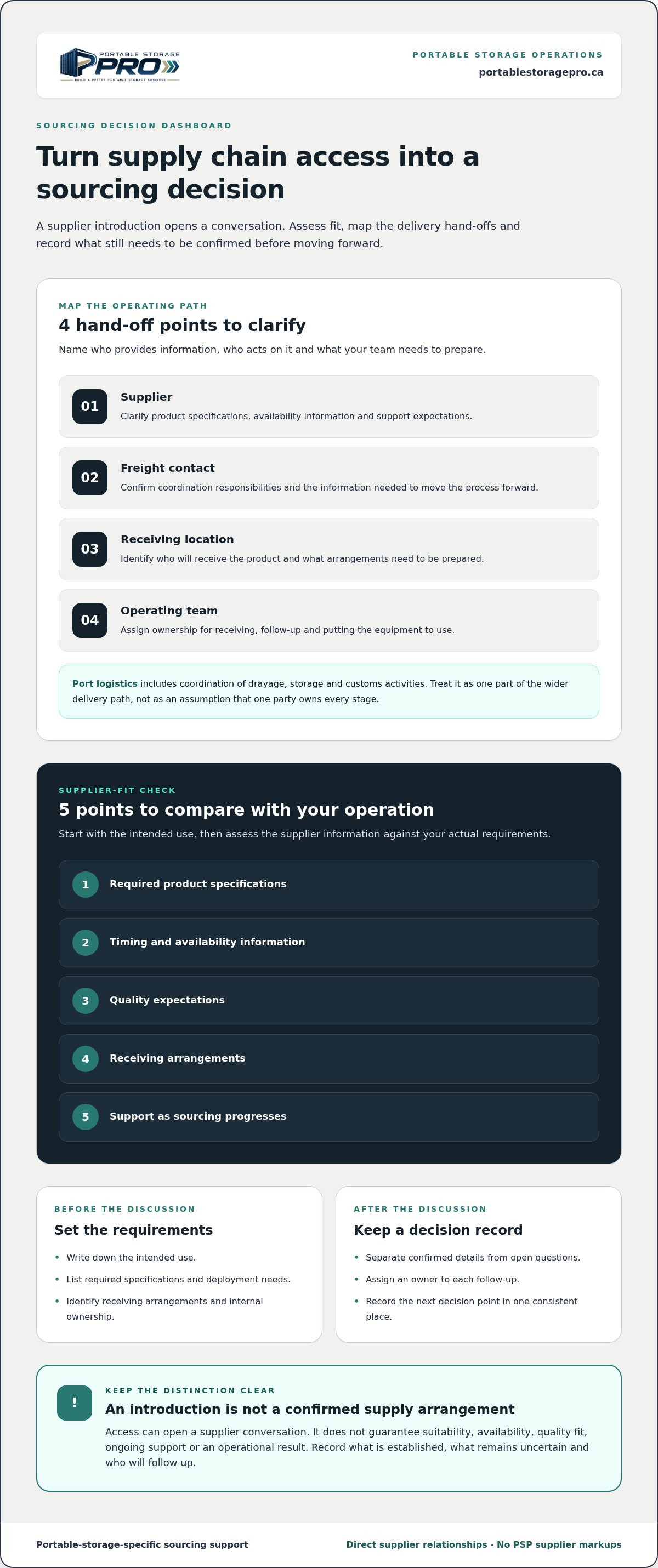
Port logistics is one part of the wider delivery path, alongside coordination between a supplier, freight contact, receiving location and operating team. Map those hand-offs early without assuming one participant owns every stage. Clarify who will share the information needed at each step and who will act on it within your operation.
For each hand-off, identify the information needed, who provides it and who acts on it. This makes gaps visible before they affect receiving plans or equipment readiness. Name the parties and record the status of each step as it becomes clear.
Use a simple hand-off record to track:
- Supplier: Product specifications, availability information and support expectations.
- Freight contact: Coordination responsibilities and information needed to move the process forward.
- Receiving location: Who will receive the product and what arrangements your operating team needs to prepare.
- Internal owner: Who tracks open questions, communicates changes and confirms readiness for operational use.
A sourcing decision must account for downstream hand-offs, because a suitable product still needs a coordinated path into service. Unclear ownership can leave scheduling, receiving or preparation unresolved even when supplier discussions are progressing. Keep responsibilities visible as the work moves forward.
How to assess supply chain access routes and supplier fit
Choose a sourcing route by the work it needs to do, not by how broad its network appears. A direct supplier relationship may help clarify product details; an industry introduction may bring another option into view; a logistics contact may explain movement and receiving dependencies. No route is universally best. Your specifications, availability needs, quality expectations and support requirements determine which one is useful.
A practical supplier-fit decision table
Use this matrix to organize what each route can help you learn. Record unknowns as open questions, not assumptions. A vendor reliability assessment means reviewing a supplier’s track record for delivery, quality and compliance. Base your assessment on available evidence, and distinguish confirmed information from unresolved items.
Access route: Direct supplier relationship
Intended use: Discuss a product or equipment requirement with its supplier.
Information to gather: Specification alignment, availability information, quality expectations and support provided.
Operational dependency: Delivery coordination and your receiving team’s readiness.
Access route: Industry introduction
Intended use: Broaden discovery and identify a potential sourcing option.
Information to gather: Who supplies the product, what they can clarify and which requirements remain open.
Operational dependency: Your team must complete the evaluation and coordinate next steps.
Access route: Logistics contact or intermediary
Intended use: Understand movement, coordination or another defined role in the sourcing path.
Information to gather: Responsibilities, information passed between parties and support involved.
Operational dependency: Clear hand-offs between the contact, supplier, receiving location and operator.
Assess each route against four practical questions: Does the information match your specifications? Is availability clear enough for planning? Can you evaluate quality against your expectations? Does the support suit how your business operates? Mark unanswered points as open. This keeps an incomplete conversation from being treated as confirmation.
Direct relationships, introductions and intermediaries
Direct supplier relationships give you a channel for discussing requirements, but they don’t automatically produce better terms or a better fit. Industry introductions can broaden your view of possible suppliers, while leaving the assessment with you. An intermediary may help coordinate communication or movement. Establish what that role covers and who remains responsible for each decision.
Supplier fit means alignment between your requirements, delivery needs and support expectations. A product may match your stated specification while the receiving plan or support process remains unresolved. Assess these as separate points, then decide whether the gaps are acceptable or need follow-up.
Use a short decision record for each option: requirement, available information, open question, responsible person and next action. This gives you a consistent basis for comparing alternatives and deciding which conversation merits further work.
A repeatable process for preparing and acting on supply chain access
A consistent workflow turns a useful connection into an informed sourcing decision. Keep it proportionate to your team: one brief, one person responsible for follow-up and a shared record of what’s known and what needs work. The aim is to keep requirements, supplier information and operational responsibilities aligned, not to add paperwork.
- Define the need. State the operational priority the sourcing work should address.
- Prepare requirements. Record specifications, intended use, deployment needs and receiving arrangements.
- Identify access routes. Select the relevant supplier, industry or logistics contacts for the questions you need answered.
- Assess fit. Compare responses with your requirements and note gaps without treating them as confirmed.
- Document follow-up. Assign each open question and next action to an internal owner.
Prepare before approaching suppliers
Write a short brief explaining the equipment need, intended use and how it will enter your operation. Include delivery coordination and support expectations so they’re part of the discussion from the start. Separate firm requirements from preferences that may change as you learn more. This helps you compare responses consistently while allowing for reasonable flexibility.
Use this checklist to prepare:
- Specifications: What product or equipment requirements must be met?
- Intended use: How will it fit into your portable storage operation?
- Receiving arrangements: Who will coordinate receipt and prepare the location?
- Support expectations: What information or assistance will your team need?
- Internal ownership: Who will assess responses and coordinate follow-up?
Turn supplier conversations into accountable follow-up
After each discussion, capture the contact, information provided, unresolved questions and agreed next steps. Assign one person to maintain the record, even if other staff provide operational input. Before making a sourcing decision, compare the information received with the original brief. This shows where a response meets a requirement, needs clarification or prompts a review of the requirement itself.
Mark each item as confirmed, unresolved or under review. For unresolved points, record the next action and its owner. The person managing procurement might gather a response while an operations lead assesses whether the receiving plan is workable. A smaller team can use a shared document; a larger team may need a defined hand-off in its existing workflow. The process matters more than the tool.
Keep the original requirement, the information used to assess it and any assigned follow-up together. This gives your team a practical reference if priorities shift or the sourcing decision needs to be revisited.
How Portable Storage Pro supports supply chain access through consulting
Portable Storage Pro supports independent portable storage and shipping container rental operators with consulting, sourcing, training and implementation support. In a sourcing engagement, the work can connect a business priority to a defined decision: what your operation needs, what information is missing and who will carry the work forward. Supplier introductions are one input to that work, not an outcome in themselves.
Portable Storage Pro provides global supply chain access and industry representation, including representation at international conferences. These connections can inform sourcing work and bring relevant discussions into view. Direct supplier relationships are part of the sourcing support. Under the consulting sourcing model, supplier pricing is not marked up by Portable Storage Pro.
What a Consulting Partner relationship contributes
A Consulting Partner relationship provides expertise and support across agreed priorities while you retain day-to-day management of your business. You remain responsible for operating decisions, assigning internal owners and deciding which sourcing options suit your operation. Consulting support can help organize the work, connect supplier discussions to your requirements and maintain attention on follow-through.
If a procurement priority also affects staff readiness or receiving procedures, account for those needs rather than treating sourcing as an isolated task. Training and implementation support can help you consider how a decision moves into practice. Your team provides the operating context and carries out its responsibilities. The aim is a clearer path from priority to decision and action, not a prescribed outcome.
Consulting support can help you:
- Clarify the business priority and the decision it requires.
- Organize supplier information around agreed requirements.
- Identify related operational considerations for your team.
- Assign follow-up and implementation responsibilities internally.
- Review the decision as new information affects the original priority.
This structure keeps you involved and makes responsibilities visible. It also leaves room to adjust the work if supplier information, business priorities or internal capacity change. Connections and introductions remain inputs to your assessment; they don’t confirm availability, suitability or commercial results.
When to discuss supply chain access with Portable Storage Pro
Consider a conversation when a sourcing priority involves related decisions, supplier discussions need to connect with operational planning, or your team needs a clearer route from agreed priorities to implementation. Bring the requirement, business context and unresolved questions. This gives the discussion a practical focus and distinguishes sourcing work from the day-to-day decisions your team owns.
Portable Storage Pro supports operators across Canada and the United States. To discuss how consulting and sourcing support could relate to your procurement priorities, discuss your supply chain priorities.
Put your next sourcing priority into motion
Choose one sourcing priority and give it a clear owner. Set out what the operation needs, what decision is pending and what information would help you move forward. This keeps storage industry supply chain access connected to a business decision rather than a list of contacts without a next step.
As supplier discussions progress, assess whether each option meets your requirements and fits the way your operation works. Adjust the plan as new information emerges, while retaining responsibility for the final decision and its implementation.
If you’re ready to take a more structured approach to procurement, discuss your supply chain priorities with Portable Storage Pro. A focused conversation can help you consider where consulting and sourcing support fit your current priorities.
Frequently Asked Questions
What does supply chain access mean for a portable storage operator?
For a portable storage operator, supply chain access is the ability to identify and engage relevant supplier and industry connections. It gives you a route to gather information, not a completed procurement decision. Compare each response with your requirements for specifications, availability, delivery arrangements and support. For example, record whether a supplier has described a feature and whether your team has confirmed it meets the intended operating use.
Can smaller portable storage operators build direct supplier relationships?
Yes. You can develop direct supplier relationships by documenting your needs, pursuing relevant introductions and following up consistently. Start with a specific sourcing priority rather than trying to maintain a large contact network. Record discussions and open questions so you can refer to them when a need arises. Choose a follow-up process that fits your team’s capacity and the importance of the decision.
Does global supply chain access guarantee better supplier availability?
No. Global supply chain access doesn’t guarantee availability, timing, specification fit or support. It broadens the opportunity to explore relevant sources, but each response still needs to be assessed against your operating requirements. A contact may provide useful product information while leaving delivery questions unanswered. Treat those gaps as unresolved and base your next step on the information available.
What should an operator prepare before speaking with a potential supplier?
Prepare a short brief covering intended use, required specifications, receiving arrangements, delivery coordination and support expectations. Separate firm requirements from preferences that could change as you learn more. List unanswered questions, such as which details need clarification or who will coordinate an operational hand-off. This preparation gives you a consistent basis for reviewing responses, but it doesn’t ensure availability or a particular sourcing outcome.
How can an operator compare supplier information when specifications differ?
Record each supplier’s stated specifications separately, then identify differences before comparing responses. Distinguish confirmed details from missing or unclear information, and assess each option against its intended use and your operating requirements. If descriptions use different terms or omit a detail, flag it for clarification rather than treating the offers as equivalent. This helps you avoid assumptions about quality, availability or suitability.
What is port logistics in the container supply chain?
Port logistics is the coordination of drayage, storage and customs activities required to move containers from a ship to a local yard. For your sourcing plan, identify the hand-offs between the supplier, freight contacts, receiving location and operating team. Clarify who passes along relevant information and prepares for receipt. Keep the process specific to your plan without assuming a standard timeline or arrangement.

Article by
Paul Taylor
Paul Taylor is the founder of Portable Storage Pro, bringing more than 35 years of experience across the container, portable storage and transportation industries. His background spans executive operations, business development, global procurement, sales, marketing and operational improvement in Canada, the UK and international markets.
Paul helps independent portable storage and container rental operators increase revenue, strengthen margins and build more efficient businesses. His work connects strategy with practical implementation, including pricing, delivery operations, supplier sourcing, staff training, technology and customer experience.
His experience includes leading multi-location storage operations and serving on the National Portable Storage Association’s board along with chairing its Canadian committee. Through Portable Storage Pro, Paul shares practical insights to help owners make informed decisions, solve operational challenges and grow profitably.
Disclaimer
Content published by Portable Storage Pro Inc. (PSP) provides general business information and industry insights. It does not replace advice tailored to your business or specialist legal, tax, engineering or other regulated advice. Reading this content or contacting PSP does not, by itself, establish a consulting engagement.
Information reflects circumstances at publication and may change. Examples and potential benefits are illustrative; results depend on individual circumstances, implementation and market conditions and are not guaranteed.
Client services are governed by the signed service agreement, agreed work plan and written amendments. Website and blog content do not amend those terms. PSP’s work is subject to applicable law and the professional commitments set out in its agreement, including the CMC-Canada Code of Professional Conduct and NPSA Code of Conduct and Ethics. Copies are available on request.
Views expressed are PSP’s own. Association membership or references do not imply association endorsement or CMC certification. Nothing in this disclaimer limits PSP’s contractual responsibilities, professional duties or rights that cannot lawfully be excluded.


