
A negative review can put an operator on the defensive, especially when the post leaves out context or describes a service failure your team sees differently. In portable storage, the customer experience can span several handoffs, and a complaint about one point may prompt questions about how the business communicates overall. That makes responding to negative reviews for a container company part of reputation management, not simply a task to clear from a review page. Your reply should reflect care and sound judgement, even when you still need to understand the full situation.
This guide offers a practical way to approach that work. It explains how to assess a complaint, choose a suitable response, and keep public wording professional. It also looks beyond the individual exchange to how owners can make review handling a useful part of staff communication and business improvement. The aim is to give you a steady process that fits the realities of container rental operations and helps your team respond with purpose.
Key Takeaways
- Use a calm public reply to acknowledge the concern, show care and signal a next step without disclosing private details.
- Before responding, match the complaint to quote, scheduling, delivery, collection and customer-communication records.
- Choose whether to reply publicly, continue privately or do both based on the issue’s sensitivity and what still needs investigation.
- For responding to negative reviews for a container company, use a specific reply structure that addresses the concern without blame or defensive explanations.
- Log review themes consistently to spot repeat problems and direct improvements in quote follow-up, dispatch communication or staff training.
Why negative reviews matter to a portable storage company
When a customer posts a negative review, your first public response should acknowledge the concern, show that you take the reported experience seriously, and indicate a sensible next step. That reply speaks to the reviewer, but it also gives future customers evidence of how your team handles a service problem. A calm, specific answer can demonstrate attention without making claims you haven’t yet checked.
A constructive review response is a brief, professional acknowledgement of the customer’s reported experience that signals care and provides a clear route to follow up. Its purpose is not to settle every disputed detail in public. It is to show that feedback has been received and that the business is prepared to understand the issue and respond appropriately. That distinction is central to responding to negative reviews for a container company.
What customers may be reacting to in a container rental experience
A review may describe a missed delivery window, unclear quote communication, concerns about equipment condition, or a lack of follow-up after collection. Each points to a different part of the customer journey. A delivery complaint may involve scheduling or updates; a quote complaint may relate to what was explained before the booking. The review is a useful signal, not a complete service record.
Don’t assume the post captures the full history, or that either the customer or your staff acted with poor intent. A reviewer may describe events from their perspective, while dispatch notes or messages may add context. A specific complaint, such as “the container arrived later than expected,” gives you something concrete to examine. A broad opinion, such as “the service was terrible,” still deserves a respectful acknowledgement, even if it doesn’t identify a particular failure.
Acknowledging a reported experience is not the same as accepting every allegation as fact. You can recognize frustration with the delay, for example, without confirming a cause before checking the schedule and communications. This measured approach reflects sound customer service principles: treat the concern seriously, while keeping your response grounded in what you know.
What a public response can and cannot accomplish
A well-judged public reply shows that feedback hasn’t been ignored and offers a route to continue the conversation. It can reassure prospective customers that your business takes concerns seriously, even when the underlying issue still needs review. Keep the message specific enough to sound attentive, but focused on the next step rather than a detailed defence.
A public response cannot verify disputed details, replace an internal investigation, or resolve every service issue on the spot. Avoid posting booking details, addresses, contact information, payment matters, or employee information. Even if a reviewer has shared personal details publicly, don’t repeat or confirm them. Invite the customer to continue through an appropriate private channel, where your team can examine the relevant records and discuss the matter with discretion.
The operational value goes beyond the reply. If reviews repeatedly mention quote clarity, delivery updates, equipment condition, or collection follow-up, those themes can point to processes worth examining. Treat each review as an individual account first, then look for patterns across feedback before deciding whether a change to communication or staff procedures is warranted.
How to investigate a negative review before replying
Before drafting a detailed public answer, establish what the available records support. A quick, ordered review helps you avoid confusing one customer’s account with the full service timeline, or making a claim you can’t substantiate. Verification should come before any detailed public claim.
Use a consistent workflow:
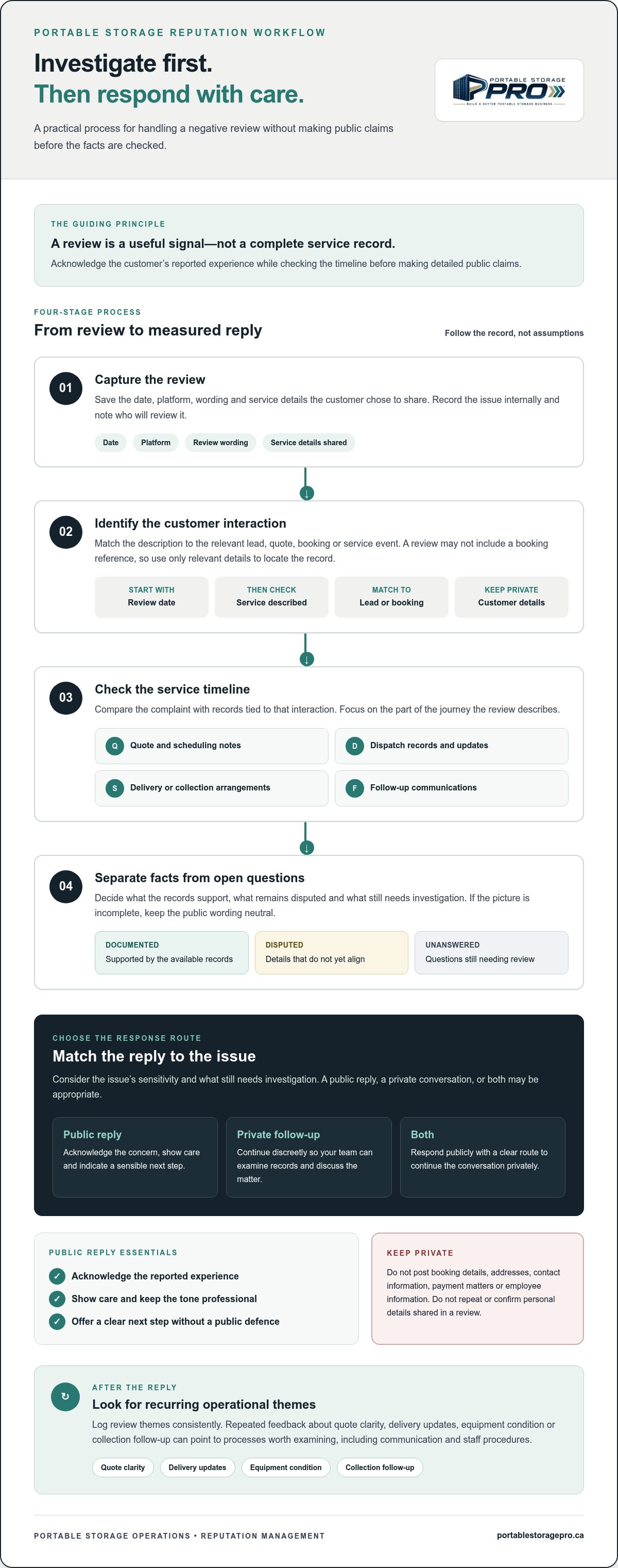
- Capture the review. Save its date, platform, wording and any service details the customer chose to share. Keep an internal record of the issue and who will review it.
- Identify the interaction. Match the description to a lead, quote, booking or service event. A customer may not include a booking reference, so use only relevant details to locate the record.
- Check the timeline. Review the quote, scheduling notes, dispatch records, delivery or collection updates, and follow-up communications that relate to the complaint.
- Choose a response based on what you know. Separate documented facts from disputed details and unanswered questions. If the picture is incomplete, keep the public reply neutral and invite private follow-up.
Match the review to the right customer interaction
Start with the review date, the service described and any reference the customer voluntarily included. Then check the relevant lead, booking, dispatch and follow-up records. For a concern about a delivery commitment, compare the quote and scheduling notes with dispatch updates. For a collection concern, look for the recorded arrangements and subsequent customer communications.
Limit access to personal information to staff who need it to investigate. Use customer details to identify the right interaction internally, but don’t reproduce names, addresses, booking information or private messages in the public reply. The purpose of matching records is to understand the service sequence, not to expose the customer’s file.
Decide what the evidence supports
Compare the review with documented commitments and the timeline. If a staff member handled the interaction, ask for their account and any supporting notes. Treat recollection as context to check, not as proof on its own. Records may confirm part of the complaint while leaving another point unresolved.
Keep a simple internal distinction between three categories:
- Verified: supported by a quote, dispatch entry, message or other relevant record.
- Disputed: described differently by the customer and the available records or staff account.
- Unknown: not established by the information you can access.
This distinction makes responding to negative reviews for a container company more precise. You can acknowledge the concern without presenting a disputed detail as settled fact. If the records don’t establish what happened, say you’re looking into the matter and offer a private way to continue. Don’t speculate about intent or assign blame in public.
If the review process exposes a need to strengthen dispatch communication or staff procedures, portable storage operations and training support can help you turn those findings into clearer internal practices.
How to choose the right response to a negative review
Choose a response by deciding what the public needs to know and what your team still needs to handle internally. A general service concern may call for a concise public acknowledgement. A complaint that depends on account history, several staff handoffs or a contested timeline needs more work outside the review thread. The right approach also depends on whether the issue is resolved, still under review or pointing to a process your team needs to examine.
When to reply publicly, privately, or both
Think in terms of purpose. A public reply can demonstrate that your business has taken notice; private communication can support account-specific follow-through. If the matter is straightforward and your response requires no personal details, keep it brief and public. If the next step involves reviewing records or coordinating staff, use the public message to indicate that follow-up is underway, then continue the substantive discussion privately.
| Complaint type | Information sensitivity | Suitable next action |
|---|---|---|
| General dissatisfaction with service | Low, provided no booking specifics are needed | Post a concise acknowledgement and note that the feedback will be reviewed. |
| Concern involving a particular delivery or collection | Moderate, because the response may depend on service records | Use a brief public reply, then follow up privately to discuss the individual service. |
| Issue involving account details or personal information | High | Keep details and troubleshooting in a private conversation. |
| Feedback that raises a wider operational question | Varies, depending on the details involved | Respond to the reviewer appropriately and assign an internal review of the process. |
How to handle disputed, vague, or potentially abusive reviews
For a disputed account, avoid using the review thread to prove your version of events. A neutral statement that you want to understand the situation leaves room for further review without making an accusation. If the feedback is too vague to identify the service, request enough information through a private channel to locate the relevant interaction.
Keep platform enforcement separate from customer-service follow-up. If a post appears to breach a platform’s rules, read the current policy and reporting instructions before acting. A negative opinion or disagreement about what happened isn’t, on its own, a reason to report a review. Don’t argue publicly, disclose records or promise a result your team hasn’t approved.
Set a clear internal owner for any follow-up so the public response doesn’t become the only action taken. If you want to review how feedback handling fits into your wider operating practices, discuss your portable storage business with Portable Storage Pro.
A practical workflow for writing and following up on the reply
A useful reply should sound like it belongs to your business, not a generic script. Keep it brief, match its wording to the complaint, and make sure a named team member takes responsibility for any action after posting. That turns a public response into a tracked customer-service task rather than a message with no clear next step.
A response structure operators can adapt
Use four parts as a drafting aid. Tailor each one to the confirmed circumstances, and remove anything that doesn’t help the customer understand what happens next.
- Acknowledge: Recognize the customer’s concern without repeating identifying details.
- Address: Name the service issue only when that description is supported by your internal review.
- State the next step: Explain what your team will do, such as reviewing the matter or arranging a follow-up.
- Invite contact: Give the customer a suitable private route to continue the conversation.
Before posting, read the reply from the customer’s perspective. Does it address the point they raised, or does it shift into defending the company? Remove explanations about internal workload, blame directed at an employee, and any assurance the team hasn’t approved. A concise, accurate message is more useful than a detailed account of events that belong in a private discussion.
Example replies for common portable storage complaints
These examples are starting points. Adapt them to the complaint and your team’s confirmed next step.
- Delivery coordination: “Thank you for sharing your concern. We understand the coordination affected your plans. Please contact our team privately so we can review the service details with you.”
- Missed update: “Thank you for letting us know you were expecting an update. We’d like to review the communication and follow up. Please reach our team through a private channel.”
- Equipment condition: “We appreciate you raising this concern. Please share the inspection details privately so our team can assess the matter and determine an appropriate next step.”
Assign one person to own the follow-up, even if another team member posts the public reply. Record the assigned owner, the action agreed with the customer, and whether that action is complete. If the customer doesn’t respond, note that too; don’t imply the matter was resolved when no resolution has been confirmed.
After the exchange, review whether your reply was clear and whether the follow-up process worked as intended. If you want to strengthen the procedures behind customer communication, discuss your portable storage business with Portable Storage Pro.
Turn recurring negative reviews into better portable storage operations
A review log can help you tell an isolated service failure from a theme that warrants operational attention. Treat each review as an individual account, then compare it with other feedback and relevant records over time. A small number of complaints can point to a question worth investigating, but it isn’t proof of a widespread failure or a reliable performance benchmark.
Keep the log consistent so you can compare like with like. Record the review date, service stage, operational theme, customer’s description, verified facts, response owner and follow-up status. Avoid storing unnecessary personal details. Separating what the customer reported from what your records confirm helps the team identify patterns without treating an allegation as established fact.
Categorize feedback without treating anecdotes as benchmarks
Use categories that reflect your operation, such as scheduling, quote communication, delivery updates, equipment condition, collection and service recovery. Keep the categories stable over time. If one review touches several stages, record a primary theme and, where useful, a secondary one rather than changing the classification to fit the story.
Review the log at a regular management meeting or another routine business review. Look for related comments across different interactions, and check them against available records. A single complaint may be isolated; repeated comments about the same handoff may justify a closer process review. Don’t claim statistical significance from a small set of reviews or assume that public feedback represents every customer’s experience.
Connect review themes to operating changes
Once a theme is supported by enough context to investigate, define a practical corrective action. Link the action to the process where the issue may originate, rather than treating the reply itself as the fix.
- Quote or follow-up communication: Review how inquiries are acknowledged and how service details are carried forward into booking. Clarify who owns the next customer update.
- Dispatch and scheduling: Examine handoffs between the person confirming the service and the team coordinating the delivery or collection. Check whether changes are recorded and communicated through the established process.
- Staff practice: If the issue points to inconsistent handling, update the relevant SOPs and use training to clarify the expected steps. Keep the guidance specific to the task, such as documenting a schedule change or recording a customer update.
For each action, name an owner, document what will change and set a review date. At that review, check whether the action was completed and whether similar feedback or related operational records show the issue recurring. If the signal remains unclear, continue monitoring rather than claiming the change solved the problem. This turns responding to negative reviews for a container company into a feedback loop: record, assess, act and review.
If review themes point to wider questions about customer communication, staff training or operating processes, discuss your portable storage business with Portable Storage Pro.
Make customer feedback part of your operating rhythm
A review response can be the start of a better process, not the last step in a difficult exchange. Decide who will track feedback, when your team will review recurring themes, and how an operational change will be checked. That gives you a practical way to connect responding to negative reviews for a container company with ongoing business improvement.
Portable Storage Pro supports portable storage operators with consulting, training and implementation support. Through the Consulting Partner model, you receive expertise while retaining responsibility for day-to-day management. The focus stays on helping your team strengthen customer communication and the operating practices behind it.
Choose one feedback theme to review with your team and identify a clear next action. Let’s talk about how your business handles customer feedback.
Frequently Asked Questions
Should a container company respond to every negative review?
Review each negative review through a consistent process, then decide whether a public reply is appropriate. A response can acknowledge the concern and offer a next step, but it shouldn’t repeat personal information or details you haven’t verified. For example, a general comment about unclear service communication may warrant a brief acknowledgement, while an account-specific concern needs private follow-up. If you suspect a policy violation, check the platform’s current rules before reporting it.
How quickly should a company reply to a negative review?
Reply as soon as your team can provide an accurate, considered acknowledgement. Set up a routine for monitoring review channels and routing new feedback to someone who can check the relevant service records. You can acknowledge the concern while that review continues, without offering an explanation prematurely. Don’t promise a resolution date unless the responsible team has confirmed the details and can meet that commitment.
What should a container company say in response to a bad review?
Keep the reply brief, professional and focused on the concern the customer described. For example, if a review mentions a missed collection update, acknowledge the communication concern without guessing why the update was missed. Say that you want to understand the issue, then provide a private way to discuss account details. Avoid blame, defensive language, customer information and promises that haven’t been approved.
Should a company reply to a review it believes is false?
Check the customer, quote, dispatch, delivery and communication records before deciding what you can say. If you can’t verify the account, don’t accuse the reviewer or publish disputed details as fact. A neutral reply can invite the person to identify the service privately. If the content may breach platform rules, review its current reporting process separately from investigating the service issue.
Can a company ask a customer to remove a negative review?
Focus first on understanding the complaint and addressing any service issue through an appropriate channel. Don’t make help or resolution conditional on changing a review. If the customer later chooses to update their feedback, that choice should remain theirs. Follow the platform’s current policies and avoid incentives or pressure that could undermine the credibility of the review process.
How can a portable storage company learn from negative reviews?
Use reviews as prompts for operational questions, not as a standalone performance measure. For example, if feedback mentions quote follow-up, compare the comments with your lead records and the steps staff are expected to take after sending a quote. Keep reported feedback distinct from verified findings, assign a person to any corrective action and check later whether similar concerns recur. This makes responding to negative reviews for a container company part of an ongoing improvement process.

Article by
Paul Taylor
Paul Taylor is the founder of Portable Storage Pro, bringing more than 35 years of experience across the container, portable storage and transportation industries. His background spans executive operations, business development, global procurement, sales, marketing and operational improvement in Canada, the UK and international markets.
Paul helps independent portable storage and container rental operators increase revenue, strengthen margins and build more efficient businesses. His work connects strategy with practical implementation, including pricing, delivery operations, supplier sourcing, staff training, technology and customer experience.
His experience includes leading multi-location storage operations and serving on the National Portable Storage Association’s board along with chairing its Canadian committee. Through Portable Storage Pro, Paul shares practical insights to help owners make informed decisions, solve operational challenges and grow profitably.
Disclaimer
Content published by Portable Storage Pro Inc. (PSP) provides general business information and industry insights. It does not replace advice tailored to your business or specialist legal, tax, engineering or other regulated advice. Reading this content or contacting PSP does not, by itself, establish a consulting engagement.
Information reflects circumstances at publication and may change. Examples and potential benefits are illustrative; results depend on individual circumstances, implementation and market conditions and are not guaranteed.
Client services are governed by the signed service agreement, agreed work plan and written amendments. Website and blog content do not amend those terms. PSP’s work is subject to applicable law and the professional commitments set out in its agreement, including the CMC-Canada Code of Professional Conduct and NPSA Code of Conduct and Ethics. Copies are available on request.
Views expressed are PSP’s own. Association membership or references do not imply association endorsement or CMC certification. Nothing in this disclaimer limits PSP’s contractual responsibilities, professional duties or rights that cannot lawfully be excluded.


