

What happens when a container is dispatched differently on every shift? A missed readiness check, unclear handoff or inconsistent customer update can turn routine work into avoidable rework. Storage business standard operating procedures help replace employee-by-employee habits with clear, repeatable workflows.
You already know that experienced staff keep a portable storage operation moving. The challenge is making their knowledge easy to transfer, so service and safety don’t depend on who happens to be working. This guide shows you how to identify the workflows worth documenting first and create instructions employees can follow and managers can review.
We’ll focus on the work that shapes daily performance: yard checks, fleet readiness, dispatch and delivery coordination, and customer communication. You’ll also see how to assign ownership, train staff on each procedure, review whether it’s being followed, and update instructions when operations change. The aim isn’t to document every task or add paperwork for its own sake. It’s to make recurring work clearer, safer and more consistent, with procedures sized to your team and the way your business operates.
Key Takeaways
- Choose recurring workflows where inconsistent execution creates operational risk or weakens customer communication.
- Map each process before drafting instructions, including handoffs, exceptions and decision points.
- Use a simple priority method to decide which storage business standard operating procedures to create first.
- Make each procedure practical to follow, then test it with staff and revise it before training the team.
- Assign an owner to keep procedures accurate as workflows, equipment and software change.
Why portable storage businesses need practical standard operating procedures
An SOP is a written, step-by-step reference for completing a recurring business process. It describes the actions staff take, the responsibilities involved and the expected result. A policy sets a rule or boundary; a general guideline offers direction. An SOP makes routine work specific enough to carry out and review.
Portable storage operations depend on coordinated work across the yard, dispatch, drivers and customer-facing roles. If each employee relies on informal knowledge, the same task can be handled differently by person or shift. One employee may treat a unit as ready based on its location, while another expects a readiness update in the dispatch record. A shared procedure clarifies what information matters and who is responsible for communicating it.
That consistency supports more than task completion. It gives a new employee a reference for learning how the business handles recurring work, helps an experienced employee check an unfamiliar situation and gives a manager a common basis for reviewing performance. It can also make customer communication more dependable: staff can follow a shared approach to recording a quote inquiry, noting its status and passing relevant details to a colleague.
These are practical reasons to develop storage business standard operating procedures for the work that recurs in your operation. The general purpose of a Standard Operating Procedure (SOP) is to document an established process. For a portable storage business, its usefulness depends on whether the instructions reflect actual responsibilities, equipment and customer interactions.
Where inconsistent procedures create operational friction
Undocumented handoffs leave room for different assumptions. Yard staff may expect dispatch to check unit status, while dispatch may expect the yard to send an update. A driver could then receive incomplete information, and the customer may need another status update after plans change. Repeated checks or corrections can affect fleet readiness and divert attention from other work.
Look at the process before assigning blame. If the same information is missed across shifts, the underlying issue may be unclear ownership, an inconsistent record or a communication gap, rather than one employee’s performance. Identifying that distinction helps managers address the cause instead of asking staff to compensate for a process that leaves key responsibilities open to interpretation.
What an SOP should and should not do
An SOP should serve as a practical reference, not a substitute for sound judgement. It can state the normal approach and identify when staff should pause and seek direction, while leaving room for employees to recognize conditions that need escalation. A procedure that attempts to script every possible situation can become difficult to follow and may give staff false confidence when circumstances fall outside its scope.
Use written instructions to support training, then pair them with supervised practice appropriate to the task. Reading about a yard or dispatch procedure doesn’t demonstrate that someone can carry it out safely. Safety and compliance instructions also need review for the jurisdictions where the business operates. Requirements differ between Canada and the United States, so procedures should reflect the applicable rules rather than rely on a generic template.
Map a portable storage workflow before writing its SOP
Start by documenting the work as it happens. Process mapping records how work currently moves before you propose changes. That gives you a grounded view of each role, handoff, information need and decision point. It also helps prevent a draft SOP from describing an ideal process that staff can’t follow in the yard.
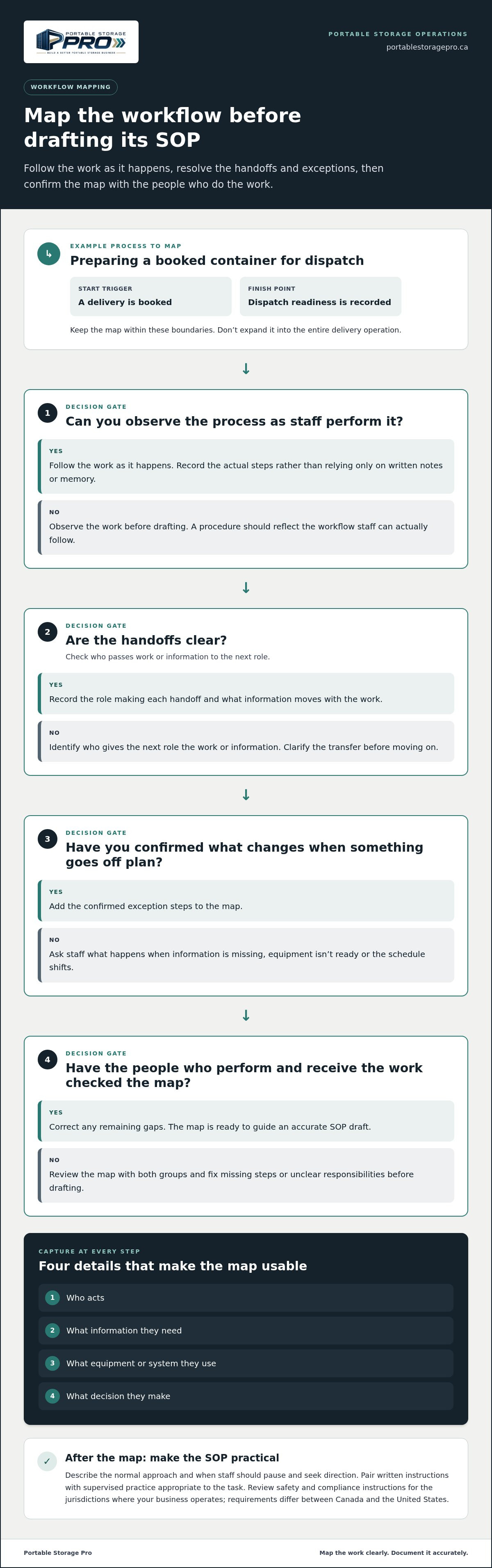
Use a short sequence to map one recurring workflow:
- Select one process. Choose a task with a clear trigger and finish, such as preparing a booked container for dispatch.
- Observe the work. Follow the process as staff perform it, rather than relying only on written notes or memory.
- Map the handoffs. Record which role passes work or information to the next role.
- Confirm exceptions. Ask what changes when information is missing, equipment isn’t ready or the schedule shifts.
- Validate the map. Review it with the people who perform and receive the work, then correct gaps before drafting instructions.
For dispatch preparation, keep the map bounded: begin with the trigger that a delivery is booked and end when the unit’s dispatch readiness is recorded. At each step, note who acts, what information they need, what equipment or system they use, and what decision they make. Don’t expand the map into the entire delivery operation. The goal is to understand this one process well enough to document it accurately.
Writing Effective Standard Operating Procedures from Penn State Extension also emphasizes the practical role of SOPs in training, communication and consistent work. Those aims start with a map that reflects the actual flow of information and responsibilities.
Choose a recurring workflow with a clear start and finish
Use a trigger staff can recognize: a booked delivery, a returned unit or a new customer inquiry. Then define completion in observable terms, such as dispatch readiness being recorded or a customer update being entered. Keep the first map narrow enough for the relevant team to review together. This makes it easier to verify details before building the wider set of storage business standard operating procedures.
Capture handoffs, decision points and exceptions
For each handoff, name the receiving role and the information that must travel with the task. Mark decisions such as whether the unit is ready, whether a schedule change affects dispatch, or whether missing customer details prevent the next step. Separate routine actions from exceptions. Routine steps belong in the main flow; exceptions should identify when to pause and which manager or designated role should decide what happens next.
Before treating the map as final, walk through it with the staff involved. Ask them to point out skipped steps, unclear ownership and situations the map doesn’t cover. If you want support turning that workflow into practical training and procedures, portable storage SOPs and operations support can be part of the conversation.
Prioritize portable storage SOPs by operational value
You don’t need to document every task at once. Compare candidate procedures by how often the work occurs, what can happen if it fails, how many handoffs it involves and how easily you can observe it. These criteria give managers a consistent basis for deciding which storage business standard operating procedures to draft first, without assuming that every operator has the same priorities.
Use the questions below to assess each workflow. They are prompts for local review, not scores or a universal ranking.
- Dispatch preparation: How often are units prepared for dispatch? What operational consequences could follow if readiness information is missing or incorrect? Which roles exchange information, and can a manager observe the process from preparation to readiness confirmation?
- Returned-unit inspection: How regularly do units return to the yard? What decisions depend on an accurate inspection record? Who receives the inspection findings before the unit is assigned again, and can staff demonstrate how findings are recorded?
- Quote follow-up: How often do new inquiries need follow-up? What could happen if key details or a customer update are missed? How many roles handle the inquiry, and can you trace it through the business records?
Answer each question using your actual workload, customer commitments, staffing and operating arrangements. A process that looks simple on paper may involve several handoffs in practice. A less frequent task may still deserve attention if an error could create serious operational or safety consequences. Priority depends on your circumstances, not on a fixed industry-wide order.
Compare procedures by repetition, risk and handoffs
Ask whether the task recurs, what could go wrong, how many roles exchange information and whether staff can show you the work from start to finish. Frequent handoffs make clear ownership and complete information especially useful. For safety-sensitive or compliance-related procedures, include appropriate expert review and account for the jurisdiction where the work takes place before treating instructions as ready for use.
Start with a manageable SOP set
Begin with a small group of recurring processes your team can review and maintain. Select candidates using the questions above, then draft and validate those procedures before expanding the set. If staff can’t follow an initial SOP during normal work, revise it before documenting more tasks. Keep the scope proportionate to your team’s size, available time and operational complexity, rather than creating a manual that becomes difficult to maintain.
Revisit priorities as operations change. New staffing arrangements, equipment, customer communication methods or workflows can alter which procedures need attention. The aim is a usable set of instructions focused on the processes that matter to your operation, not a fixed catalogue of every task.
Write, test, and train staff on standard operating procedures
A procedure becomes useful when it can guide real work, not just describe it. An SOP is usable only when staff can follow its steps and test them against the task it’s meant to control. For portable storage standard operating procedures, that means writing for the people handling yard, dispatch, fleet and customer work, then checking the instructions in the setting where they’ll be used.
Use a controlled sequence to move from process map to active procedure:
- Assign an owner. Give one person responsibility for drafting and coordinating review with the staff involved.
- Draft the instructions. Capture the process in the order it occurs, including decision points and records.
- Test with users. Have a staff member follow the draft while the owner observes.
- Revise and train. Resolve gaps, then teach the updated steps to the people who perform the work.
- Record approval. Identify the approved version and keep a record of its approval and training.
Each procedure should tell the reader why it exists, which process and people it covers, and who performs or oversees the work. State the required inputs, then give action-led steps from the trigger through completion. Include decision points, escalation instructions and the records staff must create or update. This helps an employee understand not only what to do, but how to leave the next person with the information needed to continue.
Prefer clear verbs and observable actions. “Confirm the unit’s readiness status in the dispatch record” is easier to apply and verify than “make sure everything is ready.” Explain technical terms the intended user may not know. Add a checklist or diagram only if it clarifies a decision, sequence or handoff; extra formatting can obscure rather than simplify the work.
Draft instructions staff can follow during real work
Keep each step short enough to scan while completing the task, and name the responsible role without relying on informal assumptions. Identify the required record by its purpose, such as documenting an inspection or customer update, rather than assuming every reader knows where information belongs. If a step depends on a decision, state what happens for each relevant outcome.
Test procedures with the people who perform the work
Ask a staff member to use the draft while the procedure owner observes without filling in missing instructions. Note ambiguous wording, omitted steps, unnecessary duplication and exceptions the draft doesn’t address. Revise the procedure, then train the wider team using the approved version. Training should include explanation and supervised practice where appropriate, not just distribution of a document. Record who was trained and which version was covered so managers can track whether instruction is current.
Portable Storage Pro helps operators with SOPs, training and implementation while owners retain day-to-day management. Discuss SOP development and staff training for your portable storage operation.
Maintain SOP ownership and connect procedures to operating reviews
A procedure needs an owner after approval. Assign a process owner who is responsible for keeping the instructions accurate, gathering staff feedback and coordinating controlled revisions. The owner doesn’t have to perform every task in the procedure. Their role is to ensure the documented process still reflects how the business expects the work to be done.
Set clear review triggers rather than relying on memory. Revisit a procedure when:
- A workflow or role changes, such as a new dispatch handoff.
- Recurring errors, rework or missed updates suggest the steps may not be clear or workable.
- Equipment or software changes affect how staff complete or record a task.
- Employees report an exception the current instructions don’t address.
You can also set a planned review point that suits the process and your operating rhythm. A safety-sensitive or compliance-related SOP may need a different review approach from a routine customer follow-up procedure. Keep the review proportionate, but don’t wait for a scheduled check if a change could make an instruction inaccurate or unsafe.
Keep versions and changes easy to follow
Make the current approved procedure easy for the relevant staff to find where they do the work. Each document should show its owner, approval status, revision date and a short summary of what changed. Use a consistent file name or document-control method so staff can distinguish the active version from a draft. Remove superseded copies from routine use, while retaining records according to company policy.
When a revision affects how a task is performed, identify who needs to know and whether they need updated instruction. Keep a record of that communication or training alongside the version information. This gives managers a practical way to see whether staff are using current instructions, without assuming that a document in a folder is being followed.
Use operational feedback to decide what needs attention
Bring procedure use into relevant operating reviews. For example, recurring dispatch rework, missed handoffs or exceptions in returned-unit inspections can prompt a closer look at the related process. Treat these as signals to investigate, not proof that an SOP is the cause. Separate a training gap from unclear wording, a resourcing constraint or a limitation in the system staff use to record work.
Ask what happened, where the process diverged and what information or decision was missing. Then decide whether to clarify the procedure, provide further training, address a system issue or assign a different action. Documentation supports review; it doesn’t improve operations by itself. The value comes from checking how the procedure works in practice and acting on what the review shows.
Portable Storage Pro’s Consulting Partner model offers advisory and implementation support while you retain responsibility for day-to-day management. If you’re deciding which storage business standard operating procedures to maintain or revise, discuss your SOP priorities with Portable Storage Pro.
Make your next SOP a working tool
The next step is to choose one recurring process and make its instructions part of how your team works, not just a document filed away. As that procedure is tested and maintained, it can give staff and managers a shared reference for improving the work over time. That steady discipline is what makes storage business standard operating procedures useful as your operation changes.
Portable Storage Pro provides portable-storage-specific consulting, training and implementation support. Paul Taylor brings more than 35 years of experience across containers, transportation, procurement and operations to that work. You remain responsible for day-to-day management while building procedures that fit your business.
Discuss SOP priorities for your portable storage business and identify a practical next step for your team. A clear process starts with a focused conversation and grows through consistent use.
Frequently Asked Questions
Are standard operating procedures legally required for portable storage businesses?
There isn’t one answer that applies to every portable storage operator. Requirements depend on the jurisdiction and the activity involved, particularly for safety-sensitive work. Treat an SOP as a way to communicate and apply your operating practices, not as proof that you meet every applicable requirement. Have safety and compliance procedures reviewed against the rules that apply where your business operates, and update them when those requirements change.
What is the difference between an SOP and a company policy?
A policy establishes a company rule or boundary; an SOP explains how staff carry out a process within that boundary. For example, a policy might state that customer commitments require authorized approval. The related procedure could explain how an employee records a request, identifies whether approval is needed and communicates the approved response. Keep the policy focused on what the business permits, and make the procedure specific enough to guide the work.
Can one SOP work across different yards, teams, and service areas?
It can, if the process and controls are genuinely the same. A shared procedure may set common expectations for unit identification or dispatch records, while a controlled local addendum covers differences in yard layout, equipment or assigned responsibilities. Don’t force one set of steps onto locations that work differently. For storage business standard operating procedures, identify which instructions are common and which need a defined local variation.
What should staff do when a customer request falls outside an SOP?
Staff should avoid making a commitment the procedure doesn’t authorize. They can record the request, explain that they need to confirm the appropriate response, and refer it to the designated decision-maker. The record should capture the customer’s question, who received it and what response was provided. If similar requests recur, the process owner can assess whether the procedure needs a new decision path or clearer limits.
Should employees be allowed to suggest changes to an SOP?
Yes. Employees often notice where an instruction conflicts with the work or leaves a decision unclear. Give staff a straightforward way to submit suggestions, including the step in question and a specific example. Keep suggestions separate from approved instructions: only the designated owner should coordinate review and authorize revisions. This lets the team contribute useful operational knowledge without creating competing versions or informal changes to the process.
Do SOPs need photos or diagrams to be useful?
No. Use visuals when they make a task easier to understand than words alone. A yard diagram may clarify where units are staged or how a handoff moves between work areas; a photo may help identify a particular inspection point. Label visuals clearly and update them when the layout or equipment changes. If a visual adds no clarity, direct steps and a simple record may be easier to maintain.

Article by
Paul Taylor
Paul Taylor is the founder of Portable Storage Pro, bringing more than 35 years of experience across the container, portable storage and transportation industries. His background spans executive operations, business development, global procurement, sales, marketing and operational improvement in Canada, the UK and international markets.
Paul helps independent portable storage and container rental operators increase revenue, strengthen margins and build more efficient businesses. His work connects strategy with practical implementation, including pricing, delivery operations, supplier sourcing, staff training, technology and customer experience.
His experience includes leading multi-location storage operations and serving on the National Portable Storage Association’s board along with chairing its Canadian committee. Through Portable Storage Pro, Paul shares practical insights to help owners make informed decisions, solve operational challenges and grow profitably.
Disclaimer
Content published by Portable Storage Pro Inc. (PSP) provides general business information and industry insights. It does not replace advice tailored to your business or specialist legal, tax, engineering or other regulated advice. Reading this content or contacting PSP does not, by itself, establish a consulting engagement.
Information reflects circumstances at publication and may change. Examples and potential benefits are illustrative; results depend on individual circumstances, implementation and market conditions and are not guaranteed.
Client services are governed by the signed service agreement, agreed work plan and written amendments. Website and blog content do not amend those terms. PSP’s work is subject to applicable law and the professional commitments set out in its agreement, including the CMC-Canada Code of Professional Conduct and NPSA Code of Conduct and Ethics. Copies are available on request.
Views expressed are PSP’s own. Association membership or references do not imply association endorsement or CMC certification. Nothing in this disclaimer limits PSP’s contractual responsibilities, professional duties or rights that cannot lawfully be excluded.


