
A commercial add-on earns consideration when it makes a client’s operation easier to manage, not simply because it can be added to a quote. Upselling strategies for commercial storage clients give your team a way to connect service recommendations to the work the client needs to get done, while checking that the offer makes sense for your operation.
For owners and managers, the challenge is balancing a consistent sales approach with the different requirements of each commercial account. A service that supports one project may be irrelevant to another. If staff lack a clear basis for recommending it, conversations can feel arbitrary, expectations can drift, and extra fulfilment work may outweigh the value of the sale.
A disciplined approach starts by treating each recommendation as an operating decision. This article explains how to identify a genuine fit, compare the client benefit with delivery requirements, and assess contribution using your own figures. It also shows how to give sales and operations a shared process, so the client receives a clear explanation and your team has a practical next step after the decision.
Key Takeaways
- Use upselling strategies for commercial storage clients to address a documented operating need, not to meet an automatic sales target.
- Capture each client’s use case, site constraints, decision criteria, and unresolved concerns before recommending an add-on.
- Compare service options by client benefit, fulfilment requirements, contribution, and who owns delivery.
- Give sales and operations staff consistent notes and clear handoff responsibilities so agreed services are delivered as described.
- Review a manageable group of commercial accounts to spot relevant opportunities and track revenue alongside operational impact.
Why upselling commercial storage clients starts with their operating need
Commercial upselling should begin with a requirement, not a sales quota. For a portable storage operator, an upsell is a relevant added service or service level that addresses a client’s stated need. Cross-selling offers a related but different product or service. Both should make sense for the account; neither belongs in every quote by default. The general distinction is outlined in Upselling techniques and definitions.
The right recommendation depends on the work taking place, the site, the stored contents, and the conditions the container will face. A construction project may have different access and organization requirements than a restoration job. A commercial client storing materials between work phases may have different visibility needs than one holding business records. A blanket promotion ignores these differences and can add work without improving the client’s operation.
Which commercial storage needs can prompt an add-on conversation?
Start with the client’s use case, then explore distinct needs rather than bundling every option into one pitch:
- Packing and organization: Ask whether the client needs packing kits or a way to keep stored items organized and accessible.
- Contents protection: Ask what is being stored and what protection the client expects. Contents insurance may be relevant, but it does not prevent damage, and the coverage depends on the applicable terms.
- Visibility: Ask whether the client needs information about a container’s location or conditions. Monitoring can provide information, but it does not itself control temperature or humidity, or guarantee that contents remain secure.
Use questions that connect the offer to the operating context: What needs to be stored? How long will it remain in the container? Where will the container sit, and what conditions could affect access or the contents? What would make the arrangement easier to manage? These questions help you distinguish a genuine service gap from a feature the client doesn’t need.
How to recognize a client-fit recommendation
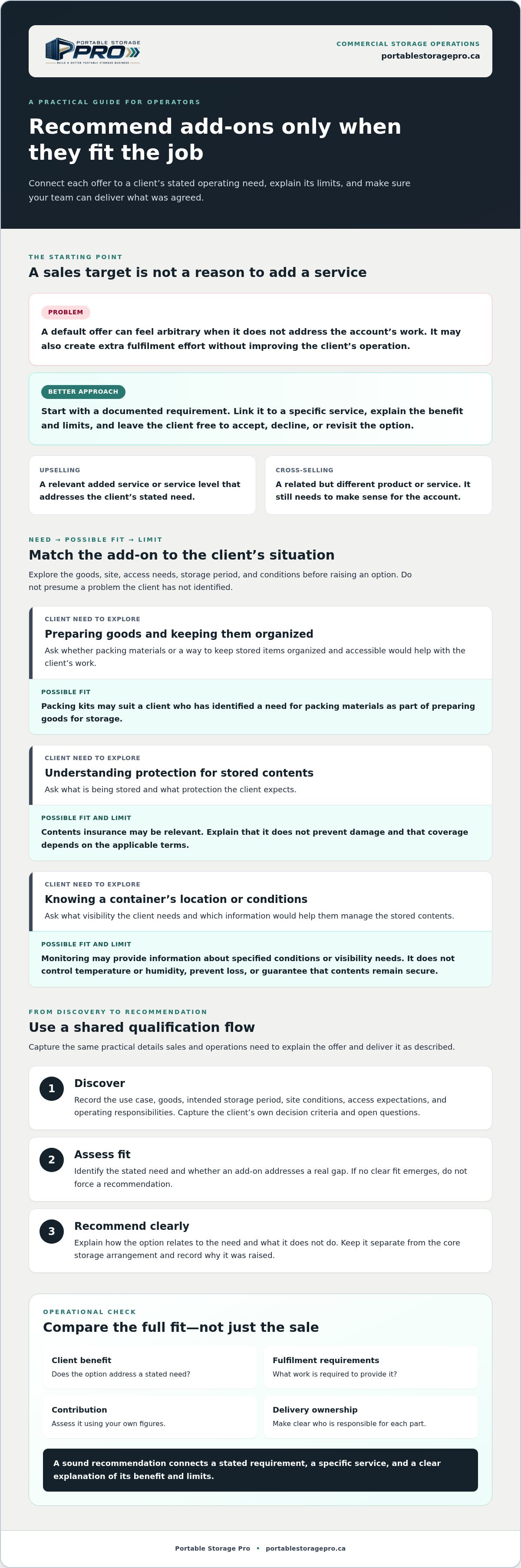
A sound recommendation links three things: a stated requirement, a specific service, and a clear explanation of its benefit and limits. If the client raises concerns about keeping track of stored contents, discuss whether a visibility option addresses that concern. Explain what information it provides and what it does not do. Don’t imply that monitoring prevents loss or changes storage conditions.
Keep the choice straightforward. Present the relevant option separately from the core storage arrangement, explain how it fits the client’s stated need, and let them accept, decline, or revisit it. Record the reason for the recommendation so staff can communicate it consistently. This is the practical foundation of upselling strategies for commercial storage clients: a recommendation earns consideration by fitting the operation, not by appearing on every quote.
Matching Portable Storage Add-ons to Client Needs
A repeatable qualification process helps your team turn a commercial conversation into a recommendation that fits the work and can be handed off clearly. The fit depends on the client’s documented need, operating constraints, decision criteria, and any concern that remains unresolved. Record these details before presenting an add-on, so the recommendation is based on the account rather than a standard sales script.
Ask discovery questions before recommending an add-on
Keep discovery focused on the goods, the site, and who is responsible for each part of the storage arrangement. Ask what will be stored, how long it is expected to remain in the container, what access is needed, and what conditions matter to the client. Then explore whether packing support, contents protection, or visibility is a priority. Don’t presume a problem that the client hasn’t raised.
Capture the client’s own language, decision criteria, and open questions. For example, note whether the priority is preparing goods for storage, understanding insurance options, or receiving information about container conditions. These notes let the next staff member explain why an option was raised and avoid presenting an unresolved concern as a confirmed requirement.
Match the recommendation to its practical benefit
Assess each option against the requirement it may address. Packing kits may suit a client who has identified a need for packing materials as part of preparing goods for storage. Contents insurance can be discussed as an insurance option, with its applicable terms made clear. Don’t present premiums as revenue retained by your operation; account for any amounts passed through to an insurer or other party separately.
Monitoring can provide information about specified conditions or visibility needs, depending on the service. It does not actively control temperature or humidity. State what information the service provides and what it cannot do, so the client can judge whether it meets the stated requirement.
Use this ordered workflow to keep discovery, recommendation, and delivery aligned:
- Discover: Record the client’s use case, goods, intended storage period, site conditions, access expectations, and operational responsibilities.
- Assess fit: Identify the stated need and any gap an add-on could address. If no clear fit emerges, don’t force a recommendation.
- Recommend: Explain the option’s practical benefit, limits, and any client responsibilities in plain language.
- Agree: Record the client’s decision, including a decline or a request to revisit the option, and note any unanswered questions.
- Hand off: Share the agreed service, site and access details, responsibilities, and client-facing explanation with the staff coordinating fulfilment.
This process makes upselling strategies for commercial storage clients easier to apply consistently without treating every account alike. It also gives operations enough context to prepare for the agreed service and flag a mismatch before it becomes a delivery issue. If you’re refining how your team qualifies and hands off add-on recommendations, discuss your process with Portable Storage Pro.
Compare add-on options by client value, fulfilment, and contribution
Compare each service as an operating commitment, not just an item on a quote. The client benefit matters, but so do the staff time, coordination, records, and follow-up needed to deliver it. The comparison below helps you see where ownership sits and what needs to be ready before your team presents an option. Adjust the responsibilities to match how your business is organized.
| Client need | Specific benefit | Delivery requirements | Operational owner |
|---|---|---|---|
| Packing materials for a project or storage period | Packing kits can help the client prepare goods using materials suited to the intended task. | Define kit contents, order and delivery timing, inventory responsibility, and how staff handle substitutions or delays. | Sales records the requested materials; the assigned fulfilment lead coordinates sourcing and client updates. |
| Interest in protection for stored contents | Contents insurance gives the client an insurance option to consider under applicable policy terms. | Use approved explanations, direct the client to policy details, document the choice, and identify who handles insurance questions. | The designated account contact communicates the option; the appropriate insurance process handles policy details. |
| Need for visibility into container location or conditions | Monitoring may provide information that supports the client’s specified visibility needs. | Set expectations about available information, access, review responsibility, and how exceptions are communicated. Monitoring does not actively control temperature or humidity. | The assigned technology or operations lead coordinates setup, access, and client communication. |
Evaluate the service and its delivery requirements
Before adding an option to your sales process, check what must happen between client agreement and completion. Does a team member need product knowledge, supplier coordination, additional records, or a separate client update? Identify dependencies and timing that could affect yard flow, dispatch, or the scheduled container placement. Set a clear owner for each handoff, and give staff a simple way to flag an issue before it reaches the client. Include limitations and client responsibilities in the recommendation, so operational work matches what was promised.
Use contribution to compare options responsibly
Compare each service using figures from your own records and the same reporting period. Incremental revenue is the amount attributable to the add-on. Incremental contribution is what remains after the direct costs to serve it are subtracted:
Incremental contribution = incremental revenue − direct costs to serve
Include service-specific fulfilment effort and supplier charges in direct costs. Keep shared overhead separate unless you have a consistent allocation method. Contribution is not overall profit; profit also reflects other operating expenses. For insurance, separate any premium passed to an insurer or another party from revenue retained by your business. For a fuller view, compare contribution with fulfilment issues and client feedback, not revenue alone. These upselling strategies for commercial storage clients work best when the service can be delivered reliably and its commercial effect is measured on a like-for-like basis.
Build a repeatable upselling workflow for commercial storage accounts
A repeatable workflow keeps an add-on recommendation connected to what the client needs and what your team can deliver. It also prevents information from being lost between sales and operations. Use the same stages for each account, then adjust the service options to the client’s requirements.
Lead qualification is the starting point: your team needs a clear picture of the inquiry before deciding whether an add-on belongs in the conversation. The portable storage lead generation guide offers related context for structuring that early sales work.
- Discover: Record the client’s use case, goods, storage conditions, access expectations, decision criteria, and unresolved concerns.
- Assess fit: Identify whether a specific service addresses a documented need and whether your operation can fulfil it as described.
- Recommend: Explain the practical benefit, limitations, client responsibilities, and any service details that affect the decision.
- Record the decision: Note whether the client accepts, declines, or wants to revisit the option, along with any outstanding questions.
- Hand off and review: Give operations the agreed scope and responsibilities, then record fulfilment outcomes for later review.
Equip staff to make useful recommendations
Give staff a short checklist they can use during account discussions. It should cover the client’s stated need, the benefit being proposed, the option’s limitations, and delivery readiness. Train the team to explain services in plain language, avoid pressure, and make no claims about outcomes the service can’t support. Consistent account notes should travel with the work from sales to operations.
- Client need: What requirement or service gap did the client identify?
- Recommendation: What option addresses it, and what does that option not provide?
- Readiness: Who is responsible for fulfilment, documentation, and client updates?
Review outcomes and improve the process
Review performance by service, not just by total add-on sales. Track how often each option is offered and accepted, whether fulfilment issues arise, what clients say about the service, whether they use it again, and the contribution after direct costs to serve. For contribution analysis and related operating measures, consult this portable storage business profitability guidance.
A declined offer is useful feedback, not a reason to pressure the client. Check whether the timing was wrong, the benefit was unclear, or the option didn’t fit the need. If several clients decline for the same reason, review how staff qualify and explain the service. These upselling strategies for commercial storage clients become more consistent as you use account outcomes to refine the process.
To strengthen your sales and operations handoffs, discuss your commercial account process with Portable Storage Pro.
Turn client-fit upselling into a disciplined commercial growth practice
Effective upselling strategies for commercial storage clients follow a clear sequence: discover the need, select a relevant service, assess whether your operation can deliver it, explain its benefit and limits, then measure the outcome. This keeps account growth tied to client value and operational readiness rather than the number of add-ons offered.
You don’t need to review every account at once. Start with a small group of commercial clients or one add-on category, then use what you learn to improve the process before extending it.
Prioritize a practical first improvement
Choose a segment or service where you can review real conversations and fulfilment details. Map the path from the initial inquiry to the recommendation and delivery handoff. Look for missed discovery questions, unclear explanations, repeated client concerns, or gaps between what sales discussed and what operations received. Focus on one process issue at a time.
- Review the conversation: Did the team record the client’s requirement and decision criteria?
- Check the recommendation: Was the benefit explained plainly, with limitations made clear?
- Follow the handoff: Did operations receive the agreed scope, responsibilities, and relevant client information?
Use the review to adjust a question, account note, service explanation, or handoff step. Then observe whether the change improves consistency and reduces avoidable clarification between teams. Keep the review proportionate to your staff and account volume.
Get support for sales and operating improvements
An add-on conversation depends on more than sales language. Staff need training to identify a fit, customer communication that sets accurate expectations, and operational readiness to deliver what was agreed. Review these elements together. A service that sounds clear in a quote can still create confusion if responsibilities, timing, or fulfilment steps aren’t understood internally.
A Consulting Partner arrangement provides expertise, resources, and support while you retain responsibility for day-to-day operations. Consulting support can be shaped around your business priorities and implementation needs, such as refining a sales process, improving staff training, or clarifying the handoff between sales and operations.
As you assess the process, track the measures that help you make practical decisions:
- Which relevant offers are presented, accepted, declined, or deferred?
- Where do fulfilment issues or client questions arise?
- How does each service perform after direct fulfilment effort is considered?
Use those findings to refine the workflow, not to push an option that doesn’t fit. A disciplined process gives staff a consistent way to recommend useful services and gives you a clearer view of the commercial and operational results.
Let’s discuss your commercial upselling process.
Make relevant add-ons part of how you serve commercial accounts
A useful next step is to make client-fit recommendations part of your team’s operating practice, not dependent on one salesperson’s instinct. Document what staff should learn, how they explain each option, and what operations needs before fulfilment. That gives your process a consistent base as commercial accounts and service conversations change.
Portable Storage Pro provides portable-storage-specific consulting across sales, marketing, training, and operations. Under its consulting sourcing model, supplier pricing is not marked up by Portable Storage Pro. The focus is practical support that fits your business priorities, while you remain responsible for day-to-day management.
Build the process at a pace your team can sustain. Start with a clear standard for useful recommendations, then improve it as account feedback and delivery experience show where the next adjustment belongs. Discuss your commercial upselling process with Portable Storage Pro and take the next step toward a sales approach that serves clients and your operation.
Frequently Asked Questions
How do you upsell commercial storage clients without making the offer feel pushy?
Keep the offer relevant, brief, and optional. Ask permission to outline a service after the client raises a related concern, then explain how it addresses that concern and state its limits. For example, if a client asks how they can receive information about container conditions, describe what monitoring can report and what it cannot control. Record a decline without repeated follow-up unless the client invites you to revisit the option.
What add-on services can portable storage operators offer commercial clients?
Options can include packing kits, contents insurance, and monitoring, depending on the operator’s service model and the client’s requirements. A business preparing equipment for temporary storage may value packing materials; another may ask about protection or visibility. Describe each option in relation to the specific use case. Avoid presenting a menu of add-ons as a standard package, since an option may not suit the client’s goods, site, or process.
How can an operator decide whether a storage add-on fits a client’s needs?
Check that the service addresses a need the client has stated and that its requirements fit the account. Confirm who will use the service, where the container will be placed, what access or information the client expects, and which staff member will manage the related steps. If the client’s expectation differs from what the service can provide, clarify that before adding it to the agreement.
Can contents insurance be presented as an add-on without overstating its benefits?
Yes. Describe contents insurance as an insurance option, not as a guarantee against loss or damage. Direct the client to the applicable policy terms, including its coverage, exclusions, and limits, and avoid promising that a particular loss will be covered. If your business receives or handles premiums, distinguish amounts passed to the insurer from revenue retained by your operation in internal reporting.
How should a portable storage business measure add-on contribution?
Track results by service and reporting period. Alongside acceptance and add-on revenue, record direct fulfilment effort, supplier amounts, issues, and any amounts passed through to another party. Compare contribution across offers using consistent accounting treatment, and review client feedback and repeat use as separate measures. Contribution helps assess the service’s direct commercial effect; it is not the same as overall business profit.
What should sales staff record before recommending an additional service?
Capture the client’s stated requirement, the goods and intended storage use, relevant site or access constraints, decision criteria, and any question that still needs an answer. Note why the service may fit and what benefit the staff member explained. Also record the client’s response and who should take the next action. These details help another team member continue the discussion without making the client repeat key information.
How can operations teams prepare to fulfil a new add-on service?
Before offering it broadly, map the service’s steps from approval to completion. Assign responsibility for ordering or setup, staff training, required records, client updates, and handling a service issue. Check that timing fits existing yard and delivery work, then document the process in a usable procedure. A limited rollout can help your team identify unclear instructions or handoff gaps before adding the option to more commercial accounts.

Article by
Paul Taylor
Paul Taylor is the founder of Portable Storage Pro, bringing more than 35 years of experience across the container, portable storage and transportation industries. His background spans executive operations, business development, global procurement, sales, marketing and operational improvement in Canada, the UK and international markets.
Paul helps independent portable storage and container rental operators increase revenue, strengthen margins and build more efficient businesses. His work connects strategy with practical implementation, including pricing, delivery operations, supplier sourcing, staff training, technology and customer experience.
His experience includes leading multi-location storage operations and serving on the National Portable Storage Association’s board along with chairing its Canadian committee. Through Portable Storage Pro, Paul shares practical insights to help owners make informed decisions, solve operational challenges and grow profitably.
Disclaimer
Content published by Portable Storage Pro Inc. (PSP) provides general business information and industry insights. It does not replace advice tailored to your business or specialist legal, tax, engineering or other regulated advice. Reading this content or contacting PSP does not, by itself, establish a consulting engagement.
Information reflects circumstances at publication and may change. Examples and potential benefits are illustrative; results depend on individual circumstances, implementation and market conditions and are not guaranteed.
Client services are governed by the signed service agreement, agreed work plan and written amendments. Website and blog content do not amend those terms. PSP’s work is subject to applicable law and the professional commitments set out in its agreement, including the CMC-Canada Code of Professional Conduct and NPSA Code of Conduct and Ethics. Copies are available on request.
Views expressed are PSP’s own. Association membership or references do not imply association endorsement or CMC certification. Nothing in this disclaimer limits PSP’s contractual responsibilities, professional duties or rights that cannot lawfully be excluded.


