
What if a rise in enquiries leaves your portable storage business no better off? A portable storage marketing agency needs to understand more than digital campaigns and lead volume. It should account for delivery radius, fleet availability and whether your team can respond to quotes promptly. Otherwise, marketing may attract enquiries that don’t fit your service area or turn into rentals.
You already know that leads need follow-up. The harder part is connecting campaign reporting to lead quality, quote conversion and the realities of dispatching containers. This article explains how to set marketing priorities around your business model, assess whether enquiries are commercially relevant and build a clearer link between lead generation and customer communication.
It also distinguishes campaign execution from strategic support. Portable Storage Pro’s Consulting Partner model helps you align marketing with sales processes and operating priorities, while you retain responsibility for day-to-day management. The focus is practical: generate qualified enquiries, follow up consistently and assess marketing by its contribution to the business, not just clicks or lead counts.
Key Takeaways
- Assess a portable storage marketing agency by whether its approach accounts for rental duration, delivery requirements and service-area fit.
- Plan channels around the customer’s path from discovery to enquiry, and use website content to set clear expectations.
- Track progression from channel activity to qualified enquiries, quotes and rental outcomes; a lead alone isn’t a sale.
- Review marketing priorities against business objectives and capacity, including who owns lead response and quote follow-up.
- Portable Storage Pro’s Consulting Partner model can support agreed marketing priorities while you retain day-to-day management.
What a portable storage marketing agency must understand about the business
A portable storage marketing agency supports operators renting portable storage containers by aligning customer discovery with the service the business can actually provide. That requires an understanding of the commercial model behind each rental, not only the channels used to promote it. A qualified enquiry has to fit the operator’s delivery coverage, equipment, rental terms and capacity to serve the requested dates.
Portable storage marketing attracts and converts rental enquiries that fit an operator’s delivery capability, available equipment and commercial requirements. Those factors shape which prospects are worth pursuing and what information the sales team needs before making a commitment.
How portable storage marketing differs from facility marketing
Facility marketing can centre on a fixed location and the availability of units there. Portable storage adds a service and fleet-planning dimension: containers must be delivered to and collected from customer locations. The PODS (Portable On Demand Storage) business model provides an overview of a prominent portable storage company and helps illustrate why this model differs from marketing access to a fixed site.
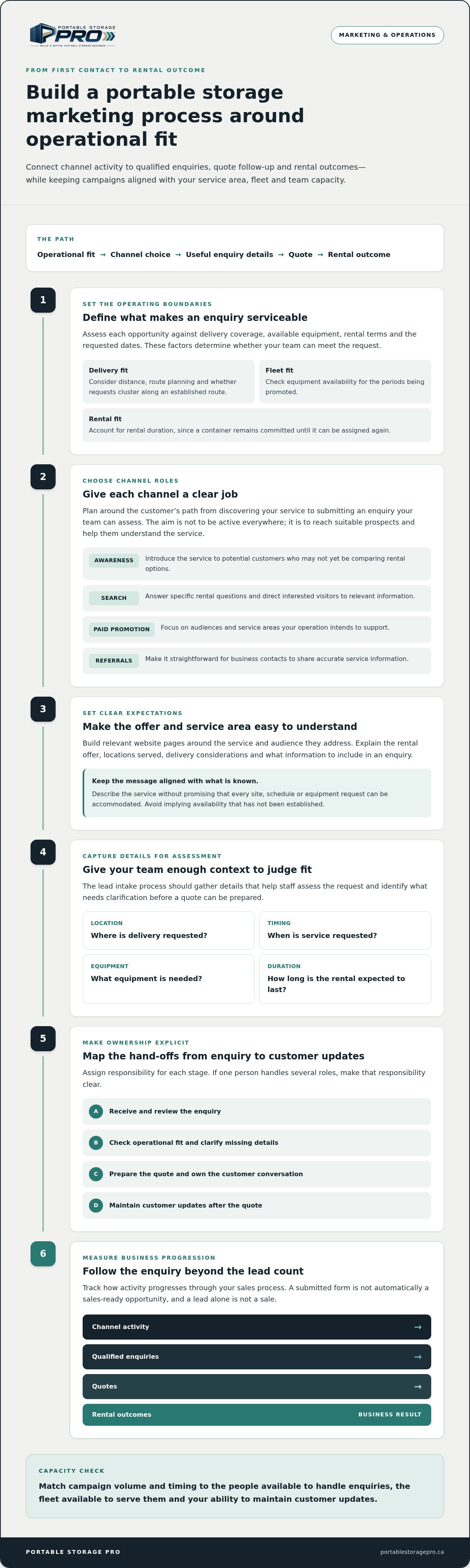
For an operator, the commercial fit of an enquiry can depend on more than its address. Delivery distance affects route planning, while rental duration determines how long a container remains committed before it can be assigned again. A cluster of requests along an established route may be more practical than scattered requests at similar distances. Marketing decisions should reflect those operating patterns rather than treating every location inside a broad radius as equally serviceable.
Equipment availability matters too. If a campaign promotes a particular container option, the team needs to know whether it can support that offer for the periods being promoted. Otherwise, the message may set expectations that the fleet cannot meet. Marketing should describe the service clearly without implying availability that hasn’t been established.
What a marketing partner needs to understand about the sales process
The sales process is not complete when a form arrives. The lead intake process needs to capture details that let staff judge fit, such as delivery location, requested timing, equipment needs and expected rental duration. Those details help the team distinguish a request that can be assessed from one that needs clarification before a quote can be prepared.
Map the hand-offs: who receives an enquiry, who checks operational fit, who prepares the quote and who owns the customer conversation afterward. If the same person handles several roles, make that responsibility explicit. This prevents marketing reports from presenting a submitted form as a sales-ready opportunity when key details are missing or no one is assigned to respond.
Finally, match campaign volume and timing to the team’s capacity and service commitments. A marketing plan should account for who will handle enquiries during busy periods and how customer updates will be maintained. The right plan supports a manageable sales process, rather than creating demand that outpaces the people and equipment available to fulfil it.
Connect portable storage marketing channels to qualified demand
Channel choice should follow the customer’s path from first exposure to an enquiry your team can assess. A portable storage marketing plan might combine search visibility, paid promotion, referral activity and useful website content, but each element needs a distinct role. The goal isn’t to be active everywhere. It’s to help suitable prospects understand the service and take a clear next step, while giving your team enough context to respond effectively.
Choose channels around customer intent and service fit
Broad awareness activity introduces your business to potential customers who may not yet be comparing rental options. Search content and paid promotion can reach people actively seeking portable container rentals. Treat these as different jobs: awareness builds familiarity, while higher-intent activity should lead to information that answers practical questions and supports an enquiry.
Build landing pages around the service and audience they address. Describe the type of rental offer, the locations served, delivery considerations and what details to include in an enquiry. A page for commercial project needs, for example, can explain the information your team uses to understand a request, without promising that every site or schedule can be accommodated. Portable storage industry context can also inform your messaging; the National Portable Storage Association’s industry resources provide a relevant sector reference.
- Awareness content: Explain the service and help prospective customers recognize when it may fit their needs.
- Search content: Address specific rental questions and direct interested visitors to a relevant page.
- Paid promotion: Focus campaigns on audiences and service areas your operation intends to support.
- Referral activity: Make it straightforward for existing business contacts to share accurate service information.
Choose a manageable channel mix based on your audience, the markets you serve and the staff available to handle incoming interest. Avoid expanding promotion simply because a channel is available. First decide what customer action it should support and how your team will recognize whether the resulting enquiry fits.
Make lead intake part of the marketing system
Use a lead management system to bring enquiries into one working view, record where they came from and assign responsibility for the next action. This could be a shared record or a CRM, depending on the size of your team and existing processes. Consistency matters more than adding software: staff should be able to see whether an enquiry is new, being assessed or awaiting a response.
Capture practical details that help distinguish a useful enquiry from an incomplete one, such as the customer’s organization, intended use, delivery location, requested timing and contact preference. Record the source accurately, too. If a person first encounters your business through search but later calls after a referral, note the relevant context rather than forcing the lead into an unreliable attribution category. This gives you better information for channel reviews and follow-up planning.
Measure marketing beyond clicks: follow the enquiry through the quote
Clicks, calls and form submissions show that people interacted with a campaign. They don’t show whether the enquiry suited your rental offer, whether a quote was prepared or whether a rental followed. Keep a record that connects each prospect to the next sales stage, then review where progress stops. That turns reporting into a management tool: you can investigate gaps, clarify ownership and make decisions using your own operating records.
Lead volume alone can’t establish marketing effectiveness because an enquiry is only the start of a sales process, not evidence of a rental. A portable storage marketing agency should be able to discuss how campaign reporting connects to those later stages without presenting clicks or raw leads as business outcomes.
Use a practical lead-to-rental measurement table
Use one record for each enquiry and apply the same stage definitions across channels. The table below gives a straightforward structure to adapt to your team’s workflow.
| Stage | Fields to record | Review question |
|---|---|---|
| Enquiry source | Channel, campaign or referral, date received | Can you identify where the enquiry came from? |
| Qualification | Service fit, delivery location, requested equipment and rental period | Was the request suitable for your offer? |
| Quote status | Not started, in preparation, sent, declined or not applicable | Did a suitable enquiry progress to a quote? |
| Follow-up | Owner, last contact, next action and due date | Is someone responsible for continuing the conversation? |
| Final outcome | Rental, lost, withdrawn or pending, with a reason if known | Is the result recorded rather than assumed? |
Before comparing campaigns or periods, check the records for blanks and inconsistent labels. A missing source prevents channel comparison. A quote with no status could mean it was never prepared, wasn’t sent or simply wasn’t updated. Keep “unknown” separate from “lost,” and don’t infer a rental when the final outcome hasn’t been confirmed. These checks reveal whether a reporting gap, rather than campaign performance, is limiting what you can learn.
Use financial terms precisely. Revenue is income recorded from rentals. Contribution describes what rental activity provides toward broader business expenses. Profit is the remaining financial result after the business’s expenses are accounted for. They answer different questions, so a lead or quote should never be counted as revenue, contribution or profit.
Read the results alongside operating capacity
Interpret rental outcomes in context. A qualified enquiry may not proceed because the requested container wasn’t available, delivery capacity was committed or the customer’s timing didn’t fit. A delay in internal response or quote preparation can also affect the outcome. Note these factors in the record, rather than treating every non-rental as a campaign failure.
Review channel patterns alongside fleet availability, delivery schedules and the team’s handling of enquiries. If similar requests repeatedly cannot be served, the finding may inform planning for capacity or campaign targeting. If suitable prospects are reaching the quote stage but outcomes aren’t recorded, improve record-keeping before drawing conclusions. This gives you a clearer basis for deciding what to adjust next.
Evaluate a marketing plan against portable storage operating realities
Before expanding marketing, check that your business can handle the demand it is designed to create. A useful review connects business objectives with delivery capacity, fleet readiness and the team’s ability to manage enquiries. For an independent operator, this doesn’t require a complex planning system. A short, consistent review can show what to fix first and what your operation can support.
Use a readiness checklist before expanding marketing activity
Review the process from first contact through fulfilment. The aim is to find gaps that could prevent a relevant enquiry from receiving a clear response or becoming a rental.
- Confirm the objective. Define the business need behind the activity, such as reaching a supported market or improving the fit of incoming enquiries.
- Check the records. Confirm that enquiry sources, qualification status and next steps are captured consistently, whether an enquiry arrives by phone, form or referral.
- Review ownership. Name who responds, who prepares quotes and who follows up. Make hand-offs clear when more than one person is involved.
- Inspect customer communication. Check whether acknowledgement, quote delivery and follow-up explain what happens next. Look for avoidable delays or unclear requests for information.
- Test operating capacity. Consider equipment availability, delivery coverage, dispatch capacity and the team’s current workload against the demand being targeted.
Keep the review grounded in records and actual processes. If enquiry sources aren’t recorded, improve that practice before comparing channels. If qualified requests are waiting for quotes, clarify quote ownership before increasing activity. A portable storage marketing agency should understand how these process conditions affect campaign decisions, rather than reporting platform activity in isolation.
Turn findings into manageable marketing priorities
Rank proposed actions by customer impact, fit with your operation and the team’s ability to carry them out. Start with the point of greatest friction. A small team may get more value from consistent enquiry tracking and clearer quote follow-up before taking on a new channel or a larger technology change.
- Immediate process work: assign lead response, standardize the information captured and define the next step after a quote.
- Channel adjustments: refine targeting or page content to reflect service areas and available rental offerings.
- Longer-term decisions: assess new channels or changes to your technology stack once the team can support them.
For each action, assign an owner, record the intended outcome and set a review point. At that review, compare relevant enquiries, quote progression and operational constraints. If results are unclear, check whether records are complete before changing the plan. This keeps marketing decisions tied to evidence and makes implementation manageable for your team.
Portable Storage Pro can help you align marketing priorities with lead handling and operating capacity. Discuss your marketing priorities with Portable Storage Pro.
How Portable Storage Pro supports marketing priorities through Consulting Partner
Marketing priorities are easier to act on when they’re considered alongside the work that turns an enquiry into a rental. Portable Storage Pro’s Consulting Partner model provides expertise, resources and implementation support for agreed priorities. You remain responsible for day-to-day management, while the support is shaped around your business context, current processes and operating needs.
This differs from a campaign-only approach. A portable storage marketing agency may focus on executing channels and reporting activity. Consulting Partner support can help you connect marketing decisions with lead handling, sales conversion, customer communication and the operational processes that affect whether your team can serve the demand.
Connect marketing advice with practical implementation
For example, if enquiries are coming in but few progress to quotes, the first step may be to examine how leads are qualified and who owns follow-up. If quotes are sent but outcomes aren’t recorded, improving the hand-off and tracking process may provide a clearer view before you change channels. The appropriate actions depend on the agreed priorities and the way your business operates.
Marketing work can also touch other disciplines. A plan to attract more enquiries should account for delivery systems and available fleet capacity. Customer communication should reflect the service commitments your team can meet. Staff training and clear procedures can help employees handle enquiries and quote follow-up consistently. Technology may support the process, but it should fit your workflows and serve a defined operating purpose.
- Lead generation: Focus activity on enquiries that fit your rental offer and service area.
- Quote follow-up: Clarify who follows up, what information is recorded and how the next step is communicated.
- Sales conversion: Review where qualified prospects pause or decline, then consider practical process changes.
- Implementation: Translate agreed priorities into steps your team can put into practice and review.
These are connected areas of work, not an assumption that one engagement includes every activity or takes over your business. The purpose is to align support with the priorities you agree on and the capacity you have to implement them.
Choose a useful next step for the operator
Start by identifying one gap between enquiries, quotes and rentals. Are relevant enquiries not reaching the right person? Are quotes delayed, or is follow-up inconsistent? Do you lack a clear record of why a prospect did not proceed? A specific question gives the business discussion a practical starting point.
Bring the process you currently use, including how enquiries arrive, how quotes are handled and how outcomes are recorded. The discussion can focus on your priorities and existing ways of working, then identify where expertise or implementation support may be useful. You retain day-to-day management and decide how agreed actions fit into the operation.
Discuss a lead-handling or quote follow-up challenge with Portable Storage Pro.
Set your next marketing priority
Choose one point in your enquiry process that deserves closer attention, then decide what information or change would help your team act on it. That gives your next marketing decision a practical starting point, grounded in your operation rather than a general agency playbook.
Portable Storage Pro brings portable-storage-specific consulting across sales, marketing, operations, procurement, training and technology. Paul Taylor has more than 35 years of experience across containers, transportation, procurement and operations. That industry context can help you assess whether a portable storage marketing agency’s recommendations fit your business and its priorities.
Use your current processes and a specific challenge to guide the conversation. Let’s discuss your portable storage marketing priorities. A clear next step can help you move forward with purpose.
Frequently Asked Questions
What does a portable storage marketing agency do?
A portable storage marketing agency helps an operator plan how prospective customers find its service and proceed from interest to a sales conversation. The work should reflect the rental offer and the operational details customers need to understand. For example, a page aimed at commercial customers could explain the types of projects served and what details help the team assess a request. Measure whether that information supports relevant conversations, not just page visits.
How is portable storage marketing different from self-storage marketing?
Portable storage marketing must account for the fact that containers are delivered to and picked up from customer locations, while self-storage marketing often centres on access to a facility. This affects what a prospect needs to know before enquiring. For example, clear information about delivery requirements can help a business customer assess whether the service suits a project. Your marketing should reflect the way your rental service is actually fulfilled.
Is SEO enough to market a portable storage business?
No. SEO can help prospective customers discover your business, but visibility alone doesn’t explain your service or guide a visitor towards a useful enquiry. Review whether key pages answer the questions your target customers ask and make the next step clear. If a page attracts visits but doesn’t support relevant enquiries, examine its content and audience fit before assuming you need more search traffic.
How should a portable storage operator measure marketing performance?
Track enquiries through their final status, then review patterns by source and customer type. For example, compare enquiries from contractors with those from restoration businesses, using the same qualification and outcome definitions for each group. Note operational factors that affected the result, such as unavailable equipment or a request outside your delivery capability. This context helps you decide whether to adjust marketing, service information or internal processes.
Can a small portable storage business manage marketing without a large team?
Yes. A small team can keep marketing manageable by assigning responsibility for specific tasks, such as updating service information, recording enquiry sources and reviewing lost quotes. A shared tracker may be enough to start; a CRM can support the process as enquiry volume and team needs change. The key is to select actions staff can maintain alongside dispatch, fleet and customer responsibilities.
What should a portable storage marketing plan include?
A useful plan should identify the customer groups and rental services you want to reach, then connect each audience to relevant information and a clear enquiry path. Include who maintains the content, who reviews incoming feedback and how changes will be assessed. For instance, repeated questions about delivery requirements may point to a gap in a web page or quote materials. Keep the plan practical enough for your team to maintain.

Article by
Paul Taylor
Paul Taylor is the founder of Portable Storage Pro, bringing more than 35 years of experience across the container, portable storage and transportation industries. His background spans executive operations, business development, global procurement, sales, marketing and operational improvement in Canada, the UK and international markets.
Paul helps independent portable storage and container rental operators increase revenue, strengthen margins and build more efficient businesses. His work connects strategy with practical implementation, including pricing, delivery operations, supplier sourcing, staff training, technology and customer experience.
His experience includes leading multi-location storage operations and serving on the National Portable Storage Association’s board along with chairing its Canadian committee. Through Portable Storage Pro, Paul shares practical insights to help owners make informed decisions, solve operational challenges and grow profitably.
Disclaimer
Content published by Portable Storage Pro Inc. (PSP) provides general business information and industry insights. It does not replace advice tailored to your business or specialist legal, tax, engineering or other regulated advice. Reading this content or contacting PSP does not, by itself, establish a consulting engagement.
Information reflects circumstances at publication and may change. Examples and potential benefits are illustrative; results depend on individual circumstances, implementation and market conditions and are not guaranteed.
Client services are governed by the signed service agreement, agreed work plan and written amendments. Website and blog content do not amend those terms. PSP’s work is subject to applicable law and the professional commitments set out in its agreement, including the CMC-Canada Code of Professional Conduct and NPSA Code of Conduct and Ethics. Copies are available on request.
Views expressed are PSP’s own. Association membership or references do not imply association endorsement or CMC certification. Nothing in this disclaimer limits PSP’s contractual responsibilities, professional duties or rights that cannot lawfully be excluded.


