
Growth can add capacity without adding clarity. As routine questions about customer follow-up, delivery schedules, fleet readiness, and approvals keep landing on your desk, it becomes harder to manage the work that actually requires your attention. Learning how to delegate tasks in a growing storage business means more than assigning jobs. It means deciding who owns each task, what standard they must meet, and which decisions still need your approval.
If you’ve handed work off verbally and then had to step back in to correct missed details, the problem may be the handoff rather than the person. Clear responsibilities and repeatable processes help your team act with confidence while keeping important operating information visible to you.
This guide sets out a practical delegation system for portable storage and container rental operators. You’ll learn how to identify work that can move off your plate, define decision rights and service standards, and use SOPs and follow-up measures to keep tasks on track. The aim is to give your team real ownership without losing sight of customer service, fleet performance, or financial decisions.
Key Takeaways
- Delegation means giving someone ownership, decision authority, and a clear outcome, not just passing along a task.
- Use frequency, process clarity, customer impact, risk, and judgement to decide which work is ready to move off your plate.
- Learn how to delegate tasks in a growing storage business with handoffs that define the trigger, owner, standard, record, and escalation path.
- Track task-specific signals, completed work, and exceptions so you can spot service or fleet issues early.
- Start with one recurring bottleneck, document the process, assign ownership, and expand the system as your team gains confidence.
Why delegation matters as a portable storage business grows
As your portable storage operation grows, more customer enquiries, delivery movements, fleet checks, and yard decisions compete for your attention. If routine work still waits for your approval, growth can create delays instead of capacity. Learning how to delegate tasks in a growing storage business starts with defining delegation clearly: “Effective delegation in a portable storage operation assigns a named owner, the authority to act within agreed limits, and a measurable expected outcome.”
That’s more than passing along a task. Asking someone to “handle the quote” doesn’t tell them when to respond, what information to confirm, what they can offer, or when to bring a decision back to you. The principles of delegation provide a useful management foundation, but the handoff must also reflect the actual sales, yard, and delivery work your team performs.
Which growth pressures signal that work needs a new owner?
Look for recurring work that stalls whenever you’re occupied elsewhere. A lead waits for a quote because only you can approve the next step. A delivery coordinator doesn’t know whether a schedule change is authorized. Containers are ready for dispatch, but competing yard priorities remain unresolved until you weigh in.
These bottlenecks affect more than your schedule. Slow quote responses can leave prospective customers waiting. Unclear delivery decisions can disrupt customer updates and fleet readiness. Team members may hold back on routine work because they’re unsure who has authority, while you spend time answering questions that could be resolved through clear ownership. This doesn’t automatically mean you need another hire or a formal department. It may mean an existing team member needs a defined responsibility and the tools to carry it out.
What delegation can and cannot solve
Delegation clarifies who is responsible and what decisions they can make. It doesn’t create extra capacity, replace training, or fix a process that changes each time someone performs it. Before transferring recurring work, make sure the person has the relevant instructions, access to the required information, and a clear route for raising problems.
Routine, repeatable steps may be suitable for delegated ownership, such as recording a lead, confirming that required details are captured, or updating fleet status after a check. Decisions with material financial, safety, or customer-service implications may need approval limits or escalation. Your role shifts from handling every routine action to staying informed about results and exceptions. That visibility helps you catch a process or capacity problem without becoming the default owner of every task.
How to decide which storage business tasks to delegate
Choose a task by examining how often it occurs, how clearly the work can be described, and what happens if it’s delayed or done incorrectly. This gives you a practical way to decide how to delegate tasks in a growing storage business without treating every task as a suitable handoff. Harvard Business School Online’s effective delegation tips for managers also stress matching work to people’s abilities and setting clear expectations.
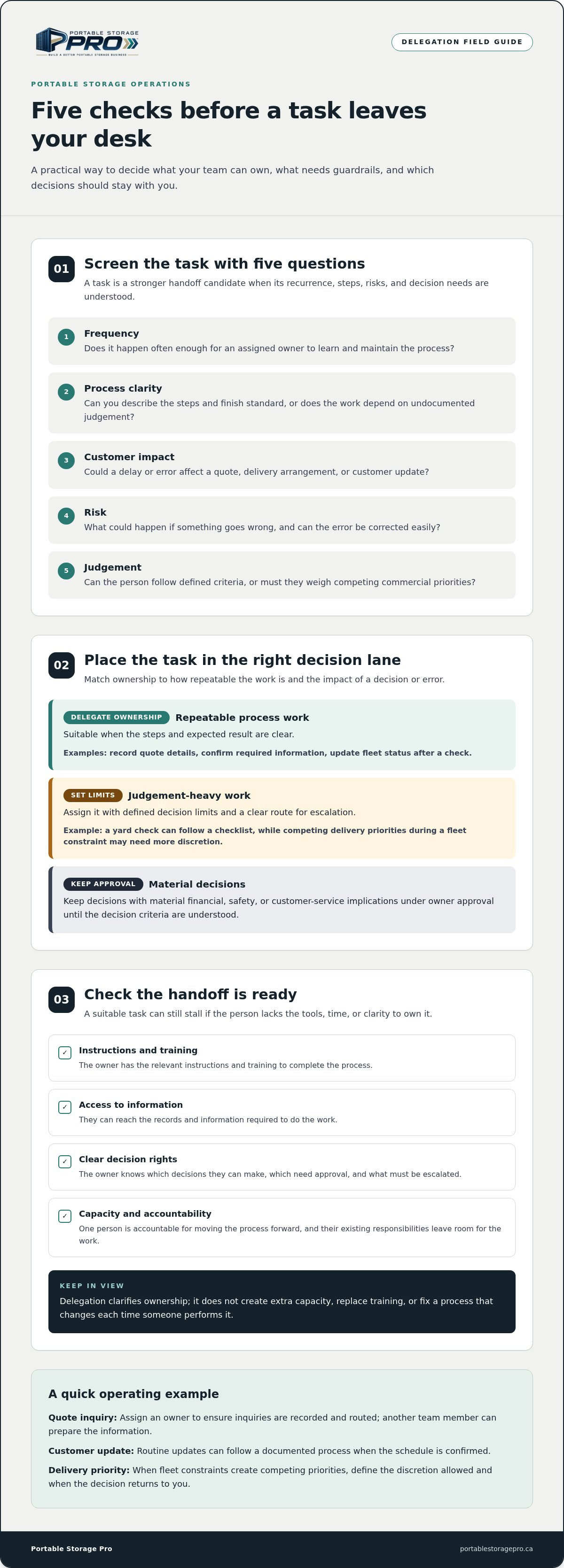
Screen each task with five questions:
- Frequency: Does the task recur often enough for an assigned owner to learn and maintain the process?
- Process clarity: Can you describe the steps and finish standard, or is the work dependent on undocumented judgement?
- Customer impact: Could a delay or error affect a quote, delivery arrangement, or customer update?
- Risk: What are the consequences of an error, and can it be corrected easily?
- Judgement: Can the person follow defined criteria, or must they weigh competing commercial priorities?
For example, recording the details needed for a quote may be repeatable if the required fields and next action are clear. Routine customer updates may fit a documented process when the schedule is confirmed. A yard check can follow a checklist, while prioritizing competing deliveries during a fleet constraint may call for more discretion.
Use a task-and-risk test before handing work over
Classify tasks as repeatable, judgement-heavy, or owner-retained decisions. Repeatable tasks are candidates for delegated ownership when the steps and expected result are clear. Judgement-heavy work may be assigned with defined limits and an escalation route. Keep decisions with material financial or customer implications under owner approval until the decision criteria are understood.
Check for gaps before transferring responsibility. If staff lack instructions, training, or access to the records needed to complete a process, address those gaps first. The task may be suitable for delegation even if the current handoff isn’t ready.
Match ownership to roles and available capacity
Name one accountable owner for each recurring process, even when several people contribute. For instance, one team member can be responsible for ensuring quote inquiries are recorded and routed while another prepares information. Shared work still needs a person accountable for the process moving forward.
Review the person’s existing responsibilities before adding ownership. An assignment without time or system access can shift the bottleneck rather than resolve it. Specify which decisions the owner can make independently, which need approval, and what must be escalated. A useful rule is: delegate repeatable process work within clear limits; retain decisions whose risk or judgement exceeds those limits.
How to hand off portable storage work without losing control
A reliable handoff makes it clear what starts the work, who owns it, what a complete result looks like, where the result is recorded, and which exceptions must be escalated. These five points connect the work across sales, dispatch, and the yard without requiring you to approve every routine step.
Consider a new rental inquiry. The trigger is a lead entering the lead management system. The assigned owner records the customer’s requirements and service location, then follows the approved quote process. The standard defines what information is needed before a quote goes out and how follow-up is handled. The record shows the status and next action. If the request falls outside the usual service area, requires an unusual commitment, or has incomplete details that affect delivery planning, the owner escalates it rather than guessing.
Once the customer accepts, ownership passes to scheduling with the job details and agreed service requirements intact. The scheduling owner confirms the delivery plan against fleet availability, records the scheduled status, and ensures the customer receives an update. If a container must be repositioned empty, the handoff should identify who updates its location, when the move is complete, and how its new status becomes visible to the person planning the next delivery. Yard flow depends on timely, accurate status information, not assumptions passed between shifts.
Document repeatable work in SOPs
SOPs turn routine processes into step-by-step instructions staff can follow consistently. Keep each procedure practical: list the information to collect, the actions to complete, the criteria for a finished task, and where to record the result. A small team usually needs a clear working document, not layers of paperwork. Review the procedure when a system, role, or operating process changes, so staff aren’t following outdated steps.
Set decision limits and escalation triggers
State what staff can resolve independently, such as sending a routine schedule update using confirmed information. Set approval triggers for unusual service commitments, material changes to a customer arrangement, or a fleet issue that could affect delivery. Define who receives an escalation and what information to include. If details are incomplete, staff should record what’s missing and pause decisions that depend on it.
A CRM or logistics tool can make ownership visible by showing the assigned person, current status, next action, and exception notes. It doesn’t define the standard or teach someone how to handle an exception. The process does that; the system keeps the handoff and its record accessible. That distinction is central to how to delegate tasks in a growing storage business without losing sight of customer commitments or fleet movement.
How to review delegated work and correct problems early
Delegation needs a review loop. Check whether the work is moving as expected, whether the finished result meets the agreed standard, and whether exceptions are recurring. These are different views of performance:
- Leading indicators show whether key steps are happening, such as quote inquiries receiving a recorded response.
- Completed outputs confirm the task reached its required finish, such as a customer receiving a confirmed delivery update.
- Exception measures reveal where work stalled, required correction, or needed escalation.
Activity counts alone can mislead. A high number of calls logged doesn’t show whether leads received useful follow-up. A completed yard check doesn’t confirm that fleet status was recorded accurately. Pair activity with the outcome that matters to the operation, then watch for repeated errors and unresolved exceptions.
Don’t set arbitrary performance targets. Use your own records to establish a baseline, then agree on a reasonable standard for the task and review changes against it. A simple review record can keep discussion specific:
Task: Customer quote follow-up
Owner: Assigned sales team member
Measure: Inquiries with a response and documented next step
Exception: Missing customer details or a quote awaiting approval
Next action: Resolve the information gap or clarify the approval route
Use the same format for fleet status updates: measure record accuracy, note discrepancies, and assign a corrective action when system records and yard information don’t match.
Choose measures that show whether the handoff works
Match the measure to the task’s purpose. For customer follow-up, review whether required responses and next steps are recorded. For operational readiness, compare reported fleet status with the information dispatch relies on. For process completion, check that required records are present and usable. Review exceptions alongside completed work; recurring rework can otherwise stay hidden.
Coach, adjust, and restore accountability
When a measure falls short, compare the work with the agreed process before judging the person’s ability. Check whether instructions are clear, workload is manageable, and system access is in place. Then agree on the correction, the owner, and when you’ll review it. If the process has changed, revise the SOP and ownership so they reflect current operations.
How to build a delegation system that can support continued growth
Build the system in stages. Start with a visible bottleneck, clarify the handoff, assign ownership, and review what happens before extending the approach. This ties delegation to real operating needs and helps you avoid creating procedures for work that isn’t causing a problem.
Choose a recurring delay, such as quote follow-up waiting for owner input or fleet status not being updated before dispatch planning. Map where the work pauses, then document the steps and decision points. Assign an owner with the training and authority to complete routine work, and identify which exceptions still need your attention.
Start with a controlled delegation pilot
Select a task with a clear trigger and observable completion point. Before the handoff, agree on training, authority limits, required records, and when you’ll review the process. As the task moves through actual operating conditions, note unclear instructions, missing information, and approval delays. Use those findings to improve the procedure before extending the system to other work.
Once the pilot is working as intended, consider connected processes that may need clearer ownership. For example, a smoother sales handoff may expose an unclear responsibility for passing accepted work into scheduling. Expand in manageable steps, keeping accountabilities and performance visible as the system develops.
Choose the right level of outside operating support
Specialist advisory support may help when you need to structure operating processes, train staff, or put SOPs into practice. A Consulting Partner provides expertise and support while you retain day-to-day management. An Operating Partner is a separate relationship that takes responsibility for defined areas while you retain ownership. In either case, clarify the agreed scope and decision authority; don’t assume all operating responsibilities transfer automatically.
Portable Storage Pro’s expertise across operations, training, sales, marketing, procurement, and technology can help operators work through agreed improvement priorities. The useful measure is whether responsibilities, procedures, and follow-up fit the way your operation runs as it grows.
Put clear ownership into practice
Delegation works when a task has a capable owner, defined authority, a clear standard, and a way to review results. Start with one recurring bottleneck. Document the handoff, provide the training and access needed, then use exceptions and completed outcomes to decide what to refine or delegate next.
That’s a practical approach to how to delegate tasks in a growing storage business: build from repeatable work while keeping customer commitments, fleet readiness, and important decisions visible. As responsibilities expand, revisit ownership and SOPs so they reflect how your operation actually runs.
If you need support shaping delegation priorities, Portable Storage Pro brings portable-storage-specific advisory expertise across operations, training, sales, marketing, procurement, and technology. Practical support focuses on translating agreed priorities into operating changes, while keeping responsibility clear between owner-led management and any defined operational scope.
Let’s Talk About Your Business about the delegation challenges and operating priorities you’re working through. A clear next step can help your team take on more responsibility with confidence.
Frequently Asked Questions
Which tasks should a growing portable storage business delegate first?
Start with recurring tasks that have a clear process, an observable result, and manageable risk. Quote intake, routine customer updates, and documented yard checks can be candidates if your team has the training and authority to complete them. To decide how to delegate tasks in a growing storage business, assess each task’s frequency, customer impact, required judgement, and error consequences before assigning an owner.
How do you delegate tasks without losing control of operations?
Set clear ownership and decision limits, then keep outcomes and exceptions visible. For each handoff, define what triggers the work, who owns it, the completion standard, where the result is recorded, and when to escalate. Review task-specific measures, such as whether follow-up is recorded or fleet status is accurate. This gives you oversight without requiring you to approve every routine action.
What is the difference between delegating a task and outsourcing it?
Delegation assigns responsibility and defined authority to someone within your operation, while you retain oversight of the work and its results. Outsourcing assigns work to an external provider under an agreed scope. Either approach requires clarity about expected outputs, records, decision limits, and escalation. For internal delegation, also confirm the person has the training, time, and system access to carry out the task.
How can a small storage team delegate when everyone already has a full workload?
First, review how existing time is spent and identify work that can be stopped, simplified, or reassigned before adding another responsibility. Choose a limited recurring task and check whether its handoff removes a bottleneck or just shifts it. Make workload and deadlines visible, then adjust ownership if the new duty conflicts with current priorities. Delegation won’t solve a genuine capacity shortage on its own.
Do portable storage businesses need SOPs before delegating work?
You don’t need a lengthy manual before assigning a task, but staff need usable instructions for recurring work. Document the steps, information required, completion standard, record location, and escalation point. For work that depends on judgement, outline decision limits and examples of exceptions. Start with a simple procedure, then update it when systems or operating responsibilities change so the written process stays practical.
How do you know whether delegated work is being done well?
Compare the work with its agreed standard using measures tied to the task. For lead follow-up, check that responses and next actions are recorded; for fleet readiness, review whether status records match the information used for dispatch. Track completed outputs, delays, rework, and unresolved exceptions. Establish a baseline from your own records, then use review discussions to identify patterns rather than relying on activity counts alone.
When should a portable storage operator get outside help with delegation?
Consider specialist support when recurring handoffs remain unclear, staff need training, or SOPs aren’t keeping pace with operating changes. Portable Storage Pro provides advisory expertise across operations, training, sales, marketing, procurement, and technology. A Consulting Partner relationship leaves day-to-day management with you; an Operating Partner relationship assigns responsibility for defined areas while you retain ownership. Clarify the scope and decision authority of any operating arrangement.

Article by
Paul Taylor
Paul Taylor is the founder of Portable Storage Pro, bringing more than 35 years of experience across the container, portable storage and transportation industries. His background spans executive operations, business development, global procurement, sales, marketing and operational improvement in Canada, the UK and international markets.
Paul helps independent portable storage and container rental operators increase revenue, strengthen margins and build more efficient businesses. His work connects strategy with practical implementation, including pricing, delivery operations, supplier sourcing, staff training, technology and customer experience.
His experience includes leading multi-location storage operations and serving on the National Portable Storage Association’s board along with chairing its Canadian committee. Through Portable Storage Pro, Paul shares practical insights to help owners make informed decisions, solve operational challenges and grow profitably.
Disclaimer
Content published by Portable Storage Pro Inc. (PSP) provides general business information and industry insights. It does not replace advice tailored to your business or specialist legal, tax, engineering or other regulated advice. Reading this content or contacting PSP does not, by itself, establish a consulting engagement.
Information reflects circumstances at publication and may change. Examples and potential benefits are illustrative; results depend on individual circumstances, implementation and market conditions and are not guaranteed.
Client services are governed by the signed service agreement, agreed work plan and written amendments. Website and blog content do not amend those terms. PSP’s work is subject to applicable law and the professional commitments set out in its agreement, including the CMC-Canada Code of Professional Conduct and NPSA Code of Conduct and Ethics. Copies are available on request.
Views expressed are PSP’s own. Association membership or references do not imply association endorsement or CMC certification. Nothing in this disclaimer limits PSP’s contractual responsibilities, professional duties or rights that cannot lawfully be excluded.


