
What if the lowest container quote leaves your fleet short when demand rises? Supplier choices affect container quality, delivery coordination and fleet readiness, so storage business procurement services should begin with what your operation needs, not just the unit quote.
If you run an independent portable storage business, purchasing can compete with sales, dispatch and yard management for your attention. Order too early and you may strain yard capacity; order too late and you may miss planned fleet growth. A clear procurement process helps you assess suppliers against operating priorities and coordinate decisions with the people who will receive and deploy the equipment.
This guide explains how to evaluate procurement support, compare suppliers and connect purchasing decisions with fleet and demand planning. It also shows how a procurement calendar and a vendor reliability assessment can make sourcing more repeatable. Portable Storage Pro supports procurement through direct supplier relationships. Supplier pricing is not marked up by Portable Storage Pro under its consulting sourcing model. You retain responsibility for day-to-day operations.
Key Takeaways
- Connect purchasing decisions to fleet availability, delivery plans, customer commitments and yard capacity.
- Use storage business procurement services to organize supplier research, purchasing coordination and follow-through around your operating priorities.
- Compare suppliers on reliability, quality, delivery coordination and operational fit, not only on quoted terms.
- Document requirements, assess suppliers, assign approvals, track delivery and review the outcome through a repeatable process.
- Align procurement timing with demand planning so purchasing supports fleet readiness without creating avoidable pressure on yard space.
Why storage business procurement services matter to portable storage operators
Procurement decisions shape whether the right containers and equipment are available when your operation needs them. For a portable storage business, a purchase affects fleet readiness, yard capacity, delivery coordination and customer commitments. A supplier decision that looks sound on paper can still create operational pressure if the timing or communication does not fit your plan.
Procurement services provide structured support for sourcing decisions, supplier relationships and purchasing processes, aligned with the operating needs of a portable storage business. That support can help you define what to buy, when to order and how to coordinate purchasing with the people responsible for receiving and deploying equipment. For a general overview of the procurement process, see this reference.
Which procurement decisions affect a portable storage operation?
Container and equipment sourcing are business purchasing decisions. Start by documenting the fleet requirement: what equipment you need, what it will be used for and when it must be ready. Then check whether your yard can receive and hold it alongside the containers already on site.
Timing matters in both directions. Ordering ahead of a demand period may support fleet availability, but receiving equipment before yard space is ready can complicate handling and organization. Waiting too long may leave fewer units available for planned deployments. Clear supplier updates on order status and delivery coordination help your team plan yard activity and prepare equipment for service.
These connected decisions are why storage business procurement services should reflect fleet plans and operating priorities rather than treat each order as a stand-alone transaction.
When does outside procurement expertise fit?
A one-off purchase may call for a focused task, such as gathering supplier information or coordinating an order. A recurring capability gap needs a more consistent process. If supplier follow-up is irregular, purchasing records are scattered or order timing repeatedly conflicts with demand and yard capacity, clarify who owns each step and how the team records progress.
Ask whether the issue ends when the current order is complete. If it does, a defined purchasing task may be enough. If the same coordination problems return, outside expertise can help establish a repeatable approach and connect sourcing decisions with fleet planning. This gives an independent operator access to procurement expertise without building a dedicated internal leadership team for the function.
Portable Storage Pro provides procurement and sourcing support through consulting and direct supplier relationships. Under its consulting sourcing model, supplier pricing is not marked up by Portable Storage Pro. Consulting support provides expertise and practical guidance, while you retain responsibility for day-to-day management and operational decisions.
What portable storage procurement services can cover
Procurement support can span the process from defining what your operation needs to coordinating a purchase and reviewing how it went. For a portable storage operator, that may include container sourcing, related equipment needs and the steps your team uses to plan fleet changes, receive deliveries and prepare units for service. The scope should reflect your requirements and decision-making process rather than assume every operator needs the same purchasing model.
Supplier research and sourcing coordination
Start with a clear description of the business requirement. Compare supplier options against the criteria that matter to your operation, such as documented quality expectations, delivery coordination and clear communication. Keep a comparison record that shows what is known, what needs clarification and how each option fits the intended use.
Procurement coordination and supplier fulfilment are separate responsibilities. Make ownership clear: who communicates with the supplier, who approves the purchase, who tracks order updates and who coordinates receiving at the yard. A simple handoff record helps prevent an order from progressing without the right people being informed.
Portable Storage Pro’s procurement and sourcing support draws on direct supplier relationships. Under its consulting sourcing model, supplier pricing is not marked up by Portable Storage Pro. The work supports sourcing decisions and purchasing coordination for your business.
Procurement support alongside day-to-day operations
Purchasing priorities need to fit the operation that will receive and deploy the equipment. A planned fleet addition may require coordination between the person approving the purchase, the team monitoring fleet availability and the staff preparing yard space. Existing SOPs can show how orders are requested, approved, recorded and followed up.
Keep the process practical. A small operator may only need a shared order record and a named owner for each step. Record what is being sourced, why it is needed, who authorizes the decision, which updates must be logged and who confirms receipt. Clear responsibilities connect purchasing activity with fleet plans without adding unnecessary administrative work.
A Consulting Partner relationship provides expertise and implementation support while you retain day-to-day management. Learn more about Portable Storage Pro’s procurement support and how it relates to your sourcing priorities.
How to compare suppliers and procurement support
Compare suppliers against the requirements of the fleet you are building, not a generic checklist. A vendor reliability assessment reviews available information on delivery history, quality and compliance. Assess procurement support separately: clarify what work it covers, who owns purchasing decisions, how implementation is handled and how supplier relationships are managed. The right fit depends on your requirements and operating capacity; no single sourcing route suits every operator.
A practical supplier evaluation framework
Document your requirements before comparing options. Include intended use, quality expectations, delivery coordination needs and how the equipment must fit your yard and operating processes. For each supplier, record what can be demonstrated and what remains unclear. Verify material claims with relevant evidence rather than treating an unconfirmed statement as fact.
Reliability: Review available delivery history and how the supplier communicates about order status or changes.
Quality: Compare available evidence with your documented requirements. Note any gaps that could affect fleet readiness.
Delivery coordination: Assess how delivery details are communicated and whether the plan fits your receiving arrangements.
Operational fit: Check whether the equipment and timing align with fleet needs, yard capacity and intended deployment.
Record the evidence, open questions and the person responsible for resolving each question. This gives your team a consistent basis for comparison and helps prevent a supplier from being treated as suitable simply because it can fulfil an order.
Direct sourcing, intermediaries and consulting support
These arrangements serve different roles. A supplier provides and fulfils the order. An intermediary may take part in the purchasing transaction. A consultant can advise on sourcing decisions and procurement processes while you retain purchasing authority. Before work begins, clarify who communicates with the supplier, who approves the order and who tracks follow-through.
Portable Storage Pro draws on direct supplier relationships for procurement and sourcing support. This describes that model, not every commercial arrangement or sourcing route.
When assessing storage business procurement services, compare the proposed scope with the support your team needs. Does it cover supplier research, evaluation or order coordination? Does your business retain approval authority? Is implementation support clearly defined? These questions help distinguish advisory support from a transfer of operational responsibility. Consulting does not automatically include day-to-day management.
How to create a procurement process that fits fleet and demand
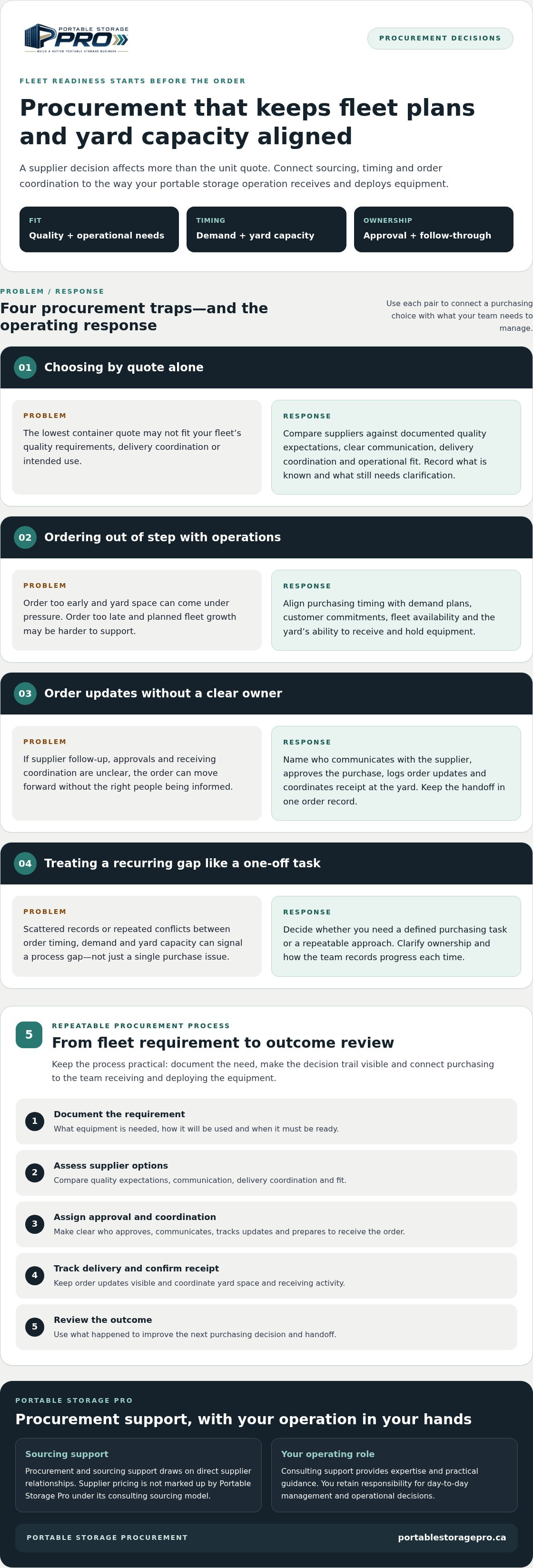
A repeatable process links each purchase to a documented fleet need, an approved supplier decision and an order that someone tracks through delivery and review. It helps you coordinate purchasing with demand planning and yard capacity without relying on fixed lead-time assumptions or ordering on instinct.
Set requirements before requesting supplier options
Begin with the intended use and the equipment characteristics your operation requires. Record constraints such as available yard space, the planned deployment period and any receiving arrangements that affect delivery. Separate confirmed requirements from assumptions that still need validation so supplier options can be assessed against a clear brief.
Assign responsibility before requesting options. Identify who defines the requirement, who approves the supplier decision and who follows order progress. A shared record can capture the specification, supplier communications, approval, stated commitments, delivery status and unresolved questions. That gives your team one reference point as the purchase moves forward.
A procurement calendar is a schedule that aligns ordering, production and delivery dates with seasonal demand peaks. Use it alongside your demand plan and fleet records to identify when equipment may be needed. Then check whether the yard can receive it at the planned time.
Track outcomes and improve the process
After delivery, compare what was planned with what happened. Record whether the order arrived in line with the supplier’s stated commitments, whether the equipment met your documented requirements and whether communication or coordination affected readiness. Check that each internal step was completed, from approval and order tracking through receipt.
Connect the review to observable operating questions: Was the fleet ready for planned deployment? Did the equipment fit its intended use? Was yard capacity workable? If a requirement was unclear or a handoff was missed, update the specification or process record before the next purchase. Consistent records make supplier assessments more useful than relying on memory alone.
A small operation can maintain the process in a shared tracker with clear ownership. As purchasing activity grows, storage business procurement services can help connect sourcing decisions with fleet plans and establish practical follow-up steps. You remain responsible for approving decisions and managing day-to-day operations.
How Portable Storage Pro supports procurement decisions
Portable Storage Pro is a specialist business-improvement resource for portable storage and shipping container rental operators. Its procurement support helps connect sourcing decisions with your business priorities, whether you are planning fleet changes, reviewing supplier options or aligning purchases with operating needs.
Connect sourcing priorities to operating goals
Begin by defining what the purchase needs to support. You might be preparing for planned fleet growth, addressing an equipment requirement or coordinating purchasing with yard capacity. Clear priorities help determine what supplier information matters and how options should be assessed.
Procurement decisions can affect work beyond the purchase itself. A fleet equipment change may require updated operating procedures or staff training. A technology purchase may need to fit the tools and processes your team already uses. Consider these connections early so you can assess a proposed purchase in its operating context.
Portable Storage Pro works with operators to relate sourcing decisions to agreed business priorities and practical implementation. The focus depends on your operation, its current processes and the decisions you need to make. Storage business procurement services should support those requirements, not impose one purchasing approach on every business.
Clarify scope, responsibilities and next steps
Before work begins, define the priorities the advisory support will address and the implementation work involved. You may need to clarify equipment requirements, assess supplier information or connect purchasing decisions with existing fleet-planning processes. Set out who provides operational details, who reviews recommendations, who approves a purchase and who handles day-to-day follow-up.
Portable Storage Pro’s procurement and sourcing work draws on direct supplier relationships. Consulting support provides expertise and guidance; it does not automatically transfer day-to-day operational responsibility. You remain responsible for running the operation and making its decisions.
A defined advisory role can help organize sourcing priorities and put agreed steps into practice while keeping management accountability with your team. Set the scope around the work your business needs, from supplier assessment to coordination with existing operating procedures.
Make your next sourcing decision with a clear plan
Effective procurement connects supplier choices to fleet readiness, demand planning and the realities of your yard. Define what your operation needs, assess suppliers against consistent criteria, and keep approvals, commitments and delivery follow-up in one repeatable process. These steps help you make decisions based on operational fit, not just an isolated quote.
Storage business procurement services can provide specialist support without shifting day-to-day management away from you. Portable Storage Pro focuses on procurement and business improvement for portable storage operators. Its consulting sourcing model draws on direct supplier relationships, and supplier pricing is not marked up by Portable Storage Pro.
Set your priorities first: identify the sourcing decision, the fleet requirement it supports and the process your team needs to follow. Then discuss your procurement priorities with Portable Storage Pro.
Frequently Asked Questions
What do storage business procurement services include?
Storage business procurement services can include supplier research, sourcing advice, purchasing coordination and order follow-up. For a portable storage operator, the work should relate to specific container or equipment requirements and fit fleet plans, yard capacity and existing processes. Support can help you compare supplier information and organize purchasing steps. The supplier remains responsible for its fulfilment, while you retain responsibility for business decisions.
How can a portable storage operator evaluate a supplier?
Evaluate a supplier against documented operating requirements, not just a quote. Review available delivery history, quality information and compliance evidence, along with communication, delivery coordination and operational fit. Record which claims are supported, which details remain unclear and who will follow up. This gives you a clearer basis for comparing suppliers and assessing whether an option fits your intended use and receiving arrangements.
What is the difference between direct sourcing and using an intermediary?
Direct sourcing connects purchasing discussions with the supplier, while an intermediary may take part in the purchasing transaction. Consulting support is different: it can help you assess sourcing options and organize decisions without becoming the seller or taking over operations. Portable Storage Pro draws on direct supplier relationships.
Does procurement consulting take over daily operations?
No. Procurement consulting provides expertise and support around agreed priorities, but it does not automatically transfer day-to-day management or purchasing authority. You remain responsible for operating the business and approving decisions. A Consulting Partner relationship provides advisory and implementation support while you retain day-to-day management. An Operating Partner relationship is separate and assigns responsibility for defined areas.
How can procurement planning account for fleet demand?
Connect planned purchases to expected demand, current fleet availability and the yard’s ability to receive equipment. A procurement calendar aligns ordering, production and delivery dates with seasonal demand peaks. Review it alongside fleet plans, then update it as operating requirements or available yard space change. Track order status and delivery commitments so your team can plan receiving and deployment without relying on assumptions about lead times.
What should an operator prepare before seeking procurement support?
Prepare a clear description of the need, including intended use, equipment requirements and operating constraints such as yard capacity or planned deployment. Gather relevant fleet and demand plans, supplier records and existing purchasing procedures. Identify who provides operational details, who approves decisions and who tracks orders. Separate confirmed requirements from assumptions that need validation so support can focus on the decisions your operation needs to make.
Can procurement services help an independent operator without an internal procurement team?
Yes. Specialist procurement support can give an independent operator access to relevant expertise without building a dedicated internal procurement function. The work can focus on your requirements, supplier assessment and purchasing processes, with the scope shaped around agreed business priorities. You and your team continue to manage day-to-day operations and retain decision authority. This can make sourcing more structured while keeping responsibilities clear.
Connect supplier choices to fleet readiness, demand planning and yard capacity. Discuss your portable storage procurement priorities with Portable Storage Pro.

Article by
Paul Taylor
Paul Taylor is the founder of Portable Storage Pro, bringing more than 35 years of experience across the container, portable storage and transportation industries. His background spans executive operations, business development, global procurement, sales, marketing and operational improvement in Canada, the UK and international markets.
Paul helps independent portable storage and container rental operators increase revenue, strengthen margins and build more efficient businesses. His work connects strategy with practical implementation, including pricing, delivery operations, supplier sourcing, staff training, technology and customer experience.
His experience includes leading multi-location storage operations and serving on the National Portable Storage Association’s board along with chairing its Canadian committee. Through Portable Storage Pro, Paul shares practical insights to help owners make informed decisions, solve operational challenges and grow profitably.
Disclaimer
Content published by Portable Storage Pro Inc. (PSP) provides general business information and industry insights. It does not replace advice tailored to your business or specialist legal, tax, engineering or other regulated advice. Reading this content or contacting PSP does not, by itself, establish a consulting engagement.
Information reflects circumstances at publication and may change. Examples and potential benefits are illustrative; results depend on individual circumstances, implementation and market conditions and are not guaranteed.
Client services are governed by the signed service agreement, agreed work plan and written amendments. Website and blog content do not amend those terms. PSP’s work is subject to applicable law and the professional commitments set out in its agreement, including the CMC-Canada Code of Professional Conduct and NPSA Code of Conduct and Ethics. Copies are available on request.
Views expressed are PSP’s own. Association membership or references do not imply association endorsement or CMC certification. Nothing in this disclaimer limits PSP’s contractual responsibilities, professional duties or rights that cannot lawfully be excluded.


