
What if the most reliable way to improve portable storage service isn’t another tool, but a team that knows how to carry out daily work consistently? Practical storage operator training programs connect routine tasks, from handling an inquiry to coordinating a delivery, with clear expectations employees can apply on the job.
You may already see where work becomes inconsistent. Staff may handle the same customer issue differently, key process knowledge may rest with one experienced employee, or written procedures may not reflect what happens in the yard. A general course won’t necessarily address those gaps. Training needs to match your operation, the tasks assigned to each role, and the decisions employees make during a typical workday.
This guide shows you how to identify training priorities, organize instruction around actual workflows, and choose formats that fit the task. It also explains how to distinguish course completion from demonstrated ability, track measures using your own operating records, and keep procedures current as work changes. The result is a practical foundation for more dependable handoffs, clearer responsibilities, and training your team can use beyond the initial orientation.
Key Takeaways
- Build storage operator training programs around the tasks each role performs, using documented procedures to set clear expectations.
- Map routine work and skill gaps before choosing what to train, then practise the tasks employees need to carry out consistently.
- Match each training format to the work: hands-on tasks may need coaching, while process reviews can benefit from SOP walkthroughs.
- Track measures tied to the trained task, such as rework, readiness, response consistency or completed handoffs, against your own records.
- Connect training priorities with operational processes so your team can apply what it learns in day-to-day portable storage work.
What should storage operator training programs cover in portable storage?
A storage operator training program is role-based instruction that teaches employees how to complete routine work to documented standards, with practice and follow-up to confirm they can apply it. Unlike a one-time orientation, it continues as tasks, procedures, and responsibilities change.
Here, the focus is portable storage and container rental operations: handling inquiries, coordinating deliveries, preparing units, and managing customer handoffs. It isn’t training for data-storage systems or underground storage tank (UST) operator certification. Portable storage sits within the broader self-storage industry, but its workflows include moving containers between yards and customer sites. Training should reflect those physical and administrative tasks.
Consistency matters at each handoff. A lead needs enough accurate information to become a workable booking; dispatch needs clear delivery details; and yard or driver teams need to understand the agreed unit condition and next step. Shared procedures also help staff care for equipment consistently and complete daily work without relying on informal knowledge held by one experienced employee.
Which roles need portable storage operations training?
Start with tasks, not titles. In a smaller operation, one employee may cover several functions, so assign training by responsibility and confirm who owns each handoff.
- Sales and customer service: capture inquiry details, explain the next steps, record commitments, and pass complete information to the person handling the booking.
- Dispatch: confirm job details, coordinate schedules, and communicate changes to the affected team members.
- Drivers and yard teams: follow the relevant procedures for unit preparation, condition checks, loading or unloading, and reporting issues.
- Managers: set process expectations, coach employees, review records, and address gaps between the written procedure and actual work.
Separate general onboarding from instruction for specialized or higher-risk responsibilities. New staff may need an overview of the operation and shared communication practices. A task involving equipment or other specific hazards calls for instruction suited to that work, including any applicable safety guidance. Don’t assume that general orientation prepares someone for every duty.
How do SOPs support consistent training?
SOPs are Standard Operating Procedures: written, step-by-step instructions for routine business processes. A procedure can make expectations visible, such as which details to record before dispatch or what to document when a unit’s condition needs attention.
Use each SOP as a training aid, not a substitute for coaching or applicable safety instruction. A supervisor can explain the steps, demonstrate the task, observe the employee practising it, and confirm what acceptable completion looks like. If staff repeatedly interpret a step differently, revise the procedure or the instruction. That keeps training connected to the way work is actually performed.
How to build a storage operator training program around daily work
Training priorities should follow the work your team actually performs and the skill gaps you observe. That keeps storage operator training programs focused on better execution, rather than on a generic list of topics.
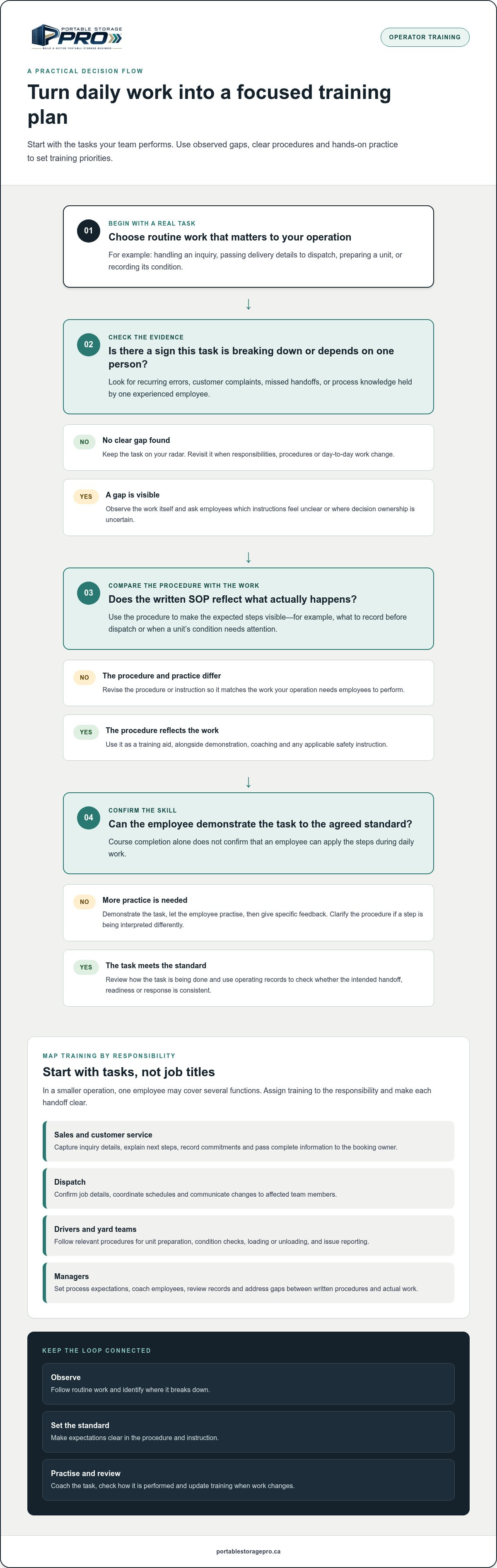
Build the program in a practical sequence: map routine tasks, identify where work breaks down, set a clear standard, practise the task with employees, then review how it’s being done. Start with the processes most connected to your current operating priorities. A small operator may focus first on lead follow-up and delivery handoffs, while a larger team may need to address role-specific procedures across sales, dispatch, drivers, and the yard.
How can an operator identify the most important skill gaps?
Use the evidence already present in daily operations. Review recurring errors, customer complaints, missed handoffs, and tasks that only one experienced employee knows how to complete. Then observe the work itself. For example, follow a quote inquiry from intake through follow-up, watch how dispatch receives delivery details, or observe how a team prepares a container.
Ask employees which instructions are unclear and where they’re unsure who can make a decision. Group the findings by task or role, then choose a manageable priority. A sample role-to-task matrix might look like this:
- Sales or customer service: capture inquiry details and record the agreed next step.
- Dispatch: pass complete delivery information to the person coordinating the job.
- Yard team: follow the unit preparation and condition-recording process.
- Manager: review the handoff or record and coach against the agreed standard.
This is a planning aid, not a required structure. Combine or split responsibilities to match your staffing and capacity. Industry resources, including the National Portable Storage Association (NPSA), can also inform your training priorities. Keep the focus on the tasks your operation performs.
How should training combine instruction and practice?
Use a simple cycle: demonstrate the task, let the employee practise it, then give specific feedback. For lead intake, have the employee record a sample inquiry and explain what information the next person needs. For delivery coordination, practise passing along a job with a changed detail. For yard flow, walk through the relevant preparation steps using the team’s documented process.
Define what successful completion looks like before practice begins. Record who has been trained on each task and what evidence shows understanding, such as an observed handoff, a completed record, or the employee explaining the next step. Review these notes when responsibilities change or a procedure is updated.
If you need support connecting training priorities to portable-storage operating processes, explore portable-storage operations and training support.
How to compare training formats for a portable storage team
No single format suits every task. Compare the work’s complexity, how often employees need access to the material, whether they must practise in context, and how much follow-up the format requires. You can combine methods: written procedures may explain a workflow, while coaching confirms an employee can apply it.
| Format | Best fit and practice needs | Access, consistency, and follow-up |
|---|---|---|
| On-the-job coaching | Physical or variable tasks, such as yard movement and delivery preparation. Allows observed practice and correction in context. | Available during work, but coaching can vary by supervisor. Requires time to observe and provide feedback. |
| Facilitated sessions | Processes that benefit from discussion, shared examples, or coordinated decisions across roles. Practice can use scenarios. | Creates a shared explanation for attendees, but takes employees away from tasks and may need repeating for staff who can’t attend. |
| Self-paced learning | Repeatable knowledge employees can review independently. May include a knowledge check, but not direct observation of field performance. | Flexible access and consistent materials. Someone still needs to track completion and follow up on questions or practical skill gaps. |
| SOP walkthroughs | Step-by-step processes employees need to revisit, such as recording a handoff or documenting a unit condition. Pair with practice where needed. | Provides a consistent reference, but procedures need updating when the process changes and coaching when instructions are unclear. |
When is hands-on coaching the right fit?
Choose observed practice when the task depends on physical layout, sequence, or judgement in the moment. A supervisor can walk through container preparation or yard movement, explain decision points, and correct a missed step before it becomes a repeated habit. For US-based teams, OSHA warehouse safety guidelines can inform safety discussions. Use applicable guidance for your location and work; a document alone doesn’t establish field competency.
When can digital learning or written procedures help?
Digital materials and written procedures work well for repeatable information employees may need to revisit. A learning tool can record who completed a module; a shared procedure can give dispatch and customer service the same reference for recording job changes. Connect these tools to a specific need in your Technology stack, such as tracking completion or distributing updated instructions. Online completion alone doesn’t show that someone can perform a task in the yard or manage a live customer handoff.
Plan for trade-offs. Coaching takes supervisor time and may be uneven; facilitated sessions interrupt normal work; self-paced materials can become detached from actual practice; and all formats need review when procedures change. If you’re aligning training methods with operating priorities, Let’s Talk About Your Business.
How to measure and maintain training after rollout
Training records show who completed instruction. They don’t, on their own, show whether an employee can perform the task or follow the process during daily work. To assess whether training is helping, track a measure tied to the task, observe the work, and compare results with your own baseline.
Before rollout, use existing records to establish what happens now. Choose a review period that fits the task and the records you keep, then use the same approach when you review progress. Avoid relying on an industry benchmark that may not match your operation.
Which operating measures can show whether training is helping?
Choose a small set of measures that reflects the work covered. For sales training, review lead response and follow-up records for consistency. For delivery and yard instruction, look at recorded readiness issues, the completeness of handoffs, and rework noted in operating records.
Customer feedback can add context. For example, comments about missed updates may point you toward a communication handoff to review. Treat feedback as a signal alongside operational evidence, not proof that training alone caused a change. Staffing, workload, or a revised workflow may also affect the result.
Separate three checks:
- Completion: Was the assigned instruction completed?
- Competence: Can the employee demonstrate the task to the agreed standard?
- Process adherence: Does the task follow the documented procedure during normal work?
This distinction gives managers a clearer next step. If an employee completed training but struggles in practice, arrange coaching. If the task is performed well but the handoff remains incomplete, review the procedure or how responsibilities are assigned.
How can managers keep SOPs and training current?
Assign an owner to each procedure. That person can review it when workflows, responsibilities, or tools change, record approved revisions, and make sure affected employees receive updated instruction. Don’t leave old copies in circulation; staff need to know which version guides the task.
Use coaching observations and employee questions as feedback on the procedure itself. Repeated confusion may mean a step is unclear, a decision point is missing, or the written process no longer reflects the work. For more guidance, see resources on storage business SOP development.
Portable Storage Pro provides portable-storage-specific operations and training support. Discuss your training priorities with Portable Storage Pro.
How Portable Storage Pro can support operator training and operations
Portable Storage Pro is a specialist consulting and business improvement resource for portable storage and shipping container rental operators. Its portable-storage-specific consulting and operational leadership can help you connect agreed training priorities with the processes, responsibilities, and management decisions around them. That matters when training needs to fit the realities of your business rather than sit apart from daily operations.
For example, a team may have procedures for customer communication but lack clarity about how responsibilities pass between staff. Advisory support can help you examine that process, identify what needs to be clarified, and connect the agreed changes to staff instruction. The focus is on making operational priorities practical, with owners and managers retaining clear oversight of how the business runs.
What can portable-storage-specific advisory support address?
Operations and training support can address agreed priorities across staff processes, SOPs, and the way routine work is organized. The starting point may be a specific gap, such as unclear responsibility for a customer handoff, inconsistent use of a procedure, or an operating process that has changed without corresponding staff guidance. The work can then connect the process, documentation, and training needs instead of treating each as a separate issue.
Portable Storage Pro also gives operators access to senior expertise without building a full internal leadership team. Support is shaped around the priorities agreed with the business, which can help owners focus attention on the operating questions that need action. Recommendations and implementation support do not guarantee a particular saving, performance result, or business outcome. The aim is to clarify the work, support practical changes, and help the team understand the processes it is expected to follow.
How can an operator start a focused training conversation?
Bring a small set of practical information to the discussion: current procedures, recurring workflow issues, and the roles most affected. A recent example of a confusing handoff or a procedure staff interpret differently can help make the issue specific. It’s also useful to identify what you want employees to be able to do more consistently, so training priorities connect to an operating need.
Under the Consulting Partner model, owners retain day-to-day management while receiving advisory and implementation support across agreed priorities. It is distinct from the Operating Partner relationship, which covers defined areas of operational responsibility. Discussing training support does not mean daily management automatically transfers to Portable Storage Pro. You and your advisory partner can keep the intended scope clear as priorities are set.
To discuss staff training priorities and the operating processes behind them, visit Let’s Talk About Your Business.
Put training into practice across your operation
Training creates value when employees can apply it during the work they’re responsible for. Build storage operator training programs around actual tasks, make expectations clear, and choose instruction that fits the work. A written procedure may support a repeatable process, while observed practice can help confirm that an employee can carry it out. Keep the approach proportionate to your team and operating priorities.
After rollout, look beyond completion records. Compare task-related measures with your own baseline, observe how work is performed, and use staff and customer feedback to spot areas that need attention. Revisit procedures when responsibilities or workflows change. This ongoing review helps you keep training connected to the operation rather than treating it as a one-time event.
Portable Storage Pro provides portable-storage-specific consulting and operational leadership, including operations and training support tied to agreed business priorities. If you’re ready to connect staff development with the processes your business needs to strengthen, Let’s Talk About Your Business. A focused discussion can help you identify a practical next step for your team.
Frequently Asked Questions
What should a portable storage operator training program include?
It should cover the work employees perform, guided by role-specific tasks rather than a generic course list. Depending on your operation, that may include customer communication, lead handling, delivery coordination, yard processes, equipment readiness, and relevant SOPs. Identify unclear instructions, define the expected process, and give employees a chance to practise. The scope of storage operator training programs should reflect your services, team responsibilities, and observed skill gaps.
How do you train staff at a portable storage business?
Map the main tasks for each role, identify skill gaps through observation and employee feedback, then document the expected steps. Demonstrate a process, let employees practise with realistic examples, and give specific feedback. Keep a record of which tasks each employee has practised and revisit instruction when procedures change. Cross-training can support continuity on a lean team, but make sure employees understand their responsibilities and can demonstrate the tasks assigned to them.
Can online training work for portable storage operators?
Yes. Online learning can deliver repeatable information, such as customer communication standards or instructions for using a business system. It also gives employees material they can revisit. However, course completion doesn’t demonstrate that someone can perform a physical workflow or respond appropriately to an exception. Pair digital learning with observation and hands-on practice for tasks that require field execution or judgement. Use completion records to identify who may need further instruction, not as proof of competency.
How often should storage operator training be reviewed?
Review training when a procedure, role, system, or operating priority changes, or when observations reveal a recurring gap. A regular review schedule can also help you catch outdated instructions, but the right interval depends on your workflows and records. Assign responsibility for each procedure, record approved revisions, and explain what changed to affected staff. Course completion alone doesn’t confirm employees are following the process correctly, so include observation and feedback in your review.
How can a small portable storage company measure training effectiveness?
Choose measures that match the task. After sales-process training, review lead response and follow-up records for consistency. After delivery-process instruction, check handoff completeness, readiness records, or documented rework. Compare your own observations over time and consider other factors, such as workload or workflow changes. Pair operating records with supervisor observations and employee feedback. A change in a measure can indicate an area to investigate, but it doesn’t prove training caused that change.
Are storage operator training programs the same as UST operator certification?
No. UST operator training relates to underground storage tank systems and may address requirements specific to that context. Portable storage operator training focuses on container rental workflows, such as lead handling, delivery coordination, yard processes, equipment readiness, and customer service. These are distinct subjects. If you’re determining whether a training or certification requirement applies to your business activities, consult current primary sources for your jurisdiction rather than assuming one program covers both.
Can Portable Storage Pro help with staff training and operating procedures?
Yes. Portable Storage Pro provides specialist consulting and operational support for portable storage and container rental operators, including support for agreed operations and training priorities. Under the Consulting Partner model, owners retain day-to-day management while receiving advisory and implementation support. The separate Operating Partner relationship covers defined operational responsibilities. Training support can connect staff priorities with operating procedures, but it doesn’t promise specific financial or operational results or automatically transfer daily management.

Article by
Paul Taylor
Paul Taylor is the founder of Portable Storage Pro, bringing more than 35 years of experience across the container, portable storage and transportation industries. His background spans executive operations, business development, global procurement, sales, marketing and operational improvement in Canada, the UK and international markets.
Paul helps independent portable storage and container rental operators increase revenue, strengthen margins and build more efficient businesses. His work connects strategy with practical implementation, including pricing, delivery operations, supplier sourcing, staff training, technology and customer experience.
His experience includes leading multi-location storage operations and serving on the National Portable Storage Association’s board along with chairing its Canadian committee. Through Portable Storage Pro, Paul shares practical insights to help owners make informed decisions, solve operational challenges and grow profitably.
Disclaimer
Content published by Portable Storage Pro Inc. (PSP) provides general business information and industry insights. It does not replace advice tailored to your business or specialist legal, tax, engineering or other regulated advice. Reading this content or contacting PSP does not, by itself, establish a consulting engagement.
Information reflects circumstances at publication and may change. Examples and potential benefits are illustrative; results depend on individual circumstances, implementation and market conditions and are not guaranteed.
Client services are governed by the signed service agreement, agreed work plan and written amendments. Website and blog content do not amend those terms. PSP’s work is subject to applicable law and the professional commitments set out in its agreement, including the CMC-Canada Code of Professional Conduct and NPSA Code of Conduct and Ethics. Copies are available on request.
Views expressed are PSP’s own. Association membership or references do not imply association endorsement or CMC certification. Nothing in this disclaimer limits PSP’s contractual responsibilities, professional duties or rights that cannot lawfully be excluded.


