

What if your fleet is busy and your sales pipeline looks healthy, yet containers still sit idle and customer issues keep recurring? The right storage business performance metrics can help show how those results connect. A long list of disconnected figures rarely tells you what to do next.
Portable storage operators need a clear view of fleet use, sales flow, delivery performance and customer outcomes. You don’t need an industry benchmark for every measure. You need a manageable scorecard, consistent definitions and enough history to see whether results are changing.
This article explains which measures to track, how to define them and how to review trends over time. Fleet utilization, lead conversion, empty repositioning, delivery reliability and customer feedback can point to practical decisions, from improving quote follow-up to reviewing routing or container readiness. The aim is a useful operating picture, not more numbers for their own sake.
Key Takeaways
- Choose storage business performance metrics that answer real operating questions, rather than tracking every number your systems produce.
- Define each measure consistently, including its numerator, denominator, time period and exclusions, so you can compare results over time.
- Connect fleet utilization, idle-container time, fleet readiness and revenue per container to the data source and decision each measure supports.
- Before acting on a change, validate the data and compare related measures, such as lead volume and conversion, to narrow down what may be driving the result.
- Build a practical review routine by documenting definitions, assigning metric owners and starting with data your business already records.
Storage business performance metrics: What should portable storage operators measure?
Your scorecard should help answer operating questions, not simply display everything your systems record. A performance metric is a measure calculated consistently over a defined period and tied to a decision. For a portable storage operation, that could mean asking whether containers are earning rental revenue, whether leads are becoming customers, whether deliveries are completed as planned or whether customers continue renting.
A small, connected set of storage business performance metrics is more useful than an unfiltered dashboard. It helps you see how activity in one area relates to results in another. For example, assess a change in sales conversion alongside lead volume and available fleet capacity. A metric is a practical performance indicator when it tracks progress towards an operating or business objective and informs action.
How do performance metrics differ from business goals?
A goal describes an intended result, such as stronger customer retention. A metric tracks progress towards that result. To make the measure useful, define how it’s calculated, where its data comes from, who reviews it and what decision it can inform.
Hypothetical example: If your goal is to improve retention, you might track the share of customers who continue renting at the end of a defined period. Specify which customers count, the period being assessed, the system that records rental status and who checks the result. The metric won’t explain the cause on its own, but it can prompt a review of service issues, delivery experience or account follow-up.
Which metrics belong on a portable storage scorecard?
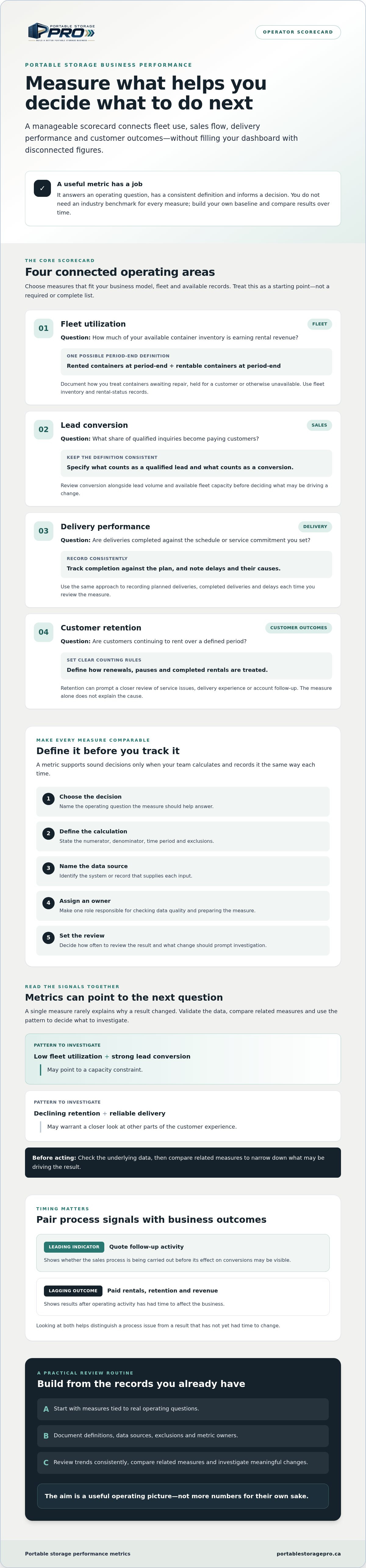
Start with measures that reflect four connected areas. The right selection depends on your business model, fleet and available records, so treat this as a starting point, not a required or complete list.
- Fleet: Fleet utilization can show how much of your available container inventory is earning revenue during a defined period.
- Sales: Lead conversion can show what share of qualified inquiries become paying customers. Define what counts as a lead and a conversion.
- Delivery: Delivery performance can track completion against the schedule or service commitment you set. Record delays consistently and note their causes.
- Customer outcomes: Customer retention can show whether customers continue renting over a defined period. Set clear rules for renewals, pauses and completed rentals.
These measures become more useful when reviewed together. For example, low fleet utilization alongside strong lead conversion may point to a capacity constraint. Declining retention alongside reliable delivery may warrant a closer look at other parts of the customer experience. Don’t assume a universal target applies to your operation. Establish your own baseline using consistent definitions, then compare results over time and investigate meaningful changes.
How to define storage business performance metrics consistently
A metric supports sound decisions only if your team calculates and records it the same way each time. Before adding a measure to your storage business performance metrics scorecard, use a repeatable sequence:
- Choose the decision: Identify the operating question the measure should help answer.
- Define the measure: State the calculation, including numerator, denominator, time period and exclusions.
- Identify the data: Name the system or record that supplies each input.
- Assign an owner: Make one role responsible for checking data quality and preparing the measure.
- Set the review: Decide how often to review the result and what change should prompt investigation.
Separate leading indicators from lagging outcomes. Quote follow-up activity is a leading indicator. It can show whether the sales process is being carried out before you can see its effect on conversions. Paid rentals, retention and revenue are lagging outcomes. Looking at both helps distinguish a process issue from a result that has not yet had time to change.
What makes a metric clear enough to act on?
Take fleet utilization. One possible definition is rented containers at period-end divided by rentable containers at period-end. Document how you treat containers awaiting repair, held for a customer or otherwise unavailable. Use fleet inventory and rental-status records as sources, and assign someone to check for missing status changes and duplicate container records.
For lead conversion, define the stage change explicitly, such as an inquiry becoming a paid rental. Compare inquiries received in the same period, and allow your chosen follow-up window to close before calculating the result. Use your CRM or lead log alongside rental records. The assigned owner should check for duplicate inquiries, missing source details and inconsistent stage updates.
Document these definitions in SOPs so staff enter and interpret information consistently. For delivery measures, define which scheduled jobs count and how rescheduled or cancelled work is recorded. Logistics resources discussing transportation performance metrics can help you consider relevant fleet and delivery measures, but adapt each definition to your own records and operating decisions.
How should operators set a baseline without a benchmark?
Start with your own historical records. Choose a period your data can support, then compare like periods using the same calculation. Note changes in fleet size, seasonality, delivery coverage or operating conditions that may affect the result. A rise or fall isn’t automatically evidence of better or worse performance.
Check record quality before interpreting a trend. Missing rental statuses, duplicate leads or inconsistent delivery updates can distort a comparison. Flag those gaps, correct what you can and establish a reliable starting point before setting an internal target. If you need support documenting measures and review responsibilities, Portable Storage Pro’s operations and training support is relevant to that work.
Which fleet, sales, and delivery metrics reveal operating performance?
Useful storage business performance metrics connect asset activity to sales flow and customer outcomes. The table below is a practical starting point, not a universal checklist. Set each review frequency to match how quickly you can act on the information, and assign someone to check that records are complete and consistently coded.
| Metric | Definition | Data source | Review frequency | Decision it can inform |
|---|---|---|---|---|
| Fleet utilization | Rented containers divided by rentable containers for the same period. | Fleet inventory and rental records | Monthly, or alongside capacity planning | Review fleet allocation, availability or demand patterns. |
| Idle-container time | Days a rentable container is available but not rented. | Container status history and rental records | Monthly | Investigate location, condition, pricing or demand constraints. |
| Fleet readiness | Containers ready for rental divided by the fleet in scope. | Inspection and maintenance records | Weekly or before dispatch planning | Prioritize repairs, inspections or yard preparation. |
| Revenue per container | Rental revenue for the period divided by the average rentable fleet during that period. | Billing records and fleet inventory | Monthly | Compare asset productivity across periods or fleet groups. |
| Lead conversion | Inquiries from a defined cohort that become paid rentals, divided by inquiries in that cohort. | CRM or lead log and rental records | Monthly, after the follow-up window | Review lead quality, sales stages or follow-up practices. |
| Quote response | Elapsed time from inquiry to first quote, summarized consistently. | Lead timestamps and quote records | Weekly | Identify delays in the lead intake or quoting process. |
| Customer retention | Eligible customers continuing to rent at the end of a defined period. | Customer and rental records | Monthly or by renewal cycle | Investigate service issues or account follow-up needs. |
| Repeat-customer activity | Returning customers or repeat rentals within a defined period. | Customer and rental history | Monthly or quarterly | Identify patterns in repeat demand and customer experience. |
| Delivery completion | Deliveries completed as scheduled divided by scheduled deliveries, using consistent exclusions. | Dispatch schedule and delivery records | Weekly | Review dispatch planning, route sequencing or yard flow. |
| Empty repositioning | Empty moves, or distance travelled empty, recorded for a defined period. | Dispatch logs or available vehicle tracking | Weekly or monthly | Assess routing, fleet positioning and dispatch decisions. |
| Damage records | Damage incidents recorded by container, type and period. | Inspection and incident records | Monthly, with prompt review of new incidents | Look for recurring handling, equipment or training issues. |
What do fleet and delivery metrics show?
High idle time alongside lower utilization may justify checking whether containers are in the right locations, ready for rental and aligned with demand. Delivery completion and empty repositioning add context: a dispatch pattern may affect both schedule reliability and where available containers sit. Readiness and damage records help distinguish usable capacity from fleet that needs attention. Set your own baselines rather than assuming a universal target.
What do sales and customer metrics reveal?
Compare lead-conversion cohorts using the same stages and time window. Quote follow-up and response timing show whether the process is being carried out, not whether a sale is guaranteed. Review retention and repeat activity alongside delivery and service records to identify questions for investigation, rather than treating a single measure as proof of the cause.
How to interpret storage business metrics and choose the next action
A scorecard earns its place when a review leads to a clear decision. When a result changes, don’t react to the number alone. First confirm the movement is meaningful against your own history, then identify what may have contributed and decide who will follow up. This keeps the review focused on practical next steps rather than speculation.
- Confirm the signal: Check whether the movement persists across comparable periods or groups.
- Check the context: Note changes in fleet mix, demand patterns, staffing or operating conditions that may affect the result.
- Investigate contributors: Break the result down by relevant stage, asset, route or process where records allow.
- Agree on follow-up: Record the action, the person responsible and when the team will review it again.
Look at connected results before settling on an explanation. If completed deliveries change, consider whether dispatch capacity, yard flow or container readiness also shifted. If customer retention changes, review relevant service feedback and account notes. These comparisons help narrow the questions to investigate, but they don’t establish cause on their own.
Keep a short decision log alongside the scorecard. Note what the team observed, what it decided to check or change, and what information would help assess the next result. This record makes it easier to distinguish a repeated issue from a one-off fluctuation and gives managers context when responsibilities or priorities shift.
How can operators investigate a metric that changes?
Start by asking the people closest to the work what they observed during the period. Compare their account with relevant records, such as dispatch notes, customer feedback or lead-stage history. Where the data supports it, separate the result into useful groups, such as container status or sales stage. Treat each explanation as a possibility to test. Avoid changing several processes at once if you need to understand which action influenced the next observation.
How often should a portable storage scorecard be reviewed?
Choose a review rhythm that matches the pace of the decision. Teams may need to address immediate operating exceptions separately from management reviews of longer-running patterns and priorities. Keep those conversations distinct so urgent follow-up doesn’t crowd out broader planning.
At each review, confirm the action owner and next check-in date. If the result hasn’t changed, decide whether to continue, adjust or close the action based on the evidence available.
Turn storage business performance metrics into an operating routine
A scorecard is useful only if your team reviews it and acts on what it shows. Keep the process straightforward: choose measures that support current operating priorities, document each definition, assign an owner and schedule a review. Start with records you already maintain, such as rental status, lead activity, dispatch logs and customer history. Add a new tracking step only when it will inform a specific decision.
- Select: Keep measures that answer a current operating question across fleet, sales, delivery or customer outcomes.
- Document: Record the calculation, data source, time period, exclusions and any limitations.
- Assign: Name the person responsible for checking data quality and bringing the result to the review.
- Review: Set a schedule, record the decision and action, then note when the team will check the result again.
Connect measures to SOPs and staff training where consistent recording or follow-up is needed. For example, a delivery measure is more useful when dispatch staff share a clear process for recording completion and exceptions. That process can be documented and reinforced through training without requiring new software. A spreadsheet or existing business system may be sufficient if it captures the information needed for the decision.
When should a business update its scorecard?
Revisit your storage business performance metrics when your strategy, fleet mix, sales process or staff responsibilities change. A measure that once guided a decision may no longer be relevant. Remove it from active review when it stops informing action, but retain its definition and historical results so past comparisons remain understandable.
Before adopting technology to track a new measure, define the operating need. Decide what information is missing, who will use it and what decision it should support. Then check whether a tool fits your existing workflow and records. Technology should address a defined tracking or operating requirement, not add reporting without a clear use.
Where can portable storage operators get practical support?
Portable Storage Pro provides consulting and operational leadership tailored to portable storage operators, with support across areas such as operations, sales, training, procurement and technology. Its advisory partnership can help connect measures to operating priorities, while the owner retains day-to-day management. For any engagement, clarify the priorities, responsibilities and work involved.
A scorecard can help identify where to focus. Portable Storage Pro can provide practical support as operators review performance and connect measures to business priorities.
Make your scorecard part of how you manage
Useful storage business performance metrics do more than report activity. They help connect fleet use, sales follow-up, delivery execution and customer outcomes to decisions your team can make. Choose measures that answer real operating questions, define them consistently and assign someone to review the data. Use your own reliable history as the baseline rather than assuming an outside target fits your fleet or business model.
Keep the scorecard active. Review definitions and priorities when your fleet, sales process or responsibilities change. Record the action taken and check the results at the next review, while treating the data as a guide for investigation rather than proof of cause.
Portable Storage Pro provides consulting and operational leadership for portable storage operators, with expertise across operations, sales, marketing, training, procurement and technology. If you’re considering how to connect your measures to practical improvement, Let’s Talk About Your Business. A clear scorecard gives you a practical starting point for steady, informed decisions.
Frequently Asked Questions
Which performance metrics should a portable storage business track first?
Start with a small set of storage business performance metrics tied to decisions you can act on. Fleet utilization shows how much rentable inventory is generating revenue; lead conversion helps assess the sales process; delivery completion highlights dispatch execution; and customer retention helps identify patterns in ongoing customer relationships. Choose measures your records can support, define them consistently and review them together rather than treating each result as a separate verdict.
How do you calculate fleet utilization for portable storage containers?
Divide the number of rented containers by the number of rentable containers in the same period, then multiply by 100 to express the result as a percentage. Choose whether you’ll use a period-end snapshot or average fleet counts, and apply that method consistently. Define how you classify containers awaiting repair or otherwise unavailable. If those rules change, document the change before comparing the new result with past periods.
What does revenue per container tell an operator?
Revenue per container shows the rental revenue generated relative to the size of the fleet in scope. One approach is to divide rental revenue for a defined period by the average number of rentable containers during that period. Use a consistent rule for revenue included and fleet availability. The measure can help you compare periods or fleet groups, but it doesn’t show profitability by itself. Review it alongside utilization and operating results.
How should a storage operator measure lead conversion?
Divide the number of leads from a defined inquiry cohort that become paying customers by the total number of eligible inquiries in that cohort. Define the conversion stage, such as a paid rental, and allow the same follow-up window for each cohort. Use CRM or lead-log records alongside rental records. Check for duplicate inquiries, missing entries and inconsistent stage updates before comparing results across periods or lead sources.
Why track empty repositioning and delivery performance?
These measures help you examine how dispatch and fleet movement relate to delivery execution. Record scheduled and completed deliveries using a consistent definition, and track empty moves or empty distance where your records allow. Review the measures together: changes may prompt questions about route planning, yard flow or where containers are positioned. They don’t prove a cause on their own, so check dispatch records and operating context before changing a process.
How often should a portable storage business review its performance metrics?
Set review timing according to how quickly your team can respond to a change. Check time-sensitive operating measures, such as fleet readiness or dispatch activity, on a schedule that supports action. Review broader sales and customer trends over periods that allow meaningful comparison. There’s no single cadence for every operator. Assign an owner to each measure, record decisions and actions, and set the next review date.
Can a small operator track performance metrics without specialized software?
Yes. You can begin with records you already maintain, such as a spreadsheet, rental-status log, lead tracker, dispatch schedule or billing records. The key is consistent definitions, timely updates and a named person who checks for missing or duplicate entries. Add software only when it addresses a defined tracking or operating need, such as connecting lead stages to rental outcomes or consolidating fleet status information.

Article by
Paul Taylor
Paul Taylor is the founder of Portable Storage Pro, bringing more than 35 years of experience across the container, portable storage and transportation industries. His background spans executive operations, business development, global procurement, sales, marketing and operational improvement in Canada, the UK and international markets.
Paul helps independent portable storage and container rental operators increase revenue, strengthen margins and build more efficient businesses. His work connects strategy with practical implementation, including pricing, delivery operations, supplier sourcing, staff training, technology and customer experience.
His experience includes leading multi-location storage operations and serving on the National Portable Storage Association’s board along with chairing its Canadian committee. Through Portable Storage Pro, Paul shares practical insights to help owners make informed decisions, solve operational challenges and grow profitably.
Disclaimer
Content published by Portable Storage Pro Inc. (PSP) provides general business information and industry insights. It does not replace advice tailored to your business or specialist legal, tax, engineering or other regulated advice. Reading this content or contacting PSP does not, by itself, establish a consulting engagement.
Information reflects circumstances at publication and may change. Examples and potential benefits are illustrative; results depend on individual circumstances, implementation and market conditions and are not guaranteed.
Client services are governed by the signed service agreement, agreed work plan and written amendments. Website and blog content do not amend those terms. PSP’s work is subject to applicable law and the professional commitments set out in its agreement, including the CMC-Canada Code of Professional Conduct and NPSA Code of Conduct and Ethics. Copies are available on request.
Views expressed are PSP’s own. Association membership or references do not imply association endorsement or CMC certification. Nothing in this disclaimer limits PSP’s contractual responsibilities, professional duties or rights that cannot lawfully be excluded.


