
The option labelled “jobsite-ready” isn’t automatically the right addition to your fleet. Effective jobsite container fleet procurement starts with how an asset will be delivered, handled, positioned and returned to service, not the product description alone.
You may be comparing a specific Site Box product with containers, mobile office trailers or smaller job boxes. These options can serve different purposes, so comparing labels or headline features can obscure the operational fit. The right choice depends on the work your fleet needs to support and the demands it will place on your yard and delivery process.
This article offers a practical framework for assessing alternatives against consistent requirements. Define the intended use, check fleet readiness and handling needs, then review supplier reliability and the terms behind each offer. A clear record of what to verify before proceeding helps ground the decision in operational evidence, not assumptions about what a product name promises.
Key Takeaways
- Start jobsite container fleet procurement by defining the use case and distinguishing fleet needs from a single-site purchase.
- Compare alternatives using the same verified specifications, handling requirements and supplier commitments, not product labels.
- Assess how each option fits your yard flow, inspections, deployment process and fleet-readiness standards.
- Use a consistent procurement process to request evidence, validate terms and document approval before committing.
- Where feasible, test handling and workflow assumptions through a limited operational trial before expanding the fleet.
Jobsite container fleet procurement: define the job before comparing alternatives
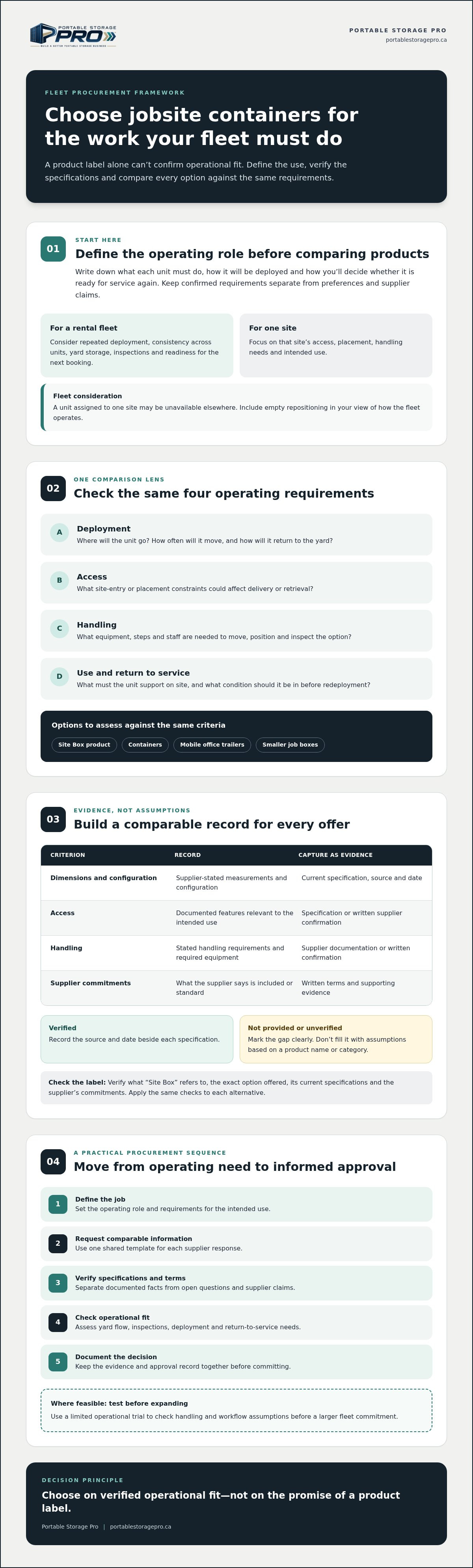
Start by defining the operating role, not by ranking supplier names or product labels. Jobsite container fleet procurement means selecting assets for a defined operating role, based on how they’ll be deployed, handled, maintained and returned to service. For a portable storage rental operator, that means assessing how an option fits repeated deployment across customer sites and the existing fleet. For an industrial buyer, the decision may centre on storage needs at one location.
These are different purchasing decisions. A product suitable for one fixed site may not fit a rental operation’s delivery, yard and fleet-readiness workflows. Before comparing alternatives, write down the job each unit must perform and how you’ll assess whether it does that job.
Which operating requirements should shape the comparison?
Record the operating conditions for each intended use. Keep confirmed requirements separate from preferences and claims a supplier describes as standard. This makes it easier to request comparable evidence instead of treating sales language as a specification.
- Deployment: where units will go, how often they’ll move and how they’ll be returned to the yard.
- Access: site entry and placement constraints that could affect delivery or retrieval.
- Handling: the equipment, steps and staff needed to move, position and inspect each option.
- Use: what the unit must support on site, and the condition it should be in before redeployment.
Next, identify what remains unknown. “Jobsite-ready” or “site box” may not identify a consistent product type. Verify what Site Box refers to, the exact option being offered, its current specifications and the supplier’s commitments using current primary sources. Apply the same checks to each alternative. Until you have that evidence, don’t assume the products are directly comparable.
Is this a fleet purchase or a single-site decision?
Repeated deployment changes the assessment. As a rental operator, consider consistency across units, inspection routines, yard storage and readiness for the next booking. Connect jobsite demand to fleet utilization: a unit assigned to one site may be unavailable elsewhere. Also account for empty repositioning, since moving a unit without a customer load affects how the fleet operates.
A single-site buyer has a narrower operating context. The key question is whether the selected option suits that site’s access, placement, handling and intended use. Keep the analysis focused on commercial site requirements rather than consumer storage advice.
Once you’ve defined the need, you can follow a structured procurement process from requirements to sourcing and approval. This sequence keeps the comparison anchored to your operation while leaving product claims and supplier terms open to verification.
Compare jobsite container alternatives using consistent procurement criteria
Once you’ve defined the operating need, compare each option against the same criteria. A consistent comparison helps separate verified product information from assumptions and shows where a supplier’s offer fits your deployment process.
Construction supply decisions can affect whether required materials and equipment are available when needed. Procore’s guide to the Construction supply chain offers broader context on procurement and continuity. Apply that thinking to your fleet by assessing the unit, delivery arrangement and supplier commitments together.
What belongs in a jobsite container comparison table?
Use a shared template for every supplier response. Record the source and date beside each specification so your team can confirm what the information describes and whether it’s current. Mark gaps as “not provided” or “unverified”; don’t fill them with assumptions based on a product name or category.
| Comparison criterion | What to record | Evidence to capture |
|---|---|---|
| Dimensions and configuration | Supplier-stated measurements and described configuration | Current specification, source and date |
| Access | Documented access features relevant to the intended use | Specification or written supplier confirmation |
| Handling | Stated handling requirements and any required equipment | Supplier documentation and questions requiring confirmation |
| Deployment suitability | Fit with delivery access, placement, storage and return workflows | Your operating requirements matched against verified information |
| Supplier commitments | Documented delivery, quality and compliance terms | Written offer, terms and responsible parties |
Using identical criteria makes supplier responses easier to assess because every option is judged against the same operating requirements and evidence standard. It also makes missing information visible before approval. Don’t infer Site Box features or treat alternatives as equivalent until current primary sources confirm what each product is and what the supplier commits to provide.
No format is best for every fleet or site. A feature that suits one deployment may add handling steps or fail to meet another operation’s requirements. Compare trade-offs against your intended use rather than trying to establish a universal ranking.
How do sourcing routes affect the decision?
When comparing direct supplier relationships and intermediary routes, document who is responsible for product information, delivery coordination, issue resolution and the commitments in the offer. Assess supplier reliability using available evidence about delivery, quality and compliance. For supplier continuity considerations, review this guide to portable storage supply chain risk management.
Portable Storage Pro provides procurement and sourcing guidance to portable storage operators. Under its consulting sourcing model, supplier pricing is not marked up by Portable Storage Pro.
Assess fleet fit, supplier reliability, and lifecycle requirements
A verified specification is only useful if the option fits your operation after delivery. For jobsite container fleet procurement, assess the full workflow: supplier receipt, yard staging, delivery, return, inspection and preparation for redeployment. A mismatch with your equipment, yard layout or documented procedures can add handling steps or leave a unit unready for its next assignment.
Map that movement before approving a purchase. Identify who handles each hand-off, what inspection is required and how the unit is recorded as it moves through the yard. Check compatibility with your team’s equipment and procedures, and identify any training needed to handle the option consistently. If a requirement is unclear, assign someone to verify it rather than leaving it to be resolved after delivery.
Will the option fit existing fleet and yard workflows?
Compare each verified option with your current deployment process. Consider whether it can be staged in the available yard space, handled with documented equipment and inspected using established procedures. Standardizing units may simplify staff training, inspection routines and fleet records, but it isn’t automatically the best choice. Different customer applications or site conditions may call for different configurations. Document where consistency helps and where a variation serves a defined operating need.
Use a total cost of ownership analysis to consider the asset’s lifecycle, not just its initial procurement. Include relevant factors such as handling, inspection, maintenance, storage and readiness for redeployment. You don’t need to publish monetary values to use the framework. Its purpose here is to make lifecycle requirements visible and comparable.
How should operators assess supplier reliability?
Supplier assurances describe intentions; evidence helps you assess performance against documented commitments. Request available records or written terms covering delivery commitments, product quality and applicable compliance documentation. Review exceptions, warranty terms and responsibility boundaries, including who handles an issue and what process applies. Record evidence separately from verbal assurances, and keep unanswered questions visible during the decision review.
Build a vendor reliability assessment that captures the evidence reviewed, open questions, follow-up owner and approval decision. This gives your team a record to revisit when comparing suppliers or planning future fleet orders. After procurement, visibility into asset location and status can also support deployment and yard decisions. Explore portable storage asset tracking solutions as you consider what information your operation needs to manage units through their lifecycle.
Use a procurement process that tests assumptions before fleet commitment
A documented process helps you move from supplier claims to a decision your operation can support. Keep it proportionate: a smaller operator may manage the review with one shared comparison sheet and a clear approval owner, while a larger procurement may need input from operations, delivery and finance.
- Define requirements. Write down the intended job, site conditions, handling needs and fleet workflows the option must support.
- Request comparable evidence. Send each supplier the same requirements and ask for current specifications and written responses.
- Review operational fit. Compare verified information against yard staging, delivery, return, inspection and staff procedures. Mark gaps for follow-up.
- Validate terms. Confirm delivery commitments, quality terms, applicable compliance documentation and after-sale responsibilities where relevant.
- Document approval. Record the selected option, evidence reviewed, unresolved exceptions, decision owner and reason for proceeding.
Before comparing final proposals, resolve unanswered questions or clearly record them as exceptions. A consistent record also makes later reviews easier if supplier commitments or operating needs change.
What should a supplier request include?
Use one request template for every supplier. Include the verified product requirements and operating conditions, then ask for written details on delivery, quality, applicable compliance documentation and responsibility after delivery. Ask suppliers to identify any requirement they can’t confirm. Keep responses, source documents and dates together so the decision team can distinguish verified facts from assumptions.
How can a pilot or first deployment reduce uncertainty?
When feasible, test an option in a limited operational trial before repeating or expanding the procurement. Set a defined purpose, such as checking site access, handling steps or fit with yard staging. Assign an owner to record observations and exceptions, including delays, damage, inspection issues and workflow changes. The aim is to test specific assumptions, not to treat a single deployment as proof that every future site will be the same.
After deployment, track whether units are ready when required, how they’re being utilized, damage noted during inspection, and delivery or yard exceptions. Review the findings with the staff who handle the units. Update the requirements or operating procedures before placing another order. These measures also connect fleet decisions to broader performance; see this portable storage profitability guidance for related considerations.
How Portable Storage Pro can support jobsite container fleet procurement
Portable Storage Pro advises portable storage and shipping container rental operators on procurement, sourcing and business improvement. For jobsite container fleet procurement, that support can help you assess supplier proposals against your fleet’s operating requirements, identify gaps in the evidence and connect the decision to yard flow, delivery systems and fleet readiness.
Portable Storage Pro’s sourcing support works through direct supplier relationships. Under its consulting sourcing model, supplier pricing is not marked up by Portable Storage Pro. The company provides advisory support, not container or equipment sales. Supplier selection and procurement outcomes depend on the evidence, terms and decisions involved; no outcome is guaranteed.
What procurement questions can an operator bring to an adviser?
Bring the material your team already uses to assess the decision, including fleet requirements, supplier proposals, yard workflows and unanswered specification questions. You can also discuss how procurement connects with delivery systems, fleet-readiness checks and operating procedures. This keeps the review grounded in how units move through your business, rather than treating the purchase as a standalone transaction.
Be clear about responsibilities. Under a Consulting Partner relationship, owners retain day-to-day management while receiving expertise, resources and support from Portable Storage Pro. Any separate operational relationship must be agreed distinctly; procurement advice alone doesn’t transfer management responsibility.
What should the next step look like?
Before moving forward, capture a short decision record. State the operating need, the option under consideration, the evidence reviewed and any open questions. Assign a person to each follow-up, such as confirming a supplier commitment or checking a workflow requirement. This gives your team a clear basis for approval, further review or a decision to wait for missing information.
That record also helps keep internal stakeholders aligned. Operations can confirm handling and yard requirements, while the person managing supplier discussions can follow up on documented terms. If your assessment identifies a need to update a procedure or staff training, record that work alongside the procurement decision so fleet readiness isn’t left until deployment.
Make your next fleet decision with clear operating criteria
Strong jobsite container fleet procurement starts with a defined operating role, not a supplier label. Compare alternatives using the same verified criteria, then check how each option fits delivery, yard flow, inspection and redeployment. Supplier assurances alone aren’t enough; document the evidence, open questions and responsibilities behind each proposal.
A practical next step is to summarize your requirements, identify what still needs verification and assign an owner to each follow-up. Where feasible, a limited deployment can test handling and workflow assumptions before you repeat or expand the order.
Portable Storage Pro provides procurement and sourcing advisory for portable storage operators. To discuss your procurement priorities, let’s talk about your business.
Frequently Asked Questions
What should I compare when evaluating jobsite container alternatives?
Compare each option against the job it must perform and the evidence suppliers provide. Review verified dimensions and configuration, access, handling needs, deployment suitability, delivery and quality commitments, and any applicable compliance documentation. Then consider fit with your yard, inspection process and return workflow. Use the same criteria for every proposal, and mark specifications that are missing or unverified rather than treating them as confirmed.
Are Site Box alternatives suitable for a portable storage rental fleet?
Suitability depends on what “Site Box” refers to and whether the specific option fits your fleet’s operating requirements. Verify the product identity, current specifications and supplier terms from current sources before drawing a comparison. Then assess the option against your delivery, handling, yard staging, inspection and redeployment processes. Don’t assume a product designed for one jobsite will suit repeated use across a rental fleet.
How do I compare suppliers when their specifications differ?
Compare operating requirements, not just specification labels. Separate criteria that every option must meet from optional features, then record each supplier’s evidence against those criteria. Ask for clarification in writing where details are missing, and document differences that affect handling, deployment or readiness. If an option can’t meet a requirement, record the exception rather than presenting the proposals as equivalent.
Can a small portable storage operator procure jobsite units without an internal procurement team?
Yes. You can assign one person to coordinate the decision without creating a dedicated procurement department. Use a shared requirements sheet, request comparable written information, involve the staff who handle delivery and yard operations, and record follow-up owners. Keep the process proportionate to your fleet and available capacity. Portable Storage Pro also provides procurement and sourcing advisory for portable storage operators.
What is a vendor reliability assessment for container procurement?
A vendor reliability assessment is a documented review of a supplier’s performance against commitments for delivery, quality and compliance. For a procurement decision, record the available evidence, written commitments, exceptions, open questions and the person responsible for follow-up. Distinguish documented evidence from verbal assurances. This gives your team a consistent basis for reviewing supplier fit and revisiting the decision if delivery or quality issues arise.
Should I test a jobsite container before adding it to a fleet?
A limited operational trial can be useful when you need to test a specific assumption and a trial is feasible. Set a clear purpose, such as checking site access, handling or yard workflow, and assign someone to document observations. Track readiness, utilization, damage and delivery or yard exceptions after deployment. Use the findings to update requirements or procedures before repeating or expanding procurement.
Does Portable Storage Pro sell jobsite containers or equipment?
No. Portable Storage Pro advises portable storage and shipping container rental operators on procurement and sourcing; it doesn’t sell containers or equipment. Sourcing support uses direct supplier relationships. Under the consulting sourcing model, supplier pricing is not marked up by Portable Storage Pro. Operators remain responsible for their procurement decisions and should verify product specifications, supplier commitments and terms before proceeding.

Article by
Paul Taylor
Paul Taylor is the founder of Portable Storage Pro, bringing more than 35 years of experience across the container, portable storage and transportation industries. His background spans executive operations, business development, global procurement, sales, marketing and operational improvement in Canada, the UK and international markets.
Paul helps independent portable storage and container rental operators increase revenue, strengthen margins and build more efficient businesses. His work connects strategy with practical implementation, including pricing, delivery operations, supplier sourcing, staff training, technology and customer experience.
His experience includes leading multi-location storage operations and serving on the National Portable Storage Association’s board along with chairing its Canadian committee. Through Portable Storage Pro, Paul shares practical insights to help owners make informed decisions, solve operational challenges and grow profitably.
Disclaimer
Content published by Portable Storage Pro Inc. (PSP) provides general business information and industry insights. It does not replace advice tailored to your business or specialist legal, tax, engineering or other regulated advice. Reading this content or contacting PSP does not, by itself, establish a consulting engagement.
Information reflects circumstances at publication and may change. Examples and potential benefits are illustrative; results depend on individual circumstances, implementation and market conditions and are not guaranteed.
Client services are governed by the signed service agreement, agreed work plan and written amendments. Website and blog content do not amend those terms. PSP’s work is subject to applicable law and the professional commitments set out in its agreement, including the CMC-Canada Code of Professional Conduct and NPSA Code of Conduct and Ethics. Copies are available on request.
Views expressed are PSP’s own. Association membership or references do not imply association endorsement or CMC certification. Nothing in this disclaimer limits PSP’s contractual responsibilities, professional duties or rights that cannot lawfully be excluded.


