
The heaviest truck in your yard might be the single largest bottleneck in your growth strategy. When evaluating the U-Box by U-Haul delivery system vs tilt bed trucks, you quickly realize that delivery chassis dictate your labour pool, maintenance overhead, and residential placement precision. You already know how difficult it is to recruit specialized drivers while dodging driveway damage claims on suburban streets. Heavy medium-duty tilt beds offer payload strength for full-size containers, but their gross vehicle weight ratings trigger stringent commercial licensing requirements that inflate wage expectations and driver turnover.
At Portable Storage Pro, we frequently see operators struggle when equipment choices outpace their local route density. You will discover the critical operational, labour, and site access trade-offs between trailer delivery systems and tilt bed trucks across North American markets. We examine driver availability, yard cycle times, and urban access constraints so you can select the ideal transport platform for sustainable fleet expansion.
Key Takeaways
- Analyzing the U-Box by U-Haul delivery system vs tilt bed trucks highlights how trailer-based models relieve commercial driver recruitment pressures and simplify onboarding.
- Tilt bed trucks require up to seventy linear feet of straight-line clearance, while trailer delivery platforms navigate tight residential cul-de-sacs with lower risk of property damage.
- Commercial licensing thresholds directly shape wage overhead, making sub-threshold gross vehicle weight configurations an effective hedge against regional driver shortages.
- Matching chassis selection to container dimensions and route density safeguards operating margins while maintaining reliable delivery turnaround times.
- Portable Storage Pro assists independent operators with fleet equipment evaluation and standard operating procedures to scale transport operations efficiently.
Delivery System Fundamentals: Specialized Trailer Platforms Versus Tilt Bed Trucks
Every commercial container operation depends on a functional match between its rolling stock and customer drop sites. Choosing between the U-Box by U-Haul delivery system vs tilt bed trucks requires examining mechanical engineering realities rather than consumer marketing brochures. While consumer platforms advertise simple DIY drop-offs, commercial operators must evaluate chassis stress, cycle times, and mechanical reliability across thousands of annual deliveries.
Light-duty trailer setups and medium-duty tilt beds serve completely distinct operational models:
- Specialized trailer systems: Engineered to transport single compact modules, deploying light-duty tow vehicles like standard three-quarter-ton pickups to drop units at street grade.
- Rigid tilt bed trucks: Built on commercial medium-duty chassis, using hydraulic hoist assemblies and heavy winches to haul full-size storage containers.
These divergent equipment architectures establish your daily delivery cadence, maximum payload weight, and vehicle maintenance schedules.
The Mechanics of Trailer-Based Delivery Platforms
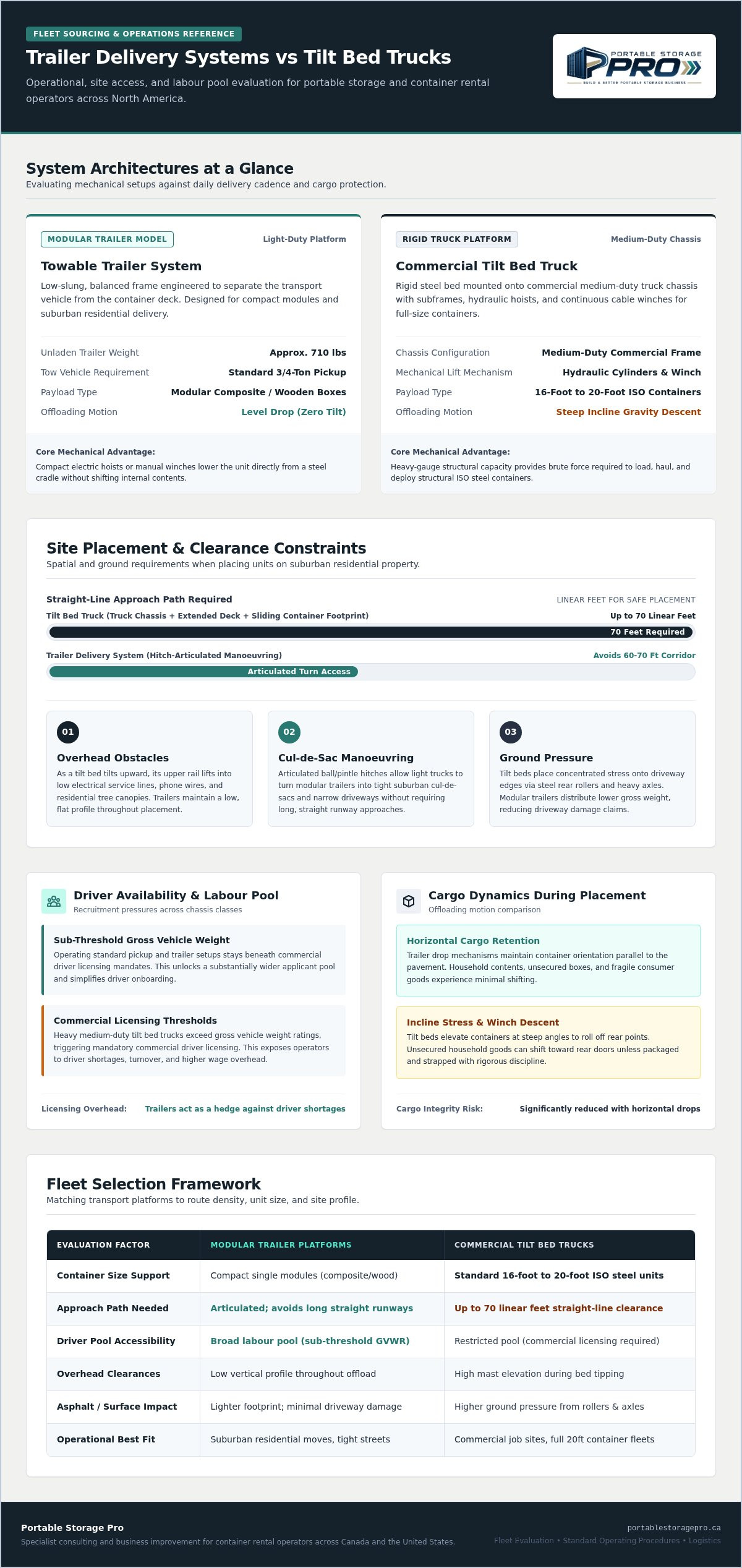
Modular trailer platforms rely on low-slung, balanced frames engineered to carry modular wooden or composite boxes. As documented across the evolution of portable storage containers, this delivery concept splits the transport vehicle from the container deck. Single trailers weigh approximately 710 pounds unladen, allowing standard light-duty trucks to tow a loaded module with modest overall pulling capacity. Operators secure the box inside a formed steel cradle, using compact electric hoists or manual winches to ease the unit to the ground without tilting the container contents.
The Architecture of Commercial Tilt Bed Trucks
Tilt bed trucks mount directly to heavy-duty truck frames equipped with secondary subframes, hydraulic cylinders, and continuous cable winches. Operating a tilt deck requires tipping the bed upward at a sharp angle so gravity pulls the rear rollers to the pavement. A steel winch cable spools out under hydraulic control, lowering the container until it rests entirely on the driveway. The rigid steel deck handles standard 16-foot to 20-foot ISO steel containers, delivering unmatched payload strength at the cost of steep loading angles and elevated ground pressure.
Understanding these distinct physical mechanics helps operators evaluate the true trade-offs in the U-Box by U-Haul delivery system vs tilt bed trucks debate. Trailer setups protect loaded household cargo by keeping the box level, while tilt beds offer the brute lifting force needed for structural steel units.
Site Access and Placement Dynamics: Analyzing Clearance and Ground Pressure
Site placement separates efficient operations from high-liability headaches. Comparing the U-Box by U-Haul delivery system vs tilt bed trucks on paper looks like a simple payload calculation, but physical drop locations dictate whether your equipment can complete the delivery. Residential driveways present tight turns, fragile asphalt, and low tree branches that challenge heavy rolling stock.
Understanding these site-level realities protects your business from costly property claims and missed appointments.
Suburban Navigation and Overhead Obstacle Clearance
Tilt bed trucks require significant room to work. Delivering a container off a tilt deck demands a straight-line approach path stretching up to seventy linear feet. The driver needs clearance for the truck chassis, the tilted bed, and the container footprint sliding backward. When the deck tilts, its upper rail lifts into low electrical service wires, phone lines, and ornamental tree canopies. Modern route planning integrations covered in The Modern Storage Business Tech Stack: A 2026 Operational Reference help dispatchers screen routes, but they cannot replace practical on-site manoeuvring.
Towable trailer platforms articulate at the hitch. This articulation allows a light truck to position a trailer into narrow driveways and tight cul-de-sacs without maintaining a sixty-foot straight approach. The container profile stays flat throughout the placement cycle, eliminating contact risks with low-hanging overhead lines.
Driveway Preservation and Surface Load Concentration
Surface load concentration creates immediate property damage risks:
- Steel roller point loads: Tilt beds drop steel tail rollers directly onto pavement. When carrying heavy payloads, this concentrated force gouges fresh asphalt, cracks decorative pavers, and damages unreinforced curbs.
- Pneumatic tyre footprint: Trailer delivery systems carry container weight entirely on wide, air-filled rubber tyres. Weight spreads across multiple contact patches, sparing suburban concrete slabs.
- Subsurface risks: Heavy commercial axles crossing lawn margins or driveway edges frequently crush subsurface irrigation lines, buried utility pipes, and septic drains.
Cargo Security and Contents Shifting Risks
Cargo behaviour during unloading directly influences customer satisfaction. Tilt bed hoists elevate the container floor to discharge angles approaching thirty degrees. Household goods, furniture, and stacked cartons shift backward against the rear doors during this drop. When customers open their container, shifted items can spill out, leading to freight claims. In contrast, level horizontal trailer hoists keep contents undisturbed on their original packing plane.
Managing equipment safety and avoiding property damage starts with disciplined driver guidelines. If your team needs to upgrade operational procedures, consulting with Portable Storage Pro helps embed clear placement standards across your field crew. Even when choosing between the U-Box by U-Haul delivery system vs tilt bed trucks, strict site operating standards protect customer relationships and preserve equipment longevity.
Labour Pools, Driver Licensing, and Fleet Operating Costs
Recruitment rules and licensing regulations define daily fleet overhead. When comparing the U-Box by U-Haul delivery system vs tilt bed trucks, the operational dividing line often comes down to driver credentials. Single-vehicle configurations carrying gross vehicle weight ratings of 26,001 pounds or more trigger commercial licensing rules. Trailer-based platforms towed behind standard pickups avoid this barrier, opening access to a significantly wider hiring pool.
Evaluating the U-Box by U-Haul delivery system vs tilt bed trucks through a labour lens proves that equipment selection is fundamentally a workforce strategy.
Driver Recruiting and Commercial Licensing Hurdles
Under Federal Motor Carrier Safety Administration (FMCSA) standards, operating combination units or medium-duty trucks rated at 26,001 pounds or higher requires a commercial driver's licence. Most medium-duty tilt bed trucks fall squarely into this regulated bracket. Recruiting certified commercial operators forces independent businesses to compete directly with national freight fleets. Running light-duty pickup and trailer setups lets you hire from the broader pool of standard passenger licence holders, shortening onboarding timelines from weeks to days.
Fuel Consumption, Maintenance, and Chassis Lifecycles
A rigorous total cost of ownership analysis exposes significant lifecycle differences between dedicated commercial cab-overs and light-duty pickup fleets:
- Powertrain maintenance: Medium-duty diesel tilt beds demand specialized commercial shop bays, certified diesel technicians, and high-pressure hydraulic hoist servicing.
- Service accessibility: Pickup trucks rely on standard domestic parts inventories and local mechanical shops, preventing prolonged downtime during peak summer delivery seasons.
- Fuel efficiency: Lighter tow vehicles burn significantly less fuel per route mile than heavy tilt chassis navigating stop-and-go metropolitan traffic.
Standard Operating Procedures for Delivery Safety
Rigorous standard operating procedures protect equipment longevity across both platforms. Trailer delivery SOPs must enforce daily hitch latch verifications, safety chain cross-checks, and electric brake controller calibration before departure. Tilt bed procedures require systematic checks on hydraulic fluid levels, winch cable spooling tension, and secondary safety locks. Documented SOPs reduce driver turnover, prevent mechanical breakdowns on customer property, and keep commercial insurance premiums manageable as your fleet grows.
Fleet Selection Framework: Matching Delivery Equipment to Operating Strategy
Selecting transport assets requires aligning hardware with your localized business model. Evaluating the U-Box by U-Haul delivery system vs tilt bed trucks involves five deliberate planning steps:
- Audit container specifications: Detail dimensions, tare weights, and maximum loaded ratings across your entire box inventory.
- Analyze route conditions: Measure urban density, street parking regulations, and regional driveway topographies.
- Assess regional labour: Determine local driver availability and prevailing commercial wage pressures within your operating zone.
- Project fleet capital efficiency: Balance container turn rates against equipment acquisition and chassis maintenance commitments.
- Test sector versatility: Determine whether your pipeline prioritizes residential moves, on-site renovations, or commercial construction accounts.
Evaluating Payload Profiles and Container Dimensions
Your container inventory determines your transport envelope. Compact eight-foot modular boxes built from wood framing or composite panels match light-duty trailer systems. These modular units fit within strict towing thresholds, letting standard trucks haul them safely. Conversely, sixteen-foot to twenty-foot steel containers demand the rigid structural support and hydraulic pulling power of a commercial tilt bed. If your business model uses a mixed inventory, operating both platforms on separated schedules prevents assigning heavy medium-duty trucks to lightweight container routes.
Territory Density and Delivery Route Logistics
Route density dictates transit profitability. In dense urban centres with narrow street corridors, overhead wires, and zero-lot-line driveways, trailer delivery platforms navigate tight access points without blocking traffic. Tilt bed chassis excel on rural routes or commercial job sites where unpaved access roads and deep gravel require higher ground clearance and rigid frame support. For an in-depth financial breakdown of territory planning, review our guide on Maximizing Portable Storage Profits: 2026 Canadian Guide.
Every equipment decision locks in long-term operational boundaries. Before purchasing your next vehicle chassis, partner with Portable Storage Pro to model your fleet requirements. Resolving the U-Box by U-Haul delivery system vs tilt bed trucks question depends on matching equipment capabilities to customer demand, driver availability, and daily route realities.
Building a High-Performance Fleet with Portable Storage Pro
Scaling a transport fleet requires an objective operational strategy rather than relying on manufacturer sales pitches. Deciding between the U-Box by U-Haul delivery system vs tilt bed trucks means balancing capital deployment against driver availability, property liability, and localized route efficiency. Portable Storage Pro works directly alongside independent container operators across Canada and the United States to evaluate transport configurations, eliminate unnecessary intermediary markups, and establish disciplined yard logistics.
Strategic Fleet Sourcing and Procurement Alignment
Direct supplier sourcing secures commercial rolling stock and container inventory without third-party broker fees. Our team helps operators evaluate trailer fabricators, truck body builders, and container manufacturers directly. Aligning your procurement calendar with seasonal customer demand curves ensures you invest in delivery equipment right when rental occupancy peaks. Standardizing chassis components across your yard also simplifies spare parts inventories and speeds up maintenance training.
Implementation Support for Scalable Fleet Operations
Selecting the right vehicle chassis solves only half the operational challenge. Developing formal standard operating procedures (SOPs), safety checklists, and driver onboarding programs secures predictable delivery times and prevents costly property claims. Connecting dispatch platforms with asset tracking inside your technology stack cuts down unbilled route mileage while lifting daily route density across your service territory.
Whether your business strategy favours trailer-mounted systems, dedicated commercial tilt decks, or a balanced hybrid configuration, working with seasoned container specialists provides operational guidance without corporate executive payroll burdens. If you want objective guidance navigating the U-Box by U-Haul delivery system vs tilt bed trucks choice for your next equipment investment, connect directly with our advisory team through Let’s Talk About Your Business.
Aligning Your Transport Fleet for Long-Term Profitability
Balancing payload requirements against driver recruitment realities defines the fundamental choice between the U-Box by U-Haul delivery system vs tilt bed trucks. While tilt decks deliver the structural strength required for full-size steel units, trailer delivery platforms protect suburban driveways and unlock a wider non-commercial labour pool. Making the right equipment investment keeps overhead low, prevents property damage disputes, and matches your specific route density.
Portable Storage Pro provides specialized operational guidance to independent operators across North America. Under our consulting models, you secure direct supplier relationships with zero supplier markup on sourced equipment, backed by practical operating systems developed by seasoned container professionals. Aligning your chassis selection with sound operating procedures ensures your fleet scales smoothly alongside customer demand. Reach out today through Let’s Talk About Your Business to strengthen your delivery operations and protect your operating margins.
Frequently Asked Questions
Can tilt bed trucks deliver eight-foot storage containers safely without cargo shifting?
Tilt bed trucks struggle to deliver compact eight-foot containers without cargo movement because their hydraulic decks incline steeply during offloading. Tipping the bed upward forces unstrapped household contents backward toward the container doors. While internal ratchet straps reduce movement, modular containers experience significantly better cargo stability on level trailer systems that keep the container floor completely parallel to the pavement throughout the drop-off process.
Do trailer delivery systems require drivers to hold a commercial driver's licence?
No, most light-duty trailer delivery setups do not require a commercial driver's licence if the combined gross vehicle weight rating remains under 26,001 pounds. Towing a single-box trailer behind a standard pickup truck keeps the entire combination within non-commercial licensing thresholds. This allows independent storage operators to recruit from the broader general driver pool, shortening onboarding timelines and containing fleet wage expenses.
How much clearance does a tilt bed truck need to unload a portable storage container?
Tilt bed trucks require between sixty and seventy linear feet of straight clearance to unload a portable container safely. This generous footprint accommodates the medium-duty truck chassis, the tilted subframe, and the container footprint sliding off the tail. Operators also require fourteen to sixteen feet of overhead vertical clearance to prevent the raised steel deck from contacting overhead power lines or low tree canopies.
What happens if a customer driveway is too steep for a trailer-based delivery system?
Steep driveway grades create traction issues and hitch clearance limits for standard light-duty tow vehicles. When site topography exceeds safe slope angles, operators utilize remote-controlled motorised dollies to transport the unit uphill or arrange street placement using local municipal permits. Establishing pre-delivery site screening procedures helps dispatch teams identify severe driveway inclines before equipment leaves the yard.
Which delivery system produces fewer property damage claims on residential surfaces?
Analyzing the U-Box by U-Haul delivery system vs tilt bed trucks reveals that trailer platforms produce far fewer residential damage claims. Trailer systems distribute container weight across multiple pneumatic rubber tyres that cushion the surface. In contrast, tilt bed trucks place heavy steel rollers directly onto pavement, which often scratches decorative sealants, cracks concrete driveways, and damages interlocking stone pavers.
Can independent operators purchase delivery trailers without joining a national franchise?
Yes, independent operators can purchase specialized container trailers directly from commercial fabricators without entering a franchise agreement. Comparing the U-Box by U-Haul delivery system vs tilt bed trucks demonstrates that trailer platforms are widely accessible through independent manufacturers. Working with experienced consulting partners allows operators to source trailer bodies and container hardware directly, avoiding expensive intermediary markups while retaining complete commercial independence.

Article by
Paul Taylor
Paul Taylor is the founder of Portable Storage Pro, bringing more than 35 years of experience across the container, portable storage and transportation industries. His background spans executive operations, business development, global procurement, sales, marketing and operational improvement in Canada, the UK and international markets.
Paul helps independent portable storage and container rental operators increase revenue, strengthen margins and build more efficient businesses. His work connects strategy with practical implementation, including pricing, delivery operations, supplier sourcing, staff training, technology and customer experience.
His experience includes leading multi-location storage operations and serving on the National Portable Storage Association’s board along with chairing its Canadian committee. Through Portable Storage Pro, Paul shares practical insights to help owners make informed decisions, solve operational challenges and grow profitably.
Disclaimer
Content published by Portable Storage Pro Inc. (PSP) provides general business information and industry insights. It does not replace advice tailored to your business or specialist legal, tax, engineering or other regulated advice. Reading this content or contacting PSP does not, by itself, establish a consulting engagement.
Information reflects circumstances at publication and may change. Examples and potential benefits are illustrative; results depend on individual circumstances, implementation and market conditions and are not guaranteed.
Client services are governed by the signed service agreement, agreed work plan and written amendments. Website and blog content do not amend those terms. PSP’s work is subject to applicable law and the professional commitments set out in its agreement, including the CMC-Canada Code of Professional Conduct and NPSA Code of Conduct and Ethics. Copies are available on request.
Views expressed are PSP’s own. Association membership or references do not imply association endorsement or CMC certification. Nothing in this disclaimer limits PSP’s contractual responsibilities, professional duties or rights that cannot lawfully be excluded.


