
The fastest route into the container rental sector often appears to be buying into a turnkey brand, yet prepackaged systems frequently compromise the long-term enterprise equity you set out to build. When evaluating a Smartbox license agreement vs owning your mobile storage fleet, the decision comes down to more than initial brand recognition. It is a choice between building durable asset equity on your balance sheet or accepting ongoing royalty burdens and territory restrictions.
You probably recognize the immediate comfort of corporate call centres, protected territories, and established marketing channels. Sourcing your own equipment, managing dispatch logistics, and drafting operating procedures from scratch can feel daunting without an existing playbook. However, trading independence for operational support often means surrendering customer ownership and capping your long-term enterprise value.
This operational comparison examines the critical trade-offs between licensing an established system and capitalizing your own fleet. We analyze asset equity mechanics, daily dispatch control, margin structures, and an objective decision framework to help you choose the right path for your target market.
Key Takeaways
- Evaluating a Smartbox license agreement vs owning your mobile storage fleet reveals whether you are paying for an established brand footprint or building permanent equity on your own balance sheet.
- Territory restrictions and centralized databases under a licensing model can limit geographic expansion, whereas independent ownership keeps customer contracts and relationship history directly in your hands.
- Recurring royalty obligations create an ongoing gross margin hurdle, contrasting sharply with the long-term cash flow and depreciation benefits of owning physical container assets.
- Independent fleet management provides the flexibility to source ISO-grade steel containers and integrate customized dispatch technology stacks instead of conforming to mandated supplier lists.
- A structured evaluation framework helps you weigh your capital reserves and operational capabilities against the strategic trade-offs of entering an ongoing licensing agreement.
Comparing the Models: License Agreement Framework vs Independent Fleet Ownership
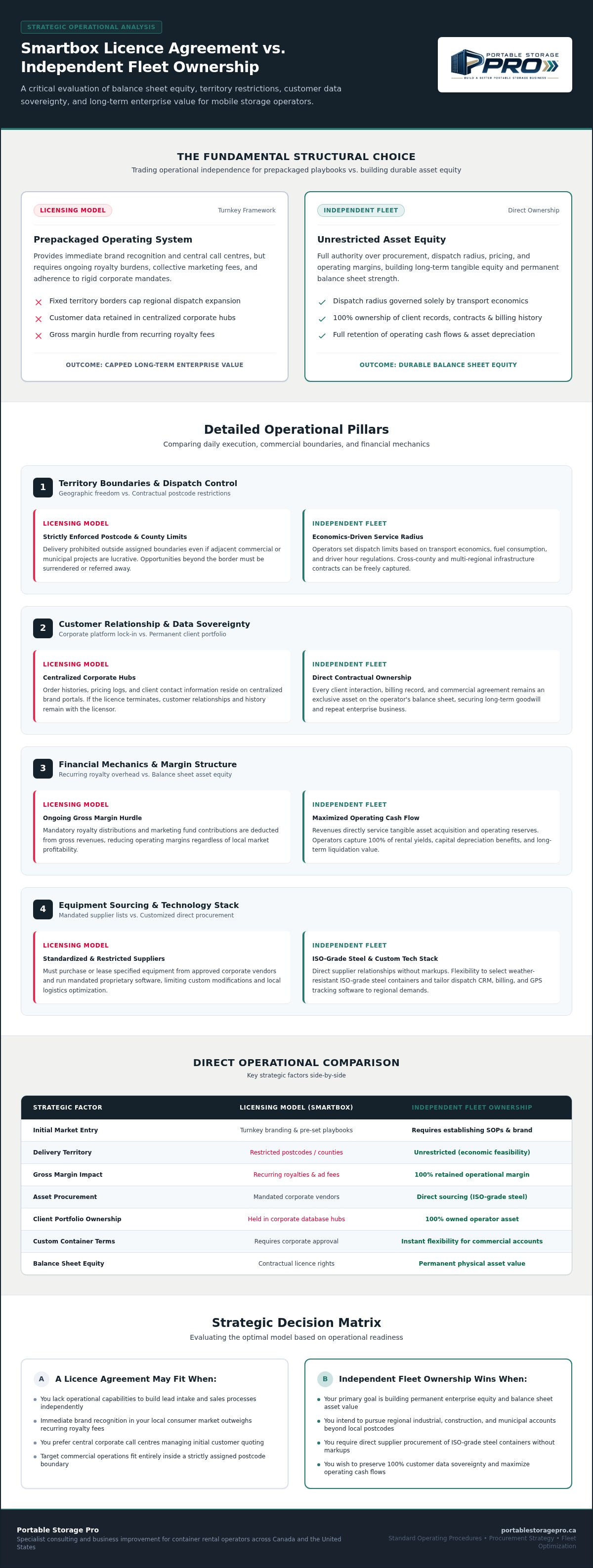
Evaluating a Smartbox license agreement vs owning your mobile storage fleet shapes every operational policy across your business. While both paths deliver portable storage containers to residential and commercial yards, their structural foundations diverge sharply. A licensing arrangement trades long-term flexibility for a prepackaged operating system. Direct fleet ownership, by contrast, gives you unrestricted control over your balance sheet, service radius, and operating margins.
Defining the Licensing Model in Portable Storage
A portable storage license operates much like a traditional franchise business model, granting temporary brand rights in exchange for strict compliance with standardized procedures. Under this structure, corporate headquarters establishes your operational playbooks. You must adopt mandated technology platforms, order from specified equipment vendors, and contribute ongoing royalty payments alongside collective marketing fees from gross revenues.
These agreements also constrain day-to-day dispatch decisions and commercial capabilities. Licensees typically cannot cross assigned territory boundaries to pursue lucrative municipal or industrial projects. You may also face restrictions on offering custom container modifications or non-standard ancillary products. While this framework provides an initial operational template, it places rigid ceilings on your ability to respond to changing local conditions.
The Independent Ownership Approach Explained
Independent ownership gives you complete authority over asset procurement, branding, and customer management. Rather than accepting standardized specifications, you choose your own fleet mix, selecting weather-resistant ISO-grade steel containers and truck-mounted delivery mechanisms engineered for your specific regional geography.
This operational freedom directly influences regional profitability. When local industrial accounts or restoration contractors require customized rental terms, you can adjust pricing and delivery schedules instantly without corporate clearance. Assessing a Smartbox license agreement vs owning your mobile storage fleet reveals that direct ownership ensures every customer relationship, billing record, and service contract remains an exclusive asset on your balance sheet.
Operational Control, Territory Boundaries, and Customer Relationship Ownership
Balancing growth targets against contractual boundaries requires examining who ultimately controls your daily route scheduling and customer database. In the debate surrounding a Smartbox license agreement vs owning your mobile storage fleet, operational friction often surfaces at the intersection of protected territories and direct client relationships. Reviewing the mandatory legal and financial commitments in corporate disclosure documents shows how geographic boundaries can either protect an operator or artificially cap regional expansion.
Territory Caps and Service Radius Restrictions
Licensing models rely on tightly defined postcodes or county borders. When a commercial client manages jobsites five kilometres outside your zone, your agreement typically bars you from dispatching boxes there. You must refer the job to an adjacent licensee or surrender the revenue entirely.
Independent fleet operators face no such artificial walls. You decide how far your delivery trucks travel based entirely on transport economics, vehicle fuel consumption, and driver hour regulations. If an infrastructure contractor offers steady container placements across three bordering counties, you simply dispatch the fleet to capture the revenue.
Direct Client Ownership vs Brand Portals
Centralized dispatch platforms create a structural barrier between you and the businesses paying for storage. Under many licensing systems, customer contact records, pricing logs, and order histories live in corporate database hubs. If your licensing contract ends, that client portfolio stays with the licensor.
Owning your operation lets you deploy an autonomous lead management system. You retain all corporate records, billing histories, and account equity. Mastering independent portable storage lead generation ensures you build long-term enterprise equity that belongs solely to your company, not an outside franchisor.
Operational Adaptability and Service Customization
Standardized licensing programs mandate uniform delivery mechanisms and container styles. This approach restricts an operator's ability to offer specialized commercial rentals, custom shelving modifications, or jobsite office conversions that local contractors demand.
Independent operators maintain the tactical flexibility to modify equipment for difficult delivery terrain, narrow suburban driveways, or unpaved construction yards. Establishing proven standard operating procedures across your dispatch crew ensures safe, consistent deliveries without paying a licensor for a generic rulebook. If you want experienced operational leadership to help calibrate your delivery protocols, consider collaborating with Portable Storage Pro to professionalize logistics across your independent fleet.
Financial Mechanics: Recurring Royalty Overhead vs Long-Term Asset Equity
The core financial divergence between licensing and ownership centres on how capital leaves your enterprise. When analyzing a Smartbox license agreement vs owning your mobile storage fleet, you must separate recurring overhead from permanent equity creation. Royalties drain top-line cash every month regardless of net margins, whereas equipment financing transforms monthly outflows into tangible balance-sheet value.
Ongoing Licensing Fees and Margin Compression
Licensing frameworks require ongoing financial commitments that often take four to twelve percent of gross revenue through royalties, brand advertising funds, and mandatory software subscriptions. These payments come off the top, meaning they hit your business before you cover yard rent, driver payroll, fuel, or equipment insurance. During seasonal dips or local economic slowdowns, this fixed operational drag elevates your break-even occupancy threshold.
Independent fleet operators preserve their entire gross revenue stream. Protecting gross margin from corporate levies provides the financial buffer required to weather market fluctuations or reinvest in yard infrastructure. Reviewing strategic methods for increasing portable storage business profitability demonstrates that retaining every dollar of operating margin significantly accelerates free cash flow generation.
Asset Equity, Depreciation, and Balance-Sheet Strength
Capital deployed into an independent fleet converts liquid reserves into tangible assets. Steel containers boast a long working lifespan, maintaining steady resale value on the secondary market if you ever need to right-size inventory. Rather than paying unrecoverable fees to an out-of-market licensor, your capital buildout secures equipment that sits directly on your corporate balance sheet.
Fleet ownership also delivers advantageous tax treatments. Independent operators can leverage tax depreciation schedules and capital cost allowances against operational profits. These write-offs lower annual tax burdens while your business steadily pays down equipment principal, converting operating profits into durable equity.
Enterprise Valuation and Business Exit Strategy
Evaluating an exit strategy highlights the ultimate contrast between a Smartbox license agreement vs owning your mobile storage fleet. Prospective buyers evaluate the security and transferability of a company's cash flow:
- Licensed operations: Often face mandatory transfer fees, rigorous corporate buyer approvals, and the risk that the franchisor exercises a right of first refusal at a discount.
- Independent operations: Sell clear title to physical assets, proprietary regional branding, and established commercial contracts without third-party interference.
Acquirers routinely assign higher valuation multiples to businesses that own their customer base and physical fleet outright. Direct equity ownership ensures that the enterprise value built through years of yard operations remains entirely yours upon sale.
Equipment Sourcing, Logistics, and Technology Stack Flexibility
Fleet infrastructure determines what kinds of jobs your business can physically take on. When weighing a Smartbox license agreement vs owning your mobile storage fleet, operational agility hinges on whether you control your hardware procurement and software choices. Mandated supply chains simplify initial purchasing, but they tether your operational capabilities to a single container style and dispatch interface.
Mandated Equipment vs Open-Market Sourcing
Licensing networks mandate that you order assets through approved vendors. This keeps regional presentation uniform across territories, but it limits your equipment options. If your local market demands wind-and-watertight storage for outdoor worksites, you cannot easily pivot away from the corporate equipment catalogue.
Independent fleet operators purchase assets across competitive international channels. Operators can build direct factory ties or source one-trip steel units directly from port logistics hubs. Applying disciplined portable storage supply chain risk management helps operators diversify container suppliers, avoid captive vendor surcharges, and adjust box dimensions to match regional commercial specifications.
Container Longevity, Durability, and Maintenance Costs
Container build materials directly dictate long-term maintenance overhead. Specialized wood-framed units with vinyl weather covers work well for residential residential moves and dry indoor warehouse staging. However, harsh Canadian winters, heavy snow loads, and active jobsite hazards demand heavier protection.
Cortén steel containers deliver weather resilience, pest exclusion, and structural security on construction sites. They require minimal annual refinishing beyond corner casting checks and door gasket lubrication. Industrial clients also expect heavy-gauge steel when storing valuable tooling, meaning an all-steel fleet immediately opens high-margin commercial opportunities that fabric-covered boxes cannot secure.
Customizing Your Operating Technology Stack
Mandatory corporate software often functions as an operational bottleneck. Closed dispatch systems leave little room to customize invoicing rules, integrate local accounting software, or configure dynamic zone rates. If the franchisor updates the user portal, your team must adapt to the new interface whether it improves daily dispatch efficiency or not.
Independent operators assemble an agile technology stack tailored to their specific yard workflows. By selecting commercial dispatch tools outlined in the modern storage business tech stack, you connect your own customer relationship management platform directly to yard operations. You can integrate cellular tracking units, motion sensors, and automated customer notifications on your own terms. For guidance on assembling an integrated technology platform without corporate software licensing costs, connect with Portable Storage Pro to optimize your operational infrastructure.
Strategic Decision Framework: Choosing the Right Path for Your Market
Determining the right operational path requires an honest evaluation of your capital structure, internal capabilities, and regional growth ambitions. Settling the question of a Smartbox license agreement vs owning your mobile storage fleet comes down to whether you prioritize turnkey operational speed or long-term enterprise value creation. The following framework provides an objective approach to assess your market opportunity.
Step-by-Step Operator Evaluation Process
To identify the best model for your market, work through these five strategic steps:
- Audit available capital reserves: Compare the liquid capital required for franchise commitments against direct fleet financing options that purchase tangible equipment.
- Assess operational capabilities: Determine whether your current team can manage local sales generation, logistics dispatching, and equipment maintenance independently.
- Evaluate local storage demand: Analyze whether your regional revenue will come from quick residential moving cycles or long-term commercial construction rentals.
- Model long-term cash flow: Project three- to five-year cash flow statements comparing recurring royalty deductions against retained asset depreciation and balance-sheet equity.
- Define your exit horizon: Clarify whether you want a lifestyle business operating under someone else's brand rules or an autonomous, high-equity enterprise built for maximum valuation.
When a Licensing Agreement May Make Sense
Licensing models offer a viable entry point under specific business conditions. If your organisation holds sufficient capital but lacks any transport experience, a packaged framework provides established workflows immediately. It suits operators who want a passive operational role, prefer centralized customer intake, and do not intend to build proprietary enterprise value in their local trade area.
Scaling Independently with Specialized Operational Leadership
Operators frequently look at licensing because they worry about managing container procurement, standard operating procedures, and fleet dispatch alone. Fortunately, you do not have to sign away ongoing gross revenues to access institutional industry expertise. Independent operators can bridge operational gaps through specialist advisory partnerships instead.
Portable Storage Pro serves as an operational alternative to a restrictive license agreement. Through models like the Consulting Partner engagement, operators receive guidance across fleet sourcing, yard layout design, and technology evaluation while maintaining one hundred percent equity and complete customer ownership. Choosing between a Smartbox license agreement vs owning your mobile storage fleet is ultimately a decision about control. With the right operational roadmap, building an independent fleet delivers total autonomy and superior enterprise returns.
Building Lasting Equity Through Direct Fleet Control
Deciding between a Smartbox license agreement vs owning your mobile storage fleet determines the ultimate trajectory of your business. While licensing offers a structured entry point, building an independent fleet secures direct customer relationships, protects your gross operating margins, and creates permanent equity on your corporate balance sheet.
You don't have to navigate equipment procurement, yard layout, or dispatch workflows in isolation. Portable Storage Pro provides independent advisory across operations, sales, procurement, and logistics without the ongoing royalty burden of a franchise. By facilitating direct supplier relationships with no middleman markup and offering fractional operational leadership for container rental businesses, you secure institutional operational discipline while retaining complete ownership of your brand. Let's Talk About Your Business to evaluate your market and map out a practical roadmap for independent fleet growth.
Frequently Asked Questions
What is the primary difference between a Smartbox license agreement and owning a container fleet?
The primary difference between a Smartbox license agreement vs owning your mobile storage fleet lies in asset equity and operational autonomy. A licensing contract grants the right to use a corporate brand, established dispatch workflows, and protected territories in exchange for recurring fees. Direct fleet ownership requires sourcing your own containers and managing logistics, but it gives you total control over pricing, contracts, and long-term balance-sheet equity.
Do independent portable storage operators face higher initial startup expenses than licensees?
Independent operators often face comparable or lower initial startup capital requirements than licensees. While purchasing an initial fleet of containers and delivery trailers demands upfront capital or commercial financing, licensing programs require substantial liquid capital reserves, initial franchise onboarding fees, and mandated facility outlays. Independent operators can scale fleet purchases incrementally, aligning container capital spending directly with verified local market demand rather than fulfilling mandatory corporate fleet quotas.
Can an independent operator buy specialized delivery equipment without joining a franchise?
Yes, independent operators can purchase specialized delivery trailers, horizontal discharge systems, and remote container movers directly from commercial equipment manufacturers. Transport equipment suppliers do not restrict sales exclusively to national franchise systems. Sourcing delivery equipment on the open market allows an operator to choose specific chassis lengths, lift capacities, and trailer configurations engineered specifically for local driveway widths, municipal weight limits, and regional weather conditions.
How do ongoing royalty fees impact long-term cash flow for storage container businesses?
Ongoing royalties continuously reduce net operating margins because they are deducted from top-line gross revenue before operating expenses are covered. In a cyclical industry where seasonal utilization dips occur, this recurring operational drag raises your break-even occupancy rate. Independent operators retain all top-line earnings, allowing them to channel free cash flow into balance-sheet equity, driver recruitment, local marketing, or additional container inventory.
Who owns the customer data and client list under a portable storage licensing agreement?
The licensor typically retains ultimate legal ownership of the customer database, booking records, and client account history. Franchise and licensing agreements generally state that corporate headquarters owns the customer portal and associated contact databases. If the licensing agreement terminates or an operator exits the network, those commercial and residential customer relationships stay with the corporate brand rather than remaining with the local business owner.
Can an independent operator purchase professional standard operating procedures without paying royalties?
Yes, independent operators can establish professional operational frameworks by partnering with specialized industry advisors such as Portable Storage Pro. Through structured consulting engagements, operators access documented standard operating procedures for yard workflows, driver safety guidelines, and dispatch logistics without paying ongoing gross revenue royalties. This approach provides institutional operational maturity while preserving full commercial independence and complete corporate equity.
What type of storage container holds higher resale value over a ten-year operational lifespan?
Cortén steel ISO-grade storage containers consistently hold higher secondary market resale value than wood-framed, vinyl-covered units over a ten-year operational lifespan. All-steel containers resist weather degradation, roof leaks, and structural frame shifting across demanding industrial and construction settings. When evaluating a Smartbox license agreement vs owning your mobile storage fleet, investing directly in steel assets ensures stable residual value and strong liquidity on your corporate balance sheet.

Article by
Paul Taylor
Paul Taylor is the founder of Portable Storage Pro, bringing more than 35 years of experience across the container, portable storage and transportation industries. His background spans executive operations, business development, global procurement, sales, marketing and operational improvement in Canada, the UK and international markets.
Paul helps independent portable storage and container rental operators increase revenue, strengthen margins and build more efficient businesses. His work connects strategy with practical implementation, including pricing, delivery operations, supplier sourcing, staff training, technology and customer experience.
His experience includes leading multi-location storage operations and serving on the National Portable Storage Association’s board along with chairing its Canadian committee. Through Portable Storage Pro, Paul shares practical insights to help owners make informed decisions, solve operational challenges and grow profitably.
Disclaimer
Content published by Portable Storage Pro Inc. (PSP) provides general business information and industry insights. It does not replace advice tailored to your business or specialist legal, tax, engineering or other regulated advice. Reading this content or contacting PSP does not, by itself, establish a consulting engagement.
Information reflects circumstances at publication and may change. Examples and potential benefits are illustrative; results depend on individual circumstances, implementation and market conditions and are not guaranteed.
Client services are governed by the signed service agreement, agreed work plan and written amendments. Website and blog content do not amend those terms. PSP’s work is subject to applicable law and the professional commitments set out in its agreement, including the CMC-Canada Code of Professional Conduct and NPSA Code of Conduct and Ethics. Copies are available on request.
Views expressed are PSP’s own. Association membership or references do not imply association endorsement or CMC certification. Nothing in this disclaimer limits PSP’s contractual responsibilities, professional duties or rights that cannot lawfully be excluded.


