
A thick binder gathering dust on an office shelf won't stop a new driver from gouging asphalt or prevent yard crews from stacking containers into an unmanageable gridlock. If you find yourself answering frantic calls to resolve dispatch bottlenecks or settle preventable damage claims, you already know that informal training cannot protect your fleet. Practical storage business SOP development isn't about writing corporate policy; it's about establishing clear, field-tested routines that your team can execute reliably without your daily intervention.
You built this business to grow, not to micromanage every strap, latch, and customer quote. You need consistent container deliveries, faster driver onboarding with lower error rates, and auditable inspection records that protect your commercial vehicle insurance. In this implementation guide, you'll learn how to build, document, and enforce standard operating procedures across lead intake, yard staging, and roadside securement. We outline the exact workflows, field checklists, and accountability routines required to stabilize your daily operations and secure long-term fleet profitability.
Key Takeaways
- Effective storage business SOP development replaces generic, hundred-page binders with role-specific tools designed for the physical realities of container handling.
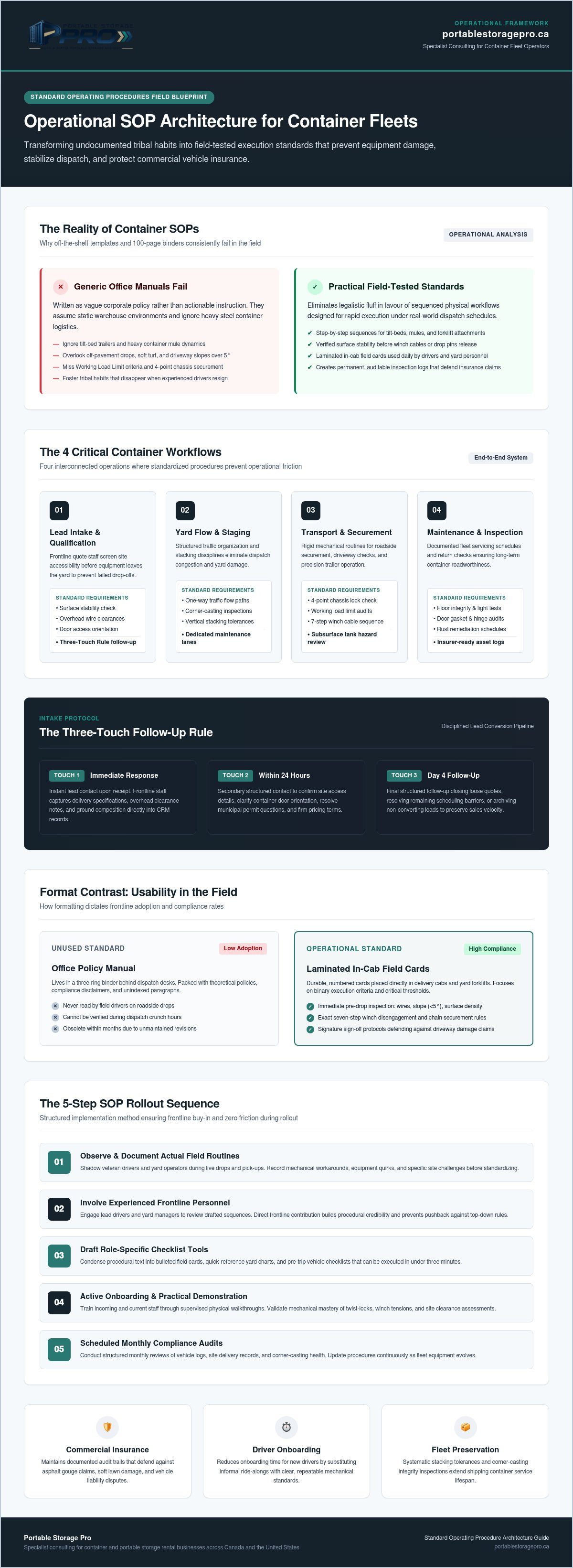
- Standardizing your four core workflows (lead intake, yard staging, transport securement, and container maintenance) prevents customer property damage and eliminates dispatch delays.
- Laminated in-cab field cards and quick-reference checklists ensure drivers and yard personnel actually execute drop-off clearances and vehicle inspections.
- Involving experienced frontline staff in the five-step development sequence accelerates onboarding and secures long-term team buy-in.
- Structured monthly audits protect fleet safety, maintain compliance with container standards, and protect commercial liability insurance.
What Storage Business SOP Development Entails (And Why Generic Manuals Fail)
In container rentals, operational success depends on how consistently physical assets move between the yard and the customer's property. Professional standard operating procedures provide the written baseline for every mechanical and logistical action your team performs. Without documented standards, companies run on tribal knowledge held entirely in the minds of a few senior staff. When those individuals take leave or resign, your operational stability vanishes. Rigorous storage business SOP development converts undocumented personal habits into permanent business assets, protecting capital investments in delivery trucks, tilt-bed trailers, and container inventory.
The True Definition of an Operational Storage SOP
An operational standard operating procedure is not a broad corporate policy statement. A policy declares that safety is a priority; an operational SOP details the exact seven-step sequence a driver must complete to confirm ground stability before releasing a winch cable. Effective procedures translate strategic safety goals into plain, actionable language that frontline crews can execute under tight dispatch schedules. The text must eliminate ambiguity, giving yard workers and drivers clear operational criteria rather than dense legal disclaimers.
Why Off-the-Shelf Templates Fail Container Businesses
Generic operational templates downloaded online fail almost immediately in container logistics. They assume clean warehouse floors and standard pallets, ignoring the harsh physical realities of industrial container yards and complex residential drop sites. Generic manuals consistently break down because they do not account for:
- Specialized equipment handling, including tilt-bed trailers, container mules, and heavy forklift corner-casting attachments.
- Unpredictable site hazards, such as low-hanging overhead power lines, unpaved surfaces, hidden septic tanks, and driveway slopes over five degrees.
- Tight load securement standards, including mandatory Working Load Limit calculations and four-point chassis twist-lock engagement.
When staff are handed generic checklists that ignore their actual physical workflows, they dismiss the documentation as corporate bureaucracy. Practical storage business SOP development demands site-specific, equipment-tested protocols. At Portable Storage Pro, we build procedures around real-world container operations so your crew adopts them naturally, maintaining safety standards without slowing down daily deliveries.
The Four Critical Workflows Requiring Standard Operating Procedures
Storage operations generate profit through four interconnected functions: intake, staging, transport, and maintenance. When any single area lacks documented standards, the friction spreads across the entire business. Sales intake errors create delivery failures, disorganized yards delay dispatch, and sloppy drop-offs cause property damage. Structured storage business SOP development addresses each handoff systematically, aligning your physical fleet with your back-office systems. Rigorous workflow control also mirrors the document lifecycle principles outlined in the EPA guidance on preparing standard operating procedures, ensuring procedures remain auditable and current.
Customer Intake and Quote Follow-Up Protocols
The lead intake process must qualify site conditions before dispatch schedules equipment. Frontline staff must verify delivery surface stability, overhead power-line clearances, and doorway access while quoting the client. Sales follow-up requires equal discipline; implementing the Three-Touch Rule (immediate response, a check-in within 24 hours, and a final follow-up on day four) prevents revenue leakage and protects quote conversion rates.
Yard Flow, Staging, and Inventory Organization
A congested yard wastes driver hours and increases equipment damage. Clear procedures establish distinct one-way traffic routes for drayage drop-offs, loaded customer staging, and maintenance lanes. Operators must document corner-casting inspection routines and vertical stacking tolerances to prevent unstable tiers. Integrating digital inventory logs with portable storage asset tracking solutions gives dispatch immediate visibility into container readiness, eliminating wasted yard searches.
Delivery Logistics and Site Placement Procedures
The transport sequence represents your greatest operational and legal risk. Delivery SOPs must define non-negotiable field requirements for tilt-bed and flatbed drivers:
- Mandatory pre-trip commercial vehicle inspection logs (eDVIRs) covering steering, braking systems, and hydraulic winches.
- Independent securement checks at all four container corners, ensuring Working Load Limits match or exceed 50% of the total cargo weight.
- On-site spatial hazard surveys verifying a minimum 3-to-4.5-metre overhead clearance and ground slope tolerances under 5 degrees.
- Mandatory multi-angle photo records of the container placed on-site, capturing existing driveway cracks to defeat false property damage claims.
If recurring operational friction or high driver turnover continues to drain your management hours, partnering with Portable Storage Pro helps you install pre-built standard operating procedures tailored directly to your local container fleet.
Building Practical Field Cards Versus Bureaucratic Policy Binders
Dense binders sitting on office shelves don't keep operations safe. When a driver arrives at a job site with tight clearances, they need immediate, practical clarity, not a hundred pages of corporate prose. Practical storage business SOP development balances technical thoroughness with frontline usability. Successful operators condense complex mechanical procedures into laminated in-cab field cards and equipment-mounted QR codes. This tactical approach directly protects your bottom line by reducing turnaround delays, which is a major factor when increasing portable storage business profitability.
The Architecture of an Effective Storage SOP
Field documentation must follow a rigid, scannable structure. Every procedure should focus on a single operational task and take less than two minutes to read. To maximize frontline compliance, build each standard operating procedure around four basic elements:
- A strict sequence of six to eight numbered physical actions, eliminating narrative descriptions.
- Clear visual aids, including high-contrast photos showing correct winch cable rigging, corner-casting pin lock engagement, and timber blocking placement.
- Defined criteria identifying unsafe conditions that require stopping work, such as overhead wires within three metres or soft ground.
- Explicit accountability, identifying who executes the task, who verifies clearance, and who logs the completed action.
Aligning these visual criteria with baseline OSHA warehousing and storage safety standards ensures that container stacking limits and perimeter ground safety rules remain compliant during busy staging cycles.
Integrating Digital Tools with Physical Checklists
Deciding between digital applications and physical reference cards depends entirely on operating context. Laminated cards clipped to the sun visor or mounted on forklift masts work best for quick reference during mechanical maneuvers. Digital forms excel when capturing time-stamped proof of completion. Pre-trip vehicle inspection slips, site arrival assessments, and offload photos should run directly through mobile forms connected to your fleet management platform.
Connecting your field checklists directly to your broader storage business tech stack creates an automated compliance log without burdening drivers with paperwork. Submitting daily electronic driver vehicle inspection reports (eDVIRs) creates an auditable record of brake tests and load securement checks. These digital logs establish verifiable proof of maintenance, protecting your commercial vehicle and liability insurance policies if roadside disputes or third-party damage claims arise.
How to Build and Roll Out Storage SOPs Step by Step
Rolling out operational standards across an active container fleet requires a deliberate sequence: observe, document, test, train, and refine. Writing procedures in an isolated back office produces manuals that frontline workers ignore. Successful storage business SOP development relies on capturing the practical techniques your most capable personnel use daily, converting their habits into repeatable company standards. Prioritize high-risk operations first, particularly tilt-bed loading and tight residential placements, before expanding documentation across the rest of the business.
Shadowing Frontline Staff to Capture True Workflows
Effective documentation starts in the truck cab and on the yard gravel. Ride along on challenging deliveries to document how experienced drivers navigate soft ground, verify overhead clearances, and rig winch cables. Seasoned operators often develop practical workarounds to bypass operational bottlenecks. Capturing these adjustments directly gives your team immediate ownership of the process and ensures your written standards reflect real site conditions.
Testing Procedures in the Yard and on the Road
Once you draft a procedure, test it against real conditions. Hand the draft checklist to a junior driver and observe them complete the task without verbal assistance. If the driver hesitates during a tilt-bed drop, miscalculates tail swing, or misses a securement step, the instruction is incomplete. Refine the wording, adjust step sequences, and update photo references based directly on these field trials.
Conducting Driver and Yard Crew Training Sessions
Yard teams and commercial drivers learn best through hands-on execution, not classroom presentations. Run practical training sessions directly in the yard:
- Demonstrate the standard walk-around, winch operation, and four-point container securement.
- Require each driver to perform the physical tasks while walking through the checklist criteria.
- Establish structured milestones for new hires, requiring signed procedural sign-offs before solitary dispatch.
- Archive signed training acknowledgments alongside vehicle maintenance records to satisfy commercial liability insurers.
If you want to accelerate this process without pulling management away from revenue generation, you can work with Portable Storage Pro to implement field-tested container operations procedures designed specifically for growing storage yards.
Sustaining Compliance, Conducting Audits, and Updating Procedures
Documenting your processes is only half the battle. Procedures lose their value if crews abandon checklists after three weeks of quiet adherence. Long-term storage business SOP development requires structured accountability routines that catch operational drift before bad habits cause serious yard accidents or highway violations. Consistent auditing protects your fleet, verifies equipment care, and ensures staff perform routine tasks according to company standards.
Setting Up Practical Operational Spot Checks
Auditing should focus on simple spot checks rather than bureaucratic reviews. Yard supervisors and owners must run targeted, scheduled checks across critical touchpoints:
- Review monthly delivery drop-off photo records, verifying drivers capture pre-existing site damage, surface slope angles, and wide-angle container positioning.
- Conduct bi-weekly roadside and yard securement audits, confirming drivers maintain four-point corner twist-lock engagement and verify chain tension before departure.
- Perform weekly quote intake spot-audits inside your customer management platform, confirming staff capture site access details and complete the Three-Touch Rule follow-up cycle.
When staff skip documented steps, handle non-compliance immediately through focused retraining rather than punitive reprimands. Walk through the failure point together, retrain the driver on the physical checklist, and log the coaching session. If shortcuts persist after instruction, formal accountability measures must follow.
Trigger Events That Require Procedure Revisions
Standard operating procedures cannot remain static documents. While routine operational reviews should occur semi-annually, specific trigger events demand immediate revisions. Update your field checklists immediately whenever you acquire new trailer styles, purchase specialized hydraulic handling equipment, or integrate different container dimensions into your fleet. In addition, every near-miss event (such as a shifted container during transit or a close call with an overhead wire) must prompt a mandatory review and update of the relevant procedure.
Operational Leadership Options for Growing Fleets
Maintaining procedural discipline becomes challenging as independent operations expand toward fifty containers and beyond. Owners often find their time absorbed by daily fires, customer quotes, and vendor negotiations, leaving little bandwidth to conduct yard audits or refine training manuals. When internal management reaches capacity, engaging external operational leadership provides the structure needed to protect fleet operations.
Through our Consulting Partner model, Portable Storage Pro provides independent container rental businesses with seasoned advisory support, helping owners implement and audit practical SOP libraries while retaining direct authority over daily operations. This structure establishes professional operational standards across your yard and transport network without overburdening executive management.
Stabilizing Your Container Fleet for Profitable Expansion
Scaling an independent container company doesn't require endless firefighting or twelve-hour days managing dispatch bottlenecks. Sustainable growth happens when you replace guesswork with practical field standards that your team can execute without constant supervision. Prioritizing systematic storage business SOP development protects your capital assets, eliminates preventable customer property damage disputes, and gives incoming drivers a reliable path to high performance.
Documented workflows turn operational consistency into a lasting competitive advantage. At Portable Storage Pro, we provide portable-storage-specific operational guidance from the yard to the boardroom. We help you install proven standard operating procedure libraries built specifically for independent operators, supported by direct supplier relationships without markups under our consulting sourcing model. Building dependable field habits today secures your operational margins tomorrow. Let's talk about your business.
Frequently Asked Questions
What is storage business SOP development?
Storage business SOP development is the structured process of defining, documenting, and validating routine workflows across container rental operations. It establishes unambiguous step-by-step instructions for lead qualification, yard stacking, commercial transport, and container inspections. Rather than relying on undocumented habits, this discipline creates repeatable field-tested standards that protect physical equipment, reduce customer property damage, and allow fleets to expand without requiring constant owner supervision.
How long does it take to develop operational SOPs for a container fleet?
Documenting a complete baseline library typically takes six to twelve weeks for an independent fleet. High-risk transport and yard safety procedures should be drafted and field-tested during the first three weeks. Secondary administrative protocols, such as intake tracking and billing disputes, follow in later stages. Operators who work with Portable Storage Pro often deploy pre-built industry frameworks immediately, cutting implementation timelines in half.
Can independent operators use off-the-shelf standard operating procedures?
Generic business templates almost always fail because they ignore the mechanical realities of container transport. Standard warehouse checklists don't address hydraulic tilt-bed angle limits, overhead utility clearances, or corner-casting lock checks. While foundational templates offer a starting layout, every operational procedure must be tailored directly to your specific truck configurations, delivery trailers, yard layouts, and regional transport regulations.
Which operational storage procedures are mandatory for liability and safety compliance?
Pre-trip vehicle inspection routines, commercial cargo securement checks, and on-site delivery hazard surveys are mandatory for commercial compliance. Insurers require auditable proof of daily walk-arounds, certified defect reporting, and working load limit verifications before equipment travels on public roadways. Maintaining documented procedures for container structural surveys and overhead power-line clearances also protects your business against third-party property damage claims.
How often should portable storage operators update standard operating procedures?
Review active operating procedures semi-annually, but make immediate updates whenever operational triggers occur. Adding different container sizes, commissioning new tilt-bed trailers, or altering yard layouts requires prompt procedural adjustments. In addition, near-miss safety incidents or roadside inspection citations must trigger an immediate review to correct instructions, update visual field cards, and retrain drivers before recurring habits create liability.
Is specialised software necessary to manage standard operating procedures?
Specialised software isn't mandatory to establish effective standards, but digital tools improve field execution. Laminated cab cards and physical checklists handle immediate reference during offloading, while simple digital forms streamline daily pre-trip logs and site delivery photos. As fleets grow beyond fifty containers, integrating electronic inspection records into your dispatch platform ensures long-term storage business SOP development remains auditable without creating paperwork bottlenecks.
Who should write standard operating procedures in a growing storage business?
Standard operating procedures should be developed collaboratively by operational leadership and experienced frontline staff. Owners or operations managers define core safety tolerances and liability boundaries, while senior drivers and yard workers verify the physical sequence of each task. Involving frontline staff during drafting ensures practical accuracy, avoids unworkable instructions, and builds genuine team buy-in across the entire company.

Article by
Paul Taylor
Paul Taylor is the founder of Portable Storage Pro, bringing more than 35 years of experience across the container, portable storage and transportation industries. His background spans executive operations, business development, global procurement, sales, marketing and operational improvement in Canada, the UK and international markets.
Paul helps independent portable storage and container rental operators increase revenue, strengthen margins and build more efficient businesses. His work connects strategy with practical implementation, including pricing, delivery operations, supplier sourcing, staff training, technology and customer experience.
His experience includes leading multi-location storage operations and serving on the National Portable Storage Association’s board along with chairing its Canadian committee. Through Portable Storage Pro, Paul shares practical insights to help owners make informed decisions, solve operational challenges and grow profitably.
Disclaimer
Content published by Portable Storage Pro Inc. (PSP) provides general business information and industry insights. It does not replace advice tailored to your business or specialist legal, tax, engineering or other regulated advice. Reading this content or contacting PSP does not, by itself, establish a consulting engagement.
Information reflects circumstances at publication and may change. Examples and potential benefits are illustrative; results depend on individual circumstances, implementation and market conditions and are not guaranteed.
Client services are governed by the signed service agreement, agreed work plan and written amendments. Website and blog content do not amend those terms. PSP’s work is subject to applicable law and the professional commitments set out in its agreement, including the CMC-Canada Code of Professional Conduct and NPSA Code of Conduct and Ethics. Copies are available on request.
Views expressed are PSP’s own. Association membership or references do not imply association endorsement or CMC certification. Nothing in this disclaimer limits PSP’s contractual responsibilities, professional duties or rights that cannot lawfully be excluded.


